Adapt Prospector Review 2026: B2B Data Coverage, Pricing & SyncGTM Comparison

By Kushal Magar · June 16, 2026 · 13 min read
Key Takeaway
Adapt Prospector works for low-volume prospecting against mid-market and enterprise contacts. The 100-contact daily cap and single-source architecture make it a poor fit for teams running real outbound volume or targeting SMBs. SyncGTM's 50+ provider waterfall delivers better hit rates from $99/mo — with buying signals and outreach included.
Adapt Prospector is a B2B sales intelligence platform with 250M+ contacts and 12M+ company profiles. Starting at $49/mo with no seat fees, it achieves strong accuracy for mid-market and enterprise targets via its Chrome extension and web app. The daily contact cap (100/day on Basic) and single-source architecture are its main structural limits. Our rating: 3.9/5.
Adapt launched as a Chrome extension-first prospecting tool and has grown into a full lead intelligence platform. The core product — Lead Builder for filtered search, Prospector for contact discovery, and an Email Finder — covers the basics well.
Where Adapt struggles is scale. A 100-contact daily cap on the $99/mo Basic plan creates workflow bottlenecks for any team running real outbound volume. And because Adapt relies on a single database, there is no waterfall fallback — when its database misses a contact, you get nothing.
This review covers what Adapt Prospector actually delivers in 2026: real pricing math, data coverage by company size, where accuracy drops, and a direct comparison against the best Adapt Prospector alternatives including SyncGTM.
What Is Adapt Prospector?
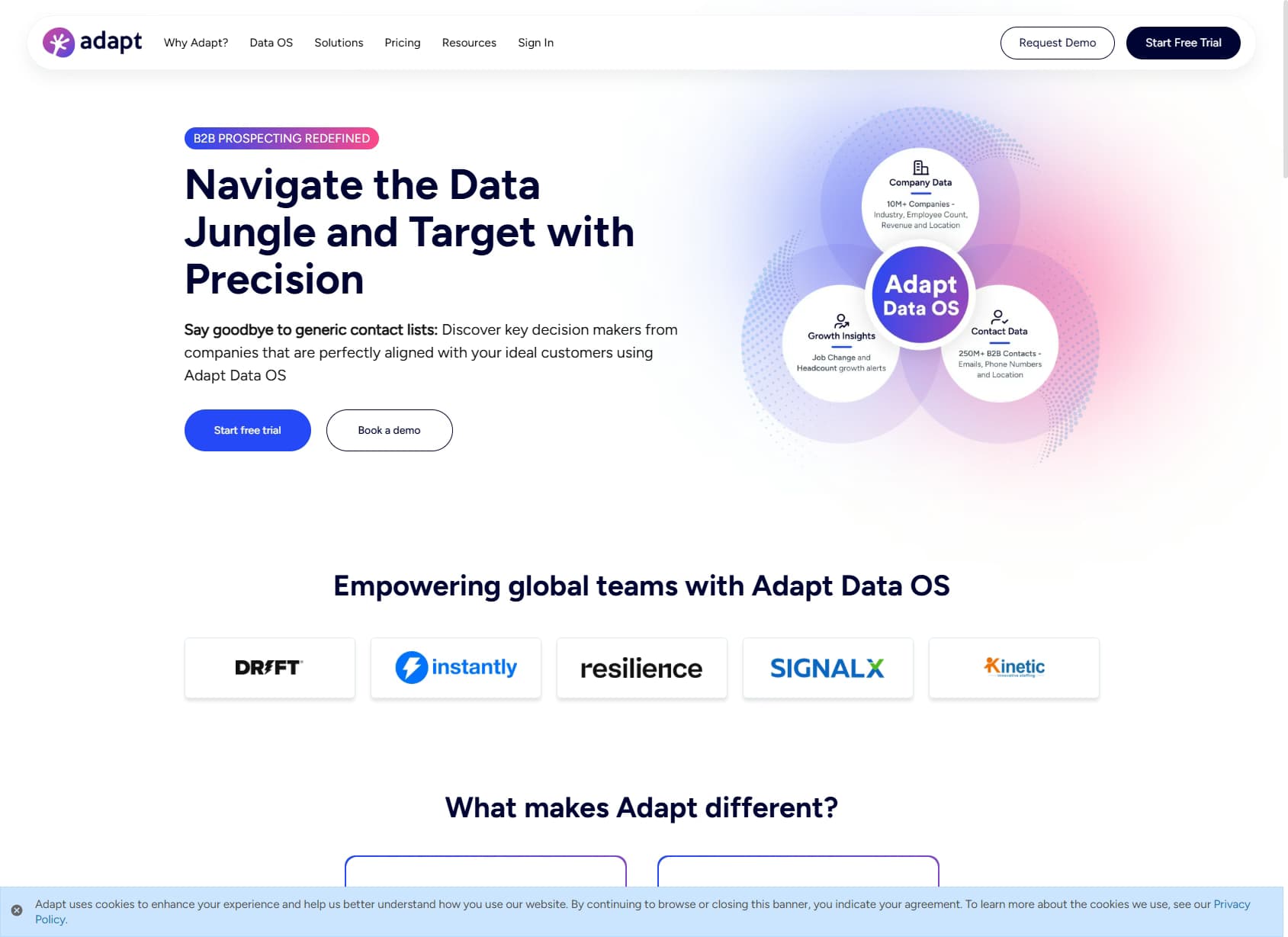
Adapt.io — B2B lead intelligence platform with 250M+ contacts across 12M+ company profiles
Adapt Prospector is a B2B lead intelligence platform that gives sales and marketing teams access to 250M+ verified contacts across 12M+ company profiles. It is best suited for teams doing broad-based prospecting against mid-market and enterprise accounts on a tight budget.
The platform was built around a Chrome extension — rated 4.6/5 on G2 across 2,789 reviews — that overlays contact data while browsing LinkedIn and company websites. It has since expanded to a full web app with Lead Builder (filtered list search), Prospector (contact discovery), Email Finder, and a B2B data API.
Adapt covers 3,000+ tech sector categories for granular industry filtering. It targets sales teams seeking pipeline acceleration, marketing teams building email campaigns, and enterprise orgs running ABM initiatives.
The platform is not a waterfall enrichment tool. Waterfall enrichment cascades through multiple providers in sequence — Adapt queries its own single database and stops. That distinction matters for hit rate, especially on SMB contacts.
Adapt Prospector Pricing: Plans, Credits, What You Actually Pay
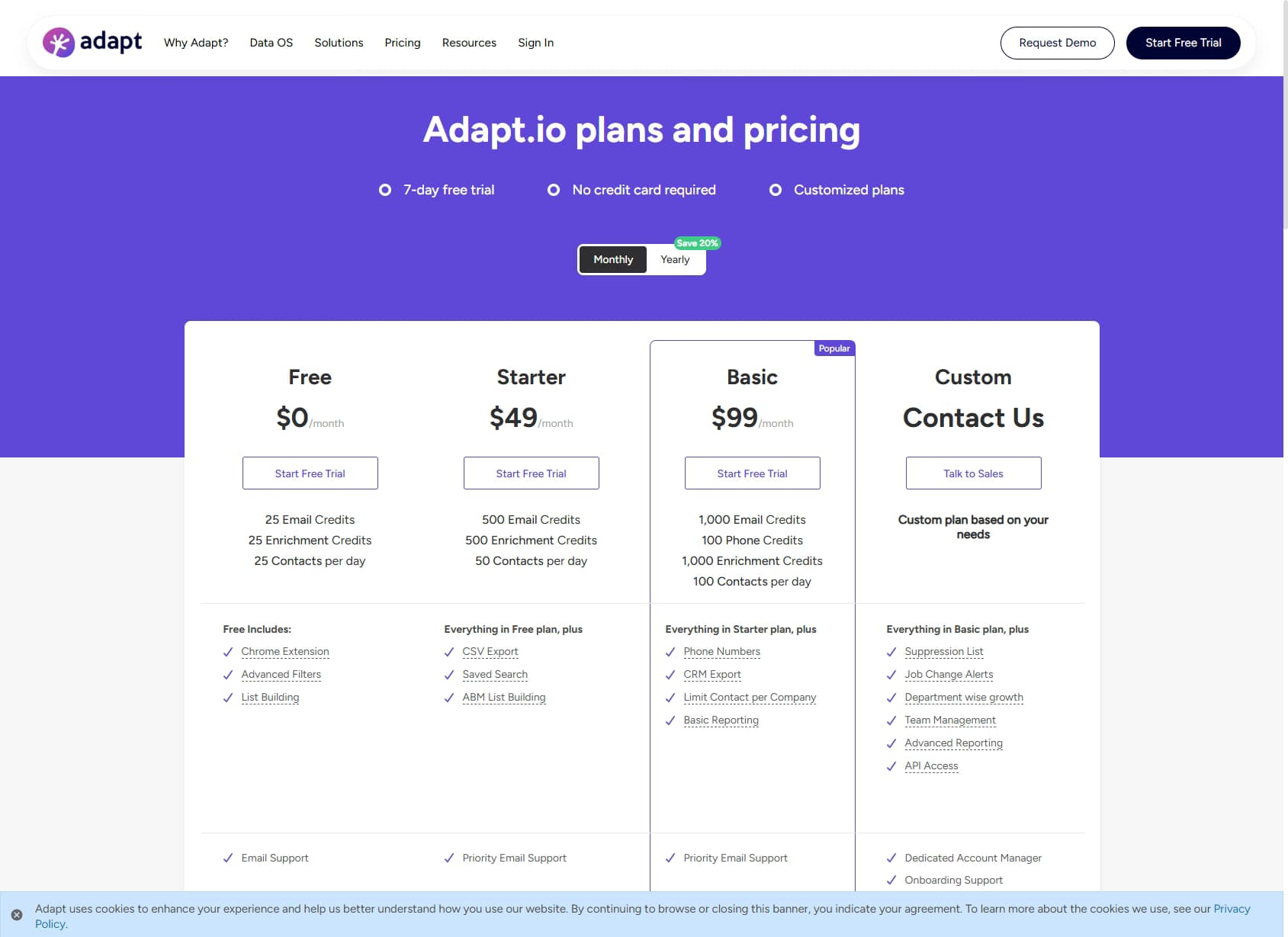
Adapt Prospector pricing — four tiers from free to $99/mo with split email and enrichment credit buckets
Adapt Prospector uses a credit-based pricing model with four tiers. The most important thing to understand: email credits and enrichment credits are separate buckets. Running out of one blocks prospecting even when the other has remaining balance.
| Plan | Price | Email Credits | Phone Credits | Daily Contact Limit | Key Unlocks |
|---|---|---|---|---|---|
| Free | $0 | 25/mo | None | 25/day | CSV export, Chrome extension |
| Starter | $49/mo | 500/mo | None | 50/day | Priority email support |
| Basic | $99/mo | 1,000/mo | 100/mo | 100/day | Phone numbers, CRM export |
| Custom | Contact sales | Negotiated | Negotiated | Unlimited | API access, dedicated support, job-change alerts |
Annual billing saves approximately 20% — Starter drops to $490/yr ($40.83/mo), Basic to $990/yr ($82.50/mo). Unlimited users can be added at no additional cost across all plans.
The real cost math: At $99/mo on Basic, 1,000 email credits cost $0.099 per contact — competitive for a self-serve B2B tool. But the 100-contact daily cap means even if you have 1,000 credits, you can only use 100 per day. A team running a 500-contact outbound campaign takes 5 days minimum to gather contacts, even with full credits available.
Phone numbers require the Basic plan ($99/mo) — they are not available on Starter. API access requires Custom pricing, which means any team wanting programmatic enrichment must enter sales negotiations rather than self-serve.
Adapt Prospector Key Features
Adapt Prospector is a multi-surface contact discovery platform. The Chrome extension is its most praised feature. The web app adds list building and filtering. Here is what each component actually delivers.
Lead Builder
Lead Builder is Adapt's filtered list-building interface. You set filters — job title, company size, industry, geography, tech stack — and pull contacts meeting those criteria from the 250M+ database. The 3,000+ tech sector categories make it unusually precise for niche markets like SaaS finance tools, healthcare IT, or manufacturing automation.
Output: name, email, job title, company, LinkedIn URL, and firmographic data. Phone numbers require Basic plan.
Chrome Extension (Prospector)
The Chrome extension is the highest-rated Adapt feature across user reviews. It overlays verified contact data directly on LinkedIn profiles and company websites — no switching between tabs. 500K+ global users as of 2026.
Users report it saves 3–5 hours per week versus manual research, particularly for individual LinkedIn lookups during account research. Accuracy is higher on the extension than on bulk list exports, likely because it performs real-time verification at the point of lookup.
Email Finder
Email Finder returns verified email addresses for a given name + company domain input. Results include a confidence score. Low-confidence emails require verification before sending to maintain deliverability.
B2B Data API
API access is Custom-plan only. Endpoints cover contact lookup, company enrichment, and bulk file processing. For teams needing programmatic enrichment integrated into CRMs or internal tools, this is a significant gate — you cannot self-serve your way to API access on any published plan.
ABM & Account Discovery
Adapt includes account-level filtering for ABM use cases: identify high-growth companies via hiring signals and expansion data. Job-change alerts — useful for tracking buyer movement — are Custom-plan only.
Adapt Prospector Data Coverage & Hit Rate
Adapt Prospector's data accuracy is company-size dependent. Mid-market and enterprise contacts (50+ employees) earn strong marks across user reviews. SMB accuracy drops significantly, with estimated bounce rates of 18–22% on small-company contacts.
Adapt's 250M+ contact database and 12M+ company profiles position it as a mid-market option — larger than tools like LeadCandy(14M contacts) but smaller than Apollo (275M) or ZoomInfo's enterprise dataset.
The database spans multiple industries: Business Services, Education, Financial Services, Healthcare, Manufacturing, Retail, and Software & Internet. The 3,000+ tech sector taxonomy is a differentiator — most competitors use broader SIC or NAICS codes with fewer subcategories.
By Company Size
| Segment | Estimated Email Accuracy | Notes |
|---|---|---|
| Enterprise (1,000+ employees) | 85–90% | Highest coverage and freshness |
| Mid-market (100–999 employees) | 75–85% | Chrome extension performs best here |
| SMB (20–99 employees) | 55–70% | Higher bounce rates reported by reviewers |
| Micro (<20 employees) | 40–55% | Inconsistent; manual verification required |
These figures are based on synthesized G2 user review data and third-party analysis — Adapt does not publish official hit rate metrics. For context, multi-waterfall tools like SyncGTM achieve 75–90% on US enterprise contacts by cascading through 50+ providers when the first source misses. According to Capterra's Adapt reviews, accuracy complaints cluster around small and mid-stage startup contacts — consistent with the company-size breakdown above.
Geographic coverage:Adapt's strength is North America and Western Europe. APAC and LATAM coverage thins noticeably — consistent with industry-wide data challenges in those markets. For teams with heavy APAC prospecting, a waterfall tool with dedicated regional providers delivers meaningfully better results.
Adapt Prospector Pros — What It Does Well
- ✓Chrome extension accuracy. The Prospector extension overlays verified contact data on LinkedIn and company sites in real time. Users consistently rate it as the most accurate feature — noticeably better than bulk export accuracy for mid-market and enterprise lookups.
- ✓No seat fees on any plan. Unlimited users can be added across all tiers including Free. For teams of 5–10 SDRs, this eliminates per-seat multipliers that inflate costs on tools like Apollo ($49/seat/mo) or ZoomInfo.
- ✓Free plan without credit card. 25 email credits and 25 daily contacts at no cost — no payment details required. Useful for testing data quality before committing to a paid plan.
- ✓3,000+ tech sector categories. Granular industry taxonomy enables precise filtering that most competitors cannot match with SIC/NAICS codes. Particularly valuable for niche GTM campaigns targeting vertical-specific buyers.
- ✓GDPR compliance baseline. Adapt processes data under EU privacy regulations. Not the most detailed compliance documentation, but better than many budget-tier tools that avoid the topic entirely.
- ✓Strong mid-market and enterprise coverage. 85–90% estimated email accuracy for companies with 1,000+ employees. For teams whose ICP concentrates in that segment, Adapt delivers reliable data at a transparent price.
Adapt Prospector Cons — Where It Falls Short
- 100-contact daily cap on Basic plan. Building a 500-contact prospect list takes 5 days minimum. Building a 2,000-contact campaign list takes 20 days. For any team running real outbound volume, this structural limit disrupts workflow.
- No waterfall enrichment. Adapt queries its own single database and stops. When its database misses a contact — common for SMB and micro-company targets — you get nothing. A waterfall tool like SyncGTM would cascade through the next provider and keep looking.
- Split credit buckets cause confusion. Email credits and enrichment credits are separate pools. 34 G2 reviewers specifically flag "limited credits" as a pain point. Running out of email credits while enrichment credits remain creates dead sessions mid-workflow.
- Phone numbers locked behind $99/mo. The $49/mo Starter plan gives no access to direct dials. If you need phone numbers for cold calling or multi-channel sequences, you must upgrade to Basic — doubling the cost.
- API access requires Custom (sales-gated) pricing. Any team wanting programmatic integration — CRM enrichment, internal tools, automated workflows — must negotiate enterprise pricing. There is no self-serve API tier at $49 or $99/mo.
- No buying signals of any kind. No hiring surge detection, no funding alerts, no tech stack change monitoring. Job-change alerts exist but require Custom pricing. Adapt gives you contact data with no signal layer for timing outreach.
- No native outreach sequencing. Adapt enriches contacts but does not send emails, manage cadences, or run LinkedIn sequences. You need a separate tool — Instantly, Outreach, Apollo Sequences — to act on the contacts you find.
- SMB accuracy drops to 40–55%. 14 G2 reviewers specifically flag incorrect email addresses for small companies. If your ICP includes companies under 20 employees, Adapt's single-source database produces inconsistent results that require manual verification.
Adapt Prospector vs SyncGTM vs Apollo vs UpLead
Adapt Prospector is the budget entry point. SyncGTM is the step up when you need higher hit rates, buying signals, and outreach in one platform. Apollo sits between them with a larger database and native sequences. UpLead wins on verified-email accuracy but at a higher price.
| Feature | Adapt Prospector | SyncGTM | Apollo.io | UpLead |
|---|---|---|---|---|
| Starting Price | $49/mo (Starter) | $99/mo | $59/mo (Basic) | $99/mo (Essentials) |
| Contact Database | 250M+ | Via 50+ providers (cascaded) | 275M+ | 160M+ |
| Waterfall Enrichment | None — single source | 50+ providers cascaded | None — single source | None — single source |
| Email Hit Rate (US Enterprise) | ~78–82% (estimated) | 75–90% | 60–75% | 85–95% (verified emails only) |
| Daily Contact Limit | 100/day (Basic) | None | None | None |
| Phone Numbers | Basic plan ($99/mo) and above | Via waterfall providers | All plans | All plans |
| Buying Signals | None | Hiring surges, funding, tech changes, job changes | Basic intent (Bombora) | None |
| Native Outreach | None | Yes — built-in sequencing | Yes — sequences included | None |
| CRM Export | Basic plan and above | Automated, real-time | All plans | All plans |
| API Access | Custom plan only | All plans | Professional plan+ | Plus plan+ |
| Seat Fees | None (unlimited users) | None | Per seat | Per seat |
| Chrome Extension | Yes — 500K+ users | Via browser workflow | Yes | Yes |
Why SyncGTM Wins on Hit Rate
The structural difference is the waterfall. Adapt queries one database. SyncGTM cascades through 50+ providers in sequence — when Provider A returns nothing, Provider B runs, then C, then D — until a verified result is found or the cascade is exhausted.
For US enterprise contacts, this delivers 75–90% hit rates versus Adapt's estimated 78–82% on the same segment. The gap widens significantly for SMB contacts: Adapt drops to 40–55% while SyncGTM maintains 65–75% by pulling from niche regional databases that Adapt's single source cannot access.
The signal layer is the other gap. SyncGTM surfaces hiring surges, funding rounds, tech stack changes, and job movement in real time. Adapt has no equivalent — job-change alerts require Custom pricing and are account-level only. For timing cold outreach to buying triggers, waterfall enrichment plus signals consistently outperforms a static database approach.
SyncGTM costs $50/mo more than Adapt Basic ($99 vs $49). But Adapt Basic is the only plan with phone numbers and CRM export — so the true comparison for a functioning outbound stack is $99 (Adapt Basic, no API, 100/day cap) vs $99 (SyncGTM, full waterfall, signals, outreach, no daily cap). At equal price, SyncGTM delivers substantially more.
For a full breakdown of alternatives, see our Adapt Prospector alternatives comparison.
Who Should Use Adapt Prospector?
Adapt Prospector is a good fit for a specific profile. Outside that profile, its structural limits create friction that better-suited tools avoid.
Adapt Prospector Is Right For
- Solo founders and very small teams (1–3 people) doing low-volume, high-touch outreach against enterprise accounts. The 100/day limit is workable when you only send 20–30 personalized emails per day.
- Teams whose ICP is mid-market or enterprise(100+ employee companies in North America or Western Europe) where Adapt's accuracy holds up best.
- Niche vertical marketers who need the 3,000+ tech sector taxonomy to find buyers in specialized categories that broader tools lump into generic SIC codes.
- Researchers and individual usersrunning LinkedIn-heavy workflows where the Chrome extension's real-time lookups save hours weekly.
Adapt Prospector Is Not Right For
- Teams running real outbound volume (>500 contacts/campaign). The daily cap turns a 1-day task into a multi-week process.
- Teams targeting SMBs or micro-companies. Single-source accuracy drops to 40–55% below 20 employees — enough to damage sender reputation and CRM hygiene.
- Teams wanting signal-timed outreach. No hiring signals, no funding alerts, no job-change tracking at standard pricing. The signal layer requires Custom.
- Teams needing API access or CRM automation. CRM export requires $99/mo; API access is gated behind Custom pricing. For automated enrichment workflows, look at FullEnrich (API on all plans) or SyncGTM (real-time CRM enrichment).
- APAC-focused teams. Geographic coverage drops significantly outside North America and Western Europe.
According to RocketReach's 2026 B2B data accuracy research, 42% of B2B contact data becomes outdated within 12 months. Single-source tools like Adapt face a harder challenge keeping pace with this decay than waterfall platforms that continuously refresh across multiple provider sources.
Adapt Prospector Review: Final Verdict
Adapt Prospector is a legitimate budget-tier B2B prospecting tool — not a scam, not a trap. For solo founders or small teams doing light prospecting against enterprise accounts, $49/mo with unlimited users and a solid Chrome extension is genuinely good value.
The problems surface at scale. The 100/day contact cap on Basic plan is a hard ceiling that breaks any workflow requiring speed. The single-source architecture means no waterfall fallback — when the database misses, you lose the record entirely. No signals, no native outreach, no self-serve API.
At $99/mo — the plan where Adapt first becomes genuinely useful (phone numbers, CRM export) — SyncGTM offers the same price with 50+ provider waterfall enrichment, buying signals, built-in outreach sequencing, and no daily caps. For teams at that budget level, the choice is straightforward.
Rating: 3.9/5 — Solid for budget-constrained solo prospecting against enterprise accounts. Not built for volume.
Ready to see what waterfall enrichment actually delivers? Start SyncGTM free — no credit card required.