

5 Best Domain Registrars for Cold Email Domains in 2026

By Kushal Magar · October 19, 2026 · 13 min read
Key Takeaway
The best domain registrar for cold email in 2026 is Porkbun for most teams: a .com costs $11.08 to register and $11.08 to renew, with free WHOIS privacy, URL forwarding, and Cloudflare-powered DNS. Namecheap is the best pick for buying domains in bulk thanks to Beast Mode search, but its .com renewal jumps to $18.48. Cloudflare Registrar is the cheapest over time at $10.46 per .com with no markup, though redirects need Cloudflare rules. Dynadot holds a flat $10.88 price with free forwarding, and GoDaddy is the most familiar but costs $22.99 per .com renewal. Whichever you pick, publish SPF, DKIM, and DMARC on day one and redirect every secondary domain to your main site.
The best domain registrar for cold email is the one that makes 20 domains as easy to manage as one. Cheap first-year prices are everywhere, but renewals, DNS control, and redirects decide what you actually pay and how much time you lose.
This guide compares 5 registrars for buying secondary cold email domains: Porkbun, Namecheap, Cloudflare Registrar, Dynadot, and GoDaddy. Each one is scored on price per domain, renewal cost, DNS control for SPF, DKIM, and DMARC, bulk buying, and redirects.
Prices are standard .com rates as of October 2026, taken from Porkbun's pricing page and the DomainOffer .com price tracker. SyncGTM does not sell domains and has no affiliate deal with any registrar here.
Quick Summary
Pick Porkbun for the best all-round value. Use Namecheap when you buy domains by the dozen. Choose Cloudflare for the lowest long-term cost and the best DNS. Dynadot is a solid flat-price alternative. Use GoDaddy only if your company already lives there.
TL;DR: Best Domain Registrar for Cold Email in 2026
- 1. Porkbun — Best overall. $11.08 per .com to register and renew, free privacy, free URL forwarding, bulk search up to 100 domains.
- 2. Namecheap — Best for bulk buying. Beast Mode searches thousands of names at once, but .com renews at $18.48.
- 3. Cloudflare Registrar — Lowest long-term cost. At-cost $10.46 per .com, best DNS, but redirects need Cloudflare rules.
- 4. Dynadot — Best flat pricing. $10.88 per .com every year, free domain and email forwarding.
- 5. GoDaddy — Most familiar, most expensive. $12.99 per .com, then $22.99 to renew.
- After the domains are warm: verify every lead before it hits your new inboxes with SyncGTM email verification.
Why Your Registrar Matters for Cold Email
Your registrar does not decide whether mail lands in the inbox. Gmail and Outlook judge your domain's authentication, age, sending patterns, and complaint rate.
But the registrar controls three things that cold email depends on. Those are DNS records, redirects, and the cost of holding many domains year after year.
- DNS control. Since 2024, Google's sender guidelines require SPF or DKIM for all senders and SPF, DKIM, and DMARC for anyone sending 5,000+ messages a day to Gmail. Microsoft applied similar rules to Outlook in 2025. You need a DNS editor that handles TXT and CNAME records cleanly.
- Redirects. Every secondary domain should forward to your main website. A prospect who types in the domain should land on your real site, not a parked page.
- Renewals at scale. Cold email programs run on 10 to 50 domains. A $7 difference in renewal price becomes $350 a year at 50 domains.
Why not send from your main domain? Because a bad campaign can damage its reputation, and that domain carries invoices, support mail, and customer threads. Our email domain warmup guide covers how to bring new domains online safely.
How We Ranked These Registrars
Each registrar was scored on five criteria that matter for cold email infrastructure. We weighted renewal price and DNS control highest, because those costs repeat every year for every domain.
- Price per domain: standard .com registration price without new-customer coupons.
- Renewal price: what you pay in year two and beyond.
- DNS control: how easily you can add SPF, DKIM, DMARC, and MX records.
- Bulk purchase: searching and buying many domains in one checkout.
- Redirects: free 301 forwarding to your main site.
We did not run inbox placement tests per registrar. There is no public data showing one registrar's domains deliver better than another's, so treat any such claim with caution.
1. Porkbun
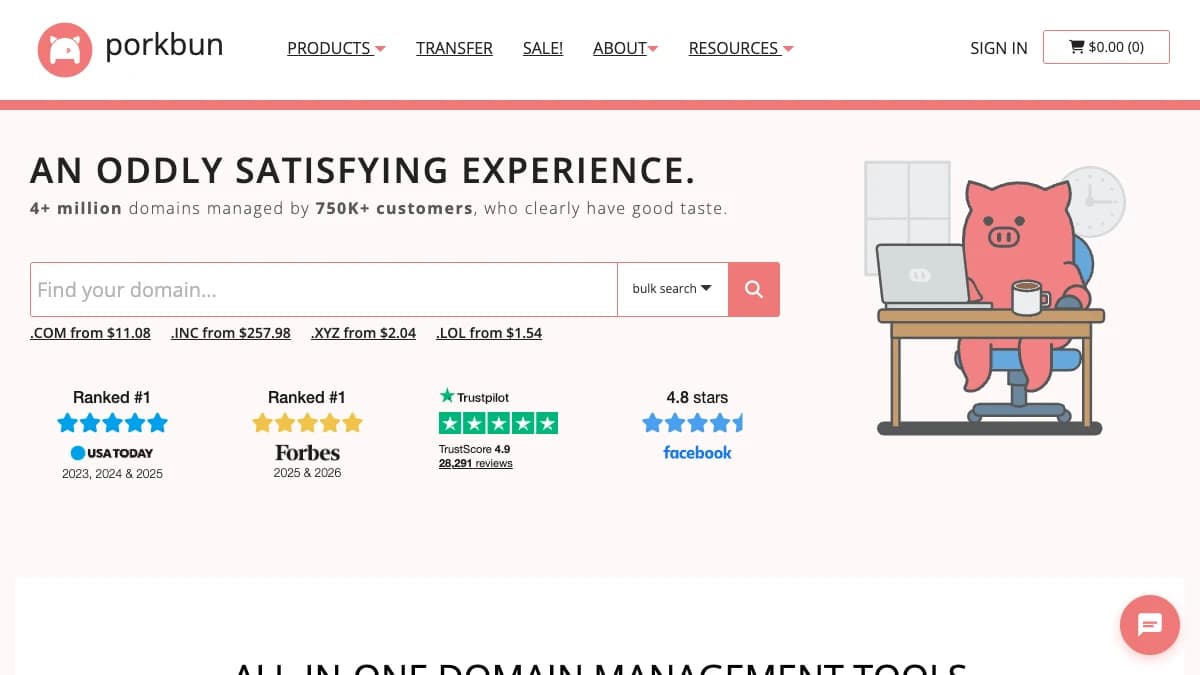
Porkbun homepage showing domain search with the bulk search option and .com from $11.08
Porkbun is a low-cost domain registrar best suited for cold email teams, offering flat .com pricing at $11.08 with privacy and forwarding included. It is our top pick because the price you see in year one is the price you pay in year five.
For cold email, the DNS editor is the big win. You add SPF, DKIM, DMARC, and MX records in one screen, and the DNS runs on Cloudflare's network, so changes spread fast.
Redirects are free and come in permanent, temporary, or masked versions. Pick permanent (301) to send every secondary domain to your main site.
Pros
- ✓ Same $11.08 price to register and renew a .com
- ✓ Free WHOIS privacy, SSL, and URL forwarding on every domain
- ✓ Bulk search checks up to 100 names at once
- ✓ DNS powered by Cloudflare's network
- ✓ Up to 20 free email forwards per domain
Cons
- ✗ First-year .com is not the cheapest promo price on the market
- ✗ Bulk search is capped at 100 names per query
- ✗ No phone support
Best for: Teams that want low, predictable renewals and simple DNS across 10 to 50 cold email domains.
Pricing: .com $11.08/yr to register and renew; .net $12.52/yr (Porkbun pricing).
2. Namecheap
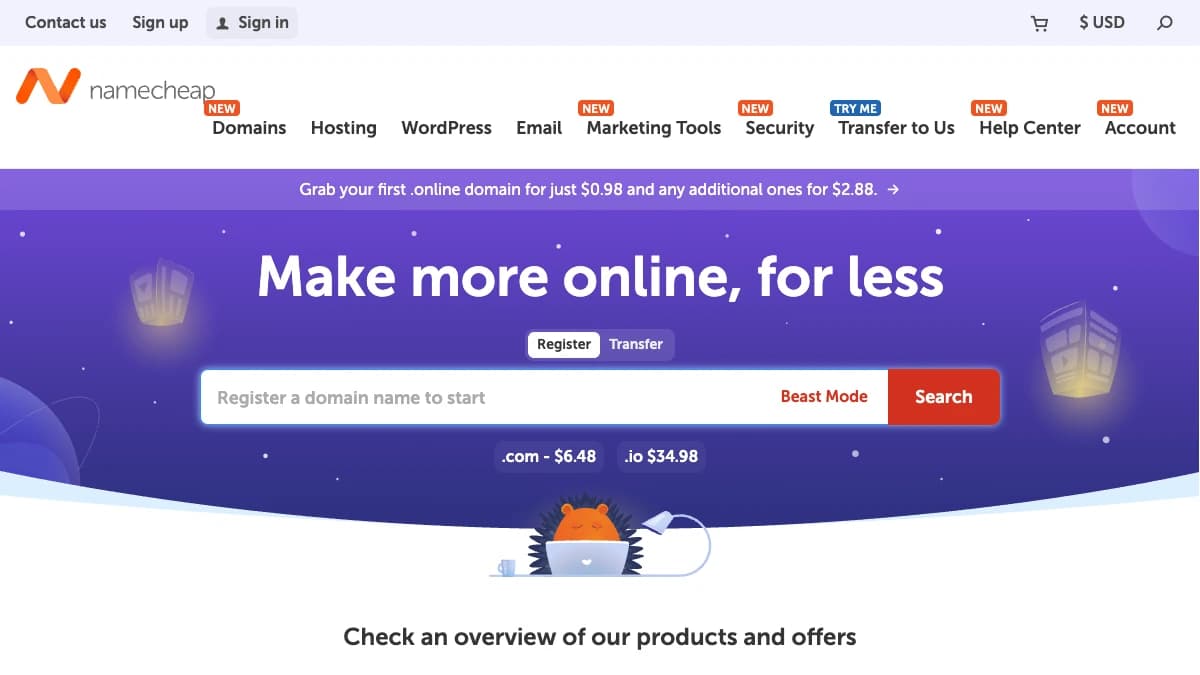
Namecheap homepage with the Beast Mode bulk search link next to the domain search bar
Namecheap is a mainstream domain registrar best suited for bulk buyers, offering Beast Mode search across thousands of names with free privacy. It is the most common registrar in cold email setup guides, so help is easy to find.
Beast Mode is the reason to choose it. Paste 200 brand variations, filter by availability and price, and add the winners to one cart.
The catch is renewal. A .com that costs $11.28 in year one renews at $18.48, about $7 more per domain than Porkbun every year after.
Some cold emailers say Namecheap domains get extra spam-filter scrutiny because the registrar is so popular. We found no public data that proves it, and authentication plus warm-up matter far more.
Pros
- ✓ Beast Mode searches up to 5,000 keywords or domains at once
- ✓ Free WHOIS privacy on every domain
- ✓ Free URL redirect records inside Advanced DNS
- ✓ Most cold email setup tutorials show Namecheap screens
- ✓ Frequent first-year promo codes for new customers
Cons
- ✗ .com renewal jumps to $18.48/yr from $11.28 registration
- ✗ Checkout pushes add-ons like hosting and email
- ✗ Promo prices are usually one domain per new customer
Best for: Agencies and teams that buy 20+ domains at once and want the widest bulk search.
Pricing: .com $11.28 first year, $18.48/yr renewal (DomainOffer, Oct 2026).
3. Cloudflare Registrar
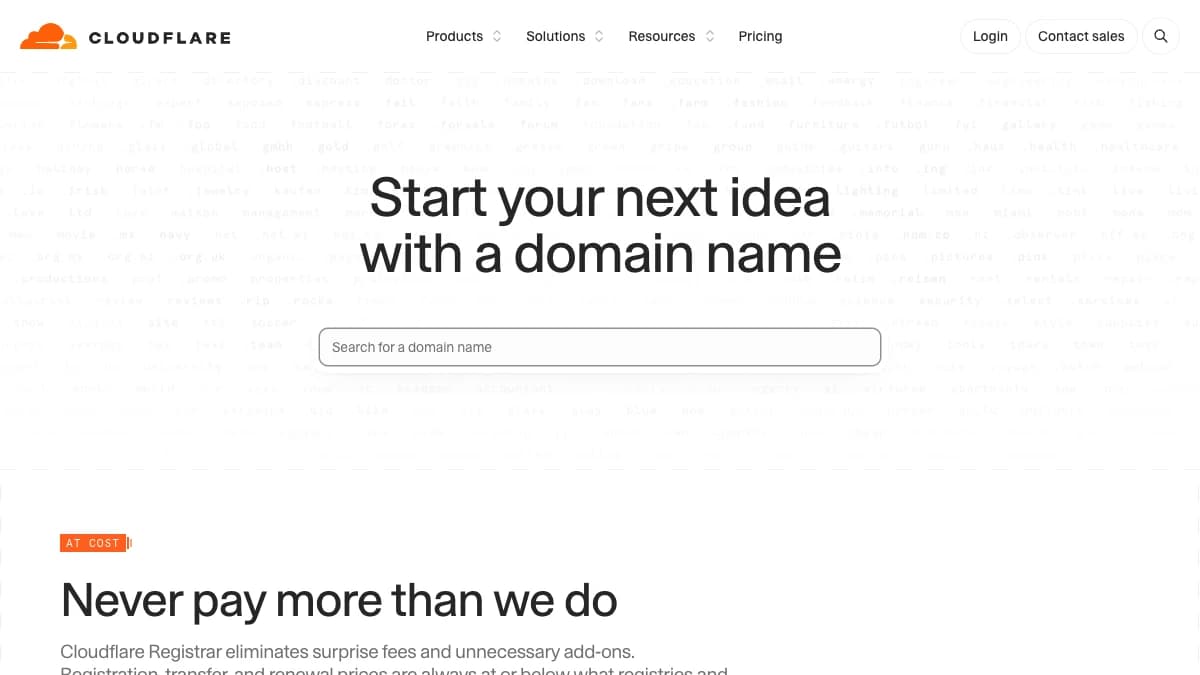
Cloudflare Registrar page with the 'Never pay more than we do' at-cost pricing promise
Cloudflare Registrar is an at-cost domain registrar best suited for technical teams, offering .com renewals at $10.46 with no markup. Over two years, it is the cheapest of the five.
The trade-off is setup effort. Cloudflare Registrar domains must use Cloudflare's nameservers, and redirects are not a single toggle.
To forward a domain, Cloudflare's own redirect guide has you add a proxied placeholder A record and then a 301 Redirect Rule. It takes about five minutes per domain once you know the steps.
Pros
- ✓ At-cost pricing with no markup: $10.46/yr per .com
- ✓ Same price for registration, renewal, and transfer
- ✓ Free WHOIS redaction and one-click DNSSEC
- ✓ Fastest, most reliable DNS of the five
Cons
- ✗ Domains must use Cloudflare nameservers
- ✗ No one-click URL forwarding; redirects need a proxied record plus a Redirect Rule
- ✗ No bulk search-and-checkout like Namecheap or Porkbun
- ✗ Does not support every domain extension
Best for: Technical teams that already use Cloudflare and want the lowest renewals for years.
Pricing: .com $10.46/yr to register, renew, and transfer (DomainOffer, Oct 2026).
4. Dynadot
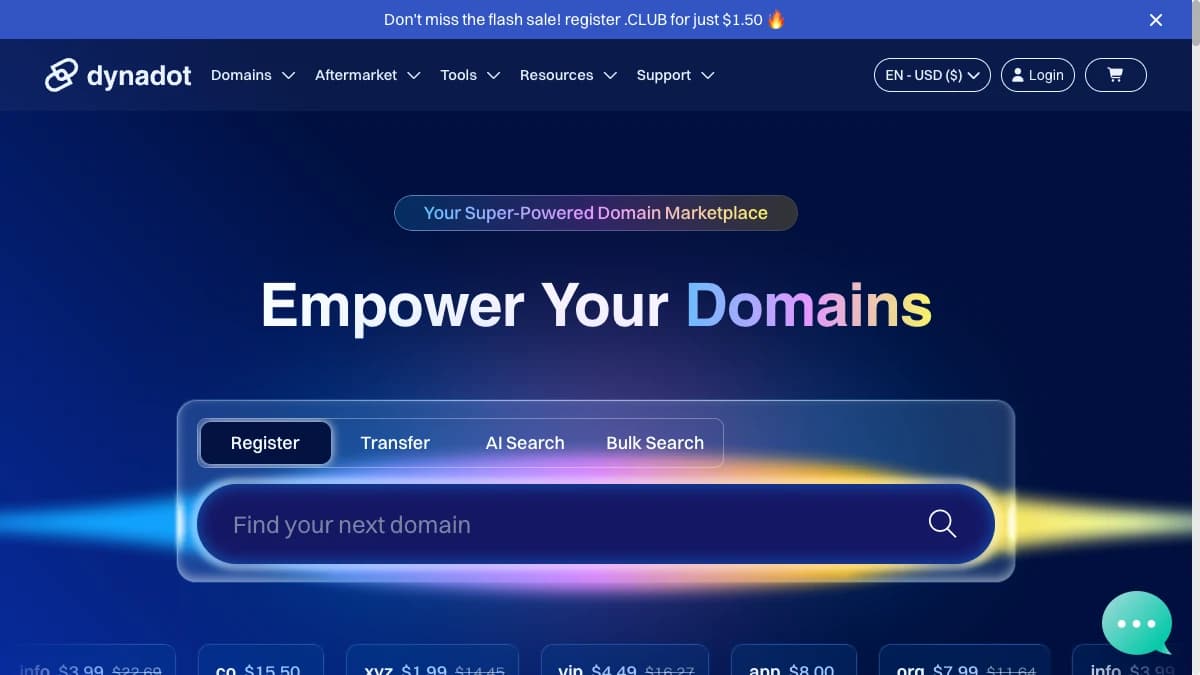
Dynadot homepage with Register, Transfer, AI Search, and Bulk Search tabs
Dynadot is a value domain registrar best suited for teams managing many domains, offering flat .com pricing at $10.88 with free forwarding. It costs less than Porkbun per year, but the interface is less polished.
The bulk tools are its strength for cold email. You can select a batch of domains and apply DNS or forwarding settings in one action instead of editing each domain.
Pros
- ✓ Flat $10.88/yr for .com registration and renewal
- ✓ Free privacy, domain forwarding, and email forwarding
- ✓ Bulk search plus bulk actions to edit many domains at once
- ✓ API access for automated management
Cons
- ✗ Domain manager feels busier than Porkbun's
- ✗ Free email forwarding is receive-only and capped at 10 addresses
- ✗ Less coverage in cold email tutorials
Best for: Teams that want flat renewals and bulk edits without moving DNS to Cloudflare.
Pricing: .com $10.88/yr to register and renew (DomainOffer, Oct 2026).
5. GoDaddy
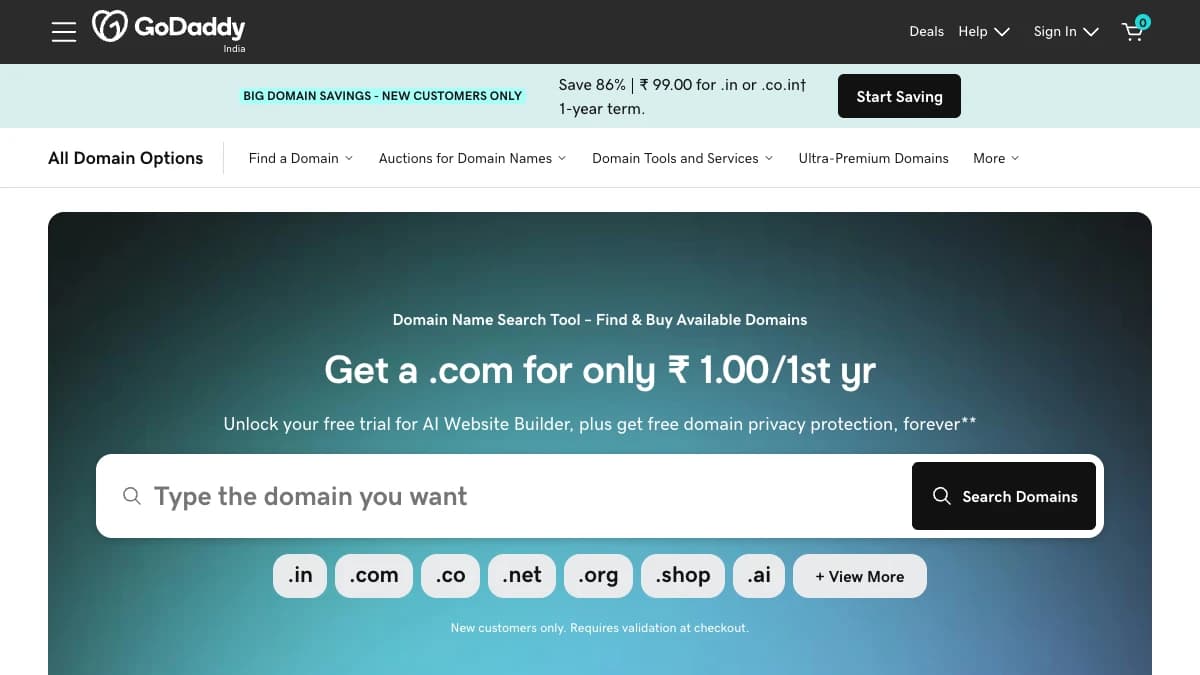
GoDaddy domain search page (regional storefront shown) with a first-year .com promotion
GoDaddy is the largest mainstream domain registrar, best suited for teams that want one familiar account, offering forwarding and phone support at a premium price. It works fine for cold email domains, but you pay for it at renewal.
At $22.99 per .com renewal, GoDaddy costs roughly twice what Cloudflare, Dynadot, or Porkbun charge. Across 20 domains, that is about $240 extra every year.
Pros
- ✓ The most familiar registrar; many companies already have an account
- ✓ Free domain privacy on eligible domains
- ✓ Domain forwarding and DNSSEC included
- ✓ 24/7 phone support
Cons
- ✗ .com renewal is $22.99/yr, the highest here
- ✗ Heavy upsells at checkout
- ✗ First-year promos are limited to new customers and one domain
Best for: Companies whose main domain already sits at GoDaddy and only need a few secondary domains.
Pricing: .com $12.99 first year, $22.99/yr renewal (DomainOffer, Oct 2026).
Side-by-Side Comparison
Standard .com prices as of October 2026, before coupons and taxes. Some registrars add a $0.20 ICANN fee at checkout.
| Registrar | .com register | .com renew | Free privacy | Free 301 redirect | Bulk buying |
|---|---|---|---|---|---|
| Porkbun | $11.08 | $11.08 | Yes | Yes, one toggle | Bulk search, 100 names |
| Namecheap | $11.28 | $18.48 | Yes | Yes, URL redirect record | Beast Mode, 5,000 names |
| Cloudflare | $10.46 | $10.46 | Yes | Yes, via Redirect Rules | Limited |
| Dynadot | $10.88 | $10.88 | Yes | Yes | Bulk search + bulk actions |
| GoDaddy | $12.99 | $22.99 | Eligible domains | Yes | Basic |
What 10 Cold Email Domains Cost Over 2 Years
Ten .com domains is a typical starting setup for 20 to 30 sending inboxes. Here is the cost for year one, year two, and the total.
| Registrar | Year 1 (10 domains) | Year 2 renewal | 2-year total |
|---|---|---|---|
| Cloudflare | $104.60 | $104.60 | $209.20 |
| Dynadot | $108.80 | $108.80 | $217.60 |
| Porkbun | $110.80 | $110.80 | $221.60 |
| Namecheap | $112.80 | $184.80 | $297.60 |
| GoDaddy | $129.90 | $229.90 | $359.80 |
The three flat-price registrars land within $13 of each other. Namecheap and GoDaddy cost $76 to $150 more by year two, almost entirely because of renewals.
Domains are the cheap part of the stack. Inboxes cost more, so compare options in our guide to the best email hosting for cold email.
DNS Setup Checklist for Every New Domain
Every registrar above can publish these records. Set them up the day you buy the domain, before any warm-up starts.
- MX records from your email host (Google Workspace, Microsoft 365, or a cold email inbox provider).
- SPF as one TXT record, such as
v=spf1 include:_spf.google.com ~all. Keep it to one SPF record and under the 10 DNS lookup limit in RFC 7208. - DKIM as the TXT or CNAME record your email host generates. Our Gmail DKIM guide walks through the Google side.
- DMARC at
_dmarc.yourdomain.com. Start withv=DMARC1; p=none; rua=mailto:you@yourmaindomain.com, then tighten to quarantine. - 301 redirectto your main website using the registrar's forwarding tool.
- Custom tracking domain as a CNAME, if your sequencer uses open or click tracking.
Then warm up for two to four weeks before real sends. Our domain warm-up guide and roundup of cold email warm-up tools cover the schedule.
Next Step: Fill Warm Inboxes With Verified Leads
Once domains are warm, the fastest way to damage them is a bad list. Bounces tell mailbox providers you are not checking who you email, and that reputation sticks to the domain.
SyncGTM handles the list side so your new domains only send to real, deliverable addresses:
- Find work emails through a waterfall of 50+ data providers for 1 credit per found email. Misses are not billed.
- Verify every email across multiple verification providers for 0.1 credits each before it reaches a sequence.
- Push verified leads into Instantly or Smartlead, where your warmed inboxes are connected.
Plans start at $49/mo on SyncGTM pricing. Learn why soft bounces matter as much as hard ones.
How to Choose the Best Domain Registrar for Cold Email
- Want the simplest setup at a fair price → Porkbun. Flat renewals and one-toggle redirects.
- Buying 20+ domains in one sitting → Namecheap, then consider transferring to a flat-price registrar after 60 days.
- Holding domains for years, comfortable with DNS → Cloudflare Registrar at cost.
- Need bulk edits without Cloudflare nameservers → Dynadot.
- Main domain already at GoDaddy, need 2 or 3 more → GoDaddy is fine. Budget for $22.99 renewals.
Wherever you buy, track where mail lands with regular inbox placement tests. The ICANN transfer policy allows a 60-day lock after registration, so choose carefully up front.
Final Verdict
Porkbun is the best domain registrar for cold email in 2026. It pairs an $11.08 flat .com price with free privacy, free redirects, and fast DNS.
Namecheap wins for bulk buying, and Cloudflare wins on long-term cost. Dynadot is a strong flat-price alternative, while GoDaddy only makes sense if you are already there.
Then protect the domains you warmed. Verify every lead with SyncGTM before it reaches a sequence, so each domain spends its reputation on real prospects.