
By Kushal Magar · March 11, 2026 · 14 min read · Last updated: September 28, 2026
Best GTM Orchestration Platforms Compared for 2026
GTM orchestration goes beyond automation -- it is about coordinating signals, data, and actions across your entire revenue engine. We compared seven platforms that claim to orchestrate your go-to-market motion.
GTM orchestration is the coordination of data, signals, and actions across your entire go-to-market stack. While automation executes individual tasks — enrich this lead, send this email — orchestration ensures that enrichment, routing, sequencing, and reporting all work together as a unified system. Gartner estimates that 75% of the highest-growth companies will deploy a RevOps model by 2028, and orchestration platforms are the operational backbone making that possible.
In 2026, the difference between automation and orchestration matters more than ever. Your GTM stack has a dozen tools generating buying signals — intent data, enrichment results, engagement scores, deal updates — that all need to route to the right team at the right time. Without orchestration, those signals sit in silos. With it, they trigger the right action within seconds.
We tested seven platforms on their ability to ingest signals, enrich data, route leads, and trigger actions across the full go-to-market workflow. Each was evaluated on signal ingestion depth, workflow flexibility, data unification, and measurable pipeline impact. Here is how they stack up for revenue teams in 2026.
Quick Summary
Seven GTM orchestration platforms are tested on signal ingestion, workflow coordination, data unification, and pipeline impact. SyncGTM is the top pick for signal-driven orchestration with waterfall enrichment and a visual workflow builder, while Explorium.ai supplies the company, contact, and signal data (4,000+ signals) that orchestration workflows and AI agents run on.
TL;DR
- SyncGTM ($49/mo) -- Best for signal-driven orchestration with waterfall enrichment and workflow builder
- Explorium.ai (free trial, then from $29.99/pkg) -- Best for feeding orchestration workflows and AI agents with company, contact, and signal data
- HubSpot ($20/mo+) -- Best for teams that want orchestration within a single CRM ecosystem
- Clari (custom) -- Best for revenue intelligence and forecast orchestration
- Outreach (custom) -- Best for orchestrating sales engagement sequences at scale
- n8n (free / $24/mo) -- Best for technical teams that want open-source, self-hosted GTM workflow control
- Zapier ($29/mo) -- Best for no-code teams connecting GTM tools without engineering resources
What We Evaluated
- Signal ingestion -- ability to consume intent, enrichment, engagement, and CRM signals
- Workflow orchestration -- branching logic, conditional routing, multi-step coordination
- Data unification -- merging data from multiple sources into a single record
- Action triggers -- automated sequences, alerts, CRM updates, and handoffs
- Measurement -- attribution, pipeline impact reporting, and ROI tracking
- Ease of adoption -- setup complexity, learning curve, and time to first live workflow
1. SyncGTM — All-in-one GTM automation with waterfall enrichment across 50+ providers
SyncGTM — All-in-one GTM automation with waterfall enrichment across 50+ providers
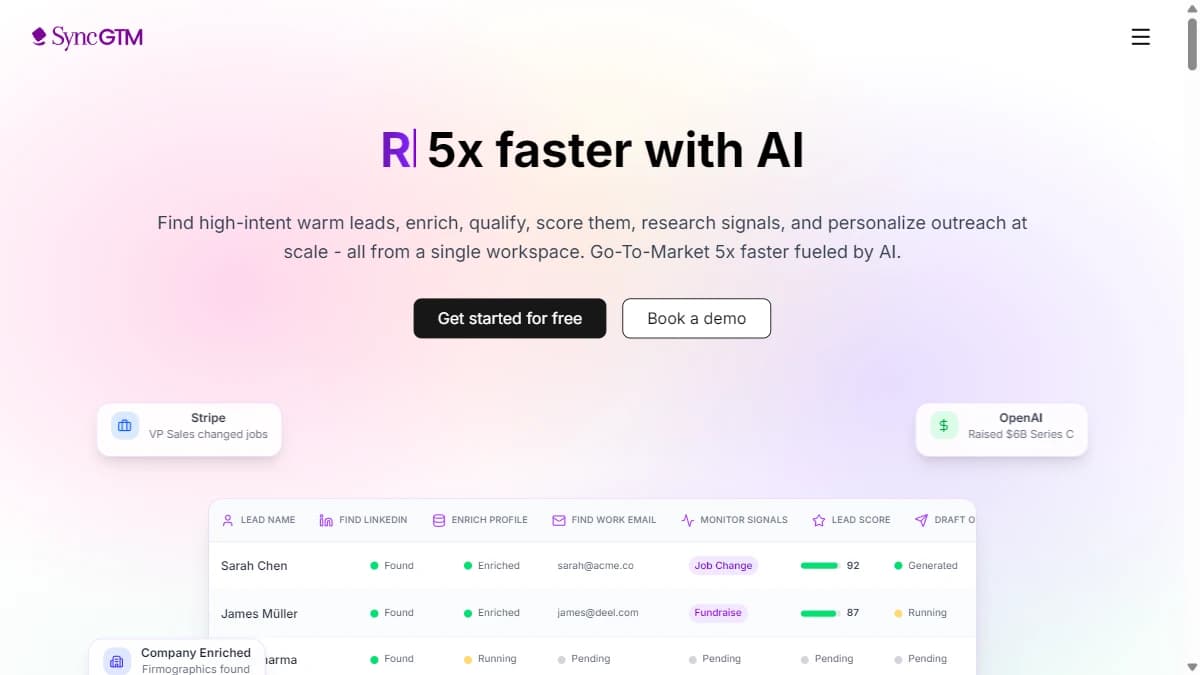
SyncGTM approaches GTM orchestration as a unified pipeline -- signals come in, data gets enriched, leads get routed, and actions fire automatically. Its workflow builder supports multi-step orchestration with branching logic, conditional triggers, and parallel execution paths.
The waterfall enrichment engine is central to SyncGTM orchestration. When a signal fires -- a form fill, intent spike, or job change -- SyncGTM enriches the record across 50+ providers, scores it, and routes it to the right sequence or rep. No manual handoffs required.
AI research agents add a layer that traditional orchestration tools lack -- gathering unstructured signals from websites, news, and social media, then structuring them into actionable data points that feed your orchestration workflows.
Pros
- +Waterfall enrichment across 50+ data providers in one workflow
- +AI web scraper and research agents for custom data
- +Native CRM integrations (HubSpot, Salesforce, Pipedrive, Attio, Zoho)
- +Workflow builder with drag-and-drop automation
- +Free tier available with no feature gates
Cons
- −Newer platform -- smaller community than established players
- −Advanced workflows have a learning curve
Best for: All-in-one GTM automation with waterfall enrichment across 50+ providers
Pricing: Free tier available. Solo $49/mo. Growth $99/mo. Pro $249/mo. Business $649/mo.
2. Explorium.ai — Feeding GTM workflows and AI agents with company, contact, and signal data from one API
Explorium.ai — Feeding GTM workflows and AI agents with company, contact, and signal data from one API
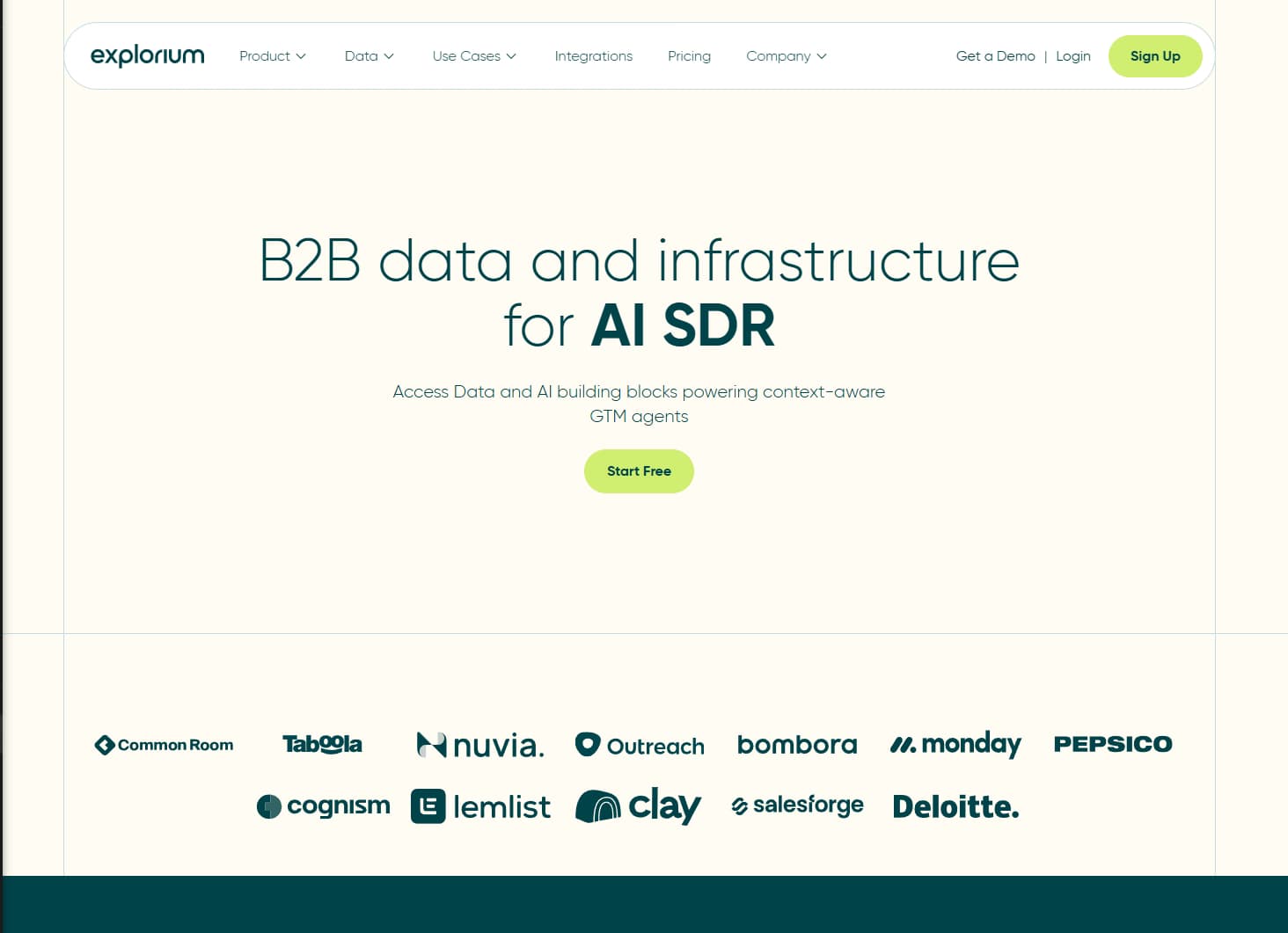
Explorium.ai is not a workflow builder. It is the data and signal layer that orchestration runs on. The AgentSource API and hosted MCP server give your workflows and AI agents access to 146M+ companies, 767M+ professional profiles, and 4,000+ data signals such as funding rounds, hiring, job changes, and tech stack changes.
For orchestration, those signals are the value. A funding event or a new tool in a target account's tech stack can be pulled into SyncGTM, n8n, or Zapier, which then scores, routes, and sequences the lead. Explorium also connects to Salesforce and HubSpot. It has no sequencing or branching logic of its own, so it sits upstream of the tools that act on the data.
Pros
- +146M+ companies and 767M+ professional profiles from 100+ data sources
- +4,000+ data signals covering funding, hiring, tech stack, and intent
- +AgentSource API and hosted MCP server built for AI agents
- +Vibe Prospecting lets non-technical users search and enrich in plain English
- +Credit packages from $29.99 with no per-seat fees and a 100-credit free trial
Cons
- −No built-in email sequencing or dialer; pair it with an engagement tool
- −Enrichments cost 1-5 credits each and package credits expire after 12 months
- −Deepest workflows assume API or MCP access, or a data team
Best for: Feeding GTM workflows and AI agents with company, contact, and signal data from one API
Pricing: Free trial: 100 credits. Lite $29.99/pkg (500 credits). Starter $149.99/pkg (5K credits). Growth $749.99/pkg (30K credits). Scale $7,499.99/pkg (500K credits). Enterprise: custom.
3. HubSpot — Teams orchestrating marketing and sales within HubSpot
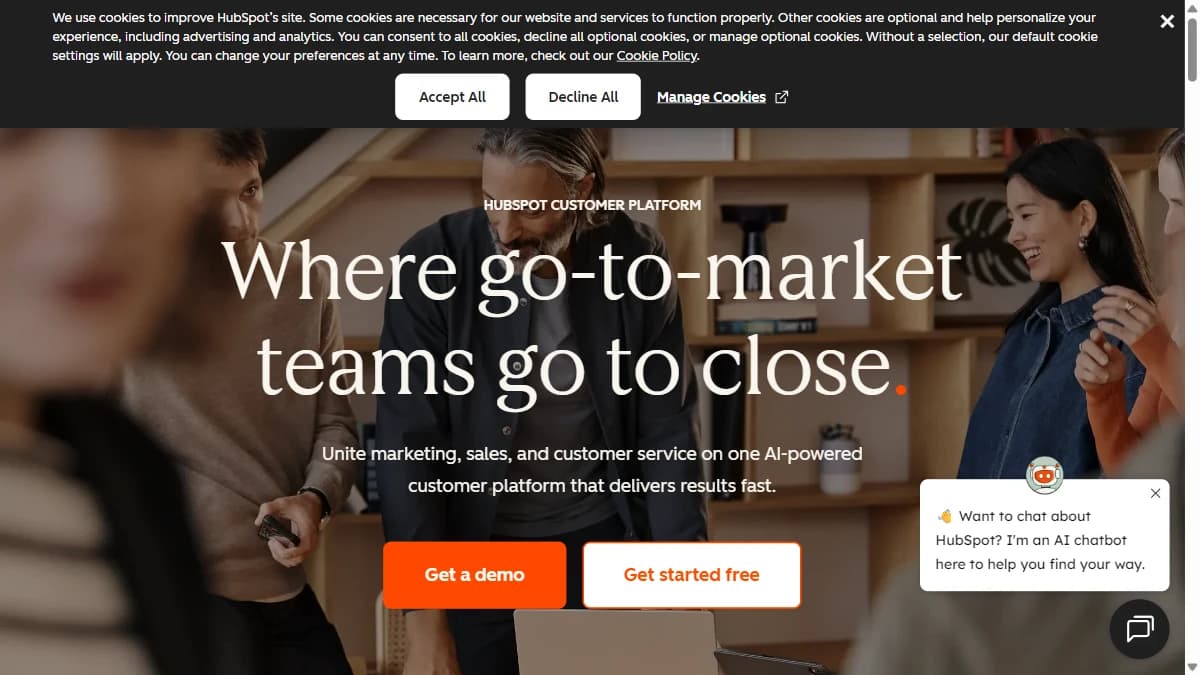
HubSpot — Teams orchestrating marketing and sales within HubSpot
HubSpot workflow engine is one of the most mature orchestration tools on the market -- provided you are operating within the HubSpot ecosystem. You can build multi-step workflows that respond to contact property changes, deal stage movements, email engagement, and form submissions.
The platform strength is unified orchestration across marketing and sales. A single workflow can enrich a lead with Breeze Intelligence, score it, assign it to a rep, enroll it in a sequence, and notify the team on Slack.
Pros
- +Free CRM with marketing and sales tools
- +All-in-one ecosystem (CRM, marketing, sales, service)
- +Extensive app marketplace
- +Strong workflow automation
Cons
- −Expensive at scale ($890/mo+ for Professional)
- −Per-contact pricing adds up
- −Feature-gated tiers limit flexibility
- −Migration complexity from other CRMs
Best for: Teams orchestrating marketing and sales within HubSpot
Pricing: Free CRM. Starter $20/mo. Professional $890/mo. Enterprise $3,600/mo.
4. Clari — Revenue intelligence and forecast orchestration for enterprise teams
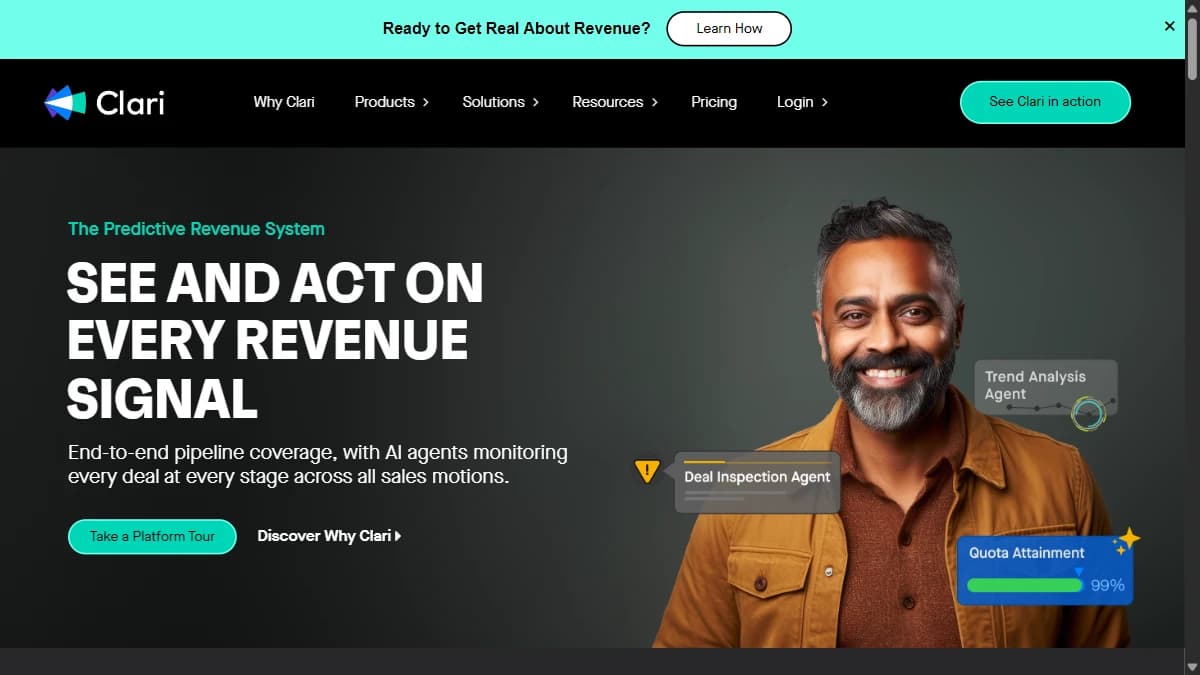
Clari — Revenue intelligence and forecast orchestration for enterprise teams
Clari orchestrates the revenue intelligence layer of your GTM stack. It ingests signals from CRM, email, calendar, and conversation intelligence tools to create a unified view of pipeline health, forecast accuracy, and deal risk.
For revenue leaders, Clari orchestration value is in surfacing the signals that matter -- deals going dark, forecast misses, rep activity gaps -- and triggering the right management actions. It is not an enrichment or outreach tool; it orchestrates visibility across the revenue team.
Pros
- +AI-powered revenue forecasting
- +Pipeline inspection and analytics
- +Deal risk scoring
- +Activity capture across channels
Cons
- −Enterprise-only pricing
- −Complex implementation
- −Requires clean CRM data for accuracy
- −Overkill for small teams
Best for: Revenue intelligence and forecast orchestration for enterprise teams
Pricing: Custom pricing. Enterprise contracts required.
5. Outreach — Enterprise sales teams needing AI-powered sequencing and deal intelligence
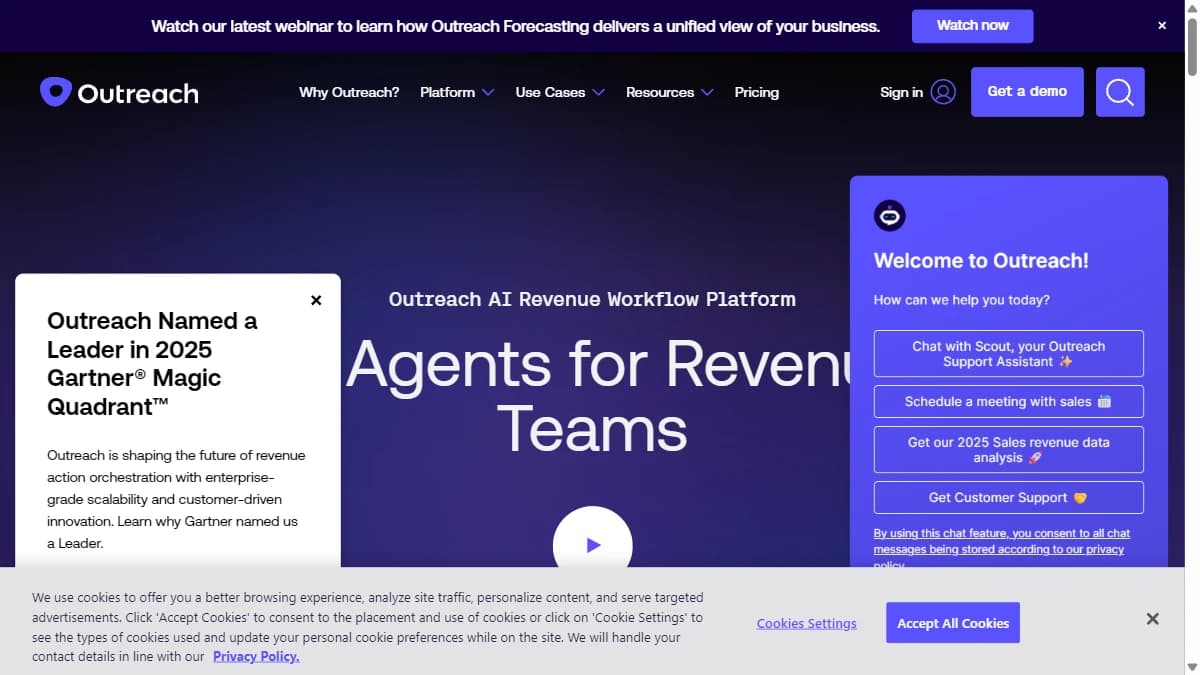
Outreach — Enterprise sales teams needing AI-powered sequencing and deal intelligence
Outreach orchestrates the sales engagement layer — sequencing emails, calls, and social touches across reps, territories, and segments. Its AI engine optimizes send times, suggests messaging variations, and prioritizes rep actions based on buyer engagement signals.
For teams with high outbound volume, Outreach orchestration ensures that the right prospect gets the right message at the right time. However, it relies on upstream tools for data enrichment and lead sourcing — you will need a platform like SyncGTM, or a data provider like Explorium.ai, upstream to feed enriched leads into Outreach sequences.
Pros
- +AI-powered sequence optimization
- +Deal intelligence and pipeline analytics
- +Enterprise-grade compliance and security
- +Deep Salesforce integration
Cons
- −$100+/user/mo with annual contracts
- −Complex setup and admin
- −Overkill for small teams
- −No built-in enrichment data
Best for: Enterprise sales teams needing AI-powered sequencing and deal intelligence
Pricing: Custom pricing. Typically $100+/user/mo with annual contracts.
6. n8n — Technical teams that want full control over GTM workflow automation
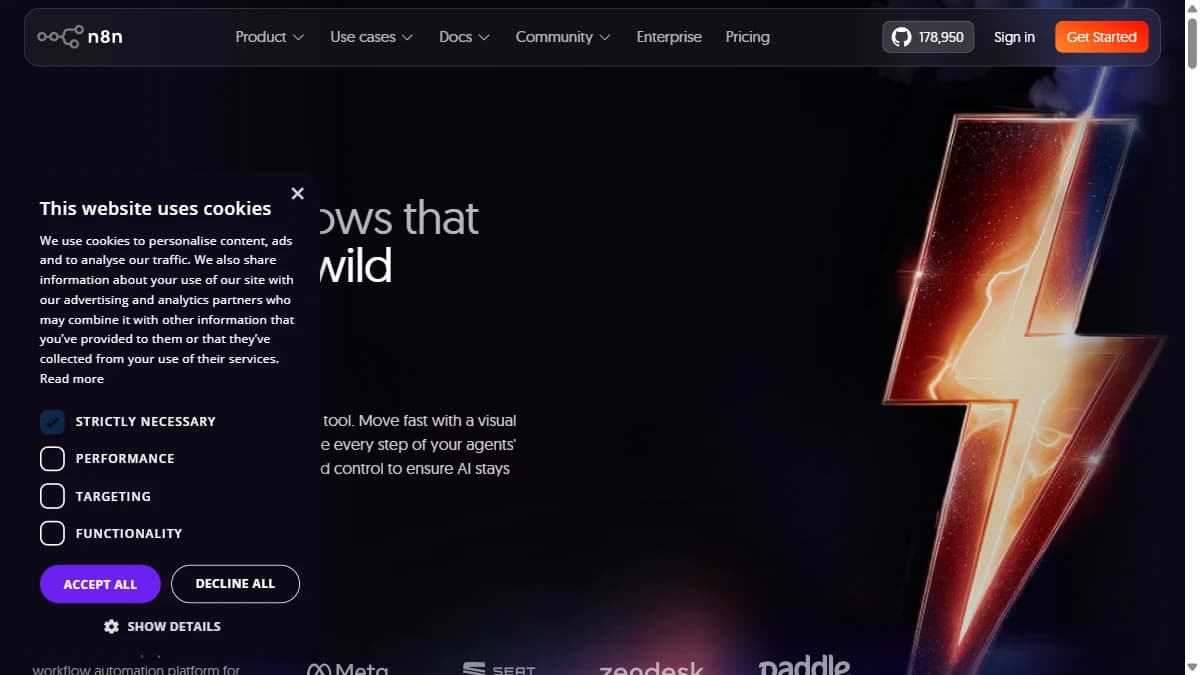
n8n — Technical teams that want full control over GTM workflow automation
n8n is the open-source option for GTM orchestration. With 400+ integrations and full code access, technical teams can build custom orchestration workflows that connect enrichment providers, CRMs, messaging tools, and databases. Self-hosting gives complete control over data flow and processing logic.
The tradeoff is clear: n8n requires engineering resources to build and maintain GTM workflows that purpose-built platforms like SyncGTM handle out of the box. There are no native enrichment providers, no built-in CRM field mapping, and no GTM-specific templates. But for teams with developers who want maximum customization and zero vendor lock-in, n8n is the most flexible foundation available.
Cloud pricing starts at $24/mo, but most GTM teams self-host for free. The active developer community means you can find pre-built GTM workflow templates on GitHub, though they require adaptation to your specific stack.
Pros
- +Open-source and self-hostable
- +400+ integrations
- +Full code access for customization
- +Active developer community
Cons
- −Requires technical skills to set up
- −No GTM-specific features built in
- −Self-hosting requires DevOps resources
- −UI less polished than commercial alternatives
Best for: Technical teams that want full control over GTM workflow automation
Pricing: Free (self-hosted). Cloud Starter $24/mo. Pro $60/mo. Enterprise custom.
7. Zapier — No-code teams that need to connect GTM tools without engineering resources
Zapier — No-code teams that need to connect GTM tools without engineering resources
Zapier is the simplest entry point for GTM orchestration. With 6,000+ app integrations, you can connect virtually any combination of GTM tools — enrichment providers, CRMs, email platforms, Slack, and more — without writing code. Multi-step Zaps support basic branching and conditional logic.
For teams running straightforward GTM motions — enrich new leads, route to CRM, notify reps on Slack — Zapier handles it in minutes. The platform excels at connecting tools that do not have native integrations with each other, acting as the glue layer in your GTM stack.
The limitation is depth. Zapier workflows are single-trigger, credit-based, and lack native enrichment or data transformation capabilities. At high volume, costs scale quickly — a 50,000-task workflow runs $299/mo. For complex orchestration with waterfall enrichment and multi-step branching, purpose-built tools like SyncGTM will serve you better.
Pros
- +6,000+ app integrations
- +No-code workflow builder
- +Fast setup for simple automations
- +Extensive documentation and community
Cons
- −Expensive at high volume
- −Limited data transformation capabilities
- −No enrichment features
- −Single-trigger workflows only
Best for: No-code teams that need to connect GTM tools without engineering resources
Pricing: Free (100 tasks/mo). Starter $29/mo. Professional $73/mo. Team $103/mo.
Comparison Table
| Tool | Best For | Free Tier | Starting Price | Standout Feature |
|---|---|---|---|---|
| SyncGTM | All-in-one GTM automation with waterfall enrichment across 50+ providers | Yes | $49/mo | Waterfall enrichment across 50+ providers with drag-and-drop workflow builder |
| Explorium.ai | Feeding GTM workflows and AI agents with company, contact, and signal data from one API | Yes (100 credits) | $29.99/pkg | AgentSource API and hosted MCP server backed by 4,000+ data signals |
| HubSpot | Teams orchestrating marketing and sales within HubSpot | Yes | $20/mo | Unified marketing and sales workflow orchestration in one CRM |
| Clari | Revenue intelligence and forecast orchestration for enterprise teams | No | Custom pricing | AI-powered revenue forecasting with pipeline orchestration |
| Outreach | Enterprise sales teams needing AI-powered sequencing and deal intelligence | No | Custom pricing | AI-powered sequence optimization with deal intelligence |
| n8n | Technical teams that want full control over GTM workflow automation | Yes (self-hosted) | Free / $24/mo cloud | Open-source workflow automation with 400+ integrations |
| Zapier | No-code teams that need to connect GTM tools without engineering resources | Yes | $29/mo | 6,000+ app integrations with no-code workflow builder |
How to Choose
- SyncGTM if you need all-in-one GTM automation with waterfall enrichment across 50+ providers
- Explorium.ai if you need feeding GTM workflows and AI agents with company, contact, and signal data from one API
- HubSpot if you need teams orchestrating marketing and sales within HubSpot
- Clari if you need revenue intelligence and forecast orchestration for enterprise teams
- Outreach if you need enterprise sales teams needing AI-powered sequencing and deal intelligence
- n8n if you need technical teams that want full control over GTM workflow automation
- Zapier if you need no-code teams that need to connect GTM tools without engineering resources