
By Kushal Magar · September 25, 2026 · 12 min read
5 Best LinkedIn Scraper MCPs for B2B Prospecting in 2026
Every LinkedIn scraper MCP claims to "connect to Claude," but that phrase hides two very different questions: what can it actually pull, and whose LinkedIn account takes the risk when it does. Some servers stop at a public profile. Others reach post commenters, reactors, and job-change alerts — and a few do it by driving a real, loggable session on your own account. We compared five on exactly those two axes: reach and risk.
Most "LinkedIn scraper" comparisons rank tools on data fields and price per record. That misses the variable that actually determines whether a workflow survives contact with LinkedIn's enforcement systems: does the server touch your logged-in session, or does it read through an architecture that never asks for your cookie in the first place.
The distinction matters because LinkedIn's User Agreement explicitly prohibits automated scraping through a member account, and Anthropic's Model Context Protocol makes it trivially easy to wire a browser-automation scraper straight into an AI assistant — which means the ban risk that used to require a developer to set up is now one Claude Desktop config file away.
We evaluated five LinkedIn scraper MCPs on what they can actually reach — profile data, post history, commenters, reactors, job-change signals — and how each one gets there: a real browser session on your account, a proxy-routed scrape, or a structured API layer that never logs in at all. SyncGTM's own MCP server is on this list, evaluated with the same pros-and-cons treatment as every other entry.
Quick Summary
Five LinkedIn scraper MCPs compared on what they can reach and how much account risk each one carries. SyncGTM leads for teams that need the widest reach — profile, post history, commenters, reactors, and job-change alerts — through an architecture that never logs into LinkedIn on your behalf, from $99/mo with a free tier. Bright Data is the strongest proxy-based option, offering a genuinely free 5,000-request monthly tier before usage-based billing kicks in, but LinkedIn-specific datasets cost more than its generic web-unlocker pricing suggests. Apify is the most flexible: its actor marketplace lists dozens of LinkedIn scrapers at different price points and risk levels, some cookie-free and some not, so the account exposure depends entirely on which actor you pick. stickerdaniel/linkedin-mcp-server is free and fully open-source, but it authenticates with your real LinkedIn session cookie and drives a real browser — the highest-reach, highest-risk option here, best suited to a disposable test account rather than your primary one. Derrick rounds out the list as the lightest-weight option: a credit-metered native enrichment MCP with transparent per-credit pricing and no scraping infrastructure of its own to babysit. The deciding factor isn't the price per record — it's whether the server ever needs your LinkedIn cookie to do its job.
TL;DR
- SyncGTM — Best for reach without account risk. Profile, post, commenter, reactor, and job-change endpoints, no LinkedIn login, from $99/mo.
- Bright Data — Best for proxy-routed scraping at scale. Free tier (5,000 requests/mo), paid usage above that.
- Apify — Best for choosing your own risk level. A marketplace of LinkedIn actors, some cookie-free, priced per 1,000 results.
- stickerdaniel/linkedin-mcp-server — Best for full control on your own infrastructure. Open-source, self-hosted, drives your real LinkedIn session — the highest ban exposure on this list.
- Derrick — Best for lightweight, credit-based lookups. Native enrichment MCP, no scraping infrastructure to manage, from $9/mo.
What We Evaluated
- Reach — which data types the server can pull: profile, posts, commenters, reactors, job changes
- Login requirement — whether the server needs your LinkedIn session cookie/credentials or works without one
- Account risk — real browser session on your account vs. proxy-routed request vs. structured API with no login
- Data freshness — live lookup at query time vs. a cached or batch-refreshed dataset
- Pricing model — flat monthly rate, per-record credits, or per-actor marketplace pricing
- Setup friction — self-hosted infrastructure to maintain vs. a connect-and-go hosted server
1. SyncGTM — Teams that want the widest LinkedIn data reach without touching their own account's login
SyncGTM — Teams that want the widest LinkedIn data reach without touching their own account's login
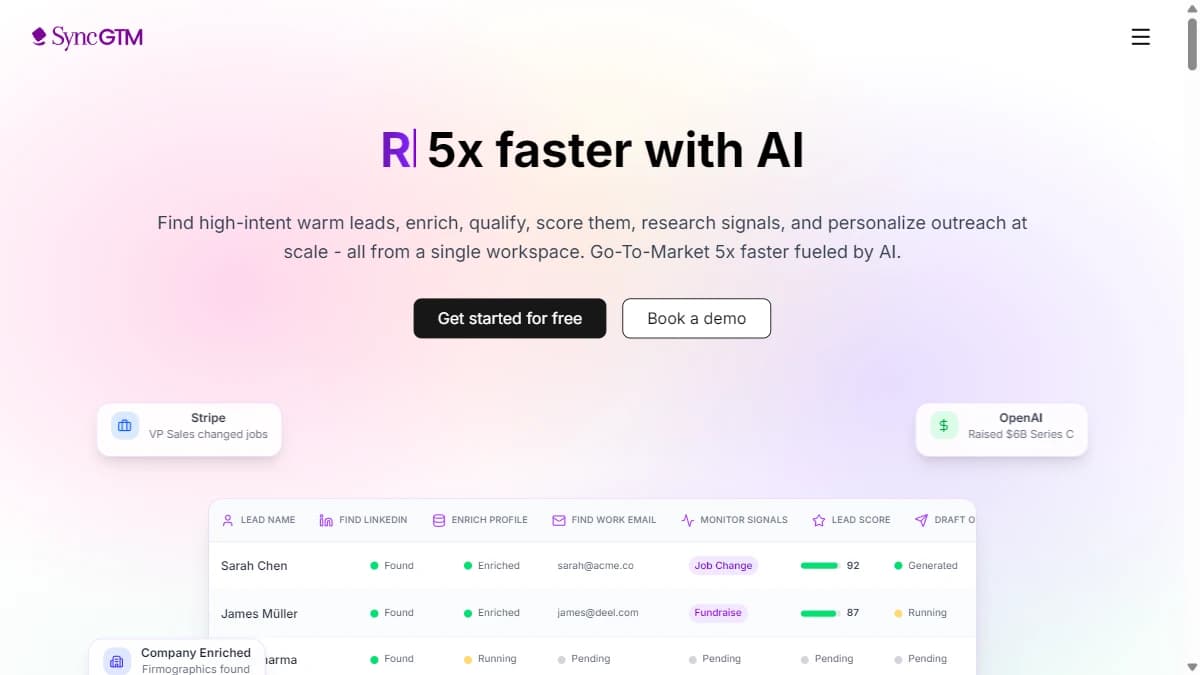
SyncGTM's MCP server exposes LinkedIn profile enrichment, post history, post commenters, post reactors, and job-change detection as direct tool calls — the widest reach of any server on this list — without ever authenticating as you on LinkedIn. There's no session cookie to manage and no browser to keep logged in, which removes the specific failure mode that breaks most self-hosted LinkedIn scrapers within weeks.
Where a typical scraper MCP stops at "pull this profile," SyncGTM's server is built for the follow-up questions a prospecting workflow actually asks: who engaged with this post, who commented, and has this person changed jobs recently. Those endpoints run against a live data layer rather than a single cached snapshot, so results reflect current activity instead of a stale scrape.
Setup is a one-line documented command with no API key to generate. Explore the underlying GTM agent library or a ready-made workflow template to see what a connected agent produces before committing to a paid plan.
Pros
- +Widest reach on this list: profile, posts, commenters, reactors, and job-change alerts from one server
- +No LinkedIn login or session cookie required — removes account-ban risk by design
- +Live lookups at query time rather than a single cached or batch-refreshed dataset
- +Flat monthly pricing, not credit-metered per record
- +Free tier available to test before paying
Cons
- −Newer MCP server than open-source scrapers with years of community-tested edge cases
- −Bulk historical post archives beyond recent activity aren't the server's focus
Best for: Teams that want the widest LinkedIn data reach without touching their own account's login
Pricing: Starts at $99/mo. Free tier available with limited credits.
2. Bright Data — Teams that want proxy-routed LinkedIn access as part of broader web-scraping infrastructure
Bright Data — Teams that want proxy-routed LinkedIn access as part of broader web-scraping infrastructure
Bright Data's MCP server routes requests through its proxy and web-unlocker infrastructure, giving an AI assistant structured access to LinkedIn profile and company data without the assistant itself needing to solve CAPTCHAs or manage IP rotation. It's general-purpose web-access infrastructure with LinkedIn as one of its higher-value, purpose-built endpoints.
The free tier is genuinely usable for testing — 5,000 requests per month with no credit card required, per Bright Data's own MCP pricing page. Past that, LinkedIn-specific datasets are priced above Bright Data's generic web-unlocker rate, reflecting the extra work of maintaining scrapers against a platform that actively defends against them.
Because Bright Data operates the scraping infrastructure rather than your session, the account-ban risk shifts to the provider rather than your own LinkedIn login — a meaningfully different risk profile than a self-hosted browser-automation scraper.
Pros
- +Free tier: 5,000 requests/mo, no credit card required
- +Proxy-routed architecture — doesn't authenticate as you on LinkedIn
- +Backed by mature, general-purpose web-scraping infrastructure beyond just LinkedIn
- +Well-documented npm package and GitHub repo with active maintenance
Cons
- −LinkedIn-specific data costs more than Bright Data's generic web-unlocker pricing
- −Broader web-access tool, not purpose-built for LinkedIn-specific workflows like job-change tracking
- −Detailed paid-tier pricing for LinkedIn volume requires contacting sales
Best for: Teams that want proxy-routed LinkedIn access as part of broader web-scraping infrastructure
Pricing: Free tier: 5,000 requests/mo. Paid usage scales from there; LinkedIn-specific volume pricing requires a sales quote.
3. Apify — Teams that want to shop LinkedIn scrapers by price and risk level rather than commit to one vendor
Apify — Teams that want to shop LinkedIn scrapers by price and risk level rather than commit to one vendor
Apify isn't a single LinkedIn scraper — it's a marketplace of dozens of them, each shipped as an "Actor" with its own MCP endpoint, price, and data scope. That makes Apify the most flexible option on this list: pick a cookie-free profile-search actor for low-risk lookups, or a deeper bulk scraper if you need more fields and accept more risk.
Pricing follows the same per-actor pattern. Profile scrapers on Apify's marketplace range from roughly $0.10 per search page up to $12 per 1,000 company records, depending on which actor and how much post-processing it does. That variance is a feature for teams that want to shop by risk and budget, but it means there's no single "Apify price" to quote.
The trade-off is diligence. Because actors are built by different third-party developers, reach, freshness, and login requirements vary actor to actor — you're evaluating a marketplace listing each time, not a single vendor's fixed product.
Pros
- +Dozens of LinkedIn actors to choose from — profile, company, post, and search scrapers
- +Several actors are explicitly cookie-free, letting you choose a lower-risk option
- +Granular, pay-per-result pricing instead of a flat subscription
- +All actors are MCP-ready for Claude, Cursor, and other MCP clients out of the box
Cons
- −No single fixed price or risk profile — varies actor by actor, requiring per-listing diligence
- −Some actors still require LinkedIn cookies, and that's easy to miss when comparing options quickly
- −Data schema and quality aren't standardized across different developers' actors
Best for: Teams that want to shop LinkedIn scrapers by price and risk level rather than commit to one vendor
Pricing: Pay-per-result, actor-dependent. Typically $0.10/search page to $12/1,000 records. Apify platform free tier available.
4. stickerdaniel/linkedin-mcp-server — Developers comfortable self-hosting who need logged-in-only data and accept the account risk
stickerdaniel/linkedin-mcp-server — Developers comfortable self-hosting who need logged-in-only data and accept the account risk
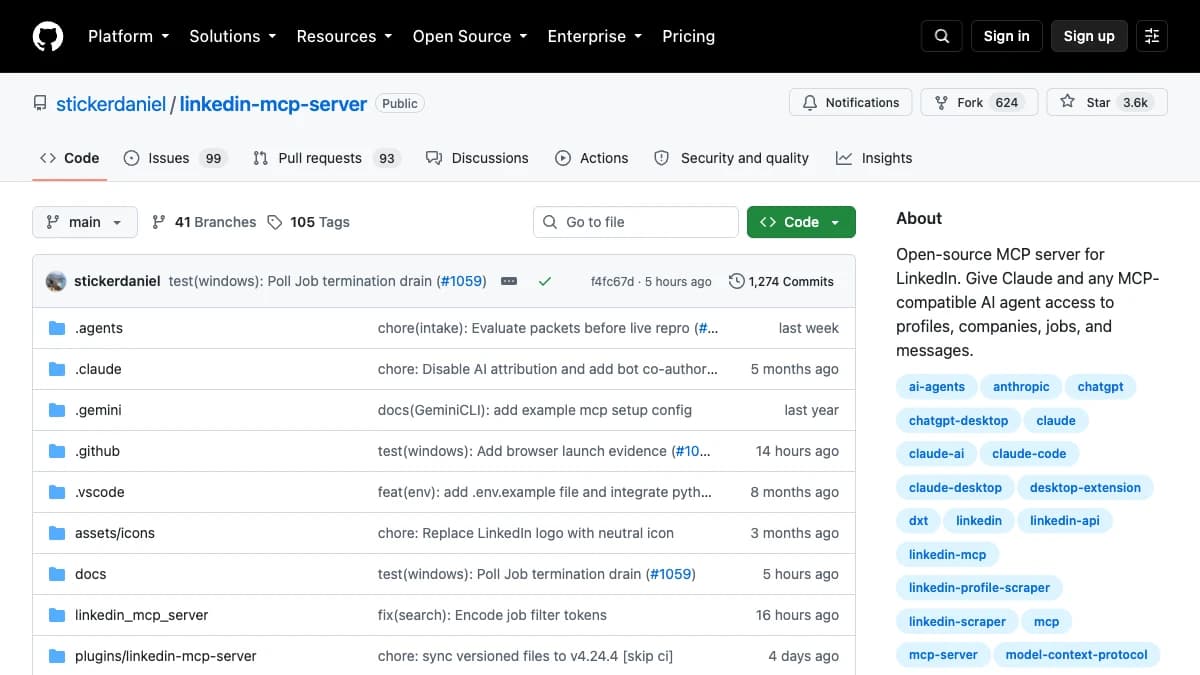
stickerdaniel/linkedin-mcp-server is a free, open-source MCP server that drives a real, logged-in LinkedIn session through Selenium-controlled Chrome to pull profile, company, and job data. It's the most transparent option here in one sense — the code is fully inspectable — and the highest-risk in another, since it authenticates as you.
Because it runs against your actual account, it can reach data that no-login servers can't — content gated behind a real logged-in view — but that same session is exactly what LinkedIn's automated-behavior detection is built to flag. The project itself is built for developers comfortable managing their own infrastructure, not a plug-and-play hosted service.
There's no vendor fee, which makes it attractive for one-off or low-volume use. For anything running regularly, the realistic cost is a disposable secondary LinkedIn account and the engineering time to keep Selenium and Chrome versions from drifting out of sync.
Pros
- +Free and fully open-source — no subscription or per-record cost
- +Full code transparency; self-hostable on your own infrastructure
- +Can reach data visible only to a logged-in session
- +Active community project with visible commit history
Cons
- −Authenticates with your real LinkedIn session — the highest account-ban risk on this list
- −Requires managing your own Selenium/Chrome infrastructure and keeping it updated
- −No official support or SLA; issues are resolved on open-source project timelines
- −Best run against a disposable account, not a primary one your team depends on
Best for: Developers comfortable self-hosting who need logged-in-only data and accept the account risk
Pricing: Free and open-source. Self-hosting infrastructure costs are on you.
5. Derrick — Teams that want fast, low-volume LinkedIn profile lookups without managing scraping infrastructure
Derrick — Teams that want fast, low-volume LinkedIn profile lookups without managing scraping infrastructure
Derrick is a native-enrichment MCP: instead of scraping LinkedIn directly, it sources contact and company data through its own pipeline and exposes it as a lightweight, credit-metered tool call. For teams that just need a fast profile or company lookup without standing up scraping infrastructure, it's the simplest server on this list to get running.
Transparent pricing is the differentiator the vendor leads with — starting at $9/mo with a 100-credit free tier, and public per-credit rates rather than a custom-quote-only model. That's a lower barrier to entry than Bright Data's or Apify's usage-based structures for teams doing occasional lookups rather than bulk volume.
The trade-off is reach. Derrick focuses on profile and company enrichment rather than post-level engagement data — it doesn't expose commenter, reactor, or job-change endpoints the way SyncGTM's MCP does, so teams that need engagement-level signals will still need a second tool.
Pros
- +Transparent, public per-credit pricing starting at $9/mo
- +100-credit free tier to test before paying
- +No scraping infrastructure to self-host or maintain
- +Simple setup for occasional, low-volume lookups
Cons
- −No post-level engagement data — commenters, reactors, and job-change endpoints aren't covered
- −Credit-based pricing can add up at higher lookup volumes
- −Narrower reach than aggregator- or scraper-style MCPs on this list
Best for: Teams that want fast, low-volume LinkedIn profile lookups without managing scraping infrastructure
Pricing: Starts at $9/mo. 100-credit free tier available.
Comparison Table
| Tool | Best For | Free Tier | Starting Price | Standout Feature |
|---|---|---|---|---|
| SyncGTM | Teams that want the widest LinkedIn data reach without touching their own account's login | Yes | $99/mo | Profile, post-engager, commenter, reactor, and job-change endpoints — no LinkedIn login required |
| Bright Data | Teams that want proxy-routed LinkedIn access as part of broader web-scraping infrastructure | Yes (5,000 requests/mo) | Free | Proxy-routed LinkedIn access with a genuinely usable free tier and no session-cookie requirement |
| Apify | Teams that want to shop LinkedIn scrapers by price and risk level rather than commit to one vendor | Yes (platform free-usage tier) | Varies by actor | Marketplace of LinkedIn actors, including cookie-free options, priced per result |
| stickerdaniel/linkedin-mcp-server | Developers comfortable self-hosting who need logged-in-only data and accept the account risk | Yes (fully free, self-hosted) | Free | Open-source, self-hosted, reaches logged-in-only LinkedIn data — at the highest account-ban risk here |
| Derrick | Teams that want fast, low-volume LinkedIn profile lookups without managing scraping infrastructure | Yes (100 credits) | $9/mo | Transparent per-credit pricing with no scraping infrastructure to maintain |
How to Choose
- SyncGTM if you need teams that want the widest linkedin data reach without touching their own account's login
- Bright Data if you need teams that want proxy-routed linkedin access as part of broader web-scraping infrastructure
- Apify if you need teams that want to shop linkedin scrapers by price and risk level rather than commit to one vendor
- stickerdaniel/linkedin-mcp-server if you need developers comfortable self-hosting who need logged-in-only data and accept the account risk
- Derrick if you need teams that want fast, low-volume linkedin profile lookups without managing scraping infrastructure