
By Kushal Magar · September 16, 2026 · 14 min read · Last updated: September 30, 2026
7 Best Revenue Automation Platforms for B2B Teams in 2026
Most revenue automation platform lists rank whatever tool pays for placement. We compared seven platforms head-to-head on data quality, workflow depth, CRM sync, buying signals, and real pricing — so you can choose the right one without stitching together five tools.
Revenue automation in 2026 means more than scheduling follow-up emails. B2B teams are expected to find in-market accounts, enrich every contact with verified data, detect buying signals before the competition, and push qualified leads into sequences — all without a RevOps team of ten people manually connecting the dots.
The problem is that most "revenue automation platforms" only own one slice of that stack. Some do pipeline forecasting. Some do contact enrichment. Some do sales engagement. Very few connect the full loop — and the ones that try often do it behind a six-figure contract.
This post compares seven platforms across five dimensions: data quality, workflow depth, CRM sync, buying signal coverage, and pricing transparency. SyncGTM is one of the seven and gets the same pros-and-cons treatment as every other platform.
Quick Summary
Seven revenue automation platforms ranked for B2B teams in 2026. SyncGTM leads for signal-driven prospecting — waterfall enrichment across 50+ providers, buying signals, AI lead scoring, and native CRM integrations, free to start. HubSpot is the default for SMB and mid-market teams that want one vendor across sales, marketing, and service. Clari is the top pick for enterprise forecasting and pipeline inspection. ZoomInfo has the largest contact database with intent signals. Outreach is the standard for enterprise sales engagement with AI deal intelligence. Apollo.io is the most affordable option for outbound prospecting with 275M+ contacts. Salesforce Revenue Cloud handles contract-to-cash at enterprise scale. Key differences: data source depth, buying signal coverage, workflow automation breadth, CRM sync quality, and whether the platform handles enrichment or just sequencing.
TL;DR
- SyncGTM — Best for signal-driven prospecting. Waterfall enrichment across 50+ providers, buying signals, AI lead scoring, and native CRM integrations. Free to start.
- HubSpot — Best all-in-one CRM for SMB and mid-market. Native automation across sales, marketing, and service from $15/user/mo.
- Clari — Best for revenue forecasting and pipeline inspection. AI-driven deal risk signals for enterprise sales teams.
- ZoomInfo — Best for the largest B2B contact database with intent data. 321M+ contacts and 1B+ buying signals per day.
- Outreach — Best enterprise sales engagement platform. AI deal insights, meeting intelligence, and multi-channel sequences.
- Apollo.io — Best for outbound prospecting on a budget. 275M+ contacts and built-in sequences from $59/user/mo.
- Salesforce Revenue Cloud — Best for enterprise contract-to-cash automation. CPQ, billing, and revenue recognition in one suite.
What We Evaluated
- Data quality and enrichment depth — how many data points per lead, how many providers, verification rate
- Buying signal coverage — job change alerts, funding rounds, hiring spikes, tech-stack changes, intent signals
- Workflow automation depth — can it trigger actions across enrichment, scoring, sequencing, and CRM in one flow?
- CRM sync quality — bidirectional sync, field mapping flexibility, supported CRMs
- Pricing transparency — published tiers vs. opaque quote-only, total cost of ownership
1. SyncGTM — B2B teams that want enrichment, buying signals, and lead scoring feeding their CRM
SyncGTM — B2B teams that want enrichment, buying signals, and lead scoring feeding their CRM
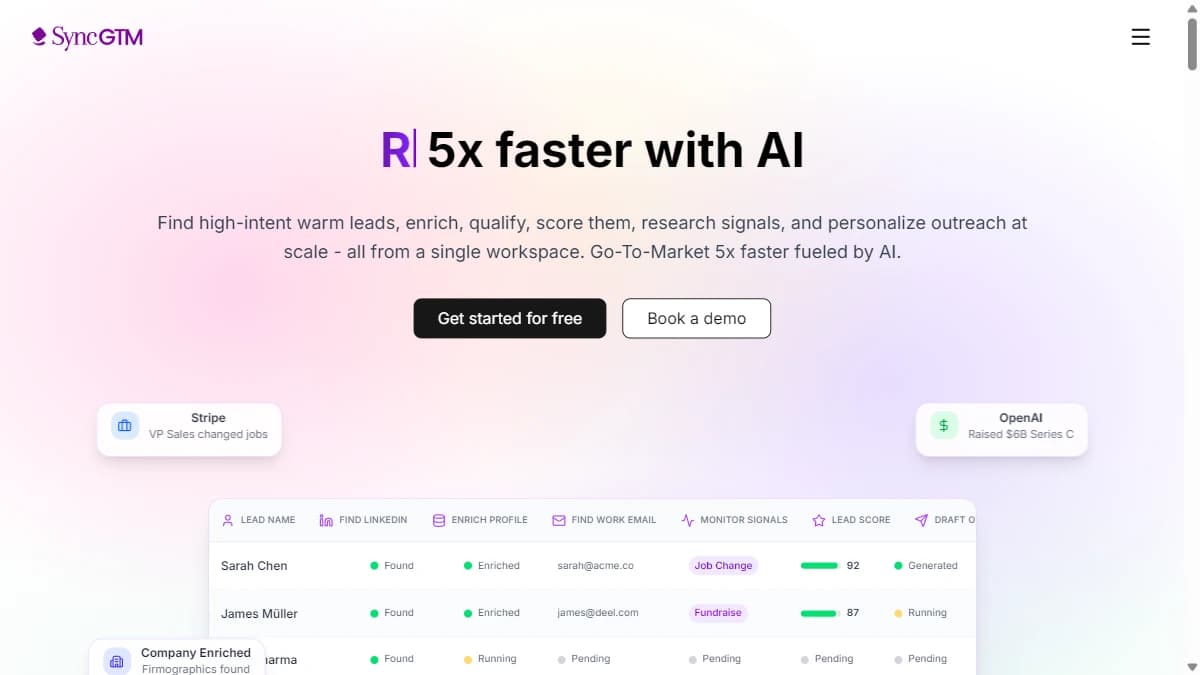
SyncGTM is a GTM data platform built for B2B sales and GTM teams. It combines waterfall enrichment across 50+ providers, buying signal detection, AI lead scoring, and native CRM integrations, so the prospecting side of the revenue cycle runs on current data. It is free to start — see the SyncGTM pricing page for current plans.
The waterfall enrichment engine queries 50+ data providers in sequence for each contact. If one provider cannot return a verified work email, the system falls back to the next until the field is filled or all sources are exhausted, returning verified emails, phone numbers, and firmographics.
Beyond enrichment, SyncGTM monitors five buying signal categories: job changes at target accounts, funding announcements, headcount growth, hiring activity, and web traffic. AI lead scoring ranks accounts against your ICP, and native integrations with Salesforce, HubSpot, Pipedrive, Attio, and Close push enriched records into the CRM your team already uses. See the full feature set.
Pros
- +Waterfall enrichment across 50+ providers for verified emails, phone numbers, and firmographics
- +Five buying signal types: job changes, funding, headcount growth, hiring, and web traffic
- +AI lead scoring against your ICP
- +Native CRM integrations with Salesforce, HubSpot, Pipedrive, Attio, and Close
- +Free to start
- +MCP access from Claude, ChatGPT, and Cursor
Cons
- −Newer platform — fewer third-party integrations than legacy tools like ZoomInfo
- −No CPQ or contract management features (not a Salesforce Revenue Cloud replacement for billing)
- −Enterprise forecasting and pipeline inspection not as deep as Clari
Best for: B2B teams that want enrichment, buying signals, and lead scoring feeding their CRM
Pricing: Free to start. Paid plans add more monthly data credits; see the SyncGTM pricing page for current tiers.
2. HubSpot — SMB and mid-market teams wanting one vendor for the full GTM stack
HubSpot — SMB and mid-market teams wanting one vendor for the full GTM stack
HubSpot is the default revenue platform for SMB and mid-market teams that want a single vendor across marketing, sales, and customer success. The CRM is free, the automation breadth is wide, and the native integrations eliminate most of the glue code that plagues multi-tool stacks.
HubSpot's Sales Hub Professional ($90/user/mo) gives you sequences, call transcription with AI summaries, deal pipeline automation, and revenue forecasting. The Marketing Hub layers email campaigns, landing pages, social scheduling, and attribution reporting on top of the same contact database — which means sales and marketing always share the same record without a sync step. Breeze Intelligence (formerly Clearbit) adds contact enrichment from inside HubSpot, though it uses a credit model and draws from fewer providers than a dedicated enrichment platform.
The main limitation is platform lock-in. HubSpot's best features only work fully when you run sales, marketing, and service on it. If your CRM is Salesforce or Pipedrive, you lose most of the automation value. Pricing also steps up steeply — the jump from Starter ($15/user/mo) to Professional ($90/user/mo) is where most SMB teams hit a ceiling.
Pros
- +Free CRM with generous contact limits — lowest barrier to entry in this list
- +Native automation across sales, marketing, and service on one contact record
- +Breeze Intelligence adds enrichment without leaving HubSpot
- +Strong reporting and attribution for all funnel stages
- +Largest ecosystem of native integrations (1,500+)
Cons
- −Advanced automation gated behind Professional tier ($800–$3,200/mo)
- −Enrichment via Breeze Intelligence uses a credit model, so costs grow with usage
- −Gets expensive fast as seat count and feature tier both grow
- −Buying signal coverage limited compared to dedicated signal platforms
- −Poor fit if your CRM is not HubSpot — loses most of its automation value
Best for: SMB and mid-market teams wanting one vendor for the full GTM stack
Pricing: Free CRM tier. Sales Hub Starter from $15/user/mo. Sales Hub Professional from $90/user/mo. Marketing Hub Professional from $800/mo. Enterprise tiers from $3,200/mo.
3. Clari — Enterprise revenue teams that need accurate forecasting and pipeline inspection
Clari — Enterprise revenue teams that need accurate forecasting and pipeline inspection
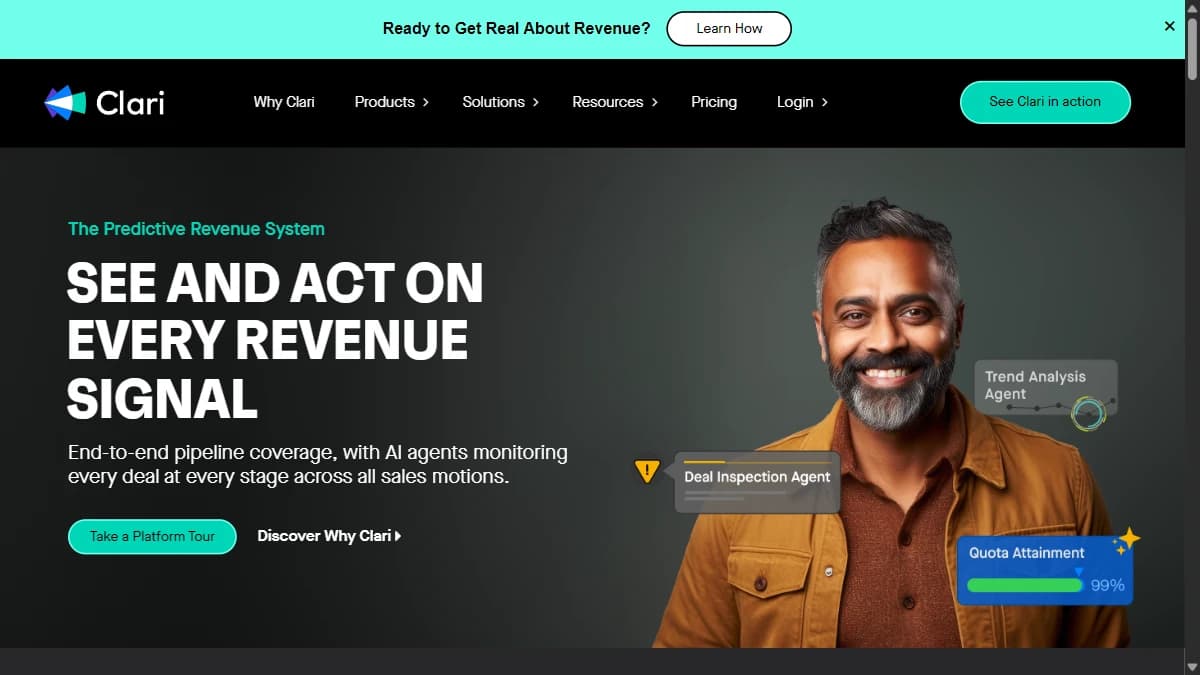
Clari is the leading revenue operations and forecasting platform for enterprise sales teams. Where most tools in this list focus on the top of the funnel — finding and enriching contacts — Clari focuses on mid-to-late funnel: pipeline inspection, deal risk scoring, forecast accuracy, and revenue leak prevention.
Clari's AI ingests CRM data, email activity, calendar data, and call recordings to surface deal risk signals in real time. A sales rep who has not logged activity on a deal in two weeks, a champion who has gone quiet, or a forecast category that historically closes at 40% instead of the committed 70% — Clari flags all of it and gives the VP of Sales a live view of where the quarter is heading. The platform also runs automated CRM hygiene enforcement, pushing reps to update fields and stages based on actual activity rather than self-reported data.
Clari does not do outbound prospecting, contact enrichment, or outreach automation. It is purpose-built for teams that already have a full pipeline and need to close it predictably. Enterprise pricing means it is not accessible for teams under 30–50 reps.
Pros
- +Best-in-class AI forecasting — consistently rated the most accurate in this category
- +Real-time deal risk signals from email, calendar, call, and CRM activity
- +Automated CRM hygiene keeps pipeline data trustworthy without rep effort
- +Strong mutual action plan and collaborative selling features
- +Deep Salesforce integration with bidirectional write-back
Cons
- −No outbound prospecting, enrichment, or contact database — pure pipeline intelligence
- −Enterprise pricing with no published tiers — typically $20,000–$80,000+/year
- −Requires at least 6–8 weeks of CRM data to build reliable AI models
- −Overkill for teams under 20 reps — ROI is harder to justify at smaller scale
- −Implementation takes 4–8 weeks with required onboarding support
Best for: Enterprise revenue teams that need accurate forecasting and pipeline inspection
Pricing: Custom enterprise pricing. Contracts typically start at $20,000/year. No self-serve or published tiers.
4. ZoomInfo — Enterprise revenue teams with budget for the largest B2B contact database
ZoomInfo — Enterprise revenue teams with budget for the largest B2B contact database
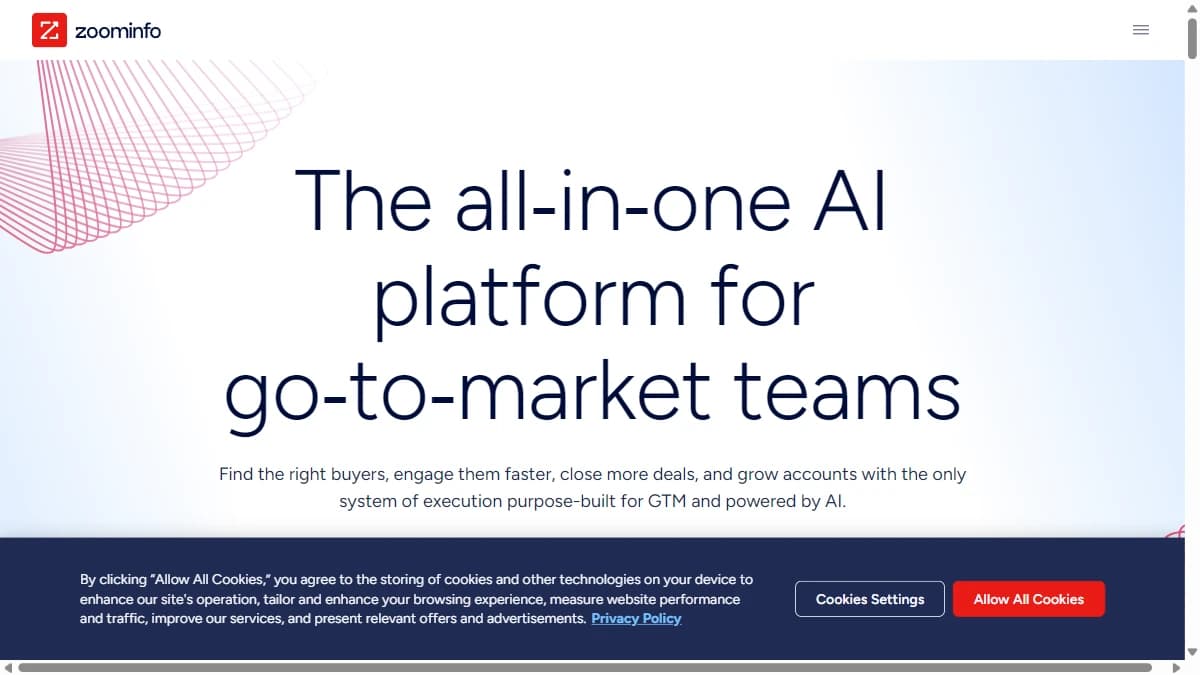
ZoomInfo is the largest B2B contact database on the market. 321M+ professional profiles, 100M+ company records, direct dial phone numbers, org charts, technographics, and intent signals from over 300 topics monitored across 30,000+ B2B websites. For teams that prioritize database size and data depth on a single platform, ZoomInfo remains the reference standard.
The platform bundles contact data with SalesOS (outbound prospecting workflows), MarketingOS (account-based advertising), and OperationsOS (data enrichment and cleansing). Buying signals include job changes, funding events, hiring intent, and topic-level intent from ZoomInfo's own publisher network. The intent layer processes over 1 billion signals per day — the largest proprietary signal volume in this comparison.
The main limitation is price. ZoomInfo starts at $15,000/year and scales quickly into six figures for enterprise contracts. It also relies on a single database — when ZoomInfo does not have a contact's direct email or mobile, you get a blank field with no fallback source. Teams paying premium prices for 100% data coverage often find 15–30% of their target contacts still return incomplete records.
Pros
- +321M+ professional profiles — largest single-source B2B database
- +Over 1 billion buying signals processed daily from proprietary publisher network
- +Org charts and reporting relationships for account-based multi-threading
- +300+ filter criteria including advanced technographic and hiring signals
- +Native Salesforce and HubSpot apps with enterprise-grade integrations
Cons
- −Pricing starts at $15k+/year with annual commitments — no self-serve option
- −Single-source database — no fallback when data is missing
- −Implementation takes 2–6 weeks with CSM requirement on most plans
- −Renewal negotiations are notoriously aggressive on multi-year contracts
- −Advanced features gated behind higher contract tiers
Best for: Enterprise revenue teams with budget for the largest B2B contact database
Pricing: Custom pricing. Entry-level contracts typically start at $15,000/year. Enterprise plans run $50,000–$100,000+/year.
5. Outreach — Enterprise sales teams that need the most capable engagement and coaching platform
Outreach — Enterprise sales teams that need the most capable engagement and coaching platform
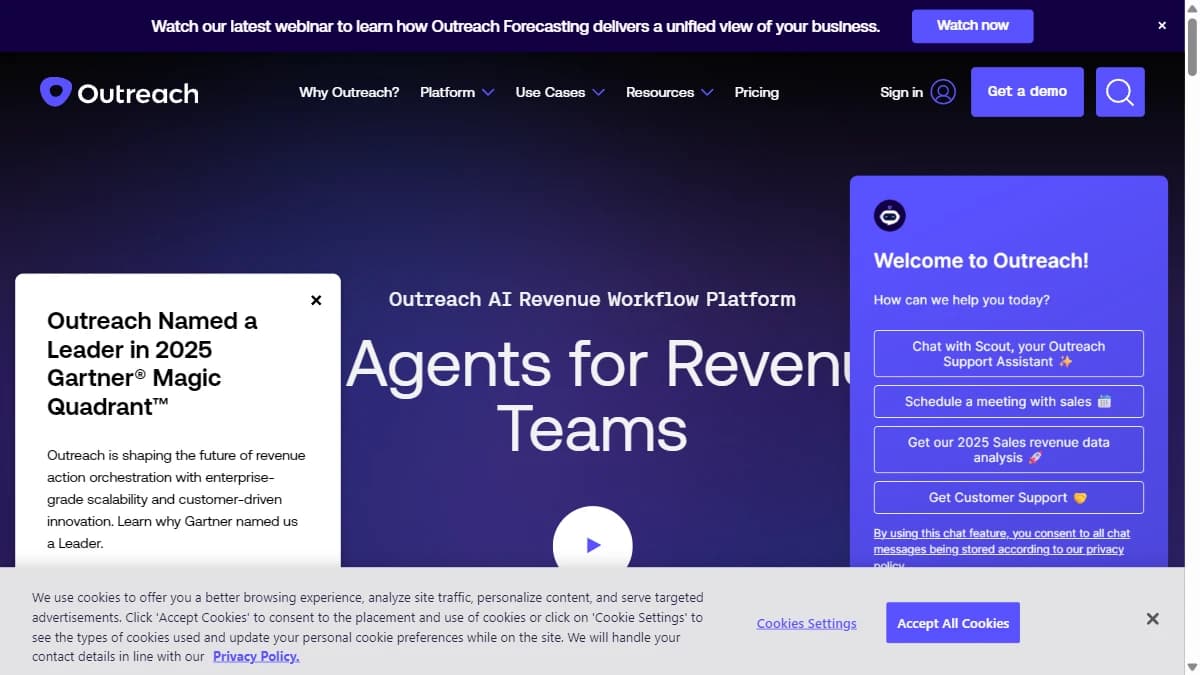
Outreach is the enterprise sales engagement platform that defines the category. Sequences, call intelligence, deal management, and revenue forecasting in one system — with Kaia, Outreach's AI meeting assistant, layering real-time coaching and automatic note-taking on top of every conversation.
The platform's deal health scoring analyzes email and call activity across the full opportunity to surface risk signals — a champion going cold, multi-threading gaps, or deal velocity slowing below the historical average. Kaia joins every call automatically, transcribes in real time, surfaces relevant talk tracks and battle cards, and syncs a clean call summary to the CRM without the rep writing a single note. For enterprise AEs running 30–50 active opportunities, this automation reduces admin work by an estimated 2–3 hours per week.
Outreach does not provide a contact database. You bring your own leads from a data provider like ZoomInfo or Apollo — Outreach handles everything that happens after the contact enters your system. The pricing reflects its enterprise focus: no published tiers, minimum contracts typically starting at $100/user/month, and a required onboarding package.
Pros
- +Best-in-class sales engagement — sequences, call recording, AI meeting summaries
- +Kaia AI assistant provides real-time coaching and automatic CRM note-taking
- +Deal health scoring across email, call, and meeting activity
- +Strong Salesforce bidirectional integration with field-level control
- +Revenue Grid and Deal Grip features for forecast management
Cons
- −No contact database — must pair with a data provider like ZoomInfo or Apollo
- −No published pricing — enterprise contracts typically run $100+/user/mo
- −Complex implementation with required onboarding — takes 4–6 weeks to go live
- −Heavy for teams under 20 reps — ROI is harder to justify at smaller scale
- −Some users report UI complexity and long ramp time for new reps
Best for: Enterprise sales teams that need the most capable engagement and coaching platform
Pricing: Custom enterprise pricing. Estimated $100–$150/user/month. Minimum commitments typically 20+ users.
6. Apollo.io — Small and mid-market outbound teams that want prospecting and sequences in one budget-friendly tool
Apollo.io — Small and mid-market outbound teams that want prospecting and sequences in one budget-friendly tool
Apollo.io is the most accessible full-stack prospecting and engagement platform in this comparison. A database of 275M+ contacts combined with email sequences, LinkedIn automation, a dialer, and basic CRM features — all from $59/user/mo on the Basic plan, with a generous free tier for smaller teams.
Apollo's filter set is strong: job title, seniority, department, company size, industry, technologies used, funding stage, and hiring activity. The Chrome extension pulls verified emails and phone numbers from LinkedIn profiles, which is the fastest path to building targeted lists for AEs who prospect inside Sales Navigator. The platform also monitors job changes and funding events as buying signals, though the signal coverage is shallower than ZoomInfo's intent layer.
The main limitation is data quality at scale. Apollo draws from a single database — when it cannot find a direct email or mobile, the record stays incomplete with no fallback. Teams sending high-volume outbound from Apollo often see bounce rates of 5–8%. Apollo also lacks deep CRM write-back compared to enterprise tools — syncing enrichment updates back to Salesforce or HubSpot requires manual configuration or Zapier.
Pros
- +275M+ contacts with strong US and North America coverage
- +Free tier available — most generous in this list for solo prospectors
- +Built-in sequences, dialer, and LinkedIn automation from $59/user/mo
- +Chrome extension for real-time prospecting inside LinkedIn
- +Basic buying signals: job changes, funding events, hiring activity
Cons
- −Single-source database — no fallback when a contact is missing, which contributes to higher bounce rates
- −Data quality degrades outside North America and senior IC / C-suite contacts
- −CRM sync requires manual configuration — not fully bidirectional out of the box
- −AI personalization features less capable than dedicated tools like Lavender
- −Support quality drops significantly on entry-level plans
Best for: Small and mid-market outbound teams that want prospecting and sequences in one budget-friendly tool
Pricing: Free tier available (50 email credits/mo). Basic plan from $59/user/mo. Professional from $99/user/mo. Organization from $149/user/mo (minimum 5 users).
7. Salesforce Revenue Cloud — Enterprise teams with complex CPQ, subscription billing, and revenue recognition requirements
Salesforce Revenue Cloud — Enterprise teams with complex CPQ, subscription billing, and revenue recognition requirements
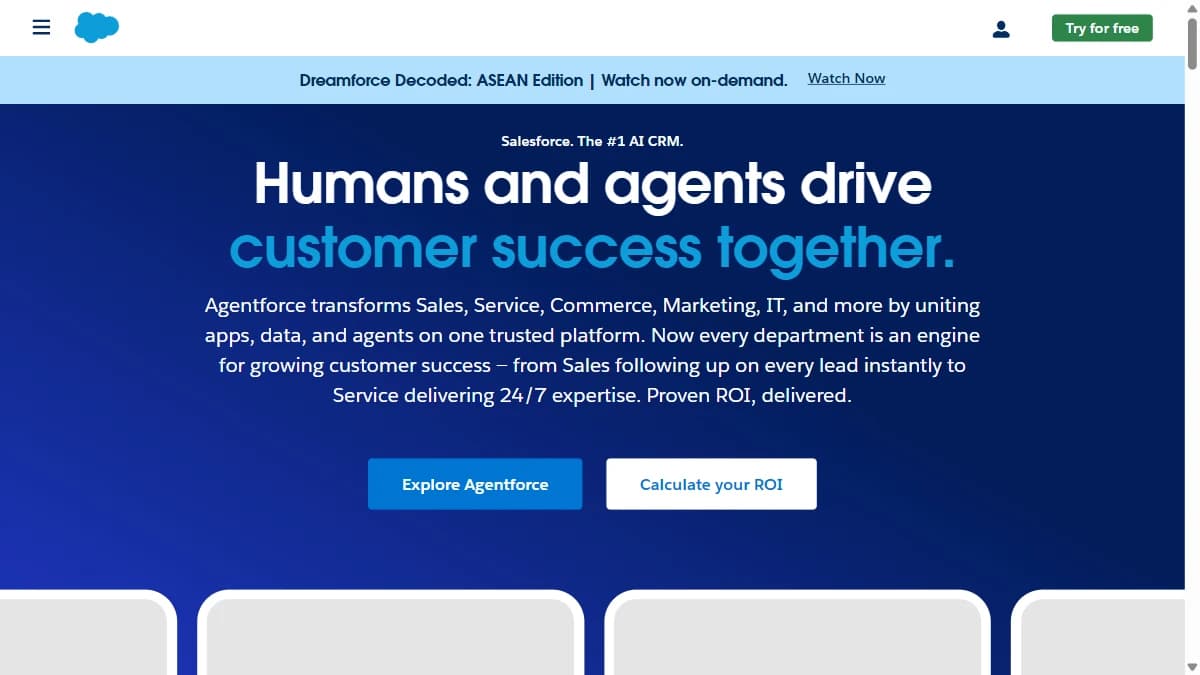
Salesforce Revenue Cloud is the enterprise platform for automating the contract-to-cash cycle. It bundles Configure Price Quote (CPQ), billing, subscription management, and ASC 606 revenue recognition into the Salesforce CRM — making it the default choice for enterprises that need to automate complex pricing, approval workflows, and downstream finance automation.
Revenue Cloud handles the revenue process after a deal is closed: the CPQ module lets sales reps configure complex product bundles, apply pricing rules, and generate accurate quotes with multi-level approval workflows in minutes instead of days. Billing automation then converts signed contracts into invoices, manages subscription renewals, handles usage-based billing, and pushes recognized revenue to the general ledger. For enterprises with revenue recognition complexity — multi-element arrangements, milestone billing, variable consideration — Revenue Cloud eliminates the manual spreadsheet work that creates audit risk.
Salesforce Revenue Cloud is not a prospecting or outreach platform. It is the system of record for everything that happens after the contract is signed. Teams that do not have complex CPQ, billing, or rev-rec needs will not see much value — and the price reflects the enterprise scope: custom pricing, mandatory implementation partners, and minimum contracts typically starting at $150+/user/month for the CPQ layer alone.
Pros
- +Industry-leading CPQ for complex product configurations and pricing rules
- +End-to-end contract-to-cash automation including billing and revenue recognition
- +Native to Salesforce CRM — no integration required for sales to finance handoff
- +ASC 606 compliance built in for enterprises with complex revenue schedules
- +Scales to the largest enterprise contract volumes without performance limits
Cons
- −Not a prospecting or outreach platform — pure post-close revenue automation
- −Custom pricing — contracts typically $150+/user/mo with mandatory implementation
- −Implementation requires a certified Salesforce partner — 3–9 month timelines
- −High total cost of ownership when implementation, admin, and license costs are combined
- −Overkill for teams without complex CPQ, billing, or revenue recognition requirements
Best for: Enterprise teams with complex CPQ, subscription billing, and revenue recognition requirements
Pricing: Custom pricing. CPQ layer typically starts at $75/user/mo. Revenue Cloud bundles run $150+/user/mo. Implementation adds $50,000–$500,000+ depending on complexity.
Comparison Table
| Tool | Best For | Free Tier | Starting Price | Standout Feature |
|---|---|---|---|---|
| SyncGTM | B2B teams that want enrichment, buying signals, and lead scoring feeding their CRM | Yes | Free plan available | 50+ provider waterfall enrichment with buying signals and AI lead scoring |
| HubSpot | SMB and mid-market teams wanting one vendor for the full GTM stack | Yes (CRM free forever) | $15/user/mo | Native automation across sales, marketing, and service on a shared CRM record |
| Clari | Enterprise revenue teams that need accurate forecasting and pipeline inspection | No | Custom (est. $20k+/yr) | AI-driven revenue forecasting with real-time deal risk signals |
| ZoomInfo | Enterprise revenue teams with budget for the largest B2B contact database | No | $15k+/year | 321M+ contacts with 1B+ daily buying signals from a proprietary publisher network |
| Outreach | Enterprise sales teams that need the most capable engagement and coaching platform | No | Custom (est. $100+/user/mo) | Kaia AI meeting assistant with real-time coaching and automatic CRM note-taking |
| Apollo.io | Small and mid-market outbound teams that want prospecting and sequences in one budget-friendly tool | Yes (50 email credits/month) | $59/user/mo | 275M+ contacts with built-in sequences and LinkedIn automation from $59/user/mo |
| Salesforce Revenue Cloud | Enterprise teams with complex CPQ, subscription billing, and revenue recognition requirements | No | $150+/user/mo | CPQ + billing + ASC 606 revenue recognition in the Salesforce CRM |
How to Choose
- SyncGTM if you need B2B teams that want enrichment, buying signals, and lead scoring feeding their CRM
- HubSpot if you need SMB and mid-market teams wanting one vendor for the full GTM stack
- Clari if you need enterprise revenue teams that need accurate forecasting and pipeline inspection
- ZoomInfo if you need enterprise revenue teams with budget for the largest B2B contact database
- Outreach if you need enterprise sales teams that need the most capable engagement and coaching platform
- Apollo.io if you need small and mid-market outbound teams that want prospecting and sequences in one budget-friendly tool
- Salesforce Revenue Cloud if you need enterprise teams with complex CPQ, subscription billing, and revenue recognition requirements