3 Best Contacts Database Online in 2026 (Ranked and Compared)

By Kushal Magar · April 24, 2026 · 12 min read
Key Takeaway
The 3 best contacts database online tools in 2026 are SyncGTM, Apollo, and ZoomInfo. SyncGTM is the top pick for most B2B GTM teams — waterfall enrichment across 50+ providers, signal-driven list building, AI web scraping, and direct CRM push from 99 dollars per month with a free tier. Apollo is the best entry-level option with 275 million proprietary contacts and built-in email sequencing from 49 dollars per month, though single-source coverage shows its limits at scale. ZoomInfo remains the enterprise standard with 300 million contacts, Bombora intent data, and org chart intelligence — but requires 15,000 dollars per year minimum and no self-serve pricing. Choose SyncGTM for the best balance of data quality, automation, and price. Choose Apollo for a cheap all-in-one starting point. Choose ZoomInfo only if you are an enterprise with real budget and need the deepest intent signals available.
Finding the right contacts database online is the most consequential tool decision a B2B GTM team makes. The wrong pick means stale emails, wasted credits, and cold outbound campaigns that damage your sender reputation before a single reply comes in.
The problem: every contacts database vendor claims the largest database, the highest accuracy, and the most integrations. None of them publish an honest comparison of their coverage gaps, bounce rates, or real-world pricing. This post does that instead.
We ranked the 3 best contacts databases online in 2026 — SyncGTM, Apollo, and ZoomInfo — on the criteria that actually matter: data quality, enrichment approach, integration depth, use case fit, and transparent pricing.
According to Gartner, B2B contact data decays at 2% per month. A contacts database you bought six months ago has already lost 12% of its accuracy. The tools that continuously re-verify on export consistently outperform those that rely on static snapshots.
Quick Summary
The best contacts database online tools in 2026 are SyncGTM, Apollo, and ZoomInfo. SyncGTM leads on data quality with waterfall enrichment across 50+ providers, signal-driven list building, and direct CRM push — starting free with paid plans from $99/mo. Apollo offers the cheapest all-in-one entry point at $49/mo. ZoomInfo is the enterprise choice at $15k+/yr minimum.
TL;DR: Best Contacts Database Online in 2026
- SyncGTM — Best contacts database online for B2B GTM teams. Waterfall enrichment across 50+ providers, signal-driven list building (hiring, funding, job changes), AI web scraper, and native CRM push. $99/mo starter. Free tier available.
- Apollo — Best entry-level contacts database online. 275M+ contacts, built-in email sequencing, transparent self-serve pricing from $49/mo. Best for solo founders and small teams starting outbound.
- ZoomInfo — Best enterprise contacts database online. 300M+ contacts, Bombora intent data, org charts, and direct dial coverage. $15k+/yr minimum. Enterprise-only.
What Is a Contacts Database Online?
A contacts database online is a cloud-based platform that provides verified B2B contact records — name, job title, company, work email, direct dial, and LinkedIn profile — searchable by ICP filters and integrated with CRM and outreach tools.
Unlike a static purchased list, an online contacts database is continuously updated and queryable in real time. You define your ideal customer profile — industry, company size, geography, job titles, tech stack — and the database returns matching contacts with verified contact information ready to import or enrich.
In 2026 the category has split into two distinct approaches. Single-source databases (Apollo, ZoomInfo) own proprietary contact repositories and serve data from them directly. Waterfall enrichment platforms (SyncGTM) cascade across dozens of providers per contact, cross-referencing sources until every field is filled and verified. The waterfall approach consistently outperforms single-source tools on coverage, especially for niche industries and international data where any one provider has gaps. For a deeper look at this approach, see our guide to the best waterfall contact providers.
A contacts database online is not a CRM. The database finds net-new prospects. Your CRM manages existing relationships. The best contacts databases push verified contacts directly into your CRM with deduplication — removing the manual export-import step that still costs most teams 3–5 hours per week.
How We Evaluated Contacts Databases Online
We evaluated each contacts database online against the five criteria B2B GTM teams care about most in 2026.
- Data quality: Email verification accuracy, bounce rates, phone number hit rate, and field-level freshness. We cross-referenced vendor claims with G2 user reviews and public benchmark data.
- Enrichment approach: Single-source versus waterfall; ability to fill gaps when one provider returns no result.
- Integration depth: Native CRM connectors (HubSpot, Salesforce, Pipedrive, Attio), deduplication logic, field mapping, API and webhook support.
- Use case fit: Outbound prospecting, ABM, TAM mapping, website visitor identification, and ongoing CRM hygiene.
- Pricing transparency: Self-serve versus sales-gated, credit model clarity, absence of aggressive auto-renewal clauses.
1. SyncGTM — Best Contacts Database Online for B2B GTM Teams
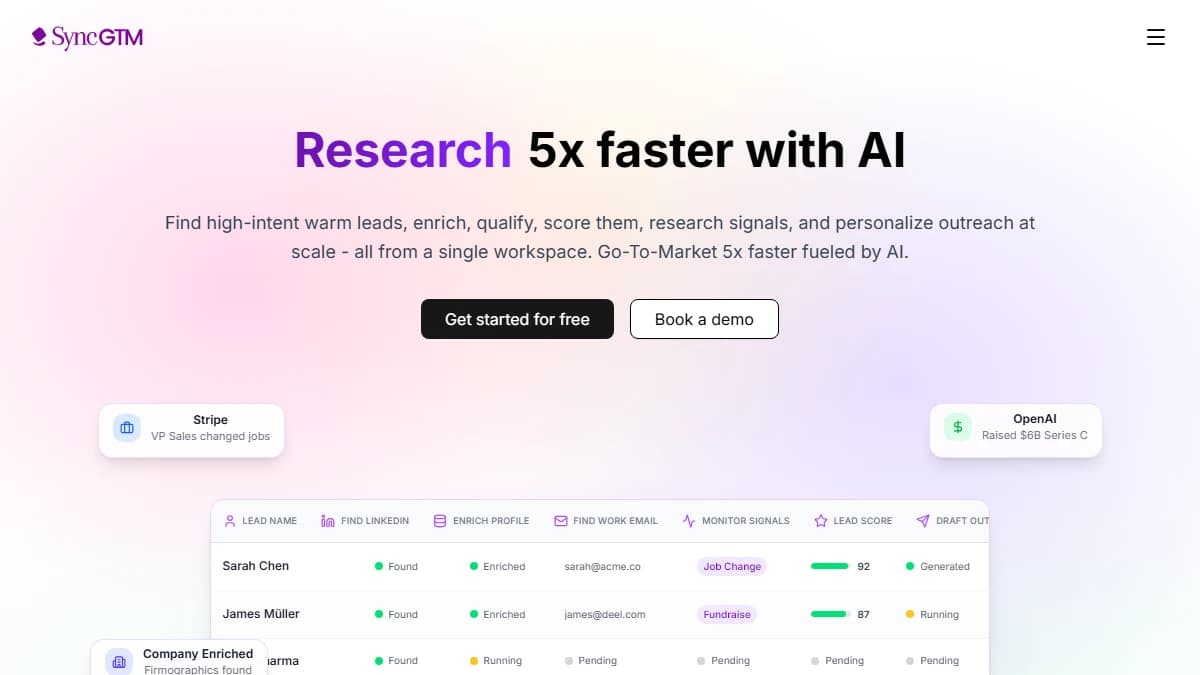
SyncGTM — contacts database online with waterfall enrichment and signal-driven list building
SyncGTM is a GTM automation platform built around a contacts database that runs waterfall enrichment across 50+ data providers. You define your ICP, SyncGTM pulls matching contacts, cascades across dozens of sources to fill every email, phone, and title field, verifies each before export, and pushes the finished record directly into your CRM. The whole workflow runs inside one platform.
What separates SyncGTM from single-source databases is signal-driven enrichment. Instead of returning a static list of every contact that matches your filters, SyncGTM can trigger contact enrichment on real-time buying signals — hiring surges, funding rounds, job changes, and tech stack shifts. This means your contacts database surfaces in-market accounts automatically, rather than requiring your team to manually run filters each week.
SyncGTM also includes an AI web scraper that extracts structured contact data from any website — useful for building contacts lists from sources not in any traditional database. Native integrations with HubSpot, Salesforce, Pipedrive, and Attio push verified contacts with deduplication and field mapping already configured. For teams comparing B2B list building services, SyncGTM occupies the top tier on both data quality and automation depth.
Pros
- + Waterfall enrichment across 50+ providers — highest field coverage
- + Signal-driven enrichment: funding, hiring, tech shifts, job changes
- + AI web scraper builds contacts from non-database sources
- + Native CRM push with dedup and field mapping
- + No-code workflow builder for multi-step enrichment automation
- + Transparent self-serve pricing with a free tier
Cons
- - No native email sequencing — pair with your outreach tool
- - Newer platform, smaller community vs. ZoomInfo
- - Advanced signal features require paid tiers
Best for: B2B sales, RevOps, and marketing teams that want a contacts database with high field coverage and signal-triggered enrichment — without paying enterprise prices.
Pricing: Free tier available. Starter $99/mo with waterfall enrichment, verified emails, and webhooks. Pro and Business tiers for higher volume. See pre-built workflow templates or take a product tour.
2. Apollo — Best Entry-Level Contacts Database Online
Apollo — contacts database online with built-in sequencing for SMB teams
Apollo is a contacts database online with a proprietary database of 275M+ contacts and built-in email sequencing. It is the most widely adopted entry-level contacts database in the market — and for good reason. The free tier is genuinely useful, setup takes minutes, and having your contacts database and outreach tool in one subscription removes the most common integration failure point for small teams.
Apollo's list-building workflow is direct: apply ICP filters (industry, size, title, geography), bulk-verify emails, and push contacts straight into a sequence. For teams running their first outbound motion, this simplicity is a real advantage. There is no data science degree required to get a list of verified contacts into your inbox within an hour of signing up.
The limitation is single-source coverage. Apollo draws from its own proprietary database — which means when Apollo has a gap (a specific niche, a non-US geography, a recently changed job title), there is no fallback. Email bounce rates above 10% appear consistently in 2025–2026 user reviews on G2. Teams building contacts lists at scale — weekly list runs, international targets, or niche verticals — typically outgrow Apollo within 12 months and migrate to a waterfall enrichment platform for better coverage. For a broader comparison, see our best B2B email finder tools guide.
Pros
- + Generous free tier — useful for founders testing outbound
- + 275M+ proprietary contacts with standard ICP filters
- + Built-in email sequencing removes the need for a separate tool
- + Transparent self-serve pricing from $49/mo
- + Fast setup — from signup to first list in under an hour
Cons
- - Single-source data — gaps visible outside North America
- - Email bounce rates above 10% reported in 2026 user reviews
- - No waterfall enrichment — no fallback when data is missing
- - Intent data and API access locked behind higher-priced tiers
- - Platform has grown bloated as Apollo expands scope
Best for: Solo founders and small teams running a first outbound motion who need a contacts database and sequencing tool in one subscription — with the expectation of graduating to a more capable stack within 12 months.
Pricing: Free tier available. Basic $49/mo. Professional $79/mo. Organization $119/mo. Enterprise custom. Intent data and API access locked behind higher tiers.
3. ZoomInfo — Best Enterprise Contacts Database Online
ZoomInfo — enterprise contacts database online with the largest B2B contact coverage
ZoomInfo is the contacts database that most enterprise sales organizations still rely on as their system of record. With 300M+ professional profiles, 100M+ company records, and continuous proprietary refresh, it is the largest B2B contacts database available online. For enterprise teams with established budgets, ZoomInfo offers capabilities that smaller tools simply cannot match at scale.
ZoomInfo's key differentiators are buyer intent data (powered by Bombora) and org chart intelligence. Bombora identifies companies actively researching topics related to your product, so your sales team can prioritize outreach to accounts already in the buying cycle. Org chart data maps reporting hierarchies across major companies — which matters when you need to multi-thread an enterprise deal and find the right decision-makers at each level.
The constraint is price and access model. ZoomInfo has no self-serve signup. Contracts start around $15,000 per year for small teams and climb to $100,000+ for enterprise. Annual contracts include auto-renewal clauses that are notoriously difficult to exit. For teams at the SMB or growth stage, ZoomInfo is almost always overkill. Many enterprise teams increasingly supplement ZoomInfo with B2B lead enrichment platforms to fill gaps and reduce per-contact costs without abandoning their existing ZoomInfo contract.
Pros
- + Largest contacts database: 300M+ contacts, 100M+ companies
- + Bombora buyer intent data for account prioritization
- + Org chart intelligence and decision-maker mapping
- + Direct dial phone numbers with high North American accuracy
- + Native integrations with all major CRMs and sales platforms
- + Continuous proprietary refresh — not a static snapshot
Cons
- - $15k+/yr minimum — not viable for SMBs or startups
- - No transparent pricing — requires a sales call
- - Annual contracts with aggressive auto-renewal clauses
- - Credit limits can restrict list pulls even on paid plans
- - International coverage weaker than North American data
Best for: Enterprise sales organizations with 10+ AEs and established budget that need the deepest contacts database, Bombora intent signals, and org chart intelligence available.
Pricing: Custom only. Typical contracts start at $15,000/yr for small teams. Mid-market and enterprise plans range from $25,000 to $100,000+/yr depending on seats, credits, and feature add-ons.
Side-by-Side Comparison: Contacts Database Online in 2026
| Tool | Best For | Free Tier | Starting Price | Data Source | Standout Feature |
|---|---|---|---|---|---|
| SyncGTM | Waterfall-enriched contacts database for GTM teams | Yes | $99/mo | 50+ providers (waterfall) | Signal-triggered enrichment + AI web scraper + CRM push |
| Apollo | Entry-level contacts database with built-in sequencing | Yes | $49/mo | Single proprietary database (275M+ contacts) | All-in-one prospecting + email sequencing |
| ZoomInfo | Enterprise contacts database with intent data | No | $15k+/yr | Proprietary (300M+ contacts, continuous refresh) | Bombora intent data + org charts + direct dials |
How to Choose the Right Contacts Database Online
The right contacts database online depends on your team size, outbound maturity, and budget. Three decision rules cover most B2B GTM teams.
- If you want the best balance of data quality, automation, and price — choose SyncGTM. Waterfall enrichment across 50+ providers at $99/mo fills more contact fields than any single-source database. Signal-driven enrichment surfaces in-market accounts automatically.
- If you are a solo founder or small team running a first outbound motion — choose Apollo. Cheap, all-in-one, fast to configure. The single-source ceiling is real, but it takes 6–12 months to hit it.
- If you are an enterprise with established budget and need intent data — choose ZoomInfo. Largest contacts database, Bombora intent, org charts. The $15k+/yr minimum is only justified for teams with 10+ reps and a mature outbound motion.
Teams that run high-volume outbound often split their stack: a contacts database for enrichment (SyncGTM) and a dedicated sequencer (Instantly, Smartlead) for sending. This produces better deliverability than all-in-one tools because each platform concentrates on what it does best. For teams building their first B2B contact lists from scratch, our best lead list generator guide covers the full workflow. For teams focused on email outreach, see our comparison of the best B2B email marketing lists.
Final Verdict: Best Contacts Database Online in 2026
The contacts database online category has a clear structure in 2026. One entry-level option, one enterprise option, and one platform that wins on data quality and automation for the majority of B2B GTM teams sitting between those two extremes.
For most B2B teams — sales, RevOps, marketing, and founder-led GTM — the best contacts database online in 2026 is SyncGTM. Waterfall enrichment across 50+ providers solves the single biggest weakness of every single-source database: coverage gaps. Signal-driven list building removes the manual weekly filter runs. Native CRM push removes the CSV export-import loop. At $99/mo with a free tier, it is priced where most teams can adopt it without a procurement cycle.
Apollo is the right starting point for teams with no outbound infrastructure yet. ZoomInfo is the right choice for enterprises that have the budget and need depth at scale. But for the vast middle — teams running mature outbound who are not yet at enterprise scale — SyncGTM delivers better lists at a fraction of the cost.
Ready to upgrade your contacts database? SyncGTM gives you waterfall enrichment across 50+ sources, signal-driven list building, AI web scraping, and direct CRM push — starting free. Start free — no credit card required.