

8 Best DataMiner Alternatives for B2B Enrichment in 2026

By Kushal Magar · June 8, 2026 · 13 min read · Last updated: September 28, 2026
Key Takeaway
DataMiner is a browser scraper, not a B2B prospecting platform — it pulls raw page data with no verification, no API, and no outreach layer, so every scrape needs cleanup and a separate verification tool before it is usable. The 8 best DataMiner alternatives for B2B enrichment in 2026 are: SyncGTM (waterfall enrichment across 50+ providers with buying signals and CRM sync from $49/mo), Apollo.io (275M+ contact database with built-in outreach from $49/mo), Explorium.ai (company and contact data for AI agents via API and MCP from $29.99 per credit package), ZoomInfo (enterprise intelligence with intent data), Hunter.io (focused email finder from $34/mo), Cognism (phone-verified mobiles with GDPR screening for EU/UK), UpLead (real-time verified contacts with a 95% accuracy guarantee from $99/mo), and Lusha (Chrome extension contact finder from $49/mo).
DataMiner is a Chrome and Edge extension that scrapes tables and lists off web pages without code. It ships with 60,000+ pre-built recipes, handles pagination, and exports to CSV, Excel, or Google Sheets. For one-off data extraction, it works.
For B2B sales, it breaks down fast. DataMiner pulls raw page text — it does not verify a single email or phone number it scrapes. Every record needs cleaning, deduping, and a separate verification pass before you can send a campaign.
There is also no API, no proxy support, and recipes that snap the moment a target site changes its layout. So you scrape, clean, verify, enrich, then move it all to yet another tool to actually reach anyone. This guide covers eight DataMiner alternatives that collapse that five-step chain into one workflow — verified contact data and outreach included.
Quick Summary
The best DataMiner alternatives in 2026 are SyncGTM, Apollo.io, Explorium.ai, ZoomInfo, Hunter.io, Cognism, UpLead, and Lusha. SyncGTM is the top pick for most B2B teams — waterfall enrichment across 50+ providers, 76+ data points per lead, buying signal detection, and native CRM integrations from $49/mo with a free tier. Apollo.io pairs a 275M+ contact database with built-in sequences from $49/mo. Explorium.ai serves 146M+ companies to AI agents through an API and MCP server from $29.99 per credit package. ZoomInfo is the enterprise standard for intent data. Hunter.io is the cleanest email finder from $34/mo. Cognism delivers phone-verified mobiles with GDPR screening. UpLead guarantees 95% accuracy on real-time verified contacts. Lusha is the easiest Chrome extension for quick mobile lookups.
TL;DR: Best DataMiner Alternatives in 2026
- SyncGTM — Best overall. Waterfall enrichment across 50+ providers, 76+ data points, buying signals, and CRM sync from $49/mo with a free tier.
- Apollo.io — Best all-in-one. 275M+ contact database with built-in email sequences from $49/mo.
- Explorium.ai — Best for AI-agent prospecting. 146M+ companies and 767M+ profiles via API, MCP, or plain-English prompts. Free trial (100 credits), then from $29.99 per credit package.
- ZoomInfo — Best for enterprise intent data. 500M+ contacts with buyer intent signals (custom pricing).
- Hunter.io — Best focused email finder. Domain search, Chrome extension, and email campaigns from $34/mo.
- Cognism — Best for EU/UK outreach. Phone-verified mobiles with DNC screening and GDPR compliance built in.
- UpLead — Best accuracy guarantee. Real-time verified contacts with a 95% accuracy promise from $99/mo.
- Lusha — Best quick Chrome lookup. Browser-extension contact finder with strong mobile data from $49/mo.
Why B2B Teams Switch from DataMiner
DataMiner is a general-purpose web scraper. It was built to pull structured data off any page — not to source, verify, and reach B2B buyers. That mismatch creates four recurring problems for sales teams.
No data verification. DataMiner extracts whatever text sits on a page. A scraped email is unverified until you run it through a separate tool, and scraped-and-guessed addresses routinely bounce at 30–50%. Sending to that list damages your domain reputation before a single reply lands.
No API and no proxy support. Every export is a manual download, so the workflow cannot be automated. Without proxies, scraping at any volume triggers IP blocks and dead ends. Recipes also break the moment a target site tweaks its layout — a constant maintenance tax.
No outreach or CRM layer. DataMiner produces a CSV. It has no sequences, no CRM sync, and no path from a scraped row to a sent email. Every record requires a separate stack to enrich and reach.
Speed and limits. On the free plan, 500 pages can take 1.5–2 hours to scrape, and exceeding limits locks your account until you upgrade. For high-volume prospecting, that throughput is a hard ceiling.
According to a Gartner analysis of B2B data quality, B2B contact data decays at roughly 30% per year. A point-in-time scrape captures a page as it looked that day — it cannot keep pace with that decay. Waterfall enrichment across multiple live providers is the only reliable way to maintain hit rate at scale.
According to G2's sales intelligence category data, teams that move from manual scraping to verified enrichment platforms report 35–50% higher email deliverability and spend 60% less time on data cleanup. The eight alternatives below fix all four DataMiner problems: verified data, automation via API, a direct outreach path, and no per-page ceiling.
1. SyncGTM
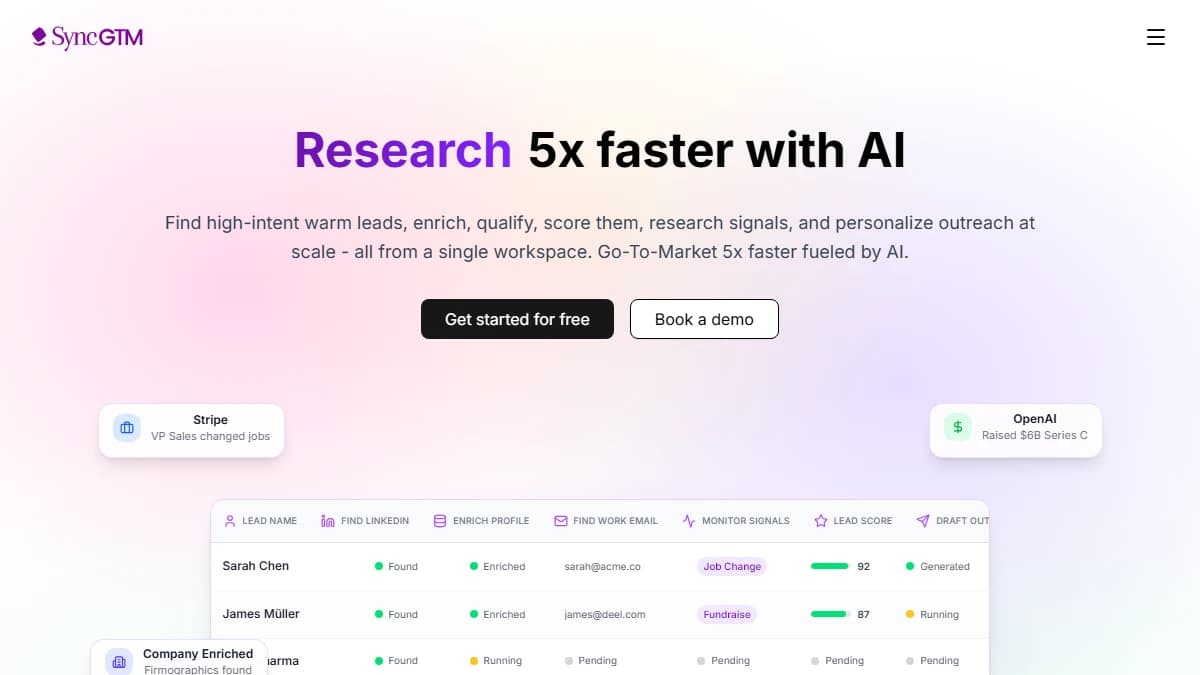
SyncGTM — waterfall enrichment across 50+ providers with buying signals and integrated outreach
SyncGTM is a B2B prospecting platform built around waterfall enrichment — querying 50+ data providers in sequence until verified contact data is found. Where DataMiner scrapes raw, unverified page text, SyncGTM returns verified emails, phone numbers, and 76+ firmographic data points in one pass.
The workflow difference is the whole point. DataMiner forces a scrape-clean-verify-enrich-export chain across multiple tools. SyncGTM handles enrichment, buying signal detection, and CRM routing in a single run — no recipes to maintain, no cleanup step, no manual export.
SyncGTM also has an AI web scraper for the cases where you genuinely need page data — but it pairs scraping with verification, so what comes out is usable, not raw. For high-volume outbound, the waterfall approach delivers 20–40% higher contact coverage than any single provider, including Apollo, ZoomInfo, or Lusha.
Pros
- • Waterfall enrichment across 50+ providers — verified data, not raw scrapes
- • 76+ data points per lead: verified email, direct dial, LinkedIn, firmographics, technographics
- • AI web scraper that pairs scraping with verification — usable output, not cleanup
- • Buying signal detection to surface in-market accounts early
- • Native CRM sync (HubSpot, Salesforce, Pipedrive, Attio, Zoho) — no Zapier required
- • Full API and no-code workflow builder for automation
- • Free tier with 200 credits/month and no credit card required
Cons
- • Starter plan at $99/mo is a higher entry point than DataMiner's $19.99 Solo plan
- • Not a general-purpose page scraper — if you only need to pull arbitrary tables off any website, DataMiner still covers that niche
Best for: B2B sales teams that need verified, CRM-ready leads at scale without scraping, cleaning, and stitching together a multi-tool stack.
Pricing: Free tier (200 credits/mo). Solo $49/mo. Growth $99/mo. Pro $249/mo. Business $649/mo. See SyncGTM pricing.
2. Apollo.io
Apollo.io — 275M+ contact database with built-in outreach sequences
Apollo.io is a prospecting platform built around a 275M+ contact database with built-in email sequencing. It removes the entire reason most people reach for DataMiner: instead of scraping pages to find contacts, you search a verified index directly.
Where DataMiner makes you scrape, clean, verify, then hand the result to a separate sequence tool, Apollo covers the full flow. Filter contacts by job title, industry, company size, and tech stack. Push them into a sequence. Track opens, replies, and meetings — all in one platform.
Apollo's free plan includes 10,000 email exports per month, one of the most generous free tiers in B2B data. The Basic plan at $49/mo adds unlimited email finding and 250 mobile number credits per month.
Pros
- • 275M+ contacts and 73M+ companies with 65+ searchable filters
- • Verified, searchable data — no scraping or cleanup required
- • Built-in email sequencing and call recording — no third-party tool needed
- • Generous free plan: 10,000 email exports/month
- • Native HubSpot, Salesforce, and Pipedrive integrations on paid plans
Cons
- • Single data source — no waterfall enrichment to recover missed contacts
- • Mobile phone coverage weaker than purpose-built phone tools like Cognism
- • European contact coverage thinner than North American data
- • CRM integrations locked to Professional plan ($79/mo) and above
Best for: SDR teams that want prospecting and outreach in one platform without building a scraping and cleanup stack.
Pricing: Free (10,000 email exports/mo). Basic $49/mo. Professional $79/mo. Organization $119/mo.
3. Explorium.ai
Explorium.ai — B2B data foundation for AI agents with an API, a hosted MCP server, and plain-English prospecting
Explorium.ai is a B2B data platform for teams that want structured company and contact data without scraping it off web pages. Instead of running a recipe against a directory and cleaning the CSV, you query 146M+ companies and 767M+ professional profiles through one API, a hosted MCP server, or plain-English prompts in its Vibe Prospecting app.
The difference from DataMiner is structure and freshness. DataMiner grabs whatever text sits on a page the day you run it. Explorium returns firmographics, technographics, funding data, workforce trends, and website changes as clean fields, and it tracks events like funding rounds, job changes, and new hiring as they happen. Bulk enrichment handles up to 50 records per request, so a script or AI agent can enrich a list without a browser tab open.
Explorium prices by credit package, not by seat. The free trial includes 100 credits, Lite costs $29.99 for 500 credits, and Starter costs $149.99 for 5,000 credits. A search costs 1 credit and an enrichment costs 1-5 credits depending on the data type.
Pros
- • 146M+ companies and 767M+ professional profiles with 4,000+ data signals
- • Structured, API-ready records — no recipes to fix when a site changes its layout
- • Hosted MCP server and a Claude Code plugin for AI-agent workflows
- • Real-time events for funding rounds, job changes, hiring, and tech changes
- • Credit packages from $29.99 with no per-seat fees
Cons
- • No built-in email sequencing, inbox, or dialer — needs a separate outreach tool
- • API and MCP paths assume some technical comfort
- • No spreadsheet-style workflow builder for custom enrichment logic
- • Credit cost varies by enrichment type, so budgeting takes some planning
- • Paid credits expire after 12 months
Best for: Teams building AI agents or scripted prospecting workflows that want structured company and contact data by API instead of scraping it from web pages.
Pricing: Free trial (100 credits). Lite $29.99 (500 credits). Starter $149.99 (5,000 credits). Growth $749.99 (30,000 credits). Scale $7,499.99. Enterprise custom.
4. ZoomInfo
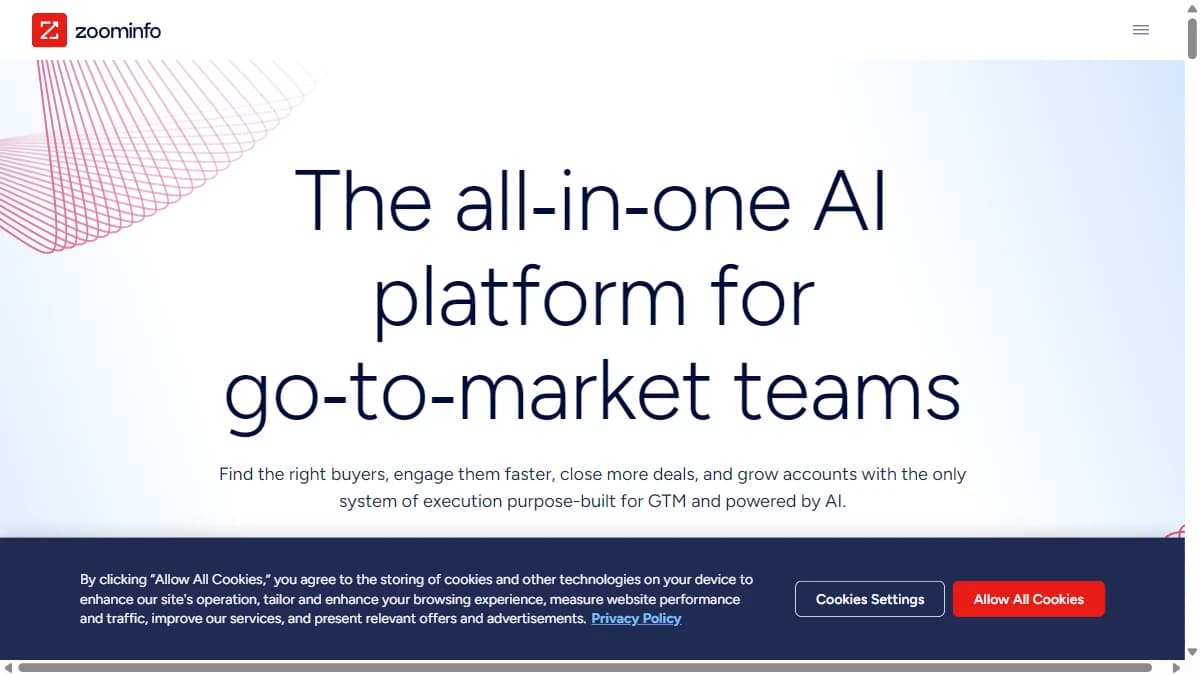
ZoomInfo — enterprise B2B intelligence with buyer intent signals across 500M+ contacts
ZoomInfo is the enterprise standard for B2B intelligence — 500M+ contacts and 100M+ companies, combined with AI-powered buyer intent signals. It is the polar opposite of DataMiner: a fully maintained, verified database instead of a DIY scraper.
The headline advantage is intent data. ZoomInfo tracks which companies are actively researching topics related to your product, so you reach accounts while they are in-market. DataMiner has no concept of intent — it only captures what is on a page right now.
The tradeoff is cost and commitment. ZoomInfo does not publish pricing; annual contracts typically start around $15,000 and climb sharply with seats and credits. For enterprise revenue teams, the data depth justifies it. For small teams, it is overkill.
Pros
- • 500M+ contacts and 100M+ companies — the deepest B2B database
- • Buyer intent data to prioritize in-market accounts
- • Org charts, scoops, and technographic detail beyond basic contacts
- • Mature CRM and workflow integrations for enterprise stacks
- • Fully verified data — no scraping, cleaning, or recipe maintenance
Cons
- • No public pricing — annual contracts from ~$15,000 require sales calls
- • Annual commitment only — no monthly or pay-as-you-go option
- • Far heavier than a small team scraping a few hundred pages needs
- • Credit limits and overage charges can escalate quickly
Best for: Enterprise revenue teams that need the deepest verified database plus intent data, and have the budget for an annual contract.
Pricing: Custom quote only. Annual contracts typically from ~$15,000/yr.
5. Hunter.io
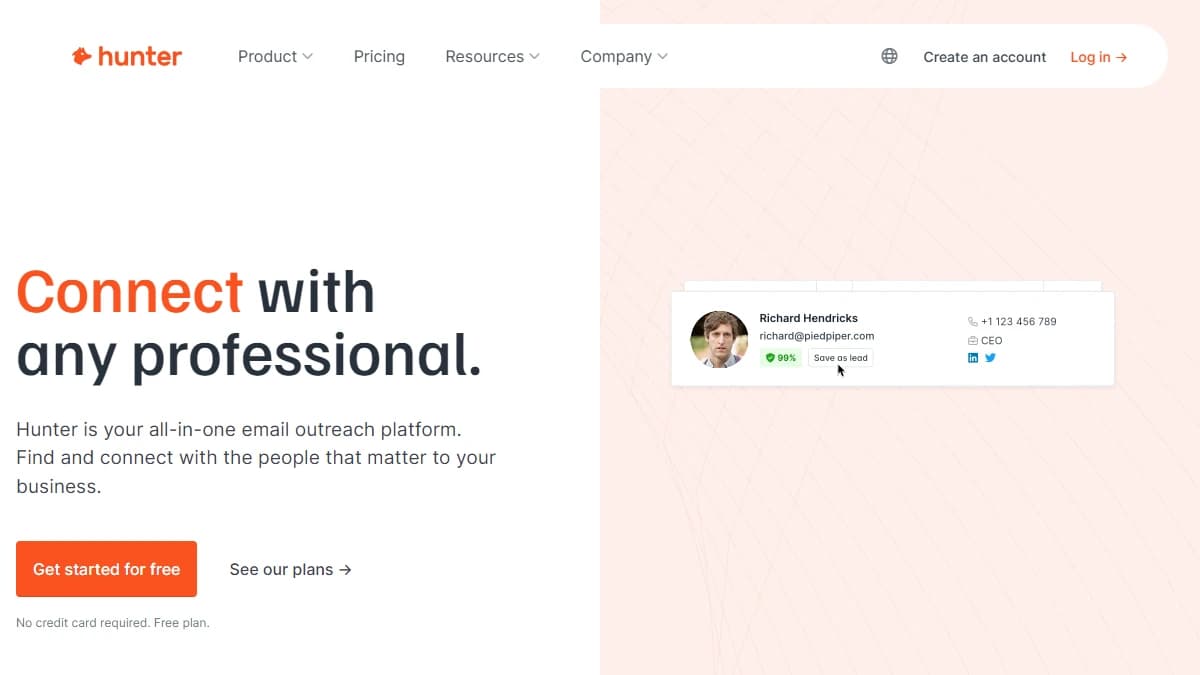
Hunter.io — domain search, email finder, and verified cold email campaigns
Hunter.io is a focused email finder — it locates and verifies professional email addresses from company domains, finds specific contacts by name and company, and validates deliverability before you send. It does one thing very well.
Hunter's Domain Search is the flagship: enter any company domain and get publicly discoverable professional email addresses with confidence scores. The Chrome extension works on LinkedIn and company sites for one-click lookups, and bulk search handles CSV uploads for list enrichment.
Unlike DataMiner's unverified scrapes, Hunter sources from publicly available web pages and verifies every address. According to Hunter's pricing page, the Starter plan at $34/mo (annual) includes 500 searches and 1,000 verifications per month, with unlimited team members on all plans.
Pros
- • Industry-leading Chrome extension for LinkedIn and website email lookup
- • Domain Search surfaces verified company emails in seconds
- • Built-in email verification — no separate validation tool needed
- • Transparent sourcing from public web pages — strong GDPR position
- • Free plan: 25 searches and 50 verifications/month, no card required
Cons
- • Email only — no phone numbers, firmographics, or technographics
- • No waterfall enrichment — single source means lower hit rate on hard contacts
- • Not a prospecting database — you need the domain to start
- • Campaign sequencing is basic versus dedicated outreach tools
Best for: Freelancers, link builders, and solo SDRs who need clean, verified emails from known company domains without complex setup.
Pricing: Free (25 searches/mo). Starter $34/mo (annual). Growth $69/mo (annual). Business $149/mo (annual).
6. Cognism
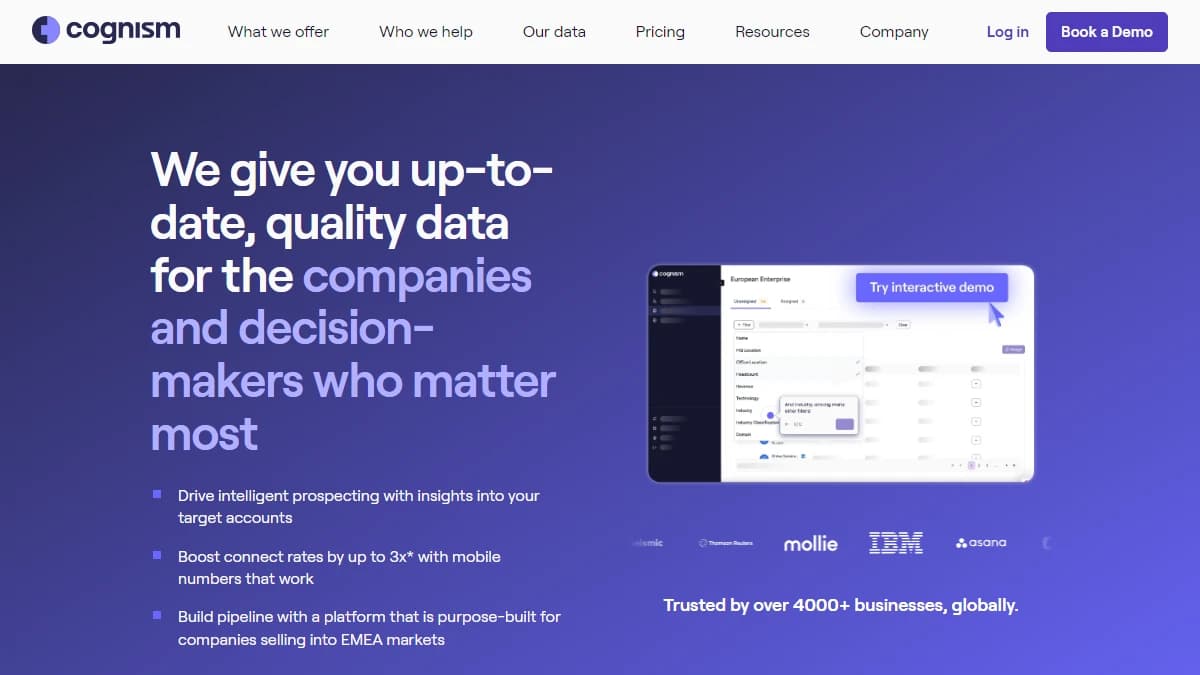
Cognism — phone-verified mobile numbers with GDPR and DNC screening built in
Cognism is a B2B data platform built for compliance-first markets. Its Diamond Data tier includes phone-verified mobile numbers — Cognism's research team manually calls numbers to confirm they reach the right person, then badges them as verified, claiming a 98% connect rate.
This is the strongest answer to DataMiner's biggest legal risk. Scraped data carries no consent layer and no DNC screening. Cognism screens against DNC lists across 14 countries, removing the compliance exposure that comes with cold-calling scraped phone numbers in the UK, DACH, France, or Nordics.
Cognism does not publish pricing. Annual contracts typically range from $15,000 to $60,000+ depending on seats, credits, and Diamond Data access. That puts it out of reach for small teams, but for enterprise EU and UK outbound, the compliance and connect-rate advantages justify the spend.
Pros
- • Diamond Data: phone-verified mobiles with a 98% claimed connect rate
- • DNC screening across 14 countries — removes scraping's compliance risk
- • Strongest phone coverage in UK, DACH, and Nordics
- • Intent data integration (Bombora) for in-market account identification
- • Chrome extension for LinkedIn-based real-time lookup
Cons
- • No public pricing — annual contracts from $15,000+ require sales calls
- • Diamond Data costs 30–50% more than the Platinum tier
- • US and APAC phone coverage thinner than UK and EU data
- • Annual contracts only — no monthly or pay-as-you-go option
Best for: Enterprise SDR teams doing high-volume phone outreach in GDPR-regulated markets — UK, DACH, France, and Nordics.
Pricing: Custom quote only. Annual contracts from $15,000/yr. Diamond Data adds 30–50% on top.
7. UpLead
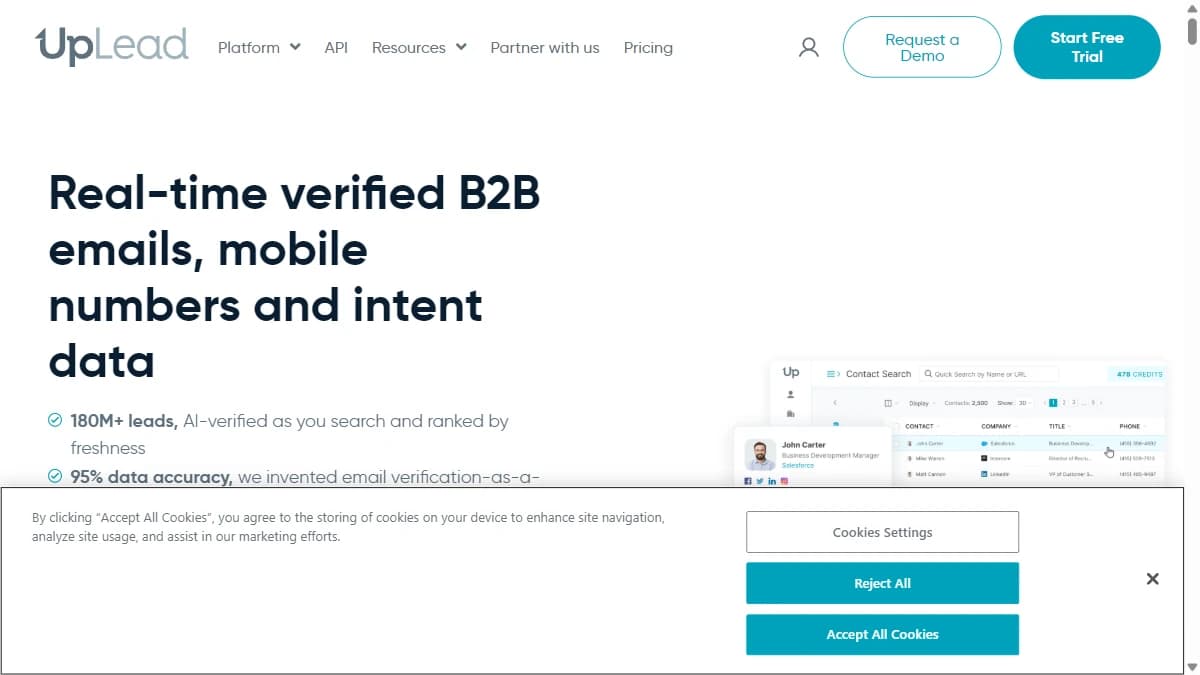
UpLead — real-time verified B2B contacts with a 95% accuracy guarantee
UpLead is a B2B contact database built around a single promise: verified data. Every email is checked in real time at the moment of export, backed by a 95% accuracy guarantee that credits you back for any bounce.
That guarantee is exactly what DataMiner cannot offer. Scraped data is unverified by definition, while UpLead validates on export so you only pay for contacts that actually land. Search 155M+ contacts across 50+ filters, including technographics and intent signals.
UpLead's Essentials plan starts at $99/mo for 170 credits, with each credit unlocking a full contact record. It is a clean, mid-market replacement for the scrape-and-verify grind, especially for North American data.
Pros
- • 95% accuracy guarantee with real-time email verification on export
- • 155M+ contacts with 50+ search filters
- • Technographic and intent data on higher tiers
- • Credit refund for any contact that bounces — no wasted spend
- • Simple, transparent monthly pricing
Cons
- • Single data source — no waterfall to recover missed contacts
- • Credit-based model gets expensive at high volume
- • International coverage weaker than North American data
- • No native outreach sequencing — export to a separate tool
Best for: Mid-market teams that want a verified, guaranteed-accurate contact database to replace scraping, especially for US prospecting.
Pricing: Free trial (5 credits). Essentials $99/mo. Plus $199/mo. Professional custom.
8. Lusha
Lusha — Chrome extension contact finder with strong B2B mobile coverage
Lusha is a contact finder built around a Chrome extension — the same one-click, browser-based feel DataMiner users are used to, but returning verified emails and direct-dial mobiles instead of raw page text.
Open a LinkedIn profile or company site and Lusha surfaces verified contact details on the spot. Where DataMiner scrapes whatever is visible, Lusha pulls from a maintained B2B database with a focus on mobile numbers — a gap most scrapers and even some databases leave open.
Lusha's free plan includes 5 credits per month. The Pro plan starts at $49/mo (annual) with 480 credits per year, plus a prospecting platform and basic CRM integrations. It is the lowest-friction upgrade for anyone who just wants quick, verified lookups.
Pros
- • Fast, intuitive Chrome extension — familiar one-click workflow
- • Strong direct-dial mobile coverage
- • Verified emails and phones, not raw scrapes
- • Bulk enrichment and CRM integrations on paid tiers
- • Free plan to test the data quality before paying
Cons
- • Credit limits run out fast on lower tiers
- • Single source — no waterfall enrichment
- • Firmographic depth lighter than ZoomInfo or SyncGTM
- • Outreach features are minimal compared to Apollo
Best for: Individual reps and small teams who want quick, verified contact lookups from a browser extension without setting up scraping recipes.
Pricing: Free (5 credits/mo). Pro $49/mo (annual). Premium $79/mo (annual). Scale custom.
Side-by-Side Comparison
| Tool | Starting Price | Free Tier | Verified Data | Waterfall | Native Outreach | Best For |
|---|---|---|---|---|---|---|
| SyncGTM | $49/mo | 200 credits | Yes | 50+ providers | Yes | Full B2B workflow |
| Apollo.io | $49/mo | 10,000 emails | Yes | No (single source) | Yes | All-in-one SDR |
| Explorium.ai | $29.99/pkg | 100-credit trial | Structured records | No (100+ sources, one API) | No | AI-agent prospecting |
| ZoomInfo | ~$15K/yr | No | Yes | No | Limited | Enterprise intent |
| Hunter.io | $34/mo | 25 searches | Yes | No | Basic campaigns | Email finding |
| Cognism | ~$15K/yr | No | Phone-verified | No | No | EU/UK compliance |
| UpLead | $99/mo | 5 credits | 95% guaranteed | No | No | US verified data |
| Lusha | $49/mo | 5 credits | Yes | No | Minimal | Quick lookups |
| DataMiner | $19.99/mo | 500 pages | No | No | No | Page scraping |
How to Choose the Right DataMiner Alternative
- You need verified contacts + outreach + CRM sync in one workflow: Choose SyncGTM. Waterfall enrichment across 50+ providers with buying signals and native CRM integrations eliminates the scrape-clean-verify chain DataMiner forces you to run.
- You need a searchable contact database with built-in sequences: Choose Apollo.io. The 275M+ database with native sequencing replaces scraping for contacts entirely.
- You want structured B2B data for scripts or AI agents instead of scrapes: Choose Explorium.ai. One API, a hosted MCP server, and 146M+ company records replace page recipes that break on every layout change.
- You are an enterprise team that needs intent data: Choose ZoomInfo. The deepest database plus buyer intent signals is worth the annual contract at scale.
- You need clean, verified emails from known domains: Choose Hunter.io. It is the most focused and GDPR-transparent email finder at its price point.
- You are cold calling in the UK, DACH, or Nordics: Choose Cognism. Phone-verified mobiles and DNC screening remove the compliance risk scraped phone data carries.
- You want a guaranteed-accurate US contact database: Choose UpLead. The 95% accuracy guarantee with credit refunds beats hoping a scrape is clean.
- You want quick browser lookups with strong mobile data: Choose Lusha. The Chrome extension keeps DataMiner's one-click feel but returns verified contacts.
Final Verdict
DataMiner is a solid general-purpose scraper for pulling tables off web pages. As a B2B prospecting tool, it falls short — it returns unverified data, has no API or proxy support, offers no outreach layer, and breaks every time a site changes its layout.
For most B2B sales teams, SyncGTM is the strongest replacement: waterfall enrichment across 50+ providers, 76+ data points per lead, buying signal detection, and native CRM integrations from $49/mo. It replaces the entire scrape-clean-verify-enrich-export chain with a single run.
Teams that want a searchable database with native sequences should evaluate Apollo.io at $49/mo. Builders who want structured data for scripts and AI agents should look at Explorium.ai from $29.99 per credit package. Enterprise teams should assess ZoomInfo, and EU/UK callers should evaluate Cognism.
The pattern is consistent across all eight alternatives: moving from DataMiner's scrape-and-clean model to a verified enrichment platform lowers effective cost per usable lead, raises hit rate and deliverability, and removes the friction between finding a contact and reaching them.
Read more in our guides to how waterfall enrichment works, the best Outscraper alternatives, and top waterfall contact providers for 2026.