Embers Review 2026: LinkedIn Engagement Signals Without Automation

By Kushal Magar · September 21, 2026 · 13 min read
Key Takeaway
Embers turns LinkedIn post likes, comment replies, competitor-profile activity, and tracked keywords into a scored lead queue — each entry shows an ICP-fit score, the evidence behind it, and a draft opener you edit and send yourself. It requires no LinkedIn password, cookies, or browser extension, and it never posts, comments, connects, or messages on your behalf. Plans start at $49/mo for 5 watched profiles and 10 keywords, scaling to $199/mo for 20 profiles — every plan is fully manual, so enrichment and follow-up sequencing still happen outside Embers.
This Embers review breaks down what actually happens after someone likes your LinkedIn post, replies to your comment, or posts about a phrase you're tracking. Embers scores that person against your ICP, shows the evidence behind the score, and drafts an opener — but it never sends anything for you. Our rating: 4.1/5.
The pitch behind Embers is that most warm LinkedIn leads get missed, not because they aren't there, but because nobody is watching the engagement feed closely enough to act on it.
Instead of scraping profiles or automating LinkedIn actions, Embers watches public engagement — post likes and comments, comment replies, competitor-profile activity, keyword mentions — and ranks the people behind it by fit and timing. No password, no browser extension, no login handover.
This review covers how the signal tracking actually works, the full pricing breakdown, the honest pros and cons, and how Embers stacks up against SyncGTM, Trigify, and Dux-Soup for teams building a warm LinkedIn pipeline in 2026.
What Is Embers?
Embers is a LinkedIn signal-monitoring tool built for founder-led and small B2B sales teams that already post and engage on LinkedIn but have no systematic way to act on who responds.
It sits upstream of outreach: Embers finds and ranks the people already engaging with your content or your market, and hands you a queue with the reasoning attached. What you do with that queue — enrich it, sequence it, ignore it — is entirely up to you.
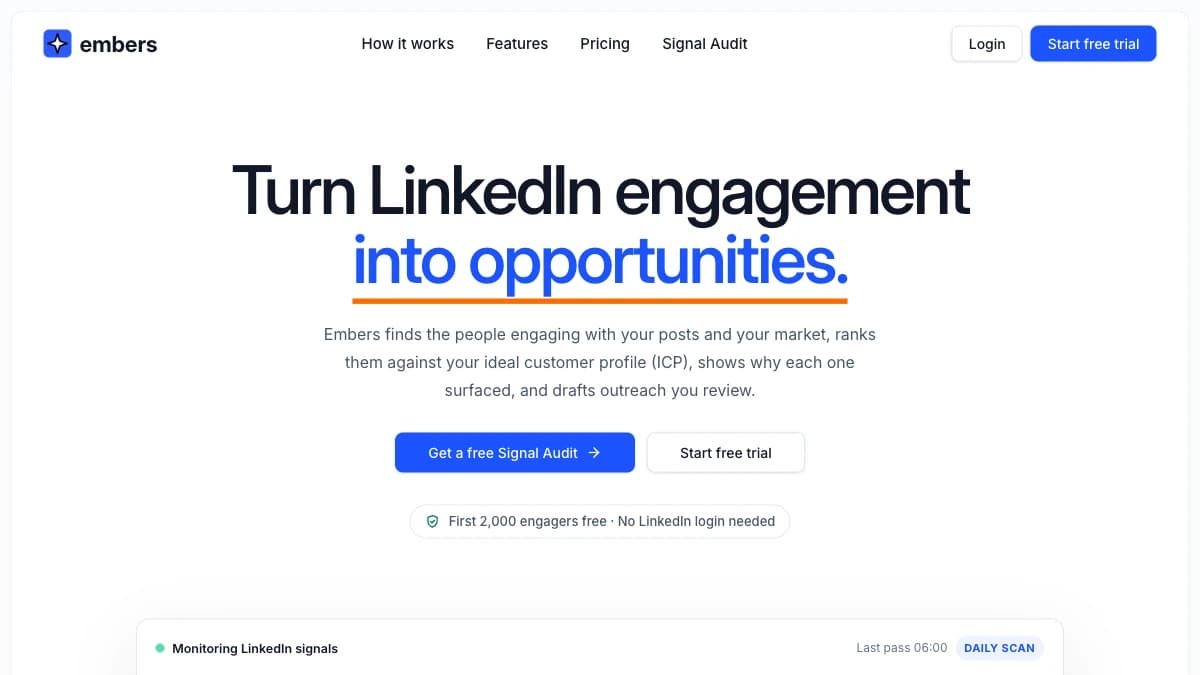
Embers' homepage — LinkedIn engagement signals turned into a prioritized, ICP-scored lead queue
The target user is a founder, an SDR, or a 1-10 person sales team running an engagement-first LinkedIn motion who wants a shortlist of warm names instead of a raw activity feed.
| Capability | What Embers Provides | Notable Gaps |
|---|---|---|
| Lead Discovery | Watches your posts, your comments, competitor or investor profiles, and tracked keywords for LinkedIn engagement. | Public LinkedIn signals only — no email, ad, or web-intent data. |
| ICP Scoring | 0-100 score per lead with fit, signal strength, recency, and exclusion reasoning shown alongside the evidence. | Scoring logic isn't independently auditable beyond what Embers surfaces. |
| Outreach Drafts | Editable opener grounded in the specific post, comment, or keyword match that triggered the lead. | Never sends — every message goes out from your own account, by hand. |
| Delivery | Slack, HubSpot, HeyReach, and signed webhooks on Solo and above. | No native email or dialer integration. |
| Reporting | Shareable engagement and ICP-match reports per period. | Covers signals, not pipeline or closed-revenue outcomes. |
How Embers Tracks LinkedIn Engagement Signals
Embers monitors four distinct LinkedIn signal sources: post engagement, comment engagement, watchlist tracking, and keyword tracking. Each one catches a genuinely different kind of buying intent.
1. Post engagement
Anyone who reacts to or comments on your own LinkedIn posts enters the queue. This is the most direct signal — they saw your content and chose to engage with it publicly.
2. Comment engagement
Embers also watches replies and reactions on comments you leave under other people's posts — including larger creators' content you don't control. If someone replies to your comment, that's a signal too.
3. Watchlist tracking
You can add any public profile — a competitor, an investor, an influencer, a teammate — and Embers surfaces the people engaging with their content, filtered against your ICP.
4. Keyword tracking
Embers monitors public posts for phrases your buyers use — a pain point, a tool name, a competitor mention — and surfaces the author as a lead when the phrase and the profile both match your ICP.
Every lead that surfaces carries source context: which post, comment, or keyword match caused them to enter the queue, plus an ICP score from 0-100 based on fit, signal strength, recency, and any exclusions you've set. That evidence trail is what turns a noisy engagement feed into something you can act on — a pattern covered in more depth in our guide to turning LinkedIn post engagement into warm leads.
Embers Pricing: Plans, Credits, and What You Actually Pay
Embers costs $49/month for Solo, $99/month for Growth, and $199/month for Enterprise, with a $999/month Signal War Room tier above that. Full pricing is public with no hidden enterprise-only tier for the core product — everything except Agency and Signal War Room is a flat monthly rate.
There is no free plan. The trial covers your first 2,000 engagers over 7 days and requires a payment method before you start, so a real evaluation means committing to a card first.
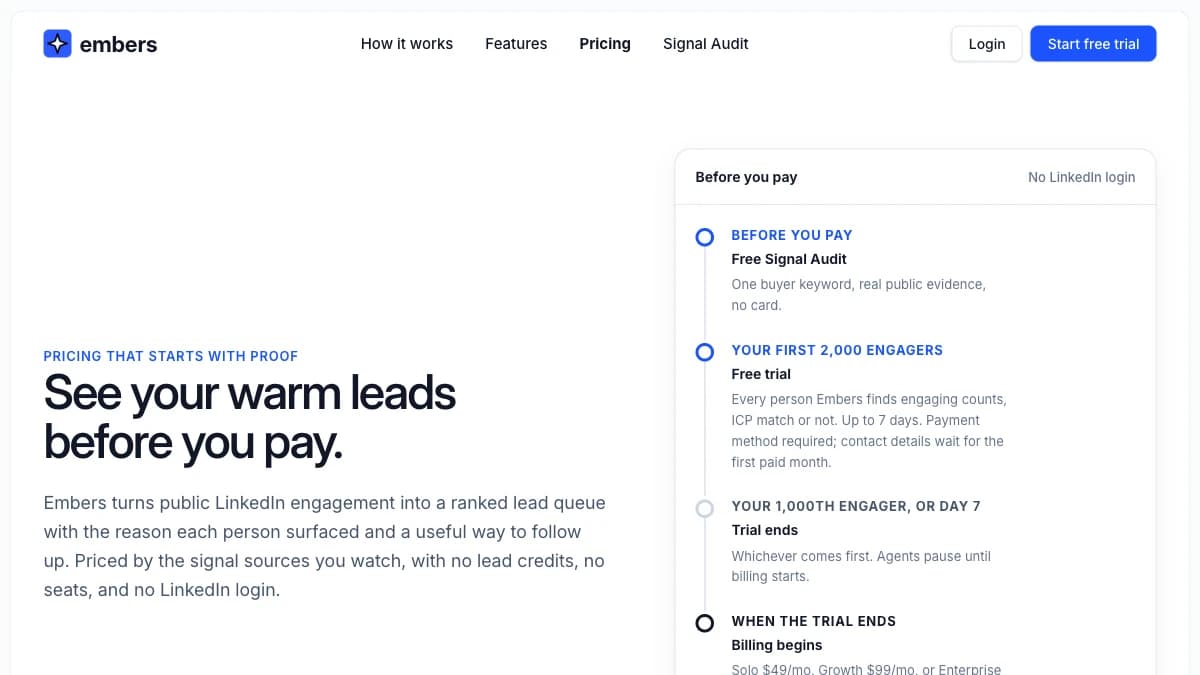
Embers pricing — Solo, Growth, Enterprise, Agency, and Signal War Room tiers
| Plan | Monthly Price | Members | What You Get |
|---|---|---|---|
| Solo | $49/mo ($39/mo billed annually) | 1 member | 5 watched profiles, 10 keywords, signed webhooks, standard support |
| Growth | $99/mo ($79/mo billed annually) | Unlimited members | 10 watched profiles, 25 keywords, priority support |
| Enterprise | $199/mo ($159/mo billed annually) | Unlimited members | 20 watched profiles, 50 keywords, dedicated onboarding |
| Agency | Custom | Unlimited per client workspace | 20 profiles and 50 keywords per client, dedicated onboarding |
| Signal War Room | $999/mo | Custom scope | Signal coverage scoped with the Embers team, weekly signal review |
The real cost math
Growth at $99/month (or $79/month billed annually) is the practical starting point for most teams — Solo's 10 keywords and 5 watched profiles get tight fast once you're tracking your own posts plus two or three competitors.
Every tier is priced on watched profiles and keywords, not on leads generated, so cost doesn't scale with pipeline the way it would with a per-lead or per-credit model. For teams that want enrichment and sequencing priced alongside signal tracking, it is worth comparing against SyncGTM pricing, which bundles signals, waterfall enrichment, and outreach from $99/month.
Embers Key Features
- Four signal sources. Post engagement, comment engagement, watchlist tracking on any public profile, and keyword tracking across public posts — detailed on Embers' features page.
- Explainable ICP scoring. Every lead gets a 0-100 score plus the specific fit, recency, and signal-strength reasoning behind it — not a black-box number.
- Source-grounded drafts. The suggested opener references the exact post, comment, or keyword match that surfaced the lead, editable before you send it.
- Delivery integrations. Push qualified leads to Slack, HubSpot, HeyReach, or a signed webhook carrying name, title, company, score, and ICP match status.
- Shareable pipeline reports. Track total engagements, unique engagers, ICP-matched engagers, and match rate over a given period.
- Zero account handover. No LinkedIn password, no session cookies, no Chrome extension — Embers never takes an action on LinkedIn on your behalf.
Embers Pros: What It Does Well
- ✓Genuinely low account risk. No password, cookies, or extension means nothing for LinkedIn's automation detection to flag — a real advantage over browser-automation tools.
- ✓Four signal types, not one. Post engagement, comment replies, competitor watchlists, and keyword tracking cover more ground than a single-signal engagement tool.
- ✓Explainable, not a black box. Every score comes with the evidence and reasoning behind it, so you can sanity-check the queue instead of trusting it blindly.
- ✓Fits an existing workflow. Slack, HubSpot, HeyReach, and webhook delivery mean the queue shows up where your team already works, not in a new inbox to check.
- ✓Visible signal ROI. Shareable engagement and match-rate reports make it easy to show a founder, a client, or a teammate that the signal is real.
Embers Cons: Where It Falls Short
- Every message is manual. Embers drafts an opener grounded in the engagement, but it never sends anything — you copy, paste, and send from your own LinkedIn account for every single lead.
- No real free tier. The trial requires a card on file and caps out after your first 2,000 engagers over 7 days, so a full evaluation means paying first.
- Pricing scales on watched profiles and keywords, not leads. Solo's 5 profiles and 10 keywords is thin if you're tracking your own posts plus a few competitors and a handful of buyer phrases at once.
- LinkedIn is the only signal surface. There's no email, website, or firmographic signal layer — Embers is one input to a pipeline, not a full prospecting stack.
- No built-in contact enrichment. Embers surfaces the LinkedIn profile and company context, but a verified email or phone still requires a separate tool once a lead is worth pursuing off-platform.
- Signal War Room jumps to $999/mo from Enterprise's $199/mo. The public pricing page doesn't spell out exactly what changes beyond scoped coverage and a weekly review call, which makes a 5x jump hard to evaluate from outside.
Embers vs SyncGTM vs Trigify vs Dux-Soup
Four different archetypes show up when teams compare Embers: manual signal tracking (Embers), signals plus enrichment and sequencing (SyncGTM), broader social-selling signals (Trigify), and browser automation (Dux-Soup). Here is how they stack up.
| Feature | Embers | SyncGTM | Trigify | Dux-Soup |
|---|---|---|---|---|
| Starting Price | $49/mo ($39/mo billed annually) | $99/mo (free trial available) | From $49/mo | From ~$14.99/mo |
| Signal Sources | Post engagers, comment repliers, watchlist profiles, keyword mentions | Post engagers plus 15 intent signals — funding, hiring, tech change, job change | Social selling signals across LinkedIn | None — it automates actions, it doesn't track signals |
| LinkedIn Login Required | No — public data only, no password or extension | No — API-based, no personal login handover | No — signal-based tracking | Yes — Chrome extension runs inside your logged-in session |
| Sends Actions For You | Never — drafts an opener, you send it | N/A — enrichment and sequencing layer | N/A — signal tracking only | Yes — auto-visits, auto-connects, auto-messages |
| Contact Enrichment | LinkedIn profile and company context only | 76+ data points via waterfall across 50+ providers | Limited | None |
| Outreach Sequencing | None — manual, one lead at a time | Native multichannel sequences | None | Built-in LinkedIn automation (that is the product) |
| Best Fit | Founder-led teams wanting a safe, manual signal queue | Teams that want signals, enrichment, and sequencing in one place | Teams wanting broader social-selling signals | Teams accepting account risk for connection volume |
The honest take on each option
Emberswins on safety and simplicity. If your LinkedIn motion is engagement-first and you want a scored queue without touching your account's automation risk, it does exactly that job well.
SyncGTM is the upgrade path once the manual send step and the missing enrichment layer become the bottleneck. It tracks post engagers and 15 intent signals per account, enriches each lead with 76+ data points across a 50+ provider waterfall, and can push qualified leads directly into an email or LinkedIn sequence — closing the exact gap Embers leaves open between a scored lead and a sent message.
Trigifycovers a wider band of social-selling signals across LinkedIn, which suits teams that want breadth over Embers' more tightly scoped four-source model. Read our full Trigify review for the detailed breakdown.
Dux-Soup sits at the opposite end of the risk spectrum entirely — it automates profile visits, connection requests, and messages from inside your logged-in session. It moves faster at volume, but it is the kind of browser automation that Embers was explicitly built to avoid. Teams weighing that trade-off should also see our roundup of LinkedIn outreach tools ranked by safety.
Want a longer shortlist before you commit? See our full breakdown of 5 Embers alternatives for LinkedIn signal prospecting.
Who Should Use Embers?
Embers fits a specific motion well: you post or comment on LinkedIn regularly, you want to know who is engaging and whether they match your ICP, and you are comfortable sending every message yourself.
Use Embers if:
- You run a founder-led or small-team LinkedIn motion and post or comment often enough to generate real engagement.
- Account safety matters more than speed — you don't want to hand over a password, cookies, or install an extension.
- You want an explainable, evidence-backed queue rather than a raw notifications feed.
- Manual, personalized sends are your actual outreach style, not a bottleneck you're trying to remove.
Do not rely on Embers alone if:
- You need automated sequencing once a lead is qualified — Embers stops at the draft.
- Your buying signals live outside LinkedIn — funding, hiring, tech changes, or website intent.
- You need verified email or phone data — Embers surfaces the LinkedIn profile, not a waterfall-enriched contact record.
- You're scaling outbound past a handful of conversations a week, where a platform like SyncGTM that pairs signals with enrichment and sequencing removes the manual step entirely.
Embers Review: Frequently Asked Questions
What is Embers and how does it work?
Embers is a LinkedIn signal-monitoring tool that watches four sources — reactions and comments on your own posts, replies and reactions on comments you leave, activity on a watchlist of public profiles (competitors, investors, influencers), and public posts that mention keywords you track. Every person who shows up gets scored 0-100 against your ICP based on fit, signal strength, recency, and any exclusions you set, alongside the specific post, comment, or mention that triggered the match. Embers then drafts an editable opener grounded in that context, which you review and send yourself from your own LinkedIn account. It reads public LinkedIn activity only — it does not request your password, browser cookies, or a Chrome extension, and it never posts, comments, connects, or messages on your behalf.
How much does Embers cost?
Embers has four standard plans plus a premium tier. Solo runs $49/month ($39/month billed annually) for 5 watched profiles and 10 keywords. Growth is $99/month ($79/month annually) for 10 profiles and 25 keywords with unlimited team members. Enterprise is $199/month ($159/month annually) for 20 profiles and 50 keywords with dedicated onboarding, and Agency is custom-priced per client workspace. Signal War Room, a white-glove tier with a weekly signal review from the Embers team, runs $999/month. There is no free plan — the trial covers your first 2,000 engagers over 7 days and requires a payment method up front.
Is Embers safe to use with my LinkedIn account?
Yes, by design. Embers does not ask for your LinkedIn password, does not install a browser extension, and does not use your session cookies — it reads publicly available engagement data through its own monitoring layer. That is a meaningfully lower account-risk profile than browser-automation tools like Dux-Soup or PhantomBuster, which run inside your logged-in session and can trigger LinkedIn's automation-detection systems. Because Embers never takes an action on LinkedIn itself — no auto-connects, no auto-messages, no auto-comments — there is nothing for LinkedIn to flag as bot behavior on your account.
Does Embers send connection requests or messages automatically?
No. Embers explicitly does not send connection requests, messages, comments, or reactions on LinkedIn under any plan. What it does is draft a first message grounded in the specific engagement — the post someone liked, the comment they left, the keyword phrase they used — and hand it to you as an editable draft. You copy it, review it, and send it yourself from your own LinkedIn account, one lead at a time. That is the trade-off at the center of this Embers review: the signal detection and ICP filtering are automated, but every send is still a manual step.
What's the best Embers alternative for teams that want automated follow-up?
If the manual-send model in Embers becomes the bottleneck, SyncGTM is the closest alternative that keeps the same no-login, no-scraping posture while adding what Embers leaves out: contact enrichment and multichannel sequencing. SyncGTM tracks post engagers and 15 intent signals per account, then enriches each lead with 76+ data points through a waterfall across 50+ providers and can hand qualified leads straight to an email or LinkedIn sequence — no copy-paste required. It costs more to start ($99/month versus $49/month), but it replaces two or three tools (signal tracking, enrichment, sequencing) instead of one.
Is Embers worth it for a solo founder or small team?
For a founder-led team running LinkedIn as a primary channel, Embers is a genuinely useful, low-risk way to stop guessing who to message. The ICP scoring and evidence trail turn a noisy engagement feed into a short, ranked queue, and the zero-login model means there is no account-suspension risk to weigh against the cost. The catch is volume: at Solo's 5 profiles and 10 keywords, and with every send still manual, it fits a founder or a one-to-two-person sales motion better than a team trying to scale outbound past a few dozen conversations a week.