

7 Best Fiber AI Alternatives for B2B Enrichment in 2026

By Kushal Magar · June 4, 2026 · 13 min read · Last updated: September 28, 2026
Key Takeaway
Fiber AI is a developer-first data API built for AI agents — not for SDR teams that need self-serve prospecting, built-in sequences, and outreach in one tool. The 7 alternatives below cover every budget and use case. SyncGTM is the only one that combines waterfall enrichment (50+ providers) with integrated outreach under a single subscription.
TL;DR
Fiber AI is a real-time B2B data API that starts at $300/month and is designed for developers building AI agents — not for revenue teams that need a self-serve interface and outreach in one platform. If you need better coverage, lower cost, or a tool your SDRs can actually use without engineering support, one of the seven alternatives below is the right pick.
| Tool | One-Line Verdict |
|---|---|
| SyncGTM | Best overall — waterfall enrichment from 50+ providers, 76+ data points per lead, and built-in outreach from $49/mo. |
| Apollo.io | Best self-serve all-in-one — 275M+ contact database, sequences, dialer, and a free tier. |
| Explorium.ai | Best API-first swap — B2B data for AI agents via a REST API and MCP server, with credit packages from $29.99. |
| ZoomInfo | Best for enterprise North America data — 260M+ profiles, intent signals, and deep CRM integration. |
| Cognism | Best for EMEA and GDPR-compliant outbound — Diamond Data verified mobile numbers across Europe. |
| Lusha | Best for quick contact lookup — Chrome extension, 45M+ profiles, and a free tier with 5 credits/month. |
| UpLead | Best for accuracy guarantee — 95% verified email promise with real-time verification at point of export. |
Why Teams Look for Fiber AI Alternatives
Fiber AI covers 40M+ active companies, 850M+ professionals, and 30M+ job listings — impressive breadth for an AI-native data layer. It serves enterprise customers like Docusign, HubSpot, and Ramp that need real-time LinkedIn data and advanced search endpoints not available on other platforms.
The friction shows up in three places. First, pricing: Fiber AI's plans run $300–$2,400/month before enterprise tiers. Second, UX: the product is API-first — there is no self-serve prospecting dashboard your SDR team can log into and start building lists. Third, enrichment model: Fiber AI is a single-source data layer. Teams that need a waterfall enrichment model — where Provider A's misses are caught by Provider B, then C — have to build that themselves on top of Fiber AI's API.
According to G2's 2026 sales intelligence category data, the top reasons teams switch from premium B2B data APIs are cost-per-enriched-contact, integration complexity, and the need for outreach tooling bundled into the same platform. All seven alternatives below address at least one of those gaps. See also our full roundup of the best waterfall contact providers.
1. SyncGTM
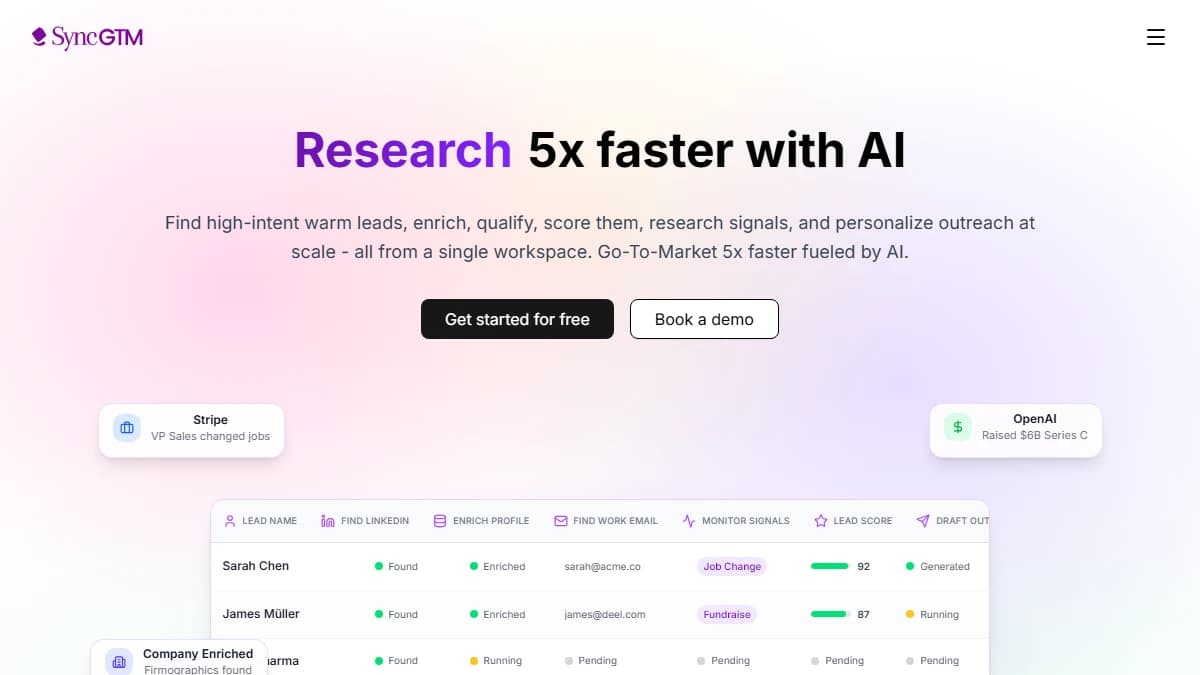
SyncGTM — waterfall enrichment across 50+ providers with built-in outreach and 76+ data points per lead
SyncGTM is a B2B enrichment and outreach platform that fixes the two core gaps Fiber AI leaves open for sales teams: it runs waterfall enrichment (not single-source API lookups) and it ships with built-in outreach so the enrichment data feeds directly into sequences.
Where Fiber AI queries one data layer and returns what it finds, SyncGTM chains 50+ providers in sequence — if Provider A misses the email, Provider B tries, then C, until the record is verified or exhausted. According to internal SyncGTM data, waterfall enrichment delivers 30–40% higher contact hit rates than single-source tools on the same prospect lists.
Each enriched lead returns 76+ data points: verified email, mobile direct dial, firmographics (revenue, headcount, tech stack), buying signals (job changes, funding rounds, hiring spikes), and social profiles. The outreach layer is included — LinkedIn sequences, email cadences, and CRM sync run from the same dashboard. This is the tool-stack Fiber AI users typically build by adding two or three additional platforms on top.
For teams already familiar with enrichment workflows, the sign-up enrichment workflow shows exactly how SyncGTM auto-enriches inbound leads the moment they submit a form — a workflow Fiber AI's API can power only with significant engineering overhead.
Pros
- Waterfall enrichment from 50+ providers — highest contact hit rate in the category
- 76+ data points per lead including mobile direct dials and buying signals
- Built-in outreach removes the need for a separate sequencing tool
- No-code interface — SDRs use it without API configuration or engineering support
- Native CRM sync pushes enriched records directly to HubSpot, Salesforce, and Pipedrive
- Free tier available — no upfront cost to test coverage
Cons
- No raw API for custom agent integrations — not a like-for-like Fiber AI replacement for developer teams
- Smaller brand awareness than Apollo or ZoomInfo in legacy procurement decisions
Best for: Revenue teams that need verified contact data at scale with enrichment and outreach under one subscription.
Pricing: Free tier available. Paid plans from $49/mo.
2. Apollo.io
Apollo.io — 275M+ contact database with email sequences, dialer, LinkedIn automation, and a free tier
Apollo.io is the most popular self-serve alternative to Fiber AI — a 275M+ contact database bundled with email sequences, a dialer, and LinkedIn automation on one subscription.
Apollo flips the Fiber AI model entirely. Where Fiber AI is API-first and designed for engineering teams building AI agents, Apollo is UI-first — an SDR can filter by job title, company size, technology stack, and funding stage, then push matching contacts directly into a sequence without writing a line of code.
The free tier makes Apollo the lowest-risk trial. Ten thousand records per month plus basic email sequences at $0 covers most individual SDRs before requiring a paid plan. The biggest tradeoff versus Fiber AI is data recency — Apollo updates its database monthly, while Fiber AI fetches live LinkedIn data. For most outbound workflows, monthly freshness is sufficient.
Pros
- Free tier with 10,000 records/mo — zero cost to start
- 275M+ contact database with email, phone, and LinkedIn data
- Native email sequences, dialer, and LinkedIn automation in one platform
- Advanced search filters including tech stack, buyer intent, and company signals
- Strong native CRM sync for HubSpot and Salesforce
Cons
- Single-source enrichment — lower mobile direct-dial hit rates than waterfall tools
- International data quality weaker outside North America
- Monthly database updates versus Fiber AI's real-time LinkedIn fetching
- Per-export credit model becomes expensive at high volumes
Best for: Founders and small teams that need a contact database plus sequences at the lowest upfront cost.
Pricing: Free (10k records/mo). $59/user/mo (Basic). $99/user/mo (Professional).
3. Explorium.ai
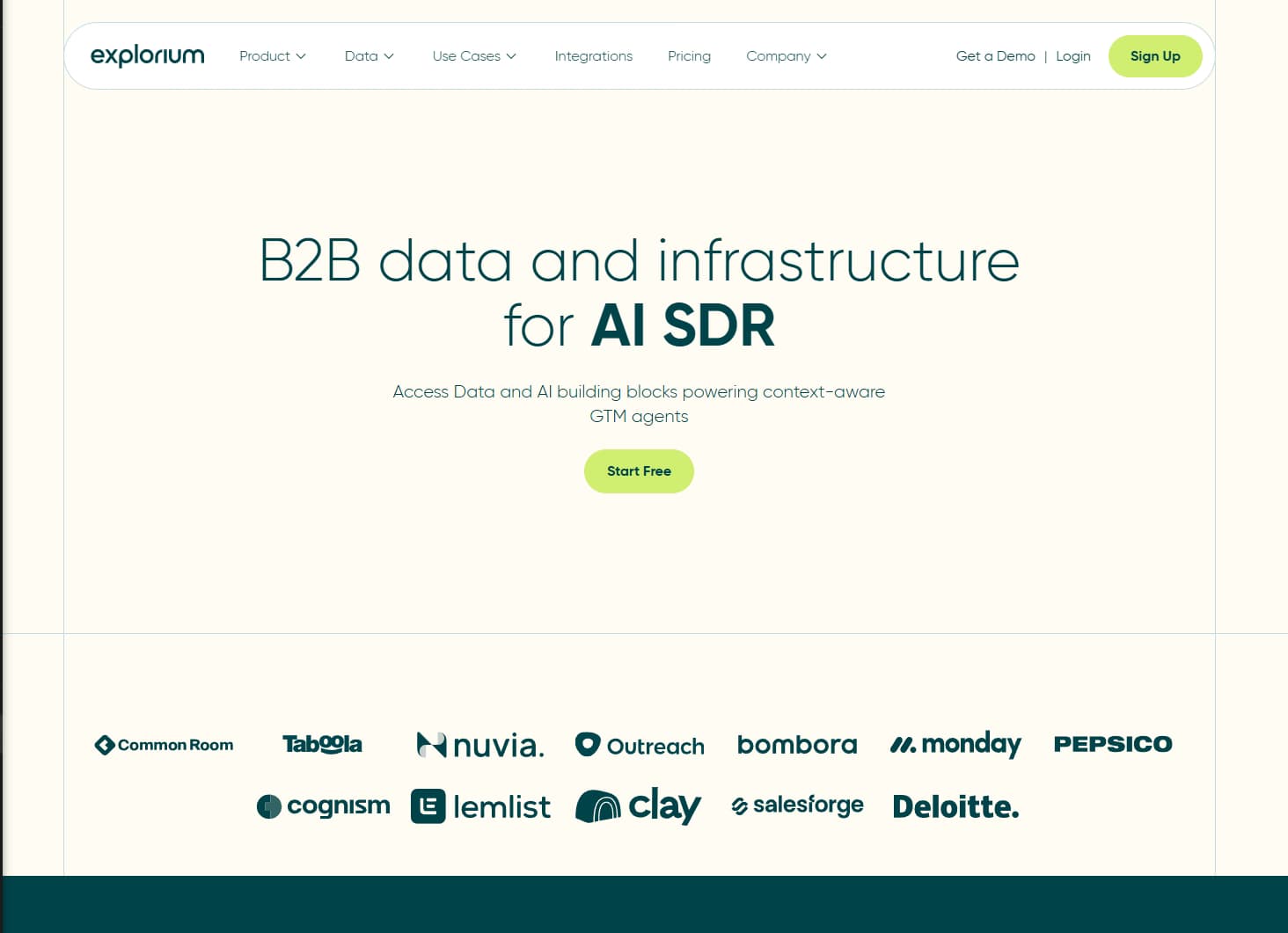
Explorium.ai — B2B data foundation for AI agents with one REST API, a hosted MCP server, and a no-code prospecting app
Explorium.ai is the closest like-for-like Fiber AI alternative on this list. Both are B2B data layers built for AI agents, but Explorium starts with a 100-credit free trial and $29.99 credit packages instead of a $300/month plan. Its AgentSource product is one REST API plus a hosted MCP server that resolves, fetches, enriches, and monitors company and prospect data.
Coverage is broad: 146M+ companies, 767M+ professional profiles, and 4,000+ data signals from 100+ sources. Events cover funding rounds, job changes, hiring, and tech changes, so an agent can react to a signal instead of re-pulling a static list. Teams building on Claude can install the AgentSource plugin for Claude Code, and the Vibe Prospecting app gives non-engineers a plain-English way into the same data.
The tradeoff is the same one Fiber AI has: Explorium is a data layer, not an outbound platform. There is no sequencer, inbox, or dialer, and each enrichment costs 1 to 5 credits depending on type. If hit rate matters more to you than API access, compare it with the multi-provider model in our waterfall enrichment explainer before you choose.
Pros
- One REST API and a hosted MCP server built for AI agents
- 146M+ companies and 767M+ professional profiles with 4,000+ data signals
- Real-time events for funding rounds, job changes, hiring, and tech changes
- Credit packages from $29.99 — a far lower entry cost than Fiber AI's $300/mo
- Vibe Prospecting app gives non-engineers a no-code way into the same data
Cons
- No native outreach layer — requires an external sequencer
- API and MCP paths assume some technical comfort
- Credit cost varies by enrichment type (1-5 credits per record)
- Paid credits expire after 12 months
Best for:Developer and GTM engineering teams building AI SDRs or agents that need a company and prospect data API without Fiber AI's $300/month floor.
Pricing: Free trial (100 credits). $29.99 (Lite, 500 credits). $149.99 (Starter, 5,000 credits). $749.99 (Growth, 30,000 credits). Custom enterprise.
4. ZoomInfo
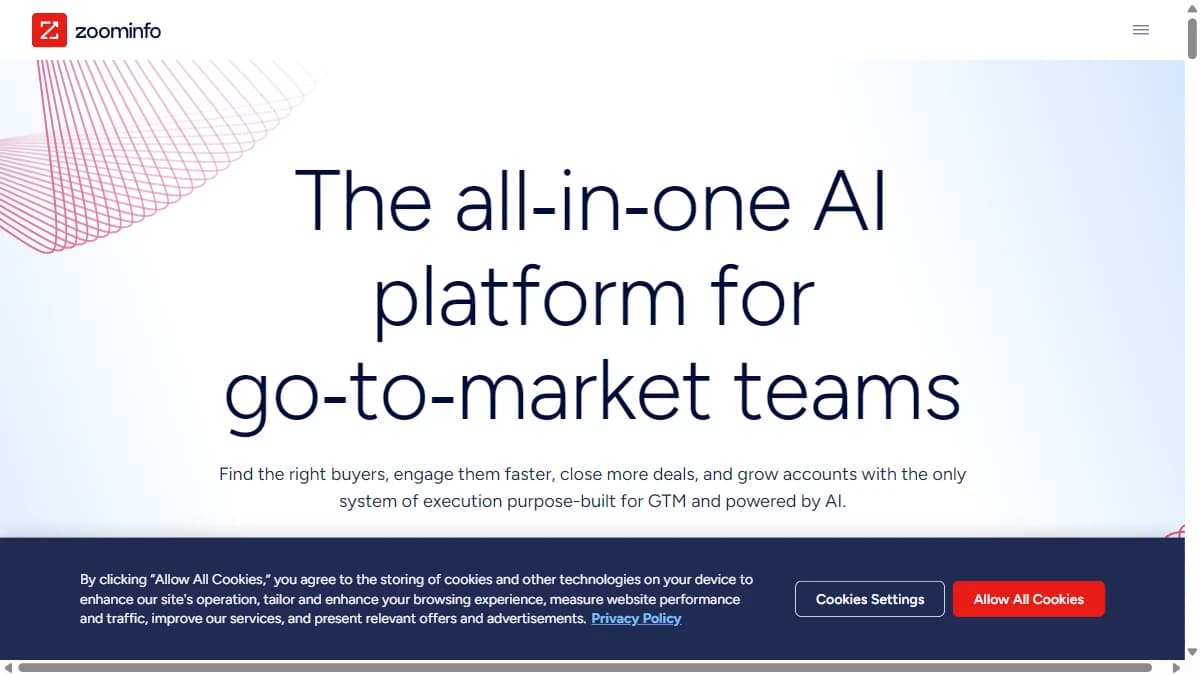
ZoomInfo — 260M+ professional profiles with intent data, website visitor ID, and deep enterprise CRM workflows
ZoomInfo is the enterprise-grade Fiber AI alternative — a 260M+ professional profile database paired with intent data, website visitor identification, and deep workflow automation for large revenue teams.
ZoomInfo's data depth is its standout for North American B2B. The platform combines contact data with company-level signals: technology install data, hiring signals, funding events, and third-party intent from 300+ publisher sites. These are the same types of signals Fiber AI provides via its agentic search endpoints, but packaged into a self-serve platform with a complete sales workflow layer.
The main friction is price. ZoomInfo's contracts typically start at $15,000/year and scale quickly with seat count and feature tiers. For teams coming from Fiber AI's $300–$2,400/month API, ZoomInfo can represent a meaningful budget increase — justified for enterprise teams running high-volume outbound across large SDR teams.
Pros
- 260M+ professional profiles — deepest North America B2B database in the market
- Intent data from 300+ publisher sites for buyer-signal-based targeting
- Website visitor identification to surface anonymous inbound traffic
- Deep CRM integrations with Salesforce, HubSpot, and Marketo
- Complete sales workflow platform — prospecting, enrichment, and sequences in one
Cons
- Annual contracts from $15,000/year — among the most expensive in the category
- International data quality significantly weaker outside North America
- Slow contract and procurement process — not suitable for small teams that need to move fast
- Single-source enrichment — no waterfall model for missed contact records
Best for: Enterprise sales teams running high-volume outbound in North America that need intent data and deep CRM automation.
Pricing: Custom. Typically starts at $15,000/year. Free trial available.
5. Cognism
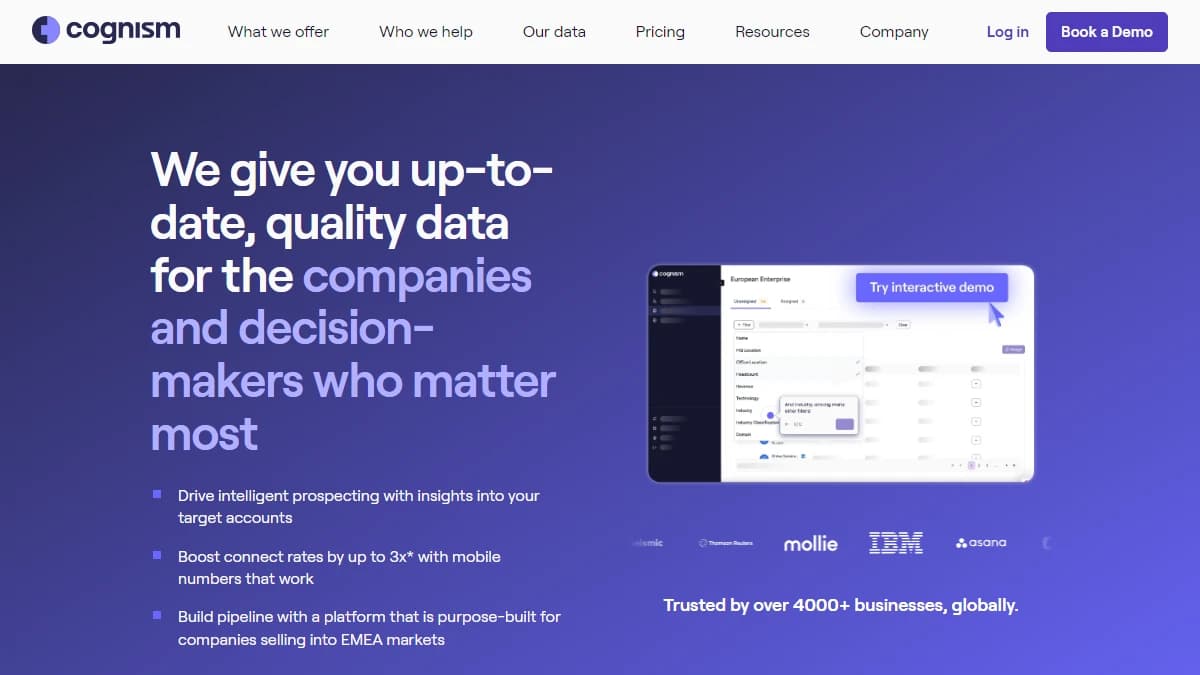
Cognism — GDPR-compliant B2B data with Diamond Data verified mobile numbers across EMEA and North America
Cognism is the Fiber AI alternative for revenue teams that need GDPR-compliant international data — particularly phone-verified mobile numbers in Europe where cell-phone data quality from US-based tools falls sharply.
Cognism's differentiator is Diamond Data: a subset of mobile numbers that are human-verified and confirmed opt-out checked before delivery. According to Cognism's published data, Diamond Data numbers deliver 3x higher connect rates compared to standard mobile data from US-focused providers like Apollo or ZoomInfo. For EMEA outbound teams dialing into the UK, Germany, France, and DACH markets, this is the largest practical gap between Cognism and its competitors.
Like ZoomInfo, Cognism is enterprise-priced. Contracts typically land between $15,000 and $60,000 per year depending on seat count and data volume. The platform includes a Chrome extension for LinkedIn prospecting, a self-serve search interface, and CRM integrations — no API configuration required.
Pros
- Diamond Data — human-verified mobile numbers with 3x higher EMEA connect rates
- GDPR-compliant by design — DNC list checked, suppression list management built in
- Strong EMEA data coverage across UK, DACH, France, Nordics, and Benelux
- Chrome extension for LinkedIn prospecting without leaving the browser
- Intent data (Bombora partnership) for buyer signal targeting
Cons
- Enterprise pricing — typically $15,000–$60,000/year, not suitable for startups
- North America data is thinner than ZoomInfo for US-focused outbound teams
- No native email sequencing — requires an external outreach tool
- Single-source enrichment — no waterfall for missed records
Best for: Mid-market and enterprise teams running outbound into EMEA markets that need verified mobile numbers and GDPR compliance.
Pricing: Custom. Typically $15,000–$60,000/year. Demo required.
6. Lusha
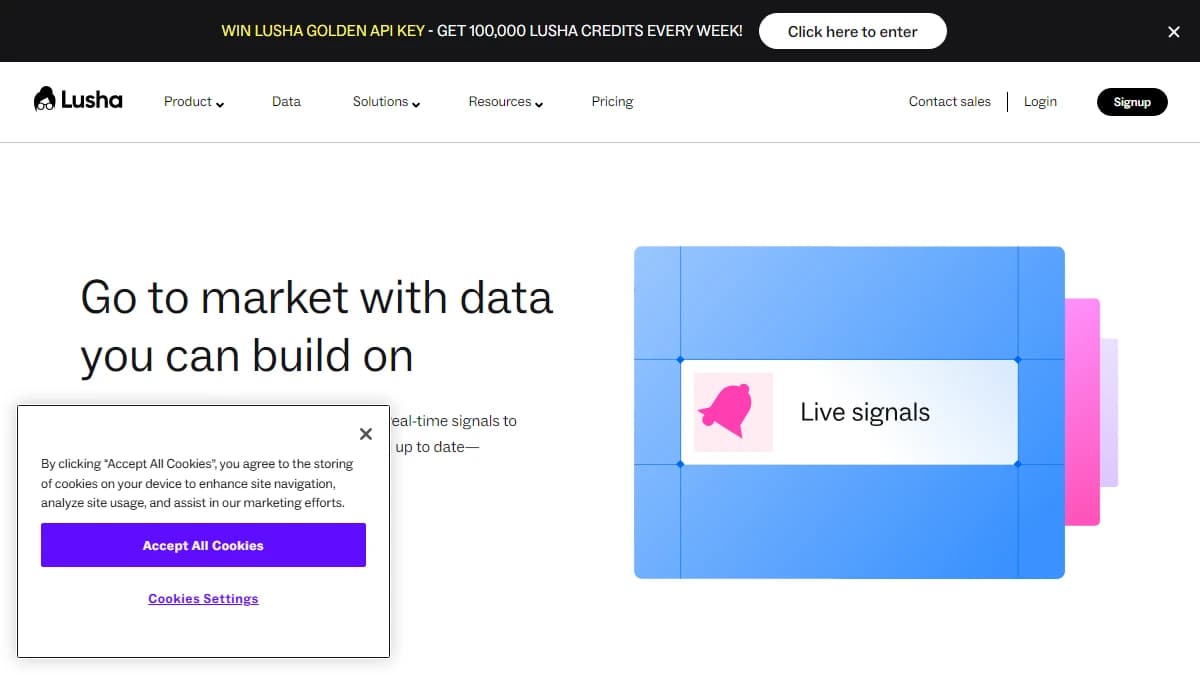
Lusha — 45M+ business profile database with a Chrome extension for instant contact lookup on LinkedIn
Lusha is the lightweight Fiber AI alternative for teams that need fast, on-demand contact lookup without committing to an enterprise contract or API integration.
Lusha's core workflow is simple: install the Chrome extension, navigate to a LinkedIn profile, and the phone number and verified email surface in a sidebar overlay. With a 45M+ business profile database, Lusha covers most North American and Western European B2B contacts that active SDRs encounter in daily prospecting. The self-serve interface means zero API or technical setup.
The free tier makes Lusha accessible for individual contributors: 5 credits per month at no cost, enough to verify a few prospect records before committing. The main limitation versus Fiber AI is data depth — Lusha returns contact details but not the advanced firmographic signals (funding, headcount trends, hiring velocity) that Fiber AI's agentic endpoints surface. See also our Lusha alternatives comparison for more options at this price point.
Pros
- Chrome extension for instant contact lookup on LinkedIn and company websites
- Free tier with 5 credits/month — zero commitment to test coverage
- Simple self-serve interface — no API, no configuration, no engineering
- 45M+ business profiles with direct dials and verified emails
- Team plan with shared credit pools and usage analytics
Cons
- No waterfall enrichment — single-source database with missed-record gaps
- Thinner data for APAC and emerging markets compared to Fiber AI's global index
- No native outreach sequences — contact export only
- Credit model becomes expensive for high-volume list building at $49+/mo per seat
Best for: Individual SDRs and small teams that need quick, on-demand contact lookup without enterprise pricing or API integration.
Pricing: Free (5 credits/mo). $49/user/mo (Pro). $79/user/mo (Premium). Custom enterprise.
7. UpLead
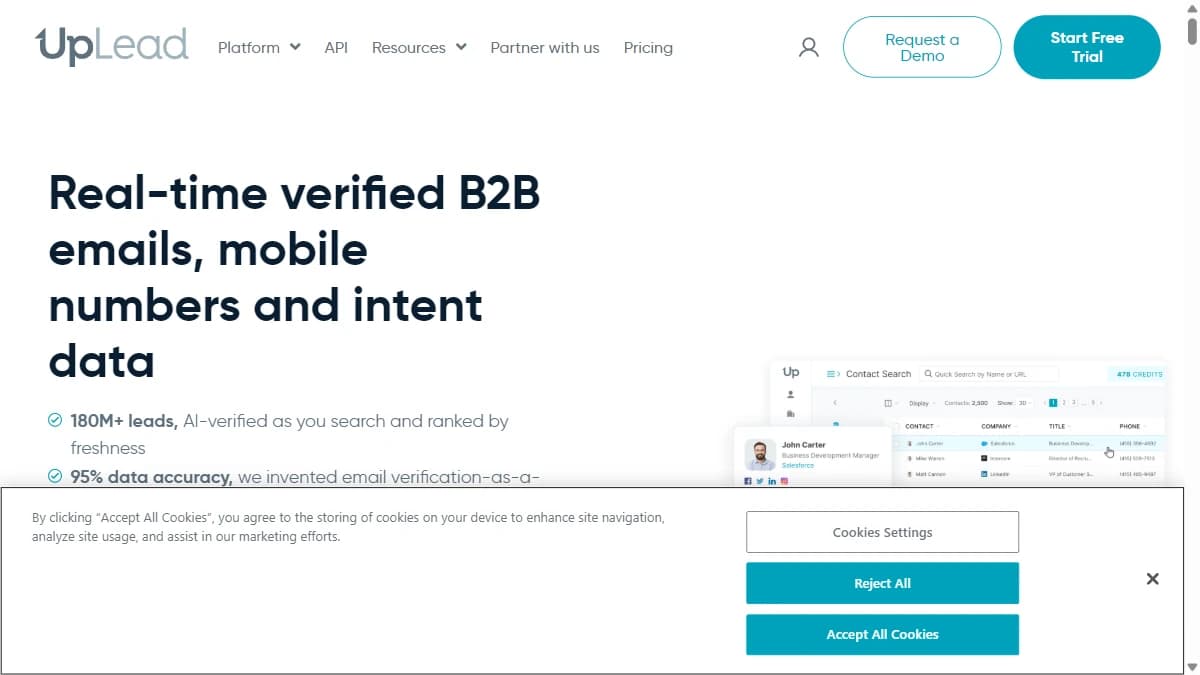
UpLead — 95% accuracy-guaranteed B2B contact database with real-time email verification at point of export
UpLead is the Fiber AI alternative for teams where email deliverability is the primary concern — it is the only provider in this comparison that offers a published 95% accuracy guarantee backed by a credit refund for bounced emails.
UpLead verifies emails in real time at the point of export — not against a static database snapshot, but against live mail server checks before the contact is delivered to your list. According to G2 reviews, this approach delivers materially lower bounce rates than competitors that verify on ingestion and then serve the same stale verified flag weeks later.
UpLead's 160M+ contact database is smaller than Apollo's 275M+ and Fiber AI's 850M+, but the higher accuracy rate means fewer wasted sends and better email sender reputation. For teams running high-frequency cold email where bounce rate directly impacts deliverability, the tradeoff favors UpLead. See our full analysis in the UpLead alternatives comparison.
Pros
- 95% accuracy guarantee — credit refund for any email that bounces
- Real-time email verification at point of export — not a stale snapshot
- 160M+ contacts with 50+ search filters including technology install data
- Intent data add-on for buyer signal targeting
- Chrome extension for LinkedIn prospecting
Cons
- Smaller database than Apollo or Fiber AI — some niche roles and markets have thin coverage
- No native email sequencing — export only to external outreach tools
- No waterfall enrichment — single-source database
- Phone data is available but accuracy guarantee applies to email only
Best for: Teams that prioritize email deliverability and want an accuracy guarantee — not just a database claim.
Pricing: $99/mo (Essentials, 170 credits). $199/mo (Plus, 400 credits). $399/mo (Professional, 1,000 credits). Free trial available.
Side-by-Side Comparison
| Tool | Database | Waterfall | Outreach | API | Starting Price |
|---|---|---|---|---|---|
| SyncGTM | 50+ providers | Yes (50+ providers) | Yes (built-in) | No | $49/mo (free tier) |
| Apollo.io | 275M+ contacts | No | Yes (built-in) | Yes | Free / $59/mo |
| Explorium.ai | 146M+ companies, 767M+ profiles | No | No (external) | Yes (API + MCP) | $29.99/pkg |
| ZoomInfo | 260M+ profiles | No | Yes (Engage) | Yes | ~$15K/yr |
| Cognism | EMEA + NA | No | No (external) | Yes | ~$15K/yr |
| Lusha | 45M+ profiles | No | No (export only) | Yes | Free / $49/mo |
| UpLead | 160M+ contacts | No | No (export only) | Yes | $99/mo |
| Fiber AI | 850M+ profiles | No | No (API only) | Yes (API-first) | $300/mo |
How to Choose
The right Fiber AI alternative depends on what specifically the tool is not delivering for your team. Five decision paths:
- You need enrichment plus outreach in one platform. Pick SyncGTM. It is the only option here that combines waterfall enrichment (50+ providers), 76+ data points per lead, and built-in outreach sequences under one subscription. No API required, no separate sequencer needed.
- You need the cheapest self-serve starting point. Pick Apollo.io. Free tier with 10,000 records/month plus email sequences at $0 covers a solo SDR's full outbound motion before paying anything. Compare against other Seamless.AI alternatives at this price point.
- You need a data API for AI agents without Fiber AI's price floor.Pick Explorium.ai. One REST API and a hosted MCP server over 146M+ companies make it the closest like-for-like swap for Fiber AI's agent use case, from $29.99 per credit package.
- You need enterprise-grade North America data with intent signals. Pick ZoomInfo. The deepest US B2B database with buying intent data from 300+ publisher sources, justified for large SDR teams.
- You're targeting EMEA or need GDPR-compliant verified mobile numbers. Pick Cognism. Diamond Data human-verified mobile numbers for the UK, DACH, and Western Europe deliver materially higher connect rates than alternatives in those markets.
If cost is the primary driver and your team needs both data and outreach, SyncGTM at $49/mo is the only option that replaces Fiber AI's data layer and eliminates the sequencer cost simultaneously. See the full SyncGTM pricing page for current plan details.
Final Verdict
Fiber AI is a strong product for its target user: an engineering team building an AI sales agent that needs a real-time data API with live LinkedIn fetching, 850M+ global profiles, and advanced search endpoints. For that use case, the $300–$2,400/month price is defensible.
For the majority of B2B revenue teams — where the problem is getting verified contacts into sequences fast, not building custom data pipelines — Fiber AI is overbuilt and overpriced. The seven alternatives above cover the full spectrum from free to enterprise, from quick lookup to full enrichment automation.
SyncGTM is the best overall replacement: waterfall enrichment from 50+ providers, 76+ data points per lead, and built-in outreach from $49/mo. Apollo.io is the best low-cost self-serve option with the lowest risk to start. Explorium.ai is the closest API-first swap for teams building AI agents. ZoomInfo wins on North America depth at enterprise scale. Cognism wins on EMEA verified mobile data. Lusha and UpLead serve teams that want simple, self-serve lookup with free tiers.
Match the tool to the problem your team actually has. If the problem is enrichment hit rate and outreach in one place, SyncGTM resolves both.