

Floqer Review 2026: Features, Pricing, Pros and Cons

By Kushal Magar · March 15, 2026 · 12 min read · Last updated: September 30, 2026
You're here because you spotted Floqer while searching for a CRM enrichment tool, and you want to know if it's actually good before you commit to a plan. Fair. That's exactly what this Floqer review covers.
Floqer positions itself as "a better version of Clay and ZoomInfo for CRM enrichment." That's a bold claim from a company founded in 2023 with roughly 16 employees. We tested the platform, read through every G2 and Capterra review we could find (it holds a 4.9/5 rating on G2), and compared it with Clay, ZoomInfo, and Apollo to see where Floqer delivers and where it falls short.
Here's the full breakdown: features, pricing, real pros and cons, who it's best for, and which Floqer alternatives are worth considering.
Floqer Review: What You Get (and What You Don't)
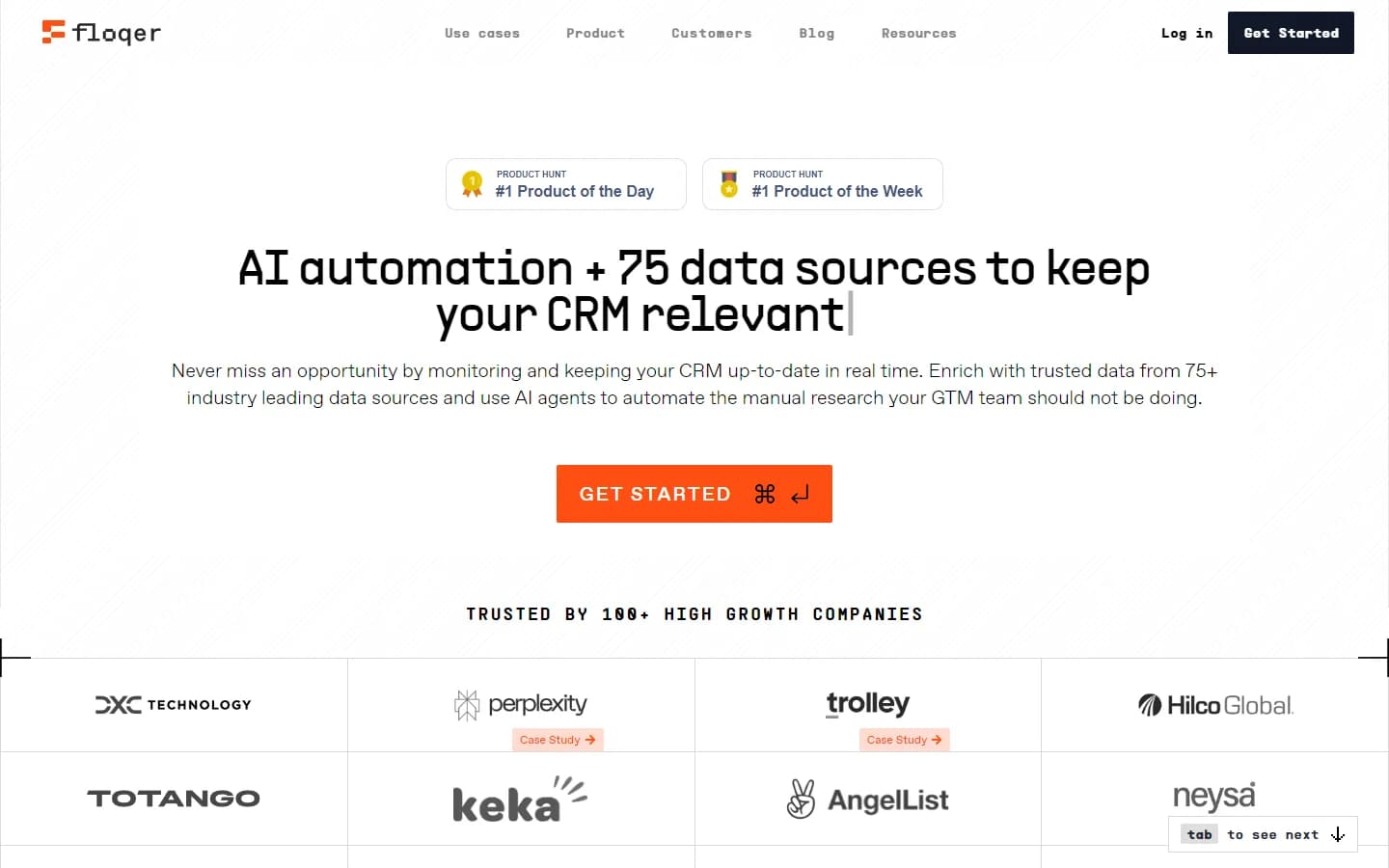
Floqer homepage -- #1 Product of the Day on Product Hunt, trusted by 100+ companies including Perplexity, AngelList, and Totango
Floqer is an AI-powered CRM data enrichment and GTM automation platform founded in 2023 and based in Halifax, Canada. It pulls data from 100+ sources -- including LinkedIn, Apollo, ZoomInfo, Cognism, and Crunchbase -- to enrich your CRM records with contact emails, phone numbers, and 75+ data points. Floqer is rated 4.9/5 on G2 and earned #1 Product of the Day on Product Hunt. The pitch: set up intent-based signals, capture leads, enrich them automatically, and trigger outbound sequences -- all without writing code.
Here's a quick-reference table of what's included and what's limited:
| Feature | What's Included | Limitations |
|---|---|---|
| Data Enrichment | 100+ data sources, 75+ data points | Data accuracy rates not publicly documented |
| Workflow Builder | Drag-and-drop, 50+ tool integrations | Power users report a learning curve with complex logic |
| AI Messaging | GPT-4 personalized outreach | Outbound only -- no inbound or marketing automation |
| CRM Sync | Two-way Salesforce and HubSpot sync on all plans, plus Pipedrive, Close, Zoho, and more | Microsoft Dynamics 365 sync is Enterprise-only |
| Intent Signals | Job postings, website visitor intent, job changes and new hires | Signal accuracy not publicly benchmarked |
| Pricing | Free plan (100 credits); self-serve from $49/mo with unlimited seats | Credit cost per action varies by source and AI step |
Floqer Key Features
Floqer's core features include multi-source data enrichment from 100+ providers, a visual no-code workflow builder, GPT-4 powered outreach messaging, and real-time CRM syncing. Here is how each feature performs in practice.
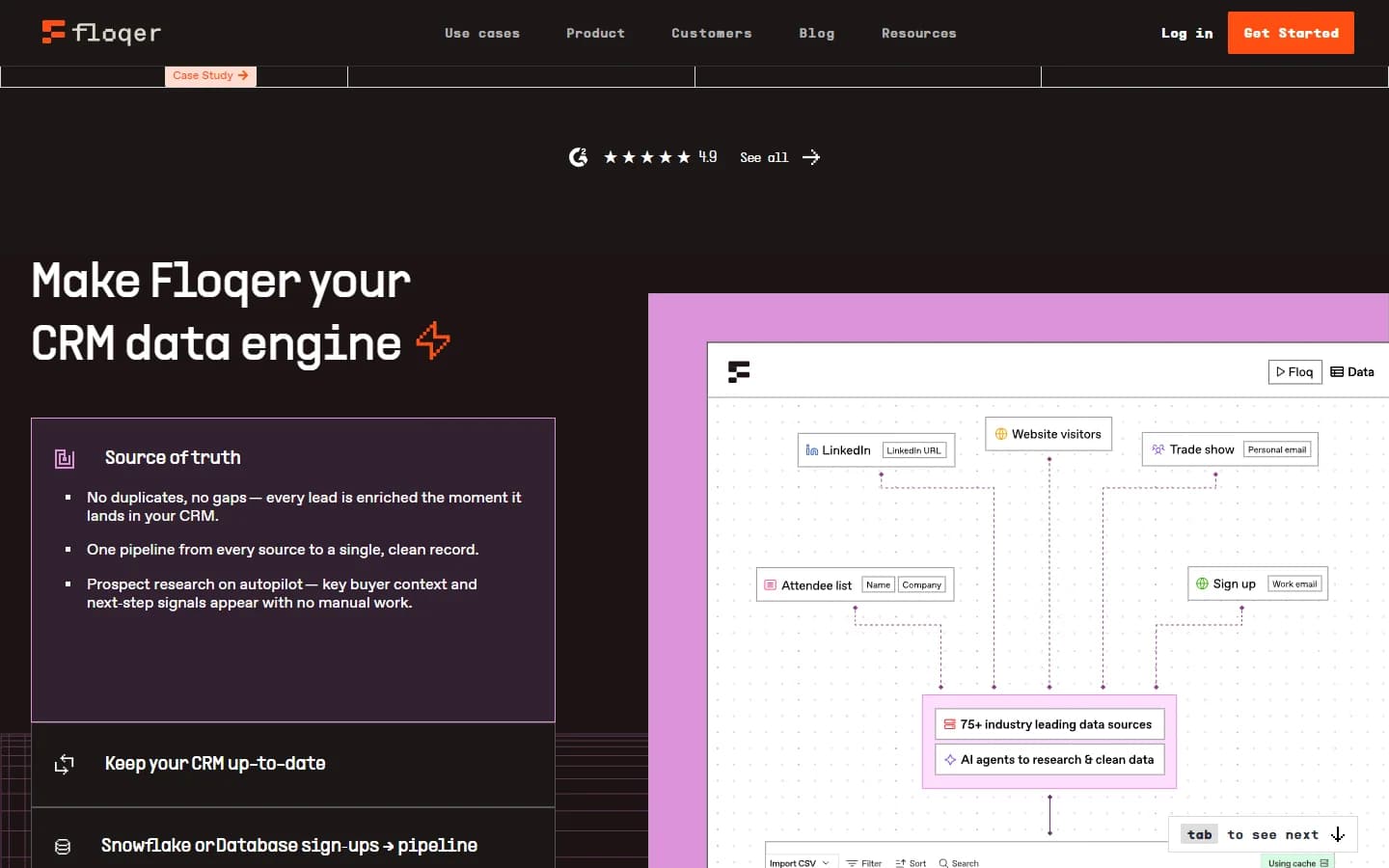
Floqer's CRM data engine -- feeds from LinkedIn, website visitors, trade shows, and sign-ups flow through 75+ data sources and AI agents
Multi-Source Data Enrichment
This is Floqer's core selling point. The platform connects to 100+ data sources -- including LinkedIn, Apollo, and other B2B databases -- to enrich your CRM records. You get 75+ data points per contact: emails, phone numbers, company details, and person-level insights.
The enrichment runs automatically when new records enter your CRM, and Floqer claims to keep data fresh with continuous updates. Companies like Trolley report 4x higher data coverage after switching to Floqer. That said, accuracy benchmarks aren't publicly shared, so you're taking their word for it until you test it yourself.
Visual Workflow Builder
Floqer's drag-and-drop workflow builder lets you chain together data enrichment, messaging, lead scoring, and CRM actions into automated sequences. You can connect 50+ sales tools directly in the builder without writing code.
The builder uses smart logic and conditions -- think if/then rules based on data matches, email responses, or enrichment results. For solo SDRs, it's straightforward. For teams building multi-step sequences with branching logic, expect a ramp-up period to get comfortable with all the options.
AI-Powered Outreach
Floqer uses GPT-4 to generate personalized outreach messages based on enriched prospect data. The AI pulls in company context, recent activity, and contact details to write emails that don't read like templates.
Users report up to 2x improvement in email response rates and 200% more closed deals after implementing Floqer's AI messaging. Those numbers are impressive, but they come from Floqer's own marketing -- independent benchmarks are hard to find.
Chrome Extension
Floqer includes a Chrome extension that lets you enrich contacts directly while browsing LinkedIn or company websites. Click on a profile, and Floqer pulls enriched data into your workflow instantly. It's a small but practical feature for SDRs who spend half their day on LinkedIn.
Intent Signals
Floqer watches for 25 intent data points -- things like companies raising funding, posting new job openings, or expanding into new markets. When a signal fires, Floqer auto-flags the account, scores it, and routes the enriched data to your CRM, Slack, or outbound sequences. This is where Floqer starts to feel like more than a data tool. Its pricing page also highlights website visitor intent and tracking of job changes and new hires.
Does Floqer Integrate with HubSpot?
Yes. Floqer natively integrates with HubSpot, Salesforce, and Zoho CRM for real-time data syncing and auto-deduplication. As of September 2026, its pricing page lists two-way Salesforce and HubSpot sync on all plans, alongside Pipedrive, Close, Zoho, Airtable, 10+ other integrations, and a two-way Snowflake sync.
The exceptions are enterprise systems: Microsoft Dynamics 365, BigQuery, and ClickHouse integrations are reserved for the custom-priced Enterprise plan. If your team runs on Dynamics, factor that into the budget from the start.
Floqer Pricing: What You Actually Pay
When this review was first published, Floqer had no public pricing page, and the only pricing details came from its Capterra and G2 listings. That has changed. As of September 2026, Floqer publishes a free plan, self-serve credit plans, and a custom Enterprise tier:
| Plan | Price | Credits | What's Included |
|---|---|---|---|
| Free | $0 | 100 | Core platform access; no card or commitment |
| Self-serve | $49–$999/mo | 2,000–80,000 per month | Unlimited seats, workflows, and apps; 100+ sources; two-way Salesforce and HubSpot sync; Chrome extension and HTTP APIs |
| Enterprise | Custom (annual) | Custom | SSO, SAML, and RBAC; SOC 2 Type 2 and GDPR; custom data residency; VPC; dedicated GTM engineer; Dynamics 365, BigQuery, and ClickHouse |
Annual billing takes 10% off self-serve plans. Credits roll over while your subscription is active and stay valid for 12 months after it ends. Admins can cap usage per workspace, watch live spend by member and workflow, and get alerts before a run uses more than expected.
What this means for your budget
The seat model is the headline: every plan includes unlimited seats, so a ten-person SDR team pays the same as one rep on the same credit bundle. The real cost driver is credit consumption. Most enrichment and lookup actions cost one to a few credits depending on the data source, while AI web agents and multi-step research cost more. At $49/mo for 2,000 credits, a credit costs about 2.5 cents (about 1.25 cents at the $999/mo tier), but a workflow that chains several lookups and an AI research step per contact burns through a bundle faster than the sticker price suggests.
For context, here is how other enrichment tools with public pricing compare:
- Clay: Free (100 credits), Launch ($167/mo), Growth ($446/mo), Enterprise (custom)
- Apollo.io: Free tier available, paid plans from $49/mo
Floqer's entry price is lower than Clay's, and unlimited seats make it easier to roll out across a team. Test on the free plan first so you know how many credits your workflows use per contact before choosing a tier.
Floqer Pros: What Works Well
Floqer's biggest strengths are its wide data source coverage (100+ providers), significant time savings for SDR teams (up to 20 hours per week), and a capable no-code workflow builder with GPT-4 powered messaging.
- Massive data source coverage. 100+ enrichment sources and 75+ data points per contact is one of the widest coverage claims in the market. More sources means higher match rates on hard-to-find contacts, the same logic behind waterfall enrichment.
- Time savings are real. Users report saving up to 20 hours per week on research, data entry, and outreach setup. For an SDR team of three, that's 60 hours a week redirected to actual selling.
- No-code workflow builder. The drag-and-drop interface makes it accessible to non-technical users. You don't need a RevOps engineer to set up basic enrichment workflows.
- AI-personalized messaging. GPT-4 integration for outreach messages is a genuine time saver. The quality of AI-written emails has improved significantly, and Floqer makes it accessible inside the workflow.
- Real customer results. Case studies show companies like Trolley doubling demos booked and generating seven-figure SQO pipeline in three months. Those are meaningful numbers for sales leaders.
- Strong early traction. Floqer earned #1 Product of the Day and #1 Product of the Week on Product Hunt, holds a 4.9/5 G2 rating, and counts Perplexity, AngelList, Totango, and DXC Technology among its customers.
- Unlimited seats and a free plan. As of September 2026, every plan includes unlimited seats, and the free plan's 100 credits let you test real workflows before paying. Credits also roll over while your subscription is active.
What Are the Downsides of Using Floqer?
Credit costs are hard to predict
When we first reviewed Floqer, the lack of public pricing was the biggest red flag. It now publishes self-serve plans, which fixes that. The remaining budgeting problem is credit consumption: actions cost one to a few credits depending on the data source, and AI web agents and multi-step research cost more. Until you run your own workflows, it is hard to know how far a plan's credits will go.
Outbound-only focus
Floqer is built for outbound sales workflows. If your GTM motion includes inbound lead routing, marketing automation, or customer success workflows, Floqer won't cover those use cases. You'll need separate tools for anything outside of outbound prospecting and enrichment.
Limited public documentation
For a tool with 100+ data sources and a long integration list, the public documentation is thin. API documentation and integration guides are hard to find, which makes it difficult to evaluate technical fit without talking to the team.
Early-stage platform risk
Floqer was founded in 2023 and has roughly 16 employees. For enterprise teams signing annual contracts, platform stability and long-term viability matter. The tool has limited public reviews on G2, which makes it harder to assess reliability at scale.
Learning curve for advanced workflows
While the basic workflow builder is intuitive, power users report needing time to master all integrations and logic conditions. Multi-step workflows with branching logic, conditional triggers, and custom data mappings require a real investment in learning the platform.
- Credit cost per action varies by source and AI step, so spend is hard to forecast
- Outbound sales only -- no marketing automation or inbound support
- Limited public documentation and integration guides
- Early-stage company with limited track record at scale
- Advanced workflows require significant ramp-up time
- Free plan capped at 100 credits -- enough for a small test only
How Floqer Works: From Signal to CRM Record
Floqer makes more sense once you see how a workflow runs end to end. Here is the typical order of operations, and where credits get spent along the way.
- Connect your systems. Link your CRM (two-way Salesforce and HubSpot sync, or Pipedrive, Close, Zoho, and others) and, if you use one, your warehouse through the two-way Snowflake sync. Seats are unlimited, so the whole team can work in the same workspace.
- Choose your inputs. Feed workflows from signals such as job postings, website visitor intent, and job changes or new hires, or from sources like LinkedIn, trade show lists, and sign-ups.
- Enrich across sources. Add enrichment steps that pull emails, phone numbers, and company data from Floqer's 100+ sources. Most lookups cost one to a few credits, depending on the source.
- Add AI research where it pays off. AI web agents can answer research questions that no data provider covers directly, but they cost more credits than simple lookups. Run them only on records that pass your ICP filters.
- Score, route, and personalize. Use if/then logic to score accounts, route them to the right owner or Slack channel, and generate GPT-4 personalized messaging for outreach.
- Sync and monitor. Push results back to the CRM, and use workspace usage caps and live spend tracking by member and workflow to keep credit use in check.
The practical takeaway: start every new workflow on a small sample. The free plan's 100 credits are enough to see what one enriched, scored, and synced contact really costs before you pick a paid tier.
Is Floqer Worth It?
Floqer is a good fit for outbound-heavy sales teams that need massive data source coverage and want to add reps without paying per seat. If you run a large SDR org and your primary bottleneck is enrichment coverage across dozens of data providers, Floqer's 100+ source approach is worth evaluating. The workflow builder is capable, the AI messaging is solid, and the early customer results are promising.
Floqer is not the right choice if you need a platform that covers more than outbound sales, or fully predictable monthly spend before you have tested your own workflows. Teams that want deep public documentation before buying may also find the evaluation slow, and the builder takes time to master.
Bottom line: Floqer has strong enrichment capabilities, and published self-serve pricing with unlimited seats has removed its biggest weakness. Start on the free plan, measure credits per enriched contact on your own data, and compare it with the alternatives below before committing to a paid tier.
Top Floqer Alternatives
If Floqer doesn't check every box, here are the strongest alternatives for GTM teams in 2026:
Clay
The most established enrichment platform with a powerful workflow builder. Starts at $167/mo but gates CRM integrations behind the $446/mo Growth plan. Better suited for teams with larger budgets and technical RevOps resources.
ZoomInfo
Enterprise-grade data provider with the largest B2B contact database. Pricing starts at $15,000+/year. Best for large sales organizations with enterprise budgets.
Apollo.io
All-in-one sales platform with a generous free tier and affordable paid plans from $49/mo. Strong for prospecting and email sequencing. Less powerful for multi-source enrichment compared to Floqer or Clay.
If the learning curve of Floqer's workflow builder is a dealbreaker, SyncGTM is one alternative worth a look: it offers waterfall enrichment across 50+ data providers and AI lead scoring, accessible from Claude, ChatGPT, or Cursor via MCP.