

GetCargo.ai Review 2026: Pricing, Features & Honest Verdict

By Kushal Magar · March 15, 2026 · 12 min read · Last updated: September 30, 2026
Your GTM stack is five tools held together with Zapier and hope. Leads come from forms, intent signals, CRM updates, and product events. Somebody has to stitch all of that into a pipeline that converts. That is the problem GetCargo.ai (commonly called Cargo) is trying to solve.
Cargo calls itself an AI revenue orchestration platform. Instead of connecting ten tools with Zapier, you build multi-agent workflows that extract, enrich, qualify, and engage leads automatically. It is Y Combinator-backed (S23 batch), raised a $19.4M Series A, and counts Descript, Gorgias, and Ashby among its customers.
This GetCargo.ai review covers the real pricing (not the marketing page version), what the AI agents actually do, where the platform falls short, and which plan fits which team. No fluff. No affiliate links.
TL;DR
- GetCargo.ai is a Y Combinator-backed AI revenue orchestration platform with SOC 2 Type II certification
- 4 AI agent types: Research, Qualification, SDR, and Custom — available on every plan including free
- Pricing (as of September 2026): Free (100 credits), Standard ($165/mo, 1.5K credits), Professional ($250/mo, 2.5K credits), Enterprise ($1,190/mo, 17K credits), Custom ($3,000+/mo, 50K+ credits)
- Key downsides: steep learning curve, complex 3-part credit model, no native outreach sequencer, near-zero public reviews, smaller enrichment network (~15 built-in providers)
- Rating: 3.4/5 — strong orchestration concept, but pricing, complexity, and gaps hold it back for most teams
GetCargo.ai Review: What You Get (and What You Don't)
GetCargo.ai is an AI revenue orchestration platform founded by Aurelien Aubert and Maxence De Villepion. It targets GTM engineers and RevOps teams who need to automate the full lead lifecycle — from data extraction through enrichment and scoring to engagement. Over 1,000 GTM professionals use the platform, and it holds SOC 2 Type II certification.
Here is a quick-reference breakdown of what Cargo includes and where the limitations sit:
| Feature | What's Included | Limitations |
|---|---|---|
| AI Agents | 4 types: Research, Qualification, SDR, Custom | Require workflow setup; not plug-and-play |
| Data Enrichment | ~15 built-in providers + third-party via integrations | Smaller network than Clay (75+) |
| Integrations | 100+ (Salesforce, HubSpot, Slack, LinkedIn, etc.) | Tools outside the standard library need webhooks |
| Orchestration | Multi-step workflows with conditional logic and branching | 100 orchestration steps = 1 credit |
| Security | SOC 2 Type II certified, audit logging | SSO only on Enterprise ($1,190/mo) and above |
| Outreach | SDR Agent handles AI-driven multi-channel outreach | No native sequence builder; relies on agent + external tools |
GetCargo.ai AI Agents: What's Real vs. What's Marketing
The core pitch of this GetCargo.ai review is the four AI agent types. Each handles a different stage of the revenue pipeline. All four are available on every plan, including free.
Research Agent
Gathers and verifies lead data from multiple sources automatically. Pulls company news, hiring signals, tech stack data, and firmographics. This is where Cargo's enrichment integrations come into play — though the built-in provider count (~15) is smaller than competitors.
Qualification Agent
Scores and categorizes leads based on fit and intent signals in real time. Applies your scoring criteria automatically so reps only see leads matching your ICP. Useful for teams drowning in unqualified inbound — but you need to architect the scoring logic yourself.
SDR Agent
Automates personalized outreach across email, SMS, and task creation. Cargo claims a "human touch," but this is AI-generated copy. It handles volume, not nuance. Not a replacement for a skilled SDR. And it is not a sequence builder — you configure it through the agent workflow.
Custom Agent
Build your own AI agent for any repetitive GTM task: territory assignment, deal routing, data hygiene, or anything unique to your business. This is where power users get value. But it requires technical setup and a clear understanding of your data model.
The 4-Step Orchestration Process
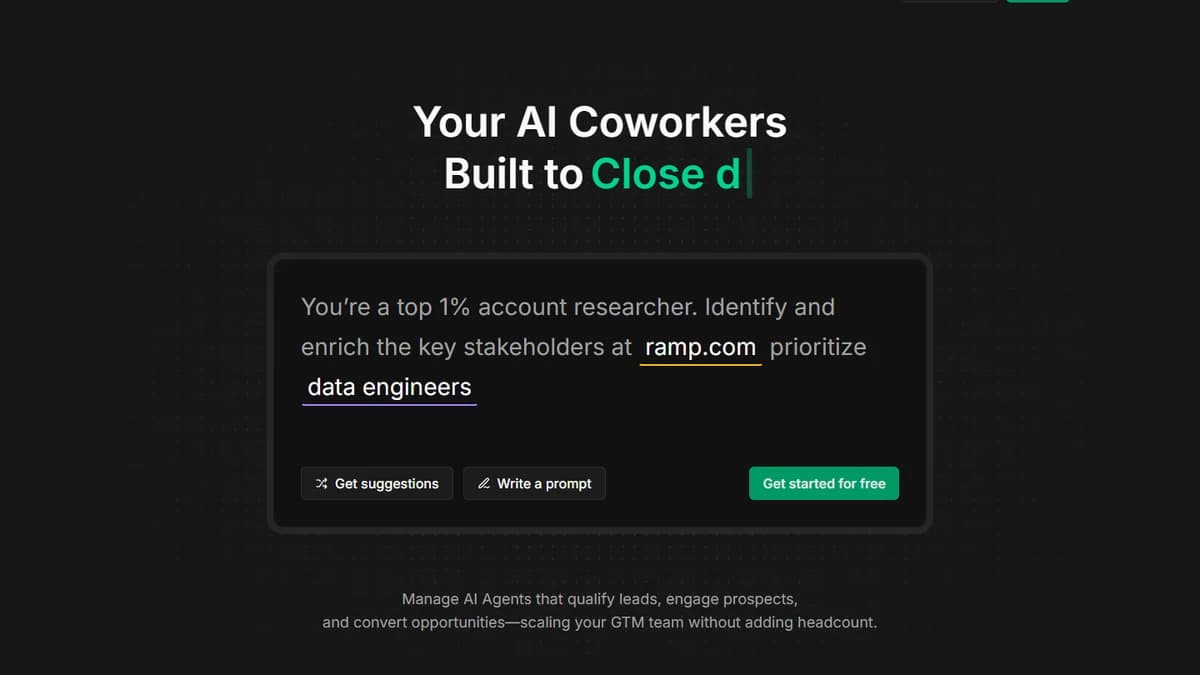
Cargo structures workflows around four steps: Extract (pull leads from CRMs, forms, intent alerts, product events), Enrich (layer data from providers to build complete profiles), Qualify (score and segment based on fit and intent), and Engage (trigger outreach via email, SMS, or task assignment).
The concept is sound. One platform handling the full pipeline reduces integration points. The question is whether Cargo's execution at each stage is strong enough to replace dedicated tools — or whether it ends up as a jack-of-all-trades. Descript reported "5x more leads generated" and Oneflow claimed "80% CRM enrichment levels," but those are vendor-selected case studies, not independent benchmarks.
GetCargo.ai Pricing: What You Actually Pay
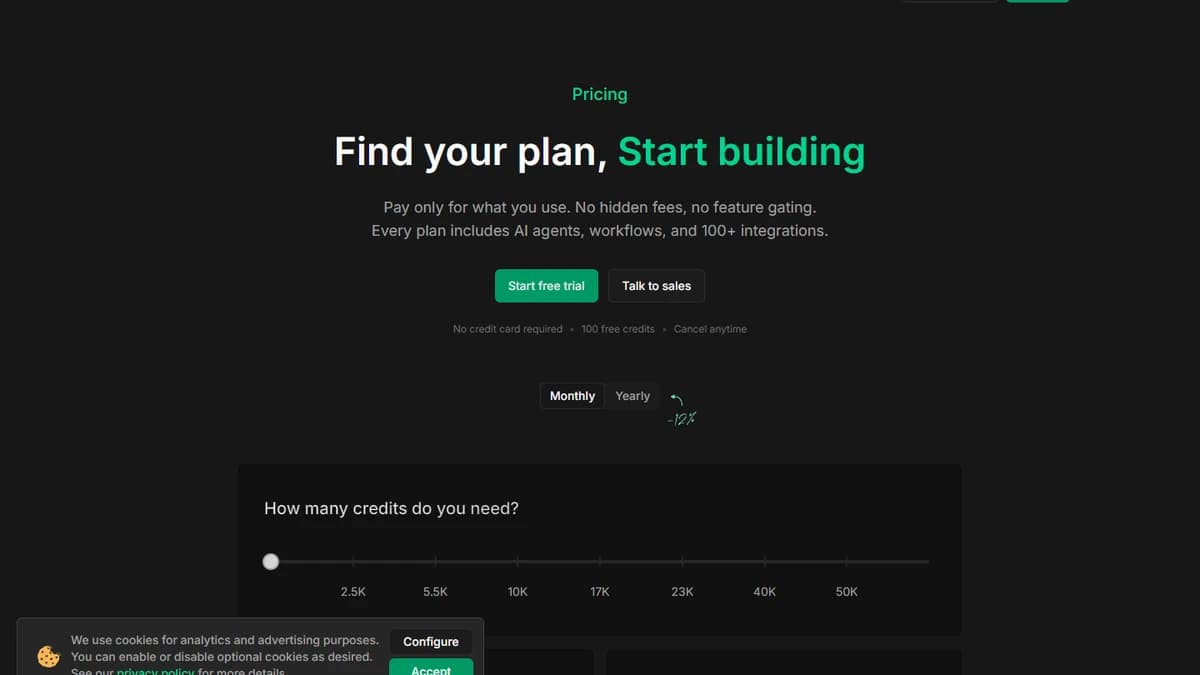
GetCargo.ai pricing uses a credit-based model. Every action — enrichment calls, orchestration steps, and data storage inserts — consumes credits. No features are gated by plan. All tiers get AI agents, workflows, data models, and all 100+ integrations. Here is what each plan includes as of September 2026:
- Free: 100 credits. Community support. No credit card required.
- Standard (from $165/mo): 1,500 credits per month. Email support. All integrations, AI agents, and workflows included.
- Professional (from $250/mo): 2,500 credits per month. Email support.
- Enterprise (from $1,190/mo): 17,000 credits per month. Priority support. SSO included.
- Custom (from $3,000/mo): 50,000+ credits per month. Dedicated support and SSO.
Understanding GetCargo.ai's 3-Part Credit Model
This is where GetCargo.ai pricing gets complicated. There are three types of credit consumption:
- Enrichment credits: Cost matches each data provider's pricing shown in the interface. One enrichment call = one or more credits depending on the provider.
- Orchestration steps: 100 workflow steps = 1 credit. A 10-step workflow processing 100 leads = 10 credits.
- Storage inserts: 1,000 inserts = 1 credit. Writing data to Cargo's internal storage counts against your balance.
What You Actually Pay: A Real Scenario
Say you have 2 SDRs processing 500 leads per week. Each lead goes through a 5-step enrichment workflow (5 credits per lead), a 10-step orchestration flow (0.1 credits per lead), and storage writes (negligible). That is roughly 2,550 credits per week, or 10,200 per month. You need the Enterprise plan at $1,190/mo, since Professional tops out at 2,500 credits.
Two billing details matter here: upgrades take effect immediately, while downgrades apply from the next billing cycle. Start on the smaller plan, measure real credit burn for a few weeks, then move up.
GetCargo.ai Integrations: CRM, Outreach, and Beyond
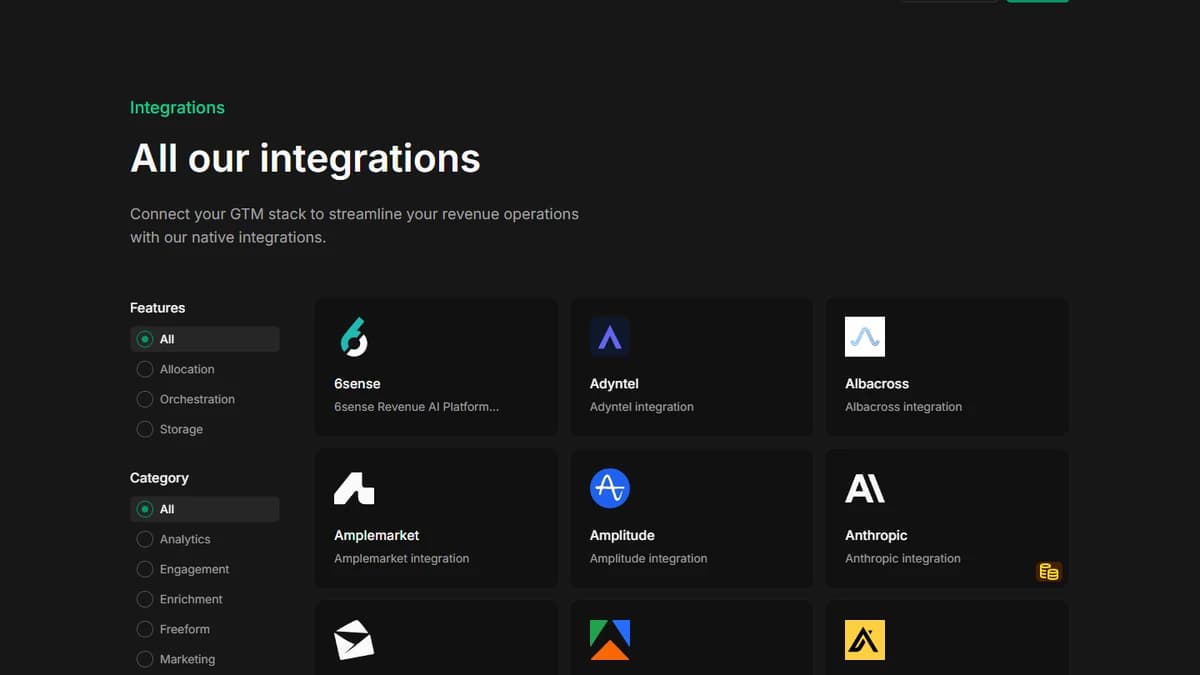
Cargo claims 100+ integrations. The list is real. The platform connects to major CRMs (Salesforce, HubSpot, Attio), outreach tools (Apollo.io, Outreach, Instantly), communication platforms (Slack, Intercom), data providers (ZoomInfo, Lusha, Proxycurl, Anymail Finder), intent tools (6sense, Albacross), and AI services (OpenAI, Anthropic).
Does GetCargo.ai Integrate with Salesforce and HubSpot?
Yes. Both Salesforce and HubSpot are native integrations available on all plans. Cargo pulls leads from your CRM, enriches them through workflows, and pushes updated records back. The bidirectional sync works — your CRM stays current without manual CSV exports.
The catch: if you need to connect a tool that is not in Cargo's standard library, expect to build workarounds through webhooks or raise it with Cargo's sales team before you sign.
GetCargo.ai Ease of Use: Setup and Learning Curve
Cargo is built for GTM engineers — people who think in workflows, data pipelines, and conditional logic. Multiple third-party sources describe it as requiring "a technical or logical mindset" and note that teams must "roll up your sleeves" to architect workflows.
The multi-agent architecture adds complexity. You are not just building a workflow. You are configuring agents, defining triggers, mapping data between steps, and testing conditional paths. Each agent type has its own configuration surface. That is a lot of knobs to turn.
Cargo's workflow builder is visual and does not require writing code. But "no-code" does not mean "no learning curve." You need to understand data modeling, enrichment provider capabilities, and scoring logic. One comparison site noted Cargo has "less community content and fewer pre-built templates to learn from" compared to Clay. Expect a 2–4 week ramp-up before anyone builds production-ready workflows.
This is not a tool you hand to an SDR. It is infrastructure for the person who builds the systems SDRs use.
What Are the Downsides of Using GetCargo.ai?
Every honest GetCargo.ai review has to cover the weak spots. Here are the real ones, sourced from third-party comparisons, directory listings, and our own analysis.
- Three-dimensional credit model (enrichment + orchestration + storage) makes costs hard to predict
- Steep learning curve — requires technical or GTM engineering background to build workflows
- Near-zero public reviews on G2, SourceForge, Capterra, and Reddit as of March 2026
- Large price jump from Professional ($250/mo, 2,500 credits) to Enterprise ($1,190/mo, 17,000 credits) with no tier in between
- No native outreach sequencer — requires SDR Agent plus external tool integrations
- Free plan gives only 100 credits, limiting evaluation depth
- Smaller enrichment provider network (~15 built-in) compared to Clay (75+)
Credit Consumption Is Hard to Predict
The three-dimensional credit model (enrichment + orchestration + storage) makes monthly cost forecasting difficult. Enrichment credits vary by provider, so a workflow calling ZoomInfo burns more credits than one using a lighter source. GTM Stack Directory noted that "credit costs scale significantly" and pricing "can feel expensive for small teams that primarily need enrichment."
The Price Jump from Professional to Enterprise Is Steep
As of September 2026, Professional costs $250/mo with 2,500 credits and Enterprise costs $1,190/mo with 17,000 credits. That is a 376% price increase. If you outgrow Professional but do not need 17,000 credits, there is no tier in between. You either pay $1,190/mo or manage credit constraints on Professional. The newer Standard plan ($165/mo, 1,500 credits) lowers the entry point but does nothing for this gap.
Near-Zero Public Reviews
As of March 2026, GetCargo.ai has near-zero reviews on major platforms. SourceForge shows 0.0/5 with zero reviews. G2 has a profile but minimal content. Reddit discussions are nonexistent. Notable customers like Descript, Gorgias, and Ashby are listed, but the lack of independent third-party reviews makes it hard to assess real-world performance at scale.
Smaller Enrichment Provider Network
Cargo offers approximately 15 built-in enrichment providers. For comparison, Clay provides 75+. One third-party comparison noted that Cargo's "enrichment provider network is smaller than Clay's, which limits options for niche data sources."
No Native Outreach Sequencer
Cargo's SDR Agent handles outreach, but there is no built-in sequence builder the way dedicated outreach tools offer. You configure AI-driven outreach through agents and external integrations (Apollo, Outreach, Instantly). For teams that want enrichment and sequencing in one tool, this means adding another subscription.
GetCargo.ai Plans Compared: Which Tier Fits
Because Cargo gates no features by plan, choosing a tier comes down to three things: monthly credit volume, support level, and whether you need SSO. Here is how the plans line up as of September 2026.
| Plan | Price | Credits | Support & SSO | Best Fit |
|---|---|---|---|---|
| Free | $0 | 100 | Community | Testing one workflow on a handful of records |
| Standard | From $165/mo | 1,500/mo | A single GTM engineer piloting low-volume workflows | |
| Professional | From $250/mo | 2,500/mo | Small teams enriching roughly 500 leads a month at ~5 credits per lead | |
| Enterprise | From $1,190/mo | 17,000/mo | Priority, SSO | Teams processing thousands of leads a month, or any team that needs SSO |
| Custom | From $3,000/mo | 50,000+/mo | Dedicated, SSO | Large RevOps orgs running many workflows at scale |
How to Estimate Your Tier Before You Buy
Estimate monthly credits from three inputs: enrichment credits per lead (read them off each provider action in the workflow builder), leads per month, and workflow length. Orchestration adds 1 credit per 100 steps and storage 1 credit per 1,000 inserts, so enrichment usually dominates the total. The scenario in the pricing section (2 SDRs, 500 leads a week, a 5-credit enrichment workflow) lands at roughly 10,200 credits a month, which only Enterprise and Custom cover.
The awkward zone sits between 2,500 and 17,000 credits. A team that outgrows Professional has no intermediate plan, so it either trims enrichment steps (fewer providers, cheaper sources first, ICP filters before expensive lookups) or jumps to Enterprise. Because upgrades apply immediately and downgrades wait for the next billing cycle, the low-risk path is to start on Standard, measure real burn for a few weeks, and upgrade once the numbers are clear.
Is GetCargo.ai Worth It?
GetCargo.ai is a good fit for mid-market and enterprise GTM teams (50+ employees) with a dedicated RevOps or GTM engineering function. If your team has the technical chops to build complex multi-agent workflows and the budget for $165–$1,190+/mo, Cargo delivers real value by centralizing the revenue pipeline into one orchestration platform.
It is not a good fit for startups, small sales teams, or anyone looking for a plug-and-play solution. The learning curve is real. The credit model requires spreadsheet-level planning. The enrichment provider network is smaller than alternatives. And the near-zero public reviews mean you are betting on vendor claims, not peer validation. If your team has fewer than 20 people or your GTM budget is under $500/mo, look at simpler Clay alternatives first.
Our verdict: GetCargo.ai scores a 3.4 out of 5. Strong orchestration concept, genuine enterprise customers, and no feature-gating across plans. But the high entry price, complex credit model, steep learning curve, smaller enrichment network, and missing native outreach hold it back for most GTM teams.
If GetCargo.ai's smaller built-in enrichment network is a dealbreaker, SyncGTM is one alternative worth a look: it runs waterfall enrichment across 50+ data providers and syncs results natively to Salesforce, HubSpot, and Attio.