

LeadRocks Review 2026: B2B Data Coverage, Pricing & SyncGTM Comparison

By Kushal Magar · May 31, 2026 · 11 min read
Key Takeaway
LeadRocks is a cheap 100M+ B2B contact database from $29/month with a Chrome extension, basic email sequencing, and a $79 AppSumo lifetime deal — but independent reviewers tested its emails at only 18-53% valid against a marketed 98%+ claim, credits are spent on blanks, geo-targeting misfires, and there are no native CRM integrations. For accurate outbound at scale, SyncGTM's waterfall enrichment across 50+ providers — with pay-only-on-success billing and native CRM sync — wins.
This LeadRocks review covers the tool's data coverage, pricing, and accuracy in 2026 — and where it falls short against waterfall enrichment. LeadRocks is a low-cost B2B contact database with a claimed 100M+ records, plans from $29/month, and a 98%+ accuracy claim that independent tests put at 18-53%. Our rating: 3.2/5.
LeadRocks' appeal is price. One subscription covers a 100M+ contact database, a Chrome extension for LinkedIn scraping, a built-in email verifier, and basic Gmail/Outlook sequencing — from $29/month or via a $79 AppSumo lifetime deal.
The structural limit is accuracy. LeadRocks leans on a single static database.
When that one source can't resolve a contact — or returns an invalid email — there is no second source to fall back on, which is exactly where waterfall enrichment pulls ahead by querying 50+ providers and keeping the best verified result.
This review breaks down LeadRocks' pricing math, the real accuracy picture versus the marketed 98%+, key features, the honest pros and cons, and a direct comparison with SyncGTM for teams weighing options in 2026.
What Is LeadRocks?
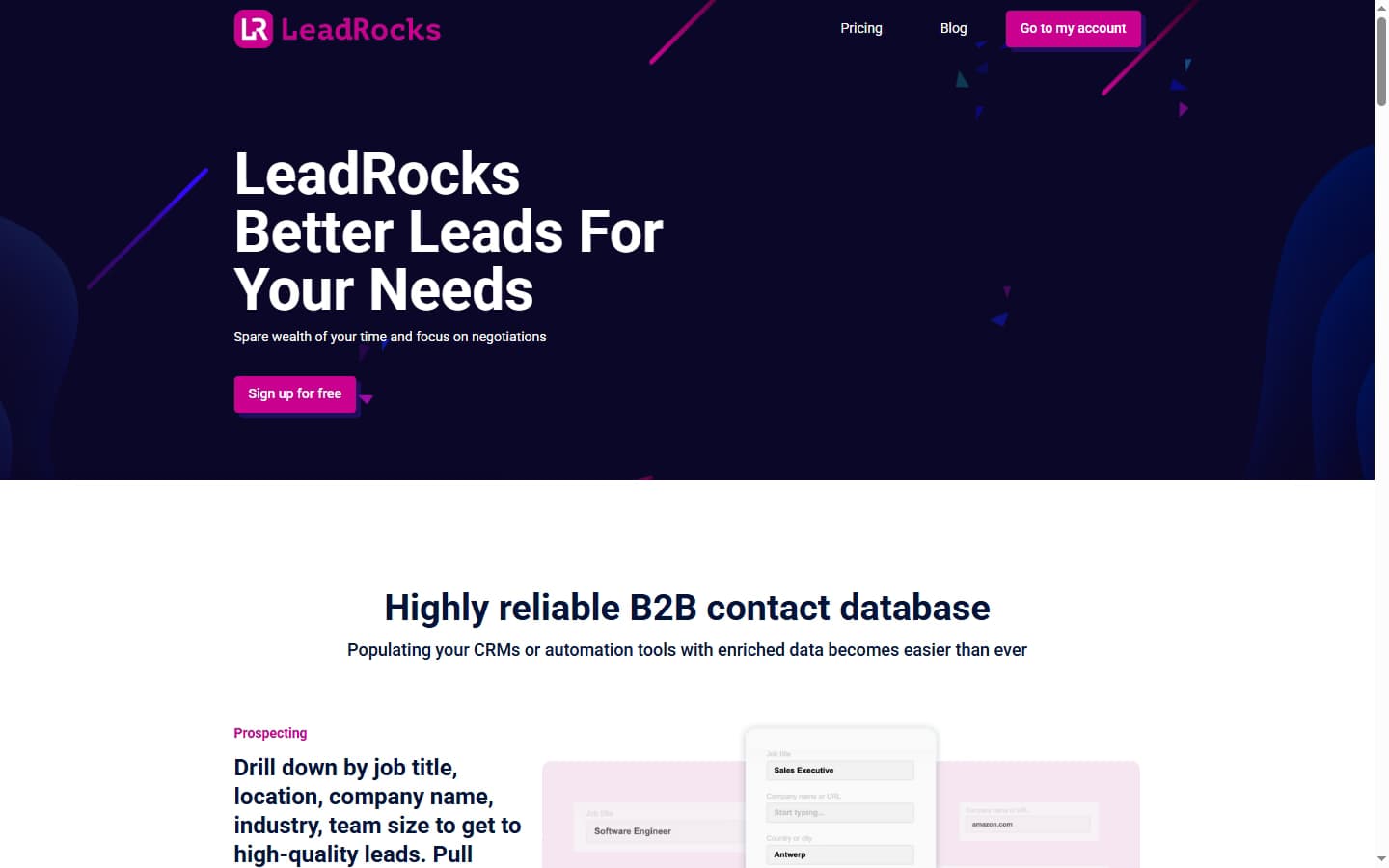
LeadRocks is a B2B contact database and LinkedIn scraping tool built for solo founders, freelancers, and small sales teams who need cheap access to email, phone, and LinkedIn data.
You search a claimed 100M+ contact index with filters across role, industry, geography, and company size, then return work emails, phone numbers, and LinkedIn URLs.
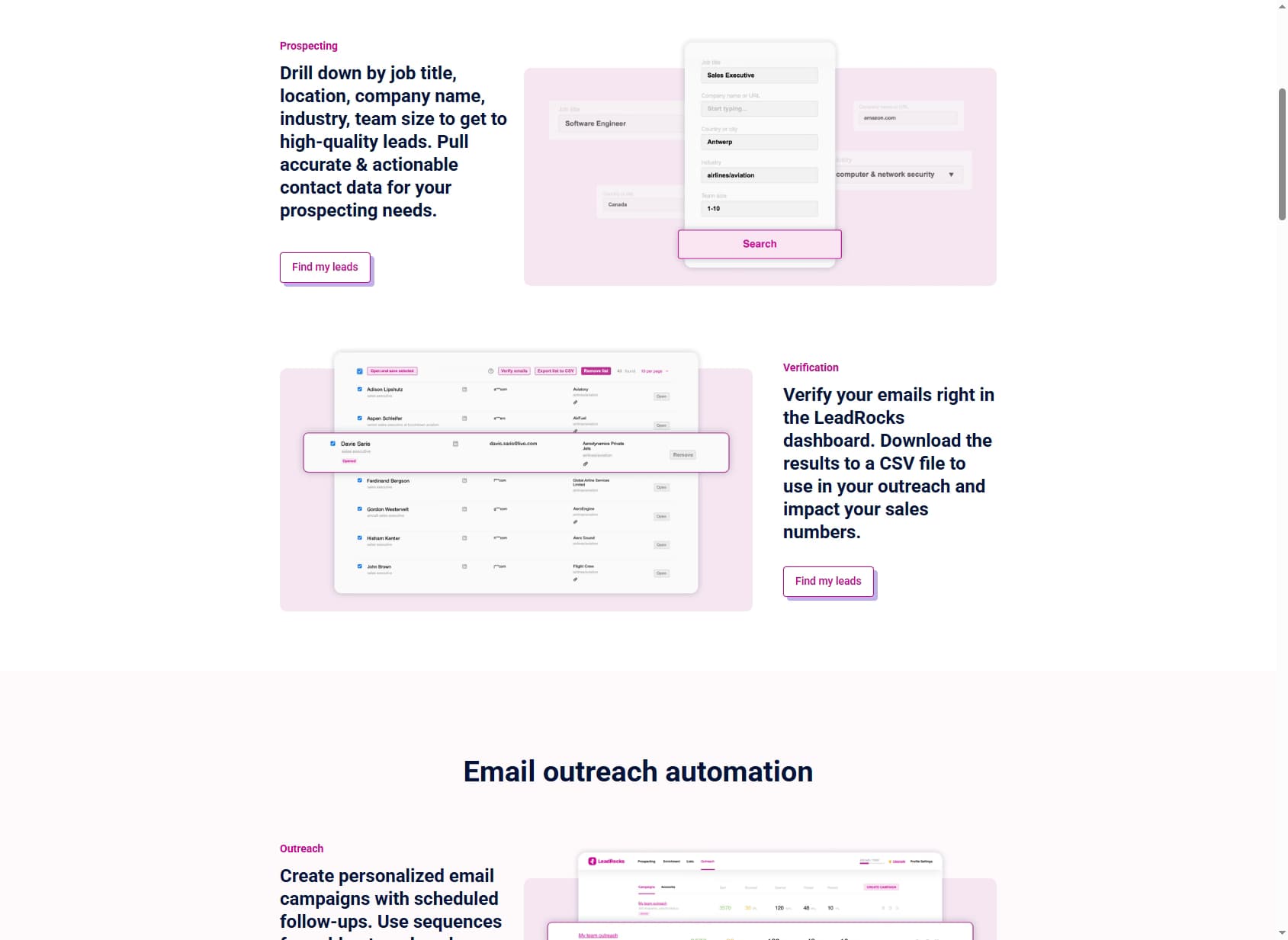
Beyond search, the platform packs in a Chrome extension for bulk extraction from LinkedIn Sales Navigator, a built-in email verifier, basic Gmail/Outlook sequencing, CSV export, and an API limited to email verification.
It is positioned as the cheapest entry point to a six-figure contact database, with a Free plan, a $29/month Starter, and a heavily promoted $79 AppSumo lifetime deal.
The headline distinction from a platform like SyncGTM is the data model. LeadRocks is single-source — every lookup hits one static database.
A waterfall contact provider queries dozens of vendors in sequence and returns whichever one resolves the contact, which is the structural difference that shows up directly in real, deliverable hit rate.
LeadRocks Pricing: Plans, Credits, and What You Actually Pay
LeadRocks pricing starts at $0/month for a Free plan with 50 credits, then climbs to a $580/month Enterprise tier.
Credits are consumed on every lookup — including ones that return invalid or blank contacts.
| Plan | Monthly Price | Credits | Notes |
|---|---|---|---|
| Free | $0 | 50 credits | Trial of database and verifier |
| Starter | $29/mo | 1,000 credits | Entry tier for solo prospectors |
| Growth | $145/mo | 5,000 credits | Most-promoted monthly plan |
| Professional | $290/mo | 10,000 credits | Higher-volume outbound teams |
| Enterprise | $580/mo | 20,000 credits | Top published monthly tier |
| AppSumo LTD | $79 one-time | 5,000 credits/mo | Lifetime deal, code stacking allowed |
The real cost math
The per-credit price looks attractive — as low as $0.029 on Starter, and effectively pennies on the $79 AppSumo lifetime deal.
But the credit model hides a real cost. Credits are spent on every lookup, even when the email comes back invalid — and independent tests put real validity at 18-53%.
That math turns the $29/month Starter tier into a real cost of roughly $0.10-$0.15 per usable contact, before factoring in the external verifier you will need to run on top.
The 50-credit free tier is enough to kick the tires but too small to pressure-test accuracy on a real list.
Teams pricing this against a waterfall provider should compare cost per verified, deliverable contact — not cost per credit. See our roundup of the best B2B email finder tools for a like-for-like comparison.
LeadRocks Data Coverage and Accuracy: What Users Actually Get
LeadRocks' accuracy claim and its real performance live in different worlds. The vendor markets 98%+ email accuracy across a claimed 100M+ contact database.
That figure is self-reported, not an independent benchmark.
Independent reviewers consistently land at a fraction of the marketed number. One Prospeo review found 53% of LeadRocks emails valid after external verification. A separate batch of 4,828 emails came back at just 18% valid — 873 usable out of 4,828 — after deduplication and verification.
Where the gap comes from
Geo-targeting is where LeadRocks draws some of the sharpest criticism. One reviewer searching for Rhode Island business owners received 17,775 nationwide records — only 56 were actually in Rhode Island, which makes territory-based prospecting effectively unworkable.
The built-in email verifier is the other structural weakness. It appears to check captured emails against LeadRocks' own database rather than running real multi-source validation, and a January 2026 AppSumo reviewer reported it returned 'unknown status' for every email tested.
There is also a coverage-versus-accuracy distinction. The 98% figure describes accuracy on data LeadRocks marks as verified — not real-world deliverability across a working outbound list, where a meaningful share of contacts won't resolve in any single static database.
This is the core argument for waterfall enrichment. By querying 50+ providers and keeping the first verified result, a waterfall raises real, deliverable hit rate on the exact contacts a single database misses — and only charges on success, so you stop paying for blanks.
See our explainer on why waterfall email finders beat single-source tools on usable hit rate.
LeadRocks Key Features
LeadRocks' feature set is narrow but coherent — built around search, scrape, verify, and send. The highlights:
| Feature | What It Does |
|---|---|
| 100M+ contact database | Search a claimed 100M+ B2B contact index with filters across role, industry, geography, and company size to build prospecting lists. |
| Email, phone, and LinkedIn lookup | Return work emails, phone numbers, and LinkedIn URLs for contacts surfaced from the database or scraped via the Chrome extension. |
| Chrome extension | Extract bulk contact data from LinkedIn Sales Navigator searches and individual LinkedIn profiles without leaving the browser tab. |
| Built-in email verifier | Run captured emails through a verifier before export, though independent tests suggest it relies on LeadRocks' own data rather than multi-source validation. |
| Basic email sequencing | Send 1:1 or short outbound sequences through Gmail or Outlook directly from the LeadRocks dashboard, without a separate outreach tool. |
| CSV export & API | Export contact lists as CSV for use in other tools. The API is limited to email verification rather than full enrichment endpoints. |
LeadRocks Pros: What It Does Well
- ✓Cheapest 100M+ database on the market. At $29/month for 1,000 credits — and $79 one-time on AppSumo — LeadRocks undercuts almost every comparable contact database by an order of magnitude.
- ✓Lifetime deal is genuinely useful. The $79 AppSumo LTD with code stacking gives solo founders 5,000 credits per month forever — a strong fit for a one-time list build.
- ✓Free tier with no card. The 50-credit free plan with no credit card required lets you spot-check the database and Chrome extension before paying.
- ✓All-in-one for solo prospectors. Search, scrape, verify, and send sit in one tool — a single $29/month subscription covers what would otherwise need a database, a verifier, and an outreach tool.
- ✓Chrome extension covers LinkedIn workflows. Bulk-extract contacts from LinkedIn Sales Navigator searches without leaving the browser, then return emails and phones in the same flow.
LeadRocks Cons: Where It Falls Short
- Email accuracy collapses in real use. LeadRocks markets 98%+ accuracy, but independent reviewers found only 18-53% valid emails after external verification. One test of 4,828 emails returned just 873 usable — an 18% hit rate that turns a cheap sticker price into 5x the effective cost.
- You pay for blanks. Credits are consumed on the lookup, not on a verified result. When 47-82% of contacts are unusable, the real cost per valid lead runs 2-5x the advertised per-credit math.
- Geo-targeting is unreliable. One reviewer searching for Rhode Island business owners received nationwide results — only 56 of 17,775 records were actually in-state, which makes territory-based prospecting effectively unworkable.
- The built-in verifier is weak. It appears to check against LeadRocks' own database rather than running real multi-source validation, and a January 2026 AppSumo reviewer reported it returned 'unknown status' for every email tested.
- No native CRM integrations. Export is CSV-only — there is no real-time push into HubSpot, Salesforce, Pipedrive, or Attio. Records go stale the moment you download them, and re-imports are manual.
- Single static database. LeadRocks finds only the contacts already in its 100M+ index. There is no waterfall fallback to a second or third provider when a lookup comes back empty — unlike platforms that query 50+ providers per contact.
LeadRocks vs SyncGTM: Waterfall Enrichment Compared
LeadRocks and SyncGTM solve a similar job — find and enrich B2B contact data — with opposite data models and opposite billing models.
LeadRocks queries one static database and charges on every lookup. SyncGTM runs a waterfall across 50+ providers and only charges on a verified result — which is the difference between paying for blanks and paying for usable leads.
| Feature | LeadRocks | SyncGTM |
|---|---|---|
| Starting Price | $29/mo (1,000 credits) | $99/mo |
| Data Sourcing Model | Single static 100M+ database | Waterfall across 50+ providers |
| Database Size | 100M+ contacts (claimed) | Best verified result across 50+ sources |
| Email Validity (Independent Tests) | 18-53% after external verification | Verified before charging — pay only on success |
| Phone Numbers | Yes, but limited and unverified | Yes — waterfall mobile + direct dials |
| Data Points per Lead | Email, phone, LinkedIn (~3 fields) | 76+ data points |
| Buying Signals | None | Hiring, funding, tech-change, job-change |
| CRM Integration | None — CSV export only | HubSpot, Salesforce, Pipedrive, Attio, Zoho |
| Workflow Automation | Basic Gmail/Outlook sequencing | AI agents + no-code workflow builder |
| Free Tier | 50 credits/month | Free plan available |
The honest take
LeadRocks wins on raw sticker price for a one-and-done list. If you are a solo founder buying a cheap 100M+ contact database, tolerating an 18-53% validity rate, and not scaling outbound, the $79 AppSumo lifetime deal is hard to beat on cost alone.
SyncGTM wins on real, deliverable hit rate and on total cost per usable contact.
Because it queries 50+ providers instead of one static database, it resolves the contacts LeadRocks misses — and because it only charges on a verified result, you stop paying for the 47-82% of credits that come back invalid. It adds 76+ data points per lead, hiring, funding, and tech-change lead enrichment signals LeadRocks does not offer, and native CRM sync to HubSpot, Salesforce, Pipedrive, Attio, and Zoho.
At $99/month, SyncGTM is the lower total-cost option for teams whose bottleneck is deliverability rather than per-credit price. For a broader market view, see our roundup of the best LeadRocks alternatives.
Who Should Use LeadRocks?
LeadRocks is the right tool in a narrow scenario: a solo founder or freelancer building a single, one-off contact list on a tight budget, who can absorb spending hours re-verifying data through an external tool.
Use LeadRocks if:
- You are a solo founder or freelancer building a one-off prospecting list on a sub-$100 budget.
- You will run captured emails through a separate verifier like NeverBounce or ZeroBounce before sending, and accept a 18-53% usable rate.
- The $79 AppSumo lifetime deal — 5,000 credits/month forever — is the structurally cheap entry point you need.
- CSV export covers your workflow and you have no need for native CRM sync, buying signals, or AI workflow automation.
Look elsewhere if:
- Deliverability is critical — LeadRocks' real 18-53% validity rate is a non-starter for cold-email campaigns where sender reputation matters.
- You run ongoing outbound at volume — a waterfall contact provider that only charges on success will be cheaper per usable lead at scale.
- You need native CRM integrations — LeadRocks ships CSV export only, with no HubSpot, Salesforce, or Pipedrive push.
- You want buying signals, deep firmographics, or AI workflow automation to prioritize accounts beyond basic contact data.
LeadRocks Review: Frequently Asked Questions
Is LeadRocks worth it in 2026?
LeadRocks is worth it for solo founders or freelancers building a single, one-off list under tight budget who can tolerate spending hours re-verifying data. At $29/month for 1,000 credits — and an $79 AppSumo lifetime deal — it is one of the cheapest 100M+ contact databases on the market. It is not worth it for any team running ongoing outbound at volume. Independent reviewers tested LeadRocks emails and found only 18-53% valid after external verification, despite a marketed 98%+ accuracy claim. Because credits are charged on the lookup rather than on a verified result, effective cost per usable lead runs 2-5x the sticker price. A waterfall enrichment platform that queries 50+ providers and only charges on success will outperform LeadRocks on real, deliverable hit rate — which is what matters once outbound moves beyond a one-time list.
How much does LeadRocks cost?
LeadRocks pricing starts at $0/month for a Free plan with 50 credits, then Starter at $29/month (1,000 credits), Growth at $145/month (5,000 credits), Professional at $290/month (10,000 credits), and Enterprise at $580/month (20,000 credits). It also offers an AppSumo lifetime deal from $79 one-time for 5,000 credits per month, with code stacking allowed for higher volume. Credits are spent on every lookup, including ones that return invalid or blank contacts — so when independent tests put real validity at 18-53%, plan capacity in usable leads, not in advertised credits. The effective cost per verified contact is 2-5x higher than the per-credit math suggests.
Is LeadRocks data accurate?
LeadRocks markets 98%+ email accuracy, but real-world tests tell a different story. One reviewer found 53% of extracted emails valid after running them through external verification. A separate batch of 4,828 LeadRocks emails came back at just 18% valid — 873 usable out of 4,828 — after deduplication and verification. Geo-targeting is also unreliable: one user searched for Rhode Island business owners and received 17,775 records of which only 56 were actually in Rhode Island. The built-in verifier appears to only compare against LeadRocks' own database, and one January 2026 AppSumo reviewer reported it returned 'unknown status' for every email tested. The 98% number describes accuracy on data LeadRocks marks as verified, not coverage or real deliverability on a working outbound list.
Does LeadRocks offer a free trial?
Yes. LeadRocks offers a Free plan with 50 credits per month, no credit card required. That is enough to spot-check the database and the Chrome extension, but too small to pressure-test real validity on a meaningful list. A 500-contact pilot will exhaust the free tier in a single batch. Most buyers move to Starter at $29/month or the $79 AppSumo lifetime deal to evaluate further. For a fair head-to-head, run the same list through LeadRocks and a waterfall provider like SyncGTM and compare cost per verified, deliverable contact — not cost per credit.
What are the best LeadRocks alternatives?
The best LeadRocks alternative depends on what you are solving for. For higher hit rates on the same contacts, a waterfall enrichment platform like SyncGTM queries 50+ providers and only charges on a verified result, which structurally beats any single-database tool. For raw match rate via a 100+ provider table model, Clay is the closest comparison. For free-tier volume, Apollo.io ships 10,000 email credits per month on a free plan. For pure email-finding with strong verification, Hunter.io and Prospeo are solid single-source picks. For a fuller list, see our roundup of the best LeadRocks alternatives for B2B enrichment in 2026. If your bottleneck is deliverability and you are tired of re-verifying lists, the waterfall model is the structural upgrade.
Does LeadRocks integrate with my CRM?
Not natively. LeadRocks exports leads as CSV files only — there is no real-time push or two-way sync into HubSpot, Salesforce, Pipedrive, or Attio. Its API is limited to email verification rather than full enrichment. That means enriched records start going stale the moment you download them, and you must re-import manually after every list run. For teams that want native CRM sync — so enriched contacts flow into HubSpot, Salesforce, Pipedrive, Attio, or Zoho automatically — a platform with native connectors is the structural fit, not LeadRocks.