

MailerCheck Review 2026: Email Verification Pricing, Accuracy & Verdict

By Kushal Magar · June 11, 2026 · 11 min read · Last updated: September 30, 2026
Key Takeaway
MailerCheck is a pay-as-you-go email verifier at $0.01/email with non-expiring credits and inbox placement testing. Best for MailerLite users cleaning lists before campaigns. It verifies emails — it does not find them. Bulk packs drop the price to $0.005 per credit at 100,000 credits (as of September 2026), and 10 free credits let you test the verifier before buying.
MailerCheck is a pay-as-you-go email verification and deliverability platform from MailerLite, charging $0.01 per email verification with non-expiring credits and a claimed 98%+ delivery rate. It verifies bulk lists, tests inbox placement, and flags spam content — but does not find or enrich B2B contact data. Our rating: 4.0/5.
The tool solves one problem well: you have a list of emails and need to know which ones are safe to send to. MailerCheck runs each address through syntax, domain, and SMTP checks, flags catch-all domains as risky, removes duplicates for free, and returns a cleaned list with status codes for each address.
The limitation is equally clear: MailerCheck works on lists you already have. If your list is thin or you need to source new contacts from scratch, verification does not help — you need an email finder or enrichment tool upstream, and MailerCheck to clean what it returns.
This review covers the credit pricing math, accuracy in practice (including the over-invalidation concern from user reviews), the inbox placement and email insights features, integrations, and a direct comparison with NeverBounce and ZeroBounce for teams evaluating email verification options in 2026.
What Is MailerCheck?
MailerCheck is an email list verification and deliverability testing product built by the MailerLite team. With over 252,000 customers worldwide, it targets email marketers and marketing operations teams who need to reduce bounce rates before campaign sends. The product bundles three distinct capabilities under one pay-as-you-go credit system:
| Feature | What It Does | Credit Cost |
|---|---|---|
| Email List Verification | Syntax check, domain validation, SMTP verification, duplicate removal, disposable/spam email detection | 1 credit per address |
| Email Insights | Spam word detection, broken link flagging, blocklist checks, content analysis before send | 200 credits per test |
| Inbox Placement | Predicts inbox vs. spam delivery across Gmail, Yahoo, AOL, and other major providers before your campaign launches | 200 credits per test |
The MailerLite SSO integration is the platform's strongest differentiator. MailerLite users can import subscriber segments directly into MailerCheck without CSV exports, run verification, and push cleaned lists back as custom fields — a seamless loop that no competitor replicates for MailerLite specifically.
For non-MailerLite users, MailerCheck is a capable but unremarkable verification tool competing in a crowded market dominated by NeverBounce and ZeroBounce.

MailerCheck Pricing: Credits and What You Actually Pay
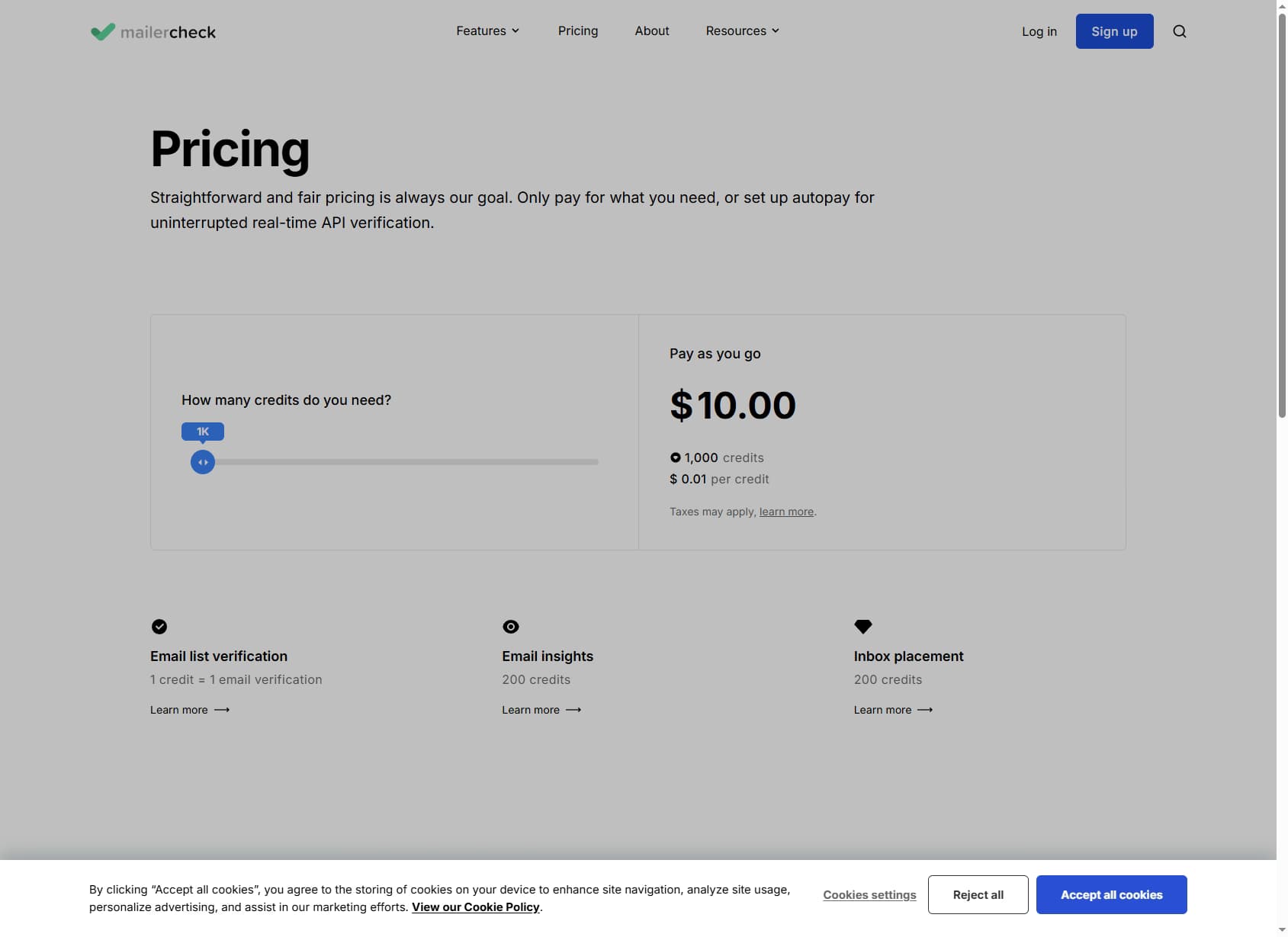
MailerCheck uses a pure pay-as-you-go credit model with no monthly subscription tiers. You buy credits in blocks, credits never expire, and there are no seat fees. This is the most flexible structure in the email verification category — but it also means there is no subscription discount for consistent usage.
| Credit Volume | Approx. Cost | Cost per Credit | Emails Verifiable |
|---|---|---|---|
| 1,000 (minimum) | $10 | $0.01 | 1,000 |
| 10,000 | $80 | $0.008 | 10,000 |
| 50,000–100,000 | $300–500 | $0.006–$0.005 | 50,000–100,000 |
| 500,000–1,000,000 | $1,500–2,000 | $0.003–$0.002 | 500,000–1,000,000 |
| Free trial | $0 | — | 10 emails |
Credit pack prices from MailerCheck's pricing page as of September 2026; taxes may apply. MailerCheck offers no discounts beyond bulk pricing, and refunds are only given if it ends your service without cause, so buy in blocks you expect to use.
Pricing comparison: MailerCheck vs NeverBounce vs ZeroBounce
At base rate, MailerCheck's $0.01/email matches Kickbox exactly and is slightly above NeverBounce ($0.008/email at comparable volumes). ZeroBounce charges $15/mo for 2,000 credits on its lowest subscription tier — which works out to $0.0075/email but requires a monthly commitment. For irregular usage, MailerCheck's non-expiring PAYG credits are the better structure.
The non-expiring credit model is genuinely useful for teams that verify lists seasonally — pre-campaign bursts rather than continuous monthly use. Competitors' monthly credit models reset unused credits, which wastes money on months with low activity.
MailerCheck Key Features
Email list verification
The core product validates email addresses through a multi-step process: syntax check (format validity), domain validation (MX record lookup), SMTP verification (server-level handshake), disposable email detection, spam trap identification, and role-based address flagging (info@, support@, admin@). Duplicate removal is included at no extra cost — a minor but practical differentiator since most tools charge credits for duplicates.
Each address in a verified list receives a status code: Valid, Invalid, Unknown (catch-all), or Risky. Catch-all domains return "Unknown" by design — these are domains where the mail server accepts all incoming email without confirming whether a specific address exists, making verification impossible without actually sending. According to Hunter's benchmarks, catch-all domains represent approximately 28% of B2B email datasets — a significant portion that MailerCheck, like all verifiers, cannot definitively classify.
Email Insights (content testing)
At 200 credits per test ($2.00 at base rate), Email Insights analyzes your email content before sending. It flags spam trigger words, checks for broken links, verifies that you are not on major blocklists, and provides a deliverability score. This is genuinely useful for teams managing high-volume outbound — a single content issue can tank deliverability for an entire sending domain.
Most email verifiers do not include content testing at all. ZeroBounce does not offer it. NeverBounce does not offer it. MailGenius is the closest standalone competitor in this category. For teams using MailerCheck primarily, having both verification and content analysis in one credit pool is a workflow simplification.
Inbox Placement testing
Inbox Placement (200 credits per test) sends a test email to seed addresses at Gmail, Yahoo, AOL, and other major providers before your actual campaign goes out. Results show whether your email lands in the primary inbox, promotions tab, or spam folder at each provider.
This is a pre-send diagnostic, not a guarantee. If your test sends land in spam at Gmail, you know to investigate SPF/DKIM/DMARC alignment, domain reputation, or content issues before deploying to your real list. For cold outbound campaigns where deliverability is existential, this feature alone can justify MailerCheck's cost.
Real-time API
The real-time API validates individual email addresses as they are collected — at form submission, CRM entry, or lead enrichment trigger. API access is included without additional cost beyond credit consumption. Rate limits apply but are sufficient for standard form-validation use cases. The MailerCheck API documentation covers single-address and bulk endpoints.
MailerCheck Pros: What It Does Well
- ✓Non-expiring credits. Credits never reset or expire. This is a meaningful cost advantage for teams with seasonal verification needs — you buy once, use whenever. NeverBounce and ZeroBounce credits expire monthly.
- ✓Inbox Placement and Email Insights in one platform. No competitor bundles content testing, inbox placement prediction, and email verification in a single credit pool at this price point. For deliverability-focused teams, this eliminates a second tool.
- ✓Native MailerLite integration. SSO login, direct segment import, and results exported as custom fields back into MailerLite. No CSV export/import cycle. If your stack runs on MailerLite, MailerCheck is the tightest-integrated verification option available.
- ✓Free duplicate removal. Deduplication is included at no extra credit cost. Competitors often count deduplication runs against credit totals. On large lists, this saves meaningful credits.
- ✓Simple setup, no long-term contracts. No onboarding calls, no annual commitment, no demo required. Sign up, buy credits, upload a list. The platform is operational in under five minutes. Capterra rates MailerCheck 4.9/5 based on user reviews, with ease of use as the most-cited strength.
MailerCheck Cons: Where It Falls Short
- No B2B contact finding. MailerCheck verifies emails — it does not find them. If you need to source verified emails for new prospects, you need a separate enrichment tool entirely.
- Over-invalidation noted by users. Multiple G2 and Capterra reviewers report MailerCheck flags more emails as invalid than competing tools, potentially discarding deliverable catch-all addresses.
- Narrow ESP integration list. Six native ESP integrations covers MailerLite's core user base but leaves Salesforce, HubSpot, Outreach, Salesloft, and most CRMs requiring API or Zapier workarounds.
- Catch-all domain uncertainty. Addresses at catch-all domains — roughly 28% of B2B email datasets — are classified as 'risky' with no definitive verdict, which is industry-wide but still limits practical utility.
- No automation or scheduling. MailerCheck lacks automated list monitoring or scheduled re-verification. You trigger verification manually each time, which creates process friction for teams managing continuously updated lists.
- Large list timeouts. Users with lists above 100,000 records report occasional timeout issues during bulk verification runs.
- Minimal free tier. 10 credits on signup is negligible for accuracy testing. Meaningful evaluation requires buying a paid credit block.
MailerCheck vs Alternatives: Comparison Table
MailerCheck competes most directly with dedicated email verifiers such as NeverBounce, ZeroBounce, and Kickbox. Here is how it compares with the two biggest names across the dimensions that matter most.
| Feature | MailerCheck | NeverBounce | ZeroBounce |
|---|---|---|---|
| Starting Price | $0.01/email (PAYG) | $0.008/email | $15/mo (2,000 credits) |
| Verification Method | Syntax + domain + SMTP | Real-time + batch | AI-scoring + SMTP |
| Claimed Accuracy | 98%+ delivery guarantee | 97–99% | 96–98% |
| Inbox Placement Testing | Yes — 200 credits per test | No | Yes |
| Email Insights (Spam/Content) | Yes — 200 credits per test | No | No |
| API Access | Yes — real-time API | Yes | Yes |
| ESP Integrations | 6 (MailerLite, Mailchimp, AC, GetResponse, Kit, Zapier) | 80+ integrations | 30+ integrations |
| Non-Expiring Credits | Yes | No | No |
The honest verdict on each option
MailerCheck wins for MailerLite users and teams that need non-expiring PAYG credits with inbox placement testing included. It is the strongest deliverability-focused verification tool in the category when you need all three features (verify, content test, inbox placement) without separate subscriptions.
NeverBounce wins on integration breadth (80+ integrations vs. MailerCheck's 6) and slightly lower per-email cost at volume. It is the better choice for non-MailerLite stacks where you need native connectors to HubSpot, Salesforce, or Outreach without Zapier.
ZeroBounce wins on review volume and track record — 4.7/5 across 1,361 reviews on G2 versus MailerCheck's 4.6/5 across 10 reviews. The AI-based email scoring for catch-all domains is more sophisticated than MailerCheck's binary Valid/Unknown classification.
None of the three will find new contacts for you — they all verify lists you already have. If you still need to build the list, start with our guide to the best waterfall contact providers, then verify the output before you send.
Who Should Use MailerCheck?
MailerCheck is the right tool in three specific scenarios. Outside these scenarios, alternatives offer better fit.
- MailerLite users. The native SSO integration and direct segment import/export loop make MailerCheck the obvious choice if MailerLite is your ESP. No other verification tool provides this seamless workflow for MailerLite specifically.
- Teams with seasonal verification needs. Non-expiring credits are the key advantage here. If you send campaigns quarterly rather than monthly, PAYG without expiry beats subscription models that reset unused credits every 30 days.
- Email marketers who need deliverability testing bundled. If you want verification, spam content flagging, and inbox placement prediction in one credit pool without subscribing to three separate tools, MailerCheck is the only option in this price range that bundles all three.
Do not use MailerCheck if:
- You need to source new B2B contacts from scratch. MailerCheck verifies — it does not find. You will need a separate email finder or enrichment tool first.
- Your stack runs on Salesforce, HubSpot, or Outreach natively. The integration depth is thin outside the MailerLite ecosystem — NeverBounce has 80+ integrations vs. MailerCheck's 6.
- You send high-volume campaigns continuously and need monthly subscription pricing. ZeroBounce's subscription tiers are cheaper per email at consistent monthly volumes above 20,000 addresses.
- You need sophisticated catch-all domain scoring. ZeroBounce's AI-based classification is more nuanced than MailerCheck's Valid/Unknown binary for catch-all domains. See our MailerCheck alternatives guide for more options.
If MailerCheck's verify-only scope is a dealbreaker, SyncGTM is one alternative worth a look: its waterfall enrichment across 50+ data providers finds verified emails, phone numbers, and firmographics.