5 Best Mailfloss Alternatives for B2B Enrichment in 2026

By Kushal Magar · June 13, 2026 · 13 min read
Key Takeaway
Mailfloss is an automated email list hygiene tool — it connects to your ESP and cleans subscriber lists continuously, but does not find new contacts, enrich data, or support B2B outbound prospecting. The 5 best Mailfloss alternatives in 2026 are: SyncGTM (waterfall enrichment across 50+ providers with verified emails, 76+ data points, and CRM sync from $99/mo), ZeroBounce (AI catch-all scoring and spam-trap detection from $18/mo), NeverBounce (pay-as-you-go from $0.003/email with 80+ integrations), Bouncer (GDPR-compliant toxicity checks and catch-all probability scoring from $0.0025/email), and MillionVerifier (budget bulk verification at $0.0012/email).
The best Mailfloss alternatives solve a problem that Mailfloss does not: they find and enrich contacts before verifying them, rather than only cleaning a subscriber list you already own inside an ESP.
Mailfloss built its reputation on automated email list hygiene — it connects to 40+ email service providers and runs daily sweeps to remove invalid addresses, fix typos, and flag risky contacts. It does that job well. The problem is scope.
Mailfloss has no contact database, no email finder, no B2B enrichment layer, and no outreach functionality. For B2B teams doing outbound prospecting, that means the tool is solving the wrong problem: it cleans the subscriber list you have, but gives no help building the prospect list you need.
According to Gartner's B2B data quality research, contact data decays at roughly 30% per year. A tool that only cleans what you already have cannot keep pace with that decay. This guide compares five alternatives — three of them make Mailfloss's standalone hygiene step unnecessary entirely.
Quick Summary
The best Mailfloss alternatives in 2026 are SyncGTM, ZeroBounce, NeverBounce, Bouncer, and MillionVerifier. SyncGTM is the top pick for most B2B teams — waterfall enrichment across 50+ providers, 76+ data points per verified person, buying signals, and native CRM sync from $99/mo.
TL;DR: Best Mailfloss Alternatives in 2026
- SyncGTM — Best overall for B2B prospecting. Waterfall enrichment across 50+ providers, verified emails + phones, 76+ data points, buying signals, and CRM sync from $99/mo with a free tier.
- ZeroBounce — Best like-for-like Mailfloss upgrade for verification depth. AI catch-all scoring, spam-trap detection across 30+ networks, and transparent pricing from $18/mo.
- NeverBounce — Best for high-volume bulk cleaning at low cost. Real-time API, 80+ native integrations, and pay-as-you-go from $0.003/email.
- Bouncer — Best for GDPR-compliant teams. Toxicity checks, catch-all probability scoring, and pay-as-you-go from $0.0025/email.
- MillionVerifier — Best budget pick. Bulk verification at $0.0012/email — the lowest per-email cost in the category.
Why Teams Look for Mailfloss Alternatives
Mailfloss is an ESP hygiene tool, not a B2B prospecting platform. It answers "how do I keep my existing subscriber list clean?" — not "who should I reach out to, what is their direct dial, and are they currently in-market?" That scope gap, combined with the tool's ESP-first design, drives four recurring pain points.
ESP-only, no standalone verification. Mailfloss works inside your email service provider — it cannot accept a raw list of B2B prospect emails and return verification results. Teams running outbound prospecting need a tool that validates any list, not just a connected ESP subscriber base.
No contact finding or enrichment. Mailfloss maintains a list you already built. B2B outbound teams still need a separate tool to find contacts, a separate verifier for those contacts, and a separate sender to reach them. That is three tools and three data hand-offs where there could be one.
ESP subscription model adds up at scale. Mailfloss charges by contacts managed per month ($17/mo for 5,000 contacts, $72/mo for 100,000). For teams with large prospect databases that are not inside an ESP, this pricing model is inefficient — you are paying for ongoing subscription access rather than verification throughput.
No CRM sync or outreach layer. Mailfloss exports cleaned lists back to your ESP. It has no native CRM sync, no sequences, and no analytics on contact-level engagement. Every cleaned contact still needs a separate tool to act on.
According to G2's email verification category data, teams that switch from standalone list hygiene to integrated enrichment platforms report 35–50% higher deliverability and spend 60% less time on manual list maintenance. The five alternatives below each address one or more of these gaps. For a broader view of how verification fits into B2B prospecting, see our best waterfall contact providers guide.
1. SyncGTM
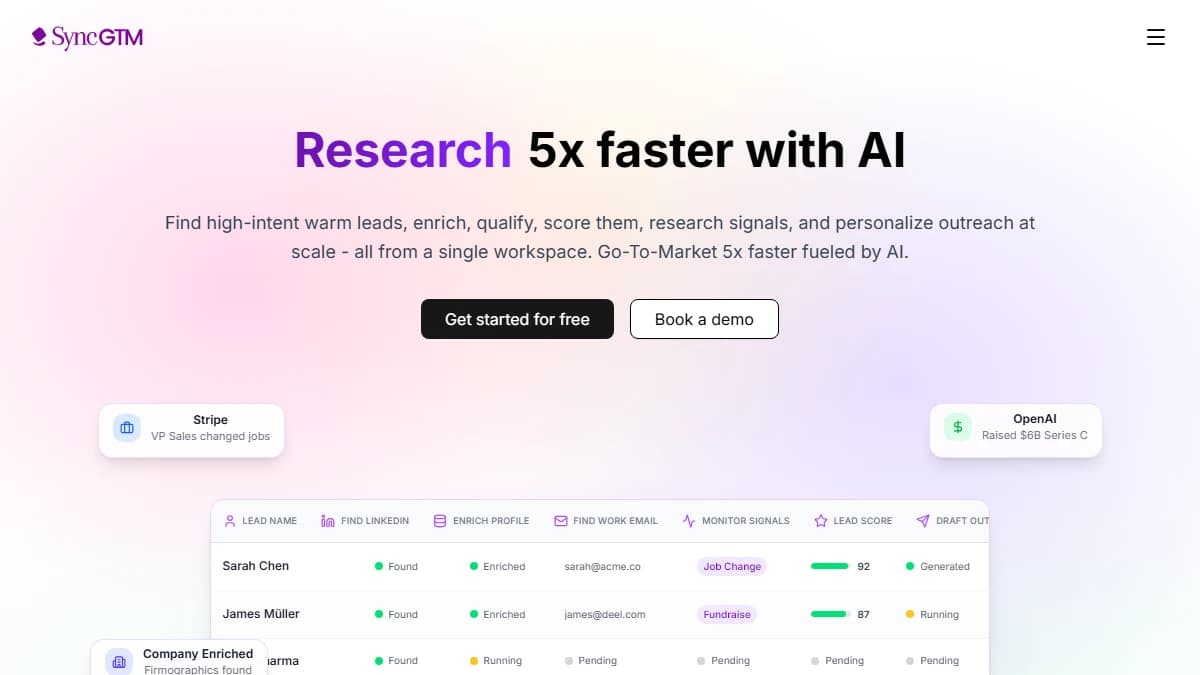
SyncGTM — waterfall enrichment across 50+ providers with verified emails, phones, and integrated outreach
SyncGTM is a B2B prospecting platform built around waterfall enrichment — querying 50+ data providers in sequence until verified contact data is found. Where Mailfloss maintains a subscriber list inside your ESP, SyncGTM builds and verifies a prospect list from scratch: verified email, direct dial, LinkedIn, and 76+ firmographic and technographic data points in one pass from a target account or company name.
The key distinction for B2B outbound teams is that verification is embedded in the enrichment output. Every email SyncGTM returns has been cross-referenced across multiple providers before delivery — making a separate hygiene step redundant. You do not pay a monthly subscription to maintain a pre-existing list; verified deliverability is the baseline on every new contact SyncGTM finds.
SyncGTM also covers the entire workflow Mailfloss leaves open. Buying signal detection surfaces in-market accounts before competitors reach them. Native CRM sync — HubSpot, Salesforce, Pipedrive, Attio, Zoho — routes enriched leads without Zapier middleware. Built-in outreach sequencing closes the loop without a third tool.
On catch-all domains — where standard verifiers flag addresses as accept-all without resolution — SyncGTM cross-references across providers to recover a meaningful share of those addresses as confirmed deliverable. Internal benchmarks show waterfall enrichment across 50+ providers delivers 20–40% higher contact coverage than any single data source. For the full breakdown of how waterfall enrichment works, see our waterfall enrichment guide.
Pros
- • Waterfall enrichment across 50+ providers — verification built into output, not a separate step
- • 76+ data points per verified person: email, direct dial, LinkedIn, firmographics, technographics, buying signals
- • Outreach included — no additional sequencing tool needed
- • Native CRM sync to HubSpot, Salesforce, Pipedrive, Attio, Zoho
- • AI research agents for custom enrichment beyond standard fields
- • Free tier with 200 credits/month, no credit card required
Cons
- • Not designed for automated ESP hygiene — Mailfloss's core use case
- • Starter plan at $99/mo is a higher floor than Mailfloss's $17/mo
- • No 40+ ESP native integrations for continuous subscriber list cleaning
Best for: B2B teams doing outbound prospecting — building lists from ICP accounts, enriching with 76+ data points, and routing verified buyers to CRM or outreach sequences.
Pricing: Free tier (200 credits/mo). Starter $99/mo. Pro $249/mo. Business $649/mo.
2. ZeroBounce

ZeroBounce — bulk email verification with AI catch-all scoring, spam-trap detection, and transparent pricing
ZeroBounce is the most direct Mailfloss replacement for teams that want deeper email verification with better technical coverage. It is not ESP-bound — ZeroBounce accepts any email list via bulk upload or real-time API, making it usable for B2B prospect lists that never touched an ESP.
The clearest technical differentiator over Mailfloss is spam-trap detection across 30+ networks — a capability Mailfloss does not advertise. ZeroBounce also uses AI scoring to classify catch-all (accept-all) domains at the individual address level, rather than simply flagging the entire domain. On enterprise B2B lists where catch-all configurations are common, this recovers a meaningful share of valid contacts.
ZeroBounce publishes its full rate card: $18/mo for 2,000 monthly verifications, $0.008/email pay-as-you-go. It also includes an email finder for domain-based prospecting and appends activity data to validated addresses — basic engagement signals alongside deliverability status. For a full benchmark, see our ZeroBounce review 2026.
Pros
- • Not ESP-bound — accepts any email list, not just connected subscriber bases
- • AI catch-all scoring — resolves what Mailfloss flags as accept-all
- • Spam-trap detection across 30+ networks (Mailfloss has no published equivalent)
- • Email finder included — basic contact discovery Mailfloss cannot do
- • Activity data layer — appends engagement signals alongside deliverability status
- • 35+ native integrations including Mailchimp, HubSpot, Salesforce
Cons
- • No waterfall enrichment, firmographics, or CRM push — verification-only
- • No outreach layer — verified contacts still need a separate sending tool
- • Email finder is domain-based only, not a full contact database
- • Pay-as-you-go at $0.008/email is higher than NeverBounce ($0.003/email)
Best for: Teams that need flexible bulk verification outside an ESP — with AI catch-all resolution and spam-trap detection beyond what Mailfloss delivers.
Pricing: Free (100 verifications/mo). Monthly from $18/mo (2,000 verifications). Pay-as-you-go from $0.008/email.
3. NeverBounce
NeverBounce — high-volume bulk email verification with real-time API and 80+ native integrations
NeverBounce is a developer-first email verification platform that undercuts Mailfloss on per-email cost while offering significantly wider integration coverage. Pay-as-you-go starts at $0.003/email — compared to Mailfloss's effective rate of $0.0034/email on the Starter plan ($17/mo for 5,000 contacts) and $0.00072/email on the Pro plan ($72/mo for 100,000 contacts).
NeverBounce's real-time API validates addresses at the point of form entry or CRM import — not only as a batch or scheduled sweep. The Sync feature re-verifies lists on a schedule automatically. For teams that want continuous list hygiene without being locked to one ESP, Sync replicates Mailfloss's core behavior across any data source via API.
NeverBounce is owned by ZoomInfo, which means enterprise infrastructure and uptime SLAs. It connects natively to 80+ platforms — broader than Mailfloss's 40+ ESP integrations. For a full analysis of NeverBounce's verification capabilities, see our NeverBounce review 2026.
Pros
- • Pay-as-you-go from $0.003/email — competitive with Mailfloss at scale
- • Real-time API with point-of-entry validation — not just scheduled sweeps
- • Sync feature for automatic list re-verification — replicates Mailfloss's core behavior without ESP lock-in
- • 80+ native integrations: Mailchimp, HubSpot, Salesforce, Marketo
- • 98%+ accuracy claimed; ZoomInfo enterprise infrastructure
- • Published pricing — full rate card on homepage
Cons
- • No spam-trap detection (ZeroBounce advantage)
- • No contact finding or enrichment — verification-only
- • No outreach layer — verified contacts need a separate sending tool
- • Catch-all handling flags unknowns but does not resolve with AI scoring
- • ZoomInfo ownership raises data-sharing concerns for some teams
Best for: Teams running high-volume email list cleaning across any data source — or developer teams embedding real-time verification into a product with 80+ integration options.
Pricing: Pay-as-you-go from $0.003/email. Monthly plans from $10/mo (1,000 verifications).
4. Bouncer

Bouncer — GDPR-compliant email verification with toxicity checks and catch-all probability scoring
Bouncer is a GDPR-compliant email verification platform trusted by over 2,000 companies across 6 continents. It is the strongest Mailfloss alternative for European B2B teams where data compliance is a hard requirement — Bouncer is SOC 2 Type II certified and built with GDPR as a design principle, not a checkbox.
Bouncer's standout feature is its toxicity check layer. Beyond standard syntax and SMTP validation, Bouncer flags addresses that historically generate complaints, spam traps, or abuse reports — a reputation signal that Mailfloss does not provide. It also includes a Bounce Estimate tool that predicts list-level bounce rate before you send, giving teams a risk signal on the full list rather than just individual addresses.
Catch-all resolution is more nuanced than Mailfloss's approach. Bouncer assigns each catch-all address a deliverability probability rather than simply flagging the domain and stopping there. Pricing starts at $0.0025/email — no ESP subscription required. For a broader look at GDPR-compliant verification alternatives, see our Bouncer alternatives guide.
Pros
- • SOC 2 Type II certified and GDPR-compliant by design
- • Toxicity checks flag high-risk addresses Mailfloss does not identify
- • Catch-all deliverability probability scoring — more resolution than a binary flag
- • Bounce Estimate tool predicts list-level bounce rate before sending
- • Not ESP-bound — accepts any B2B prospect list via upload or API
- • Published pricing from $0.0025/email — no subscription lock-in
Cons
- • No contact finding or enrichment — verification-only
- • No outreach layer — verified contacts still need a separate tool
- • Smaller integration ecosystem than ZeroBounce or NeverBounce
- • Processing speed can lag on very large batch jobs vs NeverBounce
Best for: European B2B teams where GDPR compliance is non-negotiable, or any team that wants toxicity scoring and deliverability probability on catch-all addresses.
Pricing: Pay-as-you-go from $0.0025/email. Plans from $8/mo (2,000 verifications). Volume pricing available.
5. MillionVerifier
MillionVerifier — bulk email verification at the lowest per-email cost in the category
MillionVerifier is the budget-first Mailfloss alternative for teams that need high-volume bulk verification and are optimizing purely on cost. At $0.0012/email for large batch jobs, it offers the lowest per-email rate in the category — and unlike Mailfloss, it accepts any email list without requiring an ESP integration.
MillionVerifier claims 99%+ accuracy and processes batches at high throughput — 1M+ email verifications typically complete within hours. It covers the standard verification stack: syntax, domain MX, catch-all detection, disposable address flagging, and SMTP handshake. Simplicity is by design: one job, lowest cost, straightforward output.
The trade-off is feature depth. MillionVerifier has no spam-trap detection, no AI catch-all scoring, no activity data, and a limited integration ecosystem compared to ZeroBounce or NeverBounce. For teams that have a simple use case — validate a large list cheaply and accurately, without subscribing to Mailfloss — MillionVerifier is the most cost-effective swap. For teams with compliance requirements or complex catch-all exposure, ZeroBounce or Bouncer serve better.
Pros
- • Lowest per-email cost in the category at $0.0012/email
- • 99%+ claimed accuracy on standard verification checks
- • High throughput: 1M+ emails verified typically within hours
- • Covers syntax, MX, catch-all, disposable, and SMTP — the full baseline stack
- • Not ESP-bound — accepts any list via bulk upload
- • No subscription required — pay per batch
Cons
- • No spam-trap detection (ZeroBounce, Bouncer advantage)
- • No AI catch-all resolution scoring
- • Limited integration ecosystem vs NeverBounce (80+) or ZeroBounce (35+)
- • No contact finding, enrichment, or outreach layer
- • No real-time API for point-of-entry validation — batch-only workflow
Best for: Teams with large lists and simple use cases — bulk verification at the lowest per-email cost in the category, without ESP subscription lock-in.
Pricing: Pay-per-batch from $0.0012/email. Example: 1M emails from $1,200. No subscription.
Side-by-Side Comparison
| Feature | SyncGTM | ZeroBounce | NeverBounce | Bouncer | MillionVerifier |
|---|---|---|---|---|---|
| Email verification | Embedded in waterfall | Yes — 99%+ claimed | Yes — 98%+ claimed | Yes — 99%+ claimed | Yes — 99%+ claimed |
| ESP-free (any list) | Yes | Yes | Yes | Yes | Yes |
| Catch-all resolution | Multi-provider cross-check | AI scoring | Flagged, not resolved | Deliverability probability | Flagged only |
| Contact finding | Yes — 50+ providers | Domain-based finder | No | No | No |
| B2B enrichment (76+ fields) | Yes | No | No | No | No |
| Spam-trap detection | Via waterfall providers | Yes — 30+ networks | No | Yes — toxicity checks | No |
| Outreach sequencing | Yes — built in | No | No | No | No |
| GDPR / SOC 2 | Yes | Yes | Yes | Yes — SOC 2 Type II | Yes |
| Starting price | $99/mo (free tier available) | $18/mo or $0.008/email | $0.003/email | $0.0025/email | $0.0012/email |
| Free tier | 200 credits/mo | 100 verifications/mo | No | 100 verifications | No |
How to Choose the Right Mailfloss Alternative
- If you do outbound B2B prospecting and build lists from scratch — choose SyncGTM. You need contact finding, enrichment, and verification in one step. Mailfloss (and the verification tools here) are downstream tools that clean a list after you've already built it. SyncGTM eliminates that extra step entirely — verified contacts are the output, not the starting point. Start with the waterfall enrichment guide to understand the coverage advantages.
- If you need flexible bulk verification outside an ESP — choose NeverBounce or ZeroBounce. NeverBounce at $0.003/email wins on integration breadth (80+) and real-time API options. ZeroBounce wins on catch-all resolution and spam-trap detection.
- If catch-all domain resolution is your core pain point — choose ZeroBounce or Bouncer. ZeroBounce uses AI scoring to classify catch-all addresses without resolution. Bouncer assigns a deliverability probability per catch-all email. Both recover valid enterprise contacts that a binary flag suppresses.
- If GDPR and compliance certification matter to your procurement team — choose Bouncer (SOC 2 Type II). Its documented compliance posture holds up to legal review. ZeroBounce and NeverBounce are also GDPR-compliant but less explicitly certified.
- If you are optimizing purely on per-email cost — choose MillionVerifier at $0.0012/email. It covers the full baseline verification stack with high throughput and no subscription required.
Final Verdict
Mailfloss does one thing well: it keeps subscriber lists inside an ESP clean on autopilot. If you are a newsletter operator or marketing team managing a large subscriber base inside Mailchimp, Klaviyo, or similar, Mailfloss earns its subscription fee.
For B2B outbound teams, the tool is solving the wrong problem. The fastest fix on per-email cost is switching to MillionVerifier for bulk one-off verification, or NeverBounce for ongoing verification with API access and 80+ integrations.
If you want better catch-all resolution and spam-trap detection, ZeroBounce is the like-for-like Mailfloss upgrade with more technical depth. AI catch-all scoring recovers addresses Mailfloss flags without resolution, and spam-trap detection across 30+ networks protects sender reputation at scale.
For most B2B sales and marketing teams, though, switching list hygiene tools is not the right answer — because list hygiene alone is not the right workflow. The real cost of Mailfloss for B2B outbound is the 3-tool stack it leaves intact: a list builder, a verifier, and a sender. That is three invoices, three data exports, and three integration maintenance points. SyncGTM collapses all three into one: waterfall enrichment across 50+ providers delivers verified emails, direct dials, and 76+ data points per lead, with outreach and CRM sync already built in.
Start with SyncGTM's free tier — 200 credits per month, no credit card required — to see how waterfall enrichment compares to cleaning a list you built separately. For a broader look at how verification fits into the full B2B prospecting stack, see our Emailable alternatives guide which benchmarks the same verification tools across a closely related use case.