

By Sofia K. · October 30, 2026 · 8 min read
How to Personalize LinkedIn Automation Campaigns Without Losing Trust
Recall that strange, almost uncanny feeling when receiving a LinkedIn message that is personal on the surface, but clearly automated once you actually read it. That feeling is the first step towards losing trust.
LinkedIn is a noisy place today. Everyone is using LinkedIn automation to scale outreach campaigns with the same tools.
And everyone has learned to ignore that informational noise by now.
The solution is human-led advocacy. You use the tech to build the relationship, which helps you craft personalized LinkedIn messages that get replies. It is about identifying intent signals and knowing when to take the wheel back from the machine.
This article details exactly how to scale personalized LinkedIn outreach without sounding like a robot.
Source: Pexels
TL;DR
- Treat LinkedIn automation as a megaphone, not the strategy: lead with something human to say
- Personalize beyond name tags with details from About sections, projects, certificates, and Recommendations
- Build a content moat on niche industry blogs so outreach reads as networking, not spam
- Wait for two intent signals, such as a profile view plus content engagement, before messaging
- Read every message out loud, and step in personally as soon as a lead shows real interest
The Human Element in a World of Scripts
Outreach is a complex process, so when you try to automate it, you need a smart stack of outreach tools that actually work. But while effective software is a must, the biggest mistake people make with LinkedIn lead generation is thinking the tool is the strategy. It is not. The tool is just a megaphone. If you have nothing human to say, you are just shouting into a very crowded room.
Reuters reports that 43% of professionals aged 18 to 24 already feel physically exhausted by the volume of digital content. Moreover, 54% of respondents identify a clear source of their discomfort — content generated by AI.
This wave of automated LinkedIn communication misses simple human things that a bot cannot do. For instance, a bot cannot understand a joke. It cannot feel the tension in a specific industry niche. It definitely cannot tell if a lead is having a bad day.
When you rely on scripts too much, you essentially strip away the very things that make you a professional.
Automated outreach starts to reveal itself when you are:
- Using message clichés that do not fit the actual job title.
- Referencing events that happened three years ago as if they were new.
- Forcing a connection before any value has been shared.
And, of course, the main whistleblower is the communication pattern that makes you sound like a brochure instead of a human being.
By contrast, here is what happens when you acknowledge the drawbacks of automated outreach and start to emphasize the human element:
- Your reply rates actually start to climb because you sound real.
- You avoid getting your account flagged for spammy behavior.
- You build a reputation as someone who actually listens.
- You create a foundation for long-term professional relationship-building.
You have to remember that distribution is the bottleneck today. Everyone can produce content, but very few people can distribute it with a human touch.
The goal is to be the person who actually cares. That is the only way to get your share of voice in a world that is already tired of being sold to by robots.
The Art of Subtle LinkedIn Personalization Beyond Basic Name Tags
The "delete" button is the enemy of every LinkedIn creator. To beat it, you have to be more interesting than the last five bots that messaged your prospect.
Basic personalization is no longer interesting. It is just expected. To really win, you have to find the "wow" factor in their profile and lead with that.
Knowing how to automate LinkedIn outreach safely is about being a professional peer rather than a salesperson. You reach out with a specific, personal reason and sound like the one who actually cares.
This is why "human-led advocacy" is so powerful. It puts the person first and the LinkedIn prospecting automation second.
Here is a checklist for a more humanized LinkedIn outreach strategy:
- Look for a specific "human" detail in their About section that isn't work-related.
- Reference a specific school or city only if you have a real connection to it.
- Comment on a work they did, a project they managed, or a certificate they obtained.
- Use a tone that is respectful of their seniority without being overly stiff.
Don’t be lazy. Read what your prospects write before approaching them. Segment your recipients by gender, age, and other demographics.
Small things make all the difference here. Even the technology they advocate for in their posts that you can pick and reference. Or their unique career path that you can relate to.
For instance, a recent graduate will be more interested in taking your training course than an established professional over 35 years of age. For that same reason, your communication campaign should be targeting those aged 18-34, as they constitute the majority of all LinkedIn users:
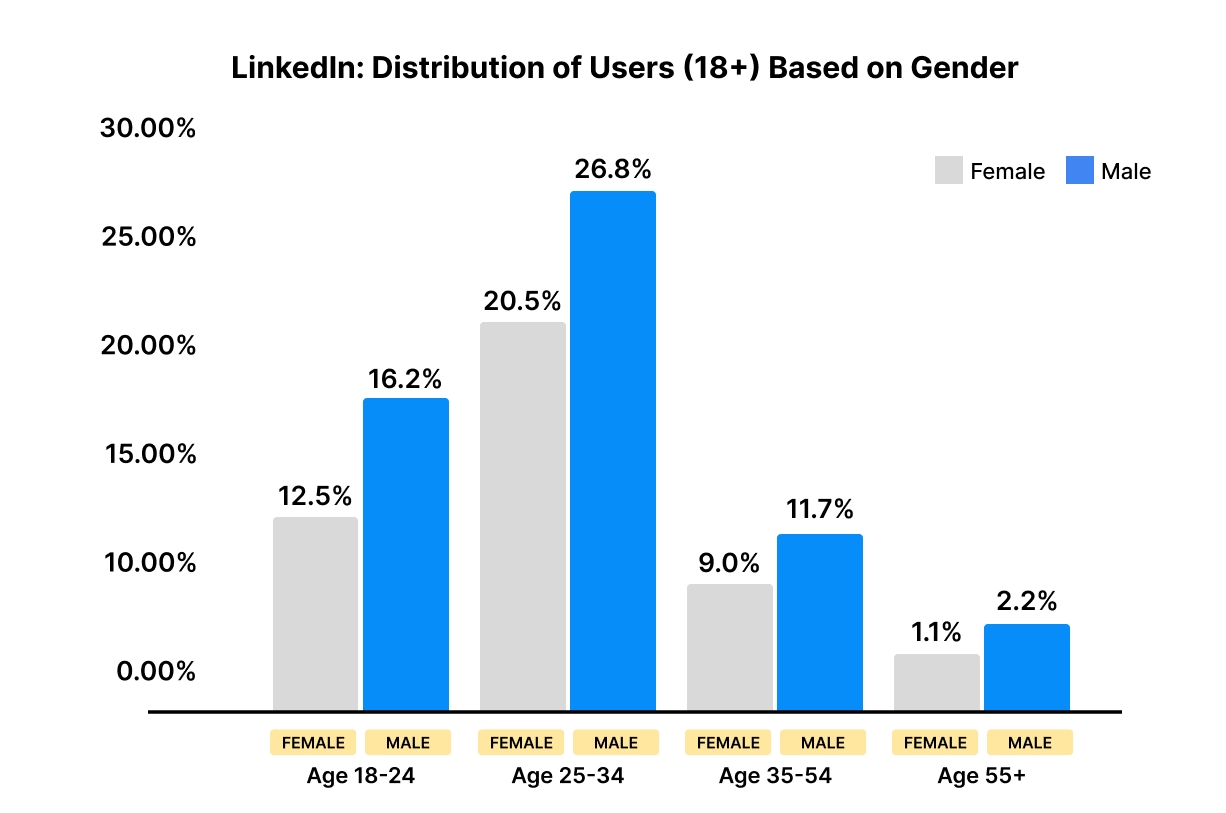
Source: Recurpost
When you combine deliberate personalized communication with your LinkedIn automation, you get the best of both worlds. You get the warmth of a real conversation and the scale of a machine.
This is how your content can help you build and protect your brand authority, as you aren’t seen as just another spammer in the inbox.
🎯 Pro tip: Build your LinkedIn personalization on what others appreciate. For that, scroll all the way down to your prospects’ Recommendations section in their LinkedIn profile. Read what their coworkers or clients actually say about them. If someone mentions they are a great problem solver, use that as your hook. It is much more powerful to say you noticed their reputation for solving tough issues than to just call them a leader.
Building a Content Moat to Support Your LinkedIn Outreach Strategy
If you are worried about being seen as a spammer, the solution is not to send fewer messages. The solution is to be more famous.
When you are a recognized name in your niche, people do not call your outreach "spam." They call it "networking." Building that level of recognition requires you to have a presence that extends far beyond your LinkedIn feed.
You need to be building what we call a content moat. Publishing your expertise on relevant industry blogs helps you reach people beyond your LinkedIn network. These articles give prospects a chance to discover your ideas even when you are not actively sending messages.
A strong content moat should prioritize the following:
- Thought leadership pieces that challenge the status quo.
- Visibility on niche blogs that your specific target audience reads.
- Strategic mentions that link back to your core business pages.
- A mix of educational and tactical content for different stages.
This is the invisible infrastructure that makes LinkedIn lead generation work at scale. You are essentially warming up the entire market before you ever send a single connection request. It makes the "ask" in your message feel much smaller because your authority is already so large.
Using Intent Signals to Identify the Right Timing
The problem with "blind" automation is that it assumes everyone is in the same stage of the buying journey. They are not. Some people are just browsing, while others are actively looking for a solution.
Intent signals let you pick up the subtle nuances in user behavior and distinguish between who is ready to do what. You can segment your outreach accordingly, e.g., based on real-time behavior instead of just job titles or locations.
If you can identify when someone is "warm," you can adjust your tone to match. You don't have to be as aggressive or formal. You can be more direct because the intent is already there.
The payoff? This makes the transition from a bot to a human much smoother. You are starting the conversation on their terms, which is the fastest way to build lasting trust.
That said, some of the best intent signals to track include:
- Prospects engaging with your specific survey or content.
- Changes in their company’s "hiring" status for relevant roles.
- Attendance of a specific webinar, or any virtual event in your professional domain.
- Public questions about a challenge that your service solves.
This strategy supports your "content moat" by making your voice feel more relevant. You aren't just everywhere; you are in the right places at the right times. It is a strategic way to manage your visibility.
When you hit the timing right, your automation becomes a powerful tool for LinkedIn lead generation and building real professional relationships.
🎯 Pro Tip: Demand two signals before you hit send. To really protect your professional reputation, make your LinkedIn messaging automation wait for a second signal. Set your rules so they have to view your profile and also engage with your content. This cuts down on accidental triggers and false positives. It ensures you are only spending your social capital on people who are actually warm.
Common Automation Fails and How to Avoid Them
Most LinkedIn users have a very low tolerance for bad automation. They have seen all sorts of mass-communication messages and have learned to ignore them.
You may think your LinkedIn automation is different, just because you’ve used a new tool or addressed recipients by their job titles. However, for experienced LinkedIn users, your message won’t stand out from the grey mass of others. They’ll find plenty of "red flags" that trigger a delete reflex:
- The Syntax Error — Forgetting a closing bracket in your template is the fastest way to prove you are using a machine.
- The Wrong Company Name — Mentioning their previous employer instead of their current one shows your data is totally out of date.
- The Overly Personal Intro — Commenting on a photo of their family or kids is a creepy move that crosses professional boundaries.
- The One Word Response — Using an automated "Thanks" that triggers at the wrong time in a real conversation.
- The Broken URL — Sending a link that leads to a 404 page makes you look like you do not check your own work.
- The Aggressive Follow-Up — Asking "Did you see my last message?" is a guilt trip that never works on a cold lead.
- The Industry Buzzword Salad — Using so much jargon that the message becomes impossible to read for a normal human.
- The Hidden Sales Pitch — Pretending to want a "partnership" when you are actually just trying to sell a five-dollar service.
Always read your messages out loud before you send them. If it sounds like a robot talking to a wall, it is time to rewrite it all.
The Bottom Line
The new AI-powered tools make it extremely easy (and tempting) to automate all your LinkedIn communication. But that easy path is not the one that will protect your online reputation.
Without a genuine human touch, even the most hyper-personalized automated campaign will feel artificial. Your recipients’ attitude will inevitably enter the “uncanny valley” of digital distrust. And once you end up there, it is almost impossible to climb back out and regain their respect.
So, what could you do to avoid the risk of damaging your reputation while still enjoying the benefits of modern-day LinkedIn outreach automation? Several things, actually:
- Build a solid content moat before you start sending — establishing yourself as an authoritative source of niche-relevant expertise. You can do so by publishing content on industry sites and using a trusted publisher outreach platform to scale your content dissemination.
- Make a move only following clear intent signals from your prospects — e.g., once someone viewed your profile or engaged with your content. Instead of LinkedIn cold outreach, your message will feel like a timely and helpful coincidence.
- Go beyond titles and names — invest your time into actually studying the prospects’ profiles, what they post, what they like, and how their careers develop. Referencing their actual experiences will make your outreach read personal and intelligent.
- Protect your brand from hitting a raw volume target — a few personalized and calculated communication moves are often worth thousands of automated and, therefore, ignored messages.
Automation is helpful and ubiquitous. The trick to successful LinkedIn lead generation is to use automation along with LinkedIn personalization at scale, e.g., just enough to help you scale, but not too much to kill trust.
For that reason, automation is great for opening doors, but it is terrible at closing deals or building deep rapport. As soon as a lead asks a real question or shows genuine interest, kill the bot and step in.