

ReactIn Review 2026: LinkedIn Intent Signals and Pricing Tested

By Kushal Magar · September 20, 2026 · 10 min read
Key Takeaway
ReactIn works well for LinkedIn-first teams hunting warm signals. The 20+ trigger types and SmartLists are genuinely useful — but the per-sender pricing, 2,000-credit monthly cap, and LinkedIn-only signal coverage limit multi-channel teams. SyncGTM extends the same signal logic to 15 cross-channel triggers and 50+ enrichment providers under a flat monthly price.
Quick Verdict
Our ReactIn review in one line: it is an intent-based LinkedIn outreach tool that monitors 20+ behavioral signals and auto-enrolls warm prospects into campaigns. The Growth plan costs $69/sender/month and includes SmartLists, AI enrichment, and sender rotation. Strong for LinkedIn-first teams; limited for multi-channel outreach.
ReactIn positions itself as the replacement for your LinkedIn automation tool, intent data provider, and enrichment stack — all at $69 per sender per month. The pitch is compelling: monitor 20+ behavioral signals, auto-populate SmartLists from Stripe and Calendly events, tag every lead with AI-generated ICP and decision-maker scores, and launch LinkedIn campaigns on warm prospects instead of cold lists.
We tested the platform across signal breadth, enrichment quality, pricing at team scale, and multi-channel reach. The headline finding: ReactIn delivers on its LinkedIn signal promise, but the per-sender model compounds fast, the 2,000 enrichment credit cap runs out in one mid-size campaign, and the LinkedIn-only signal scope misses the buying intent happening outside the platform.
This review covers every tier, every signal type, and where the cracks show — so you can decide whether ReactIn fits your stack or whether you need broader coverage from the start.
What Is ReactIn?
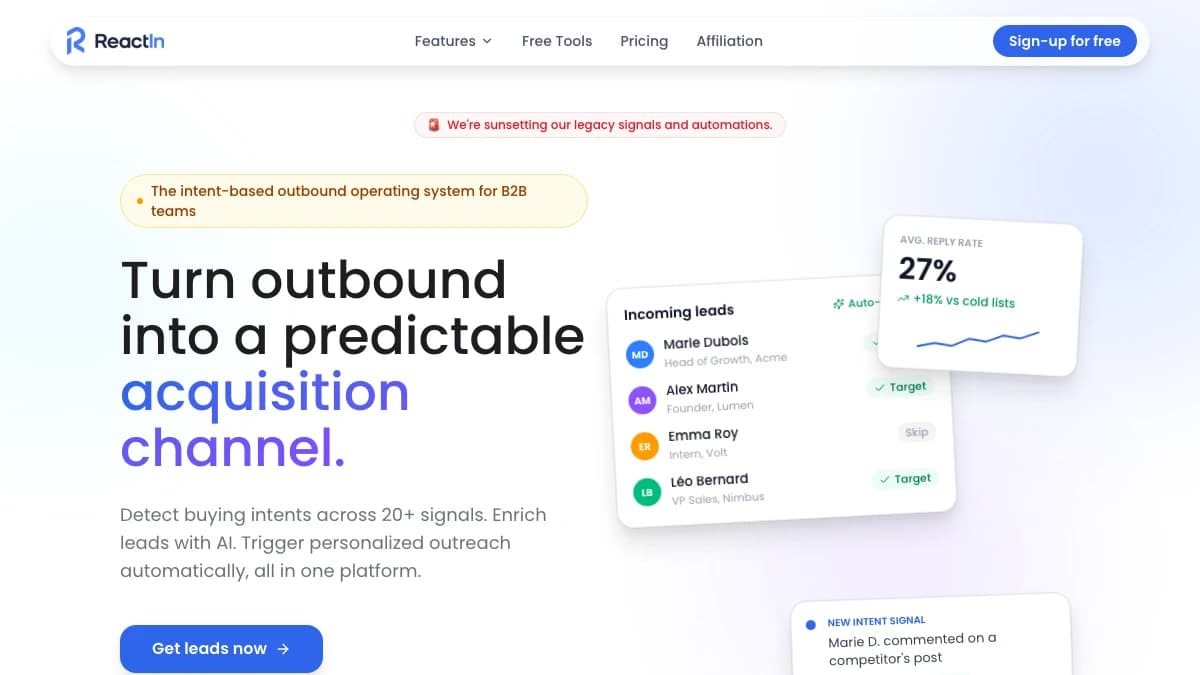
ReactIn homepage — positioned as the intent-based outbound operating system for B2B teams.
ReactIn is an intent-based outbound platform for B2B sales teams that detects buying signals on LinkedIn and product surfaces, then automatically enrolls those prospects into LinkedIn outreach sequences. It was built on a core insight: people who engage with your content, visit your profile, or take an action in your product (booking a Calendly call, submitting a Tally form, paying via Stripe) are significantly warmer than cold list prospects — and reaching them immediately after the signal fires drives reply rates up to 27%, compared to 5–8% from cold outreach.
The platform covers five functional areas: signal detection (20+ triggers), AI enrichment (B2B tag, ICP fit, decision-maker scoring), SmartLists (dynamic lists that auto-populate when a trigger fires), campaign automation (multi-step LinkedIn sequences with conditional logic), and team management (unified inbox, sender rotation, shared sequences). It is LinkedIn-first with optional email steps added via webhooks to external tools.
One caveat at the time of writing: ReactIn's homepage carries a banner saying it is "sunsetting our legacy signals and automations," without listing which ones. The same page still advertises 20+ intent triggers, so confirm which triggers remain supported before you build a campaign around a specific signal.
ReactIn's target buyer is a B2B founder, SDR team, or LinkedIn agency that already generates inbound interest via content, events, or product — and wants to systematically convert that interest into pipeline without manual list-building. Teams that operate entirely cold, or that need heavy email and phone channels, will hit limitations quickly.
ReactIn Intent Signals: All 20+ Triggers Explained
ReactIn organizes its signal library into three categories: LinkedIn engagement signals, profile-based signals, and product/event webhooks. Here is what falls into each bucket and what it actually means for outreach timing.
LinkedIn Engagement Signals
- Post likes and reactions — fires when someone engages with a post from your connected LinkedIn account. Strong signal for content-led teams.
- Post comments — fires on comments to your posts, including longer-form discussion that often indicates higher intent.
- Competitor post engagement— fires when a target persona likes or comments on a competitor's LinkedIn content. Particularly useful for competitive displacement campaigns.
- Connection request sent or accepted — fires at each stage of the connection flow so you can route accepted connections immediately into a warm follow-up sequence.
- LinkedIn group activity — tracks engagement within specific LinkedIn groups relevant to your ICP.
Profile and Company Signals
- Profile visits— fires when someone visits your LinkedIn profile or a connected team member's profile. Most reliable signal in the library; profile visitors convert at 3–5× cold lists.
- Company page visits — fires when someone engages with your LinkedIn company page.
- Job change detection— fires when a tracked prospect changes roles, creating a natural outreach moment during their "new in role" window.
- Webinar and event attendance — fires when a registered attendee joins a LinkedIn Live or connected event.
- Lead magnet downloads — fires via a webhook when someone downloads a connected lead magnet hosted outside LinkedIn (landing page with a form).
Product and Event Webhooks
This is where ReactIn genuinely differentiates from pure LinkedIn automation tools. The product webhook library connects directly to:
- Stripe — new customer created, subscription upgraded, or churn event. Particularly useful for PLG teams that want to trigger expansion or win-back campaigns based on product events.
- Calendly — booked meeting, rescheduled, or cancelled. Fire a LinkedIn message sequence when a prospect books a demo, or re-engage immediately after a cancellation.
- Tally.io — form submission on any Tally form. Useful for teams running gated content or event registration outside LinkedIn.
The webhook triggers are straightforward to connect (no code required) and fire reliably. The limitation is scope: only these three product tools are natively supported. Connecting HubSpot forms, Typeform, or custom CRM events requires a Zapier or Make intermediate layer.
What ReactIn's signal library does notcover: hiring surges (companies adding headcount in your target function), funding rounds (seed to Series C announcements), tech stack installs or removals, and web visit activity (anonymous or identified). Those signals tend to precede LinkedIn activity — a company raising a Series B or posting 10+ SDR roles is showing buying intent weeks before any individual starts engaging on LinkedIn. SyncGTM's ReactIn alternatives roundup covers tools that add those upstream signals.
ReactIn SmartLists and AI Enrichment Columns
SmartLists are dynamic prospect lists that auto-populate when a configured signal fires. You define the trigger (e.g., "anyone who commented on a competitor post in the last 48 hours"), set ICP filters (industry, company size, seniority), and ReactIn continuously adds matching profiles to the list as signals come in. There is no manual list-building or CSV exports — the list is live.
You can then attach a SmartList directly to a campaign, so new matches are automatically enrolled in the outreach sequence without any manual intervention. For teams running always-on campaigns against warm audiences, this is the most time-saving part of the platform.
AI Enrichment Columns
Every lead captured by a SmartList goes through ReactIn's enrichment engine, which adds three AI-generated columns:
- B2B tag — identifies whether the lead works at a B2B or B2C company, filtering out consumer-focused prospects that waste sending credits.
- ICP fit score — scores the lead against your defined Ideal Customer Profile parameters (industry, company size, role level). Reduces manual qualification before launching a campaign.
- Decision-maker flag — identifies whether the lead holds purchasing authority based on job title and seniority.
These three columns cover the first qualification pass reasonably well. What the enrichment does notcover: verified work email, direct dial phone number, LinkedIn URL resolution, company revenue, funding history, headcount, or technology stack. For teams that need those data points before outreach, ReactIn's enrichment is a filter layer rather than a full enrichment solution — and each enrichment run draws down against the 2,000 monthly credit limit.
The Credit Cap Problem
ReactIn includes 2,000 enrichment credits per plan per month. At first glance that seems adequate — but in practice, a single active campaign consuming 500 new leads weekly burns through the monthly allocation in four weeks with zero buffer. Credit top-ups are available but are an additional cost not reflected in the $29 or $69 headline price. Teams running high-volume campaigns should factor this into their true monthly cost.
ReactIn Pricing: Basic, Growth, and Agency
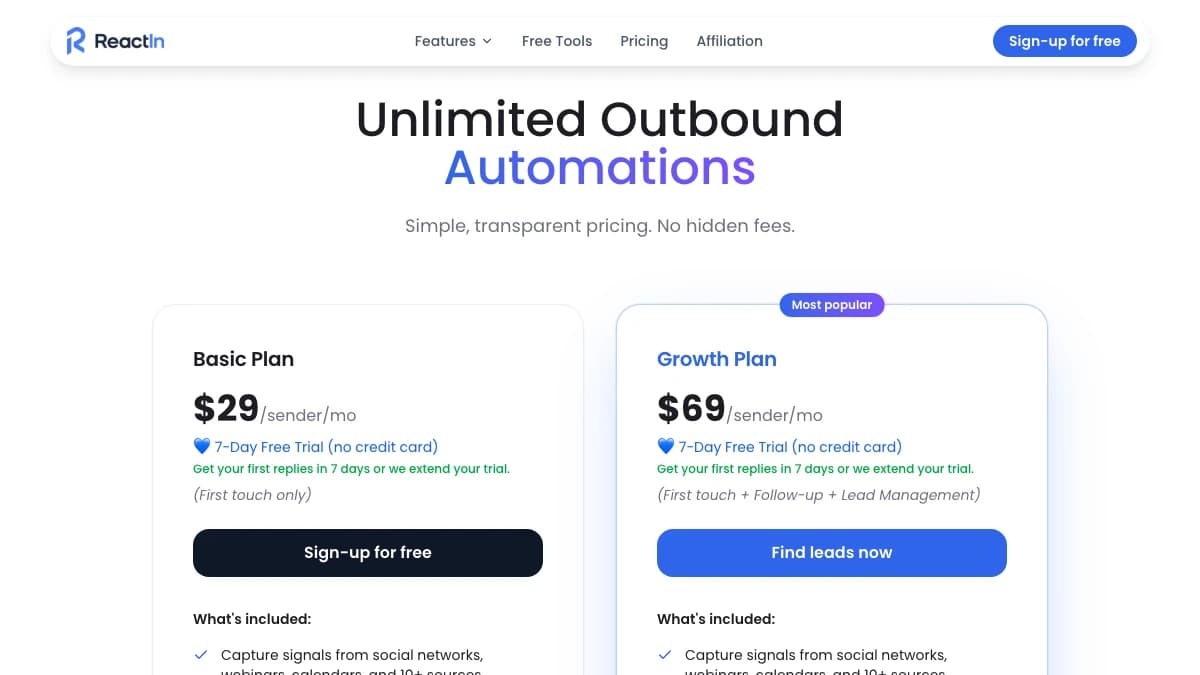
ReactIn pricing page — Basic and Growth plans are billed per sender. The Agency plan ($999/mo, up to 50 senders) sits further down the page.
| Plan | Price | What's Included | What's Missing |
|---|---|---|---|
| Basic | $29/sender/mo | 10+ signal sources, AI ICP segmentation, 2,000 enrichment credits, unlimited SmartLists | No LinkedIn outreach — signal capture only |
| Growth | $69/sender/mo | All Basic features + outreach campaigns, sender rotation, lead management, unified inbox | Email sequencing still requires external tool |
| Agency | $999/mo (up to 50 senders) | Centralized account management, white-label reporting, bulk sender onboarding | Custom demo required — no self-serve |
What ReactIn Pricing Actually Costs at Team Scale
The per-sender model is the pricing detail most reviews skip. At $69/sender/month on the Growth plan:
- 1 sender = $69/mo
- 3 senders = $207/mo
- 5 senders = $345/mo
- 8 senders (max per org) = $552/mo
None of those figures include email outreach tooling, enrichment credit top-ups, or Zapier/Make subscriptions for CRM sync. A 5-sender team running ReactIn plus Instantly for email sequencing is looking at $400–$500/month — comparable to tool stacks ReactIn claims to replace.
For agencies, the $999/month Agency plan works out to approximately $20/sender (vs $69 individual), which is more defensible — but requires a sales call and custom onboarding, with no self-serve access.
ReactIn Pros — What Works
- ✓Intent signals fire before cold outreach — you reach people already showing buying behavior, which is why ReactIn users report 27% reply rates versus 5–8% from cold lists.
- ✓SmartLists auto-populate from real product events (Stripe payment, Calendly booking, Tally form), turning PLG motion into outbound sequences without manual list building.
- ✓AI enrichment columns (B2B tag, ICP fit, decision-maker flag) cut manual qualification time before you spend sending credits on mismatched leads.
- ✓Campaign ponderation and sender rotation keep LinkedIn accounts within safe daily limits automatically — useful for agencies running 5+ sender accounts.
- ✓7-day free trial with no credit card, so you can actually test signal quality on your own target accounts before committing.
- ✓Unified inbox consolidates replies from multiple senders into one dashboard — a genuine time-saver for agencies managing multiple client accounts.
ReactIn Cons — Where the LinkedIn-Only Focus Bites
- LinkedIn-only signals. ReactIn monitors LinkedIn engagement, profile visits, and product webhooks — but misses funding rounds, hiring surges, tech stack installs, and web activity signals that reveal buying intent before a prospect ever touches LinkedIn.
- 2,000 enrichment credits per plan per month. A mid-size campaign (500 leads × 4 enrichments) consumes your monthly allocation in one run. Credit top-ups are an additional cost not shown in the headline pricing.
- Per-sender pricing compounds fast. At $69/sender/month (Growth), a 5-rep team pays $345/month — and that still does not include email outreach, which needs a separate tool.
- No native email sequencing. ReactIn's LinkedIn automation is strong, but email sequences require a separate integration (Instantly, Lemlist, or similar) via webhook. Multi-channel campaigns add tooling overhead and cost.
- No waterfall enrichment. ReactIn uses a single proprietary enrichment engine. When it cannot find an email, there is no fallback — unlike waterfall tools that cascade across 50+ providers to push hit rates above 80%.
- Webhook-only CRM sync. There are no native two-way CRM integrations for HubSpot or Salesforce. Field mapping, record creation, and activity logging all go through Zapier or Make, which adds latency and requires a third subscription.
- Signal breadth is LinkedIn-centric. Strong for founder-led B2B teams whose buyers are active on LinkedIn. Weak for industries where buyers are less active — manufacturing, healthcare, government — where web and firmographic signals matter more.
ReactIn vs SyncGTM: Signal Coverage and Multi-Channel
The most common ReactIn comparison is against pure LinkedIn tools like Waalaxy and Dripify — but the more useful comparison is against platforms that cover the signal layer ReactIn misses. Here is how ReactIn stacks against the tools buyers most often evaluate when they realize LinkedIn-only coverage is not enough.
| Feature | ReactIn | SyncGTM | Apollo | Waalaxy |
|---|---|---|---|---|
| Starting Price | $29/sender/mo (Basic) | $99/mo (published) | $59/mo (Basic) | $40/sender/mo |
| Intent Signals | 20+ LinkedIn signals only | 15 signals (LinkedIn + web + firmographic) | Bombora intent (3rd-party) | None native |
| Outreach Channels | LinkedIn + limited email | LinkedIn + email + multi-channel (Instantly, Smartlead) | Email + LinkedIn | LinkedIn + email |
| Enrichment Providers | 1 (proprietary, 2,000 credits/mo) | 50+ waterfall providers | Single database | Dropcontact only |
| Data Points per Lead | B2B tag, ICP fit, DM flag | 76+ data points | Contact + firmographic | Basic contact only |
| SmartLists / Dynamic Lists | Yes — Stripe, Calendly, Tally | Yes — 15 signal triggers | Saved searches | None |
| Sender Rotation | Yes (Growth plan) | Via Instantly / Smartlead | No | No |
| CRM Integrations | Via webhooks / Zapier | HubSpot, Salesforce, Pipedrive, Attio | HubSpot, Salesforce native | HubSpot, Salesforce via Zapier |
| Pricing Model | Per sender | Flat (not per sender) | Per seat | Per seat |
| Free Trial | 7 days, no credit card | Free tier available | Free tier (limited) | Free tier (limited) |
The honest take on each option
ReactIn is the right choice for one specific profile: a founder-led or SDR team running LinkedIn-first outreach, generating inbound signals via content and events, and needing those signals to auto-trigger outreach sequences with no manual list work. The SmartLists and AI enrichment columns deliver real efficiency for that workflow.
SyncGTM is the right choice when your signal coverage needs to extend beyond LinkedIn. SyncGTM tracks 15 intent signals including hiring surges, funding rounds, tech stack changes, and job changes — signals that precede LinkedIn engagement and give you the first-mover advantage. Enrichment runs across 50+ providers in a waterfall model for 75–90% email hit rates, and outreach sequences run natively via Instantly and Smartlead for true multi-channel. Flat pricing at $99/mo means a 5-rep team pays the same as a 1-rep team. You can read the full SyncGTM feature overview to see the complete signal and enrichment stack.
Apollo is the default for teams that want a combined contact database plus email sequences, with published pricing from $59/mo and no per-sender penalty. Its intent data comes from Bombora (third-party) rather than real-time LinkedIn signals, which is less precise for LinkedIn-first motions but broader for account-based campaigns.
Waalaxyis the budget LinkedIn automation tool (from $40/sender/mo) with email steps added. It does not have a signal detection layer — you build lists manually or import from Sales Navigator. For teams that do not need intent-triggered automation and just want reliable LinkedIn + email sequencing, Waalaxy is simpler and slightly cheaper than ReactIn's Growth plan.
Who Should Use ReactIn?
ReactIn is a good fit if:
- Your ICP is active on LinkedIn and your team generates meaningful inbound signals via content, events, or community.
- You run a PLG or product-led motion with Stripe, Calendly, or Tally triggering outbound campaigns.
- You have 1–3 senders, so the per-sender pricing stays manageable ($69–$207/mo).
- LinkedIn-first outreach covers 80%+ of your sequences — email is supplemental, not primary.
- You are a LinkedIn agency that needs sender rotation and centralized management for multiple client accounts (Agency plan at $999/mo for 50 senders is competitive for that use case).
ReactIn is not a good fit if:
- You need upstream signals — hiring, funding, tech stack — that precede LinkedIn engagement. ReactIn has no access to those layers.
- Multi-channel email outreach is a core part of your sequences. The webhook integration adds tooling overhead and cost.
- Your team has 5+ senders. At that scale, the per-sender model moves ReactIn into the $345–$552/mo range, where flat-pricing alternatives become more cost-effective.
- You need deep firmographic enrichment (revenue, headcount, tech stack, funding) before outreach. ReactIn's three AI columns cover basic qualification but not the full data picture.
- Your buyers are not active LinkedIn users — manufacturing, government, healthcare verticals where LinkedIn engagement rates are lower and web/firmographic signals are more reliable indicators.
ReactIn Review Verdict: Is It Worth It?
ReactIn earns a 3.8 / 5 for LinkedIn-first teams. The signal-to-sequence automation is genuinely well-built — the SmartLists are reactive without being brittle, the AI enrichment columns add real filtering value, and the PLG webhook integrations are a legitimately useful differentiator compared to pure LinkedIn automation tools.
The limitations are not bugs — they are deliberate product scope choices. ReactIn decided to go deep on LinkedIn signals and leave everything else to integrations. That works if your motion stays on LinkedIn. It creates real friction if your buyers live elsewhere, if your team grows beyond three senders, or if you need verified email data beyond the 2,000-credit monthly cap.
Before committing, run the per-sender math for your actual team size, estimate enrichment credit consumption against your campaign volume, and honestly assess what percentage of your outreach happens outside LinkedIn. If those numbers still make ReactIn the right fit, the 7-day free trial is a risk-free way to test signal quality on your own target accounts.
For teams that need broader signal coverage and multi-channel reach without per-sender pricing overhead, the ReactIn alternatives roundup covers six options that extend beyond LinkedIn-only signals. And if you want to understand how SyncGTM's 15 intent signals compare to ReactIn's LinkedIn-first approach, the feature page shows the full stack side by side.