

SellHack Review 2026: B2B Data Coverage, Pricing & Alternatives

By Kushal Magar · May 28, 2026 · 11 min read · Last updated: September 30, 2026
Key Takeaway
SellHack is a cheap, verification-first email finder with a Chrome plugin and plans from $3/month — but its single-source coverage caps hit rates, it publishes no accuracy benchmark or database size, and it offers no buying signals. It is a strong budget pick for low-volume, verified-email outreach, but teams whose bottleneck is coverage will outgrow it.
This SellHack review covers the tool's data coverage, pricing, and accuracy in 2026 — and where it falls short against waterfall enrichment. SellHack is a budget B2B email finder built around a Chrome plugin and a real-time 12-step verification engine, with individual plans from $3/month and a free tier of 10 credits. Our rating: 3.8/5.
SellHack's appeal is price and precision. Install the plugin, open a LinkedIn profile, click once, and get a verified work email that has already passed a 12-step validation check — for as little as $3 a month.
The structural limit is just as simple. SellHack pulls every contact from a single underlying source. When that one index doesn't have a record, there is no second source to fall back on — which is exactly where waterfall enrichment pulls ahead by querying several providers in sequence and keeping the best verified result.
This review breaks down SellHack's pricing math, the real accuracy picture behind the 12-step engine, its key features, the honest pros and cons, how the workflow runs day to day, and who should use it in 2026.
What Is SellHack?
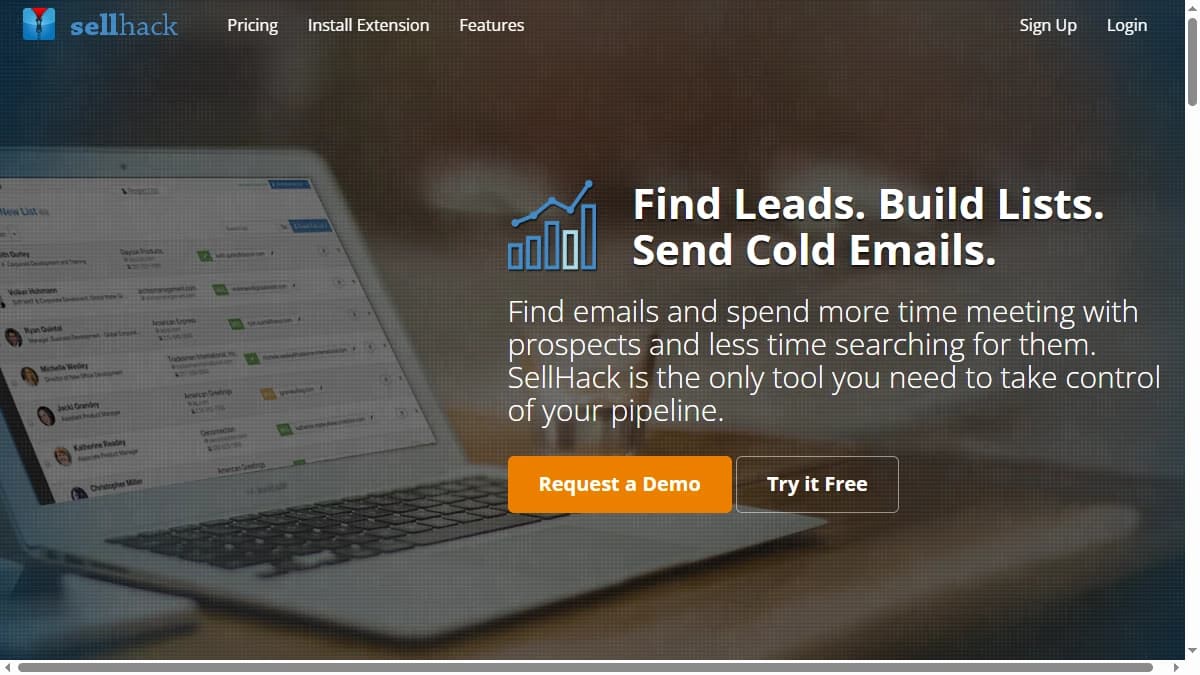
SellHack is a B2B email-finding tool built around a Chrome plugin and a prospect list builder. It is aimed at sales reps, marketers, and recruiters who want verified work emails fast and cheap, and who prospect profile by profile or list by list.
SellHack's signature feature is a real-time 12-step email verification engine that validates each address through multiple checks before returning it. On top of the finder, the platform offers bulk CSV verification, Salesforce and Replyify integrations, and a free tier of 10 credits per month. Pricing is per-credit and unusually low, which makes it a natural fit for cost-sensitive solo users and small teams.
The headline distinction from multi-provider enrichment platforms is the data model. SellHack is single-source: every lookup hits one index, then verifies. A waterfall enrichment tool queries dozens of providers in sequence and returns whichever one resolves the contact — a structural difference that shows up directly in hit rate, which we cover in the data-coverage section below.
SellHack Pricing: Plans, Credits, and What You Actually Pay
SellHack pricing starts at $3/month and is structured around email credits. A credit is consumed only when SellHack returns a verified result, and individual plans scale from 100 to 2,500 credits before you move up to team tiers.
| Plan | Monthly Price | Email Credits | Effective Cost / Email |
|---|---|---|---|
| Free | $0 | 10 | — |
| Lite | $3/mo | 100 | ~$0.030 |
| Basic | $15/mo | 350 | ~$0.043 |
| Starter | $30/mo | 1,000 | ~$0.030 |
| Pro | $60/mo | 2,500 | ~$0.024 |
| Team | $99–$499/mo | Tiered by seat | Varies |
The real cost math
On paper, SellHack is one of the cheapest verified-email tools you can buy — the Lite plan's $3/month works out to about $0.03 per email, and the Pro plan drops it to roughly $0.024. Annual billing trims that further, with advertised yearly savings of $24 to $468 depending on plan.
The catch is not the price per credit — it is how many credits you actually need to fill a list. Because SellHack draws from a single source, you burn more lookups that return nothing, so the cost-per-usable-contact climbs faster than the headline rate suggests. Teams that need both emails and mobile numbers at volume should price this carefully against a waterfall provider that bundles both. For a broader market view, see our roundup of the best B2B email finder tools.
SellHack Review: Data Coverage and Accuracy Tested
SellHack's accuracy story is strong on precision and quiet on coverage. The vendor markets a real-time 12-step email verification engine that validates every address before it returns, which keeps bounce rates low on the emails it does find.
What SellHack does not publish is just as important: there is no stated database size, no overall hit-rate benchmark, and no data-refresh frequency. That matters because email lists decay at roughly 22.5% per year, so a source that doesn't disclose how often it refreshes is a coverage risk no verification step can fix.
Where the gap comes from
Verification and coverage are two different problems. SellHack's 12-step engine improves the precision of what it finds — fewer bad emails get through. It cannot improve coverage on contacts the single underlying source simply doesn't have. That distinction between accuracy and coverage is where single-source tools lose ground.
SellHack is also absent from the major independent enrichment studies — the kind that test 15+ tools against tens of thousands of real contacts — so its coverage can't be verified against peers. Reviewers on directories like G2 and Capterra praise the verification quality and price but note that coverage can be inconsistent, especially for smaller or international companies.
This is the core argument for waterfall enrichment. By querying multiple providers and keeping the first verified result, a waterfall raises coverage on the exact contacts a single index misses — see our explainer on why waterfall email finders beat single-source tools on hit rate.
SellHack Key Features
SellHack's feature set is built around fast, low-cost email finding and verification rather than automated GTM workflows. The highlights:
| Feature | What It Does |
|---|---|
| 12-step email verification | A real-time verification engine validates each email through multiple checks before returning it, keeping bounce rates low on resolved contacts. |
| Chrome plugin | Find and verify emails directly from LinkedIn profiles and company websites in a single click, without leaving the page. |
| Prospect list builder | Build targeted prospect lists with minimal manual data entry, then export contacts for outreach. |
| Bulk CSV verification | Upload a list of names and companies and SellHack appends and verifies emails where it finds matches. |
| CRM & outreach integrations | Push verified contacts directly into Salesforce, and sync with Replyify for cold-email sequencing. |
| Pay-for-results credits | A credit is consumed only when SellHack returns a verified email, so empty lookups don't burn budget. |
How SellHack Works: From Plugin to Verified List
SellHack keeps the workflow short. Here is how a typical prospecting session runs with the features covered above, and where the credit math shows up along the way.
- Start on the free tier. Sign up for 10 credits a month with no credit card, and run lookups on people from your own ICP before choosing a plan.
- Install the Chrome plugin.Open a LinkedIn profile or a company website and click the plugin to request that person's work email without leaving the page.
- Let verification run. Each address goes through the real-time 12-step verification engine before it is returned. If SellHack cannot return a verified email, no credit is spent.
- Build lists as you go. Save contacts into the prospect list builder instead of copying them into a spreadsheet by hand.
- Bulk-process existing lists. Upload a CSV of names and companies, and SellHack appends and verifies emails where it finds matches.
- Push to your stack. Send verified contacts to Salesforce, or sync them with Replyify to start a cold-email sequence.
Two habits keep the credit math honest. First, run a sample from your real target list and track how many lookups come back verified: that match rate, not the headline price per credit, sets your true cost per usable contact. Second, treat bulk CSV results as a coverage report. The rows that come back empty show which segments, often the smaller or international companies reviewers flag, need a second data source.
That second source is where most teams end up once volume grows. For a primer on combining data sources, see our guide to B2B lead enrichment.
SellHack Pros: What It Does Well
- ✓Extremely affordable entry point. At $3/month for the Lite plan, SellHack is one of the cheapest verified-email tools on the market — hard to beat for solo founders and tight budgets.
- ✓Real-time 12-step verification. Every email passes multiple validation checks before it returns, so bounce rates stay low and sender reputation is protected on the contacts SellHack resolves.
- ✓Pay only for results. Credits are consumed only when SellHack actually returns a verified email, so you don't burn budget on empty lookups.
- ✓Fast list builder and plugin. The Chrome plugin and prospect list builder turn LinkedIn profiles and websites into verified contacts with minimal manual data entry.
- ✓Simple, low-friction UI. Reviewers consistently praise the clean interface and ease of use — a quick tool to learn for non-technical sellers and recruiters.
SellHack Cons: Where It Falls Short
- Single-source coverage. SellHack verifies emails well, but it pulls from one underlying index. When that source doesn't have a contact, there's no fallback — unlike multi-provider waterfall tools, which query several providers and keep whichever one resolves the record.
- No published accuracy or coverage benchmark. SellHack discloses neither database size, overall hit rate, nor data-refresh frequency, and it is absent from the major independent enrichment tests — so coverage claims can't be verified.
- Email-first, thin on phone data. SellHack is built around finding and verifying emails. Teams that need mobile numbers and direct dials at volume will find the phone coverage limited compared with multi-channel tools.
- Credit math adds up at scale. The entry plans are cheap, but per-contact economics tighten on bigger volumes, and high-volume senders quickly outgrow the 2,500-credit Pro tier.
- No buying signals. SellHack offers no hiring, funding, or tech-adoption signals to prioritize which accounts to work first — it finds contacts but doesn't tell you which ones are in-market.
- Limited automation. SellHack is a finder and verifier, not a full GTM workflow platform. CRM enrichment and orchestration are basic compared with a platform that automates the whole pipeline.
Who Should Use SellHack?
SellHack is the right tool in a specific scenario: low-volume, cost-sensitive email finding by a team that values verified addresses and a cheap monthly price over maximum coverage.
Use SellHack if:
- You are a solo founder, freelancer, or small team on a tight budget who wants verified emails for as little as $3/month.
- Bounce rate matters more to you than raw volume — the 12-step verification engine keeps the emails you do send clean.
- You prospect profile by profile or in small lists and stay comfortably inside the credit limits.
- You want a simple finder-and-verifier with a Chrome plugin and minimal setup, not a full GTM platform.
Look elsewhere if:
- Coverage is your bottleneck — a single source will miss the harder-to-find contacts that a waterfall contact provider resolves.
- You prospect at high volume and need both emails and mobile numbers, where SellHack's email-first model runs thin.
- You want buying signals — hiring, funding, tech adoption — to prioritize accounts, not just contact data.
- You need automated CRM enrichment and workflow orchestration rather than manual, one-at-a-time lookups.
Verdict: Is SellHack Worth It in 2026?
SellHack earns its 3.8/5 on price and precision. For solo founders, freelancers, and small teams that find emails profile by profile, it is one of the cheapest ways to get verified addresses, and paying only for verified results keeps waste low.
Its limits are structural rather than cosmetic: one underlying source, no published accuracy or coverage benchmark, thin phone data, and no buying signals. Teams prospecting at volume will feel those limits first in coverage, then in automation.
Bottom line: start on the free tier, test on your own ICP, and upgrade only if the match rate holds. If it does not, compare the best SellHack alternatives before committing.
If SellHack's single-source coverage is a dealbreaker, SyncGTM is one alternative worth a look: it runs waterfall enrichment across 50+ data providers for verified emails, phone numbers, and firmographics.