


5 Best WebTechSurvey Alternatives for B2B Enrichment in 2026

By Kushal Magar · September 22, 2026 · 11 min read
Key Takeaway
WebTechSurvey profiles 100M+ websites but refreshes monthly, exports CSV-only, and fills lead lists with emails scraped from public contact pages rather than verified through mailbox checks. The 5 best WebTechSurvey alternatives for B2B enrichment in 2026 are: SyncGTM (tech-stack lookup plus waterfall enrichment across 50+ providers, 76+ data points, and outreach from $99/mo), BuiltWith (491.9M+ domains, 18+ years of trend history, and near real-time change alerts from $295/mo), Wappalyzer (browser extension plus lead-list API from $250/mo, free tier available), WhatRuns (a completely free browser extension with no paid tier), and Datanyze (a budget technographic and contact-reveal Chrome extension from $21/mo, free tier included).
The best WebTechSurvey alternatives fix the two things WebTechSurvey never quite solved: contact data you can trust, and technology data that updates faster than once a month.
WebTechSurvey profiles the technologies behind more than 100 million websites — CMS, hosting, analytics, frameworks — and lets you filter and export company lists by technology, category, geography, language, and TLD. For a self-serve technographic lookup, that's a genuinely useful starting point.
The gaps show up once a list turns into outreach. WebTechSurvey's lead lists carry email addresses scraped from a company's public contact page, not verified through mailbox checks, and the underlying data refreshes only once a month. Reports export as CSV only, with no native CRM sync and no outreach layer — and credits on both subscription and one-time plans expire within one to three months of purchase.
Company-level tech-stack lookups are the baseline every tool below clears — the differences show up in how fresh the data is, whether contact information is actually verified, and whether the workflow ends at a spreadsheet or continues into a reachable lead. This guide compares five alternatives — one of them turns a tech-stack match directly into a verified contact.
Quick Summary
The best WebTechSurvey alternatives in 2026 are SyncGTM, BuiltWith, Wappalyzer, WhatRuns, and Datanyze. SyncGTM is the top pick for B2B prospecting — tech-stack lookup plus waterfall enrichment across 50+ providers, 76+ data points per lead, and integrated outreach from $99/mo.
TL;DR: Best WebTechSurvey Alternatives in 2026
- SyncGTM — Best overall for B2B prospecting. Tech-stack lookup plus waterfall enrichment across 50+ providers, 76+ data points, and outreach from $99/mo with a free tier.
- BuiltWith — Best for historical trend depth and near real-time alerts. 491.9M+ domains tracked across 18+ years of technology adoption data from $295/mo.
- Wappalyzer — Best browser extension plus lead-list combo. Free tier with 50 lookups/mo, paid plans from $250/mo.
- WhatRuns — Best free option. Completely free browser extension, no paid tier, 450,000+ active users.
- Datanyze — Best budget option for individual reps. Technographic data plus contact reveals from $21/mo annual, free Nyze Lite tier included.
Why Teams Look for WebTechSurvey Alternatives
WebTechSurvey answers "which companies run this technology?" reasonably well across its 100M+ site index. It struggles the moment that list needs to become contacted pipeline. That gap drives five recurring pain points for B2B teams.
Unverified, scraped contact emails.WebTechSurvey's lead lists pull email addresses directly from a company's public contact page — not through mailbox-level verification. There's no confirmation the address is still active before you send to it, which pushes bounce risk onto your sending domain.
Monthly refresh, not live signal tracking.The underlying technology index updates on a monthly crawl cycle. A target account that adopts or drops a technology this week won't show up in WebTechSurvey's data until the next refresh — a real lag for teams that want to act on fresh signals.
CSV-only exports, no native CRM sync. Every report leaves WebTechSurvey as a downloadable CSV. According to G2's research on technographic data, sales and marketing teams get the most value from tech-stack signals when they route directly into a CRM or sequencing tool — a step WebTechSurvey leaves entirely manual.
Credits expire fast.Subscription credits lapse one month after cancellation, and separately purchased credits expire three months after purchase. Unused access doesn't roll over the way it does with tools like TheirStack or Datanyze.
No outreach layer. A WebTechSurvey export is where the workflow ends — every contact still needs a separate verification pass and a separate sequencing tool before a rep can send the first email.
Per Gartner's research on B2B data quality, B2B contact and firmographic data decays at roughly 30% per year — which makes scraped, unverified emails on a monthly refresh cycle an especially risky foundation for outbound. The five alternatives below each close one or more of these gaps.
1. SyncGTM
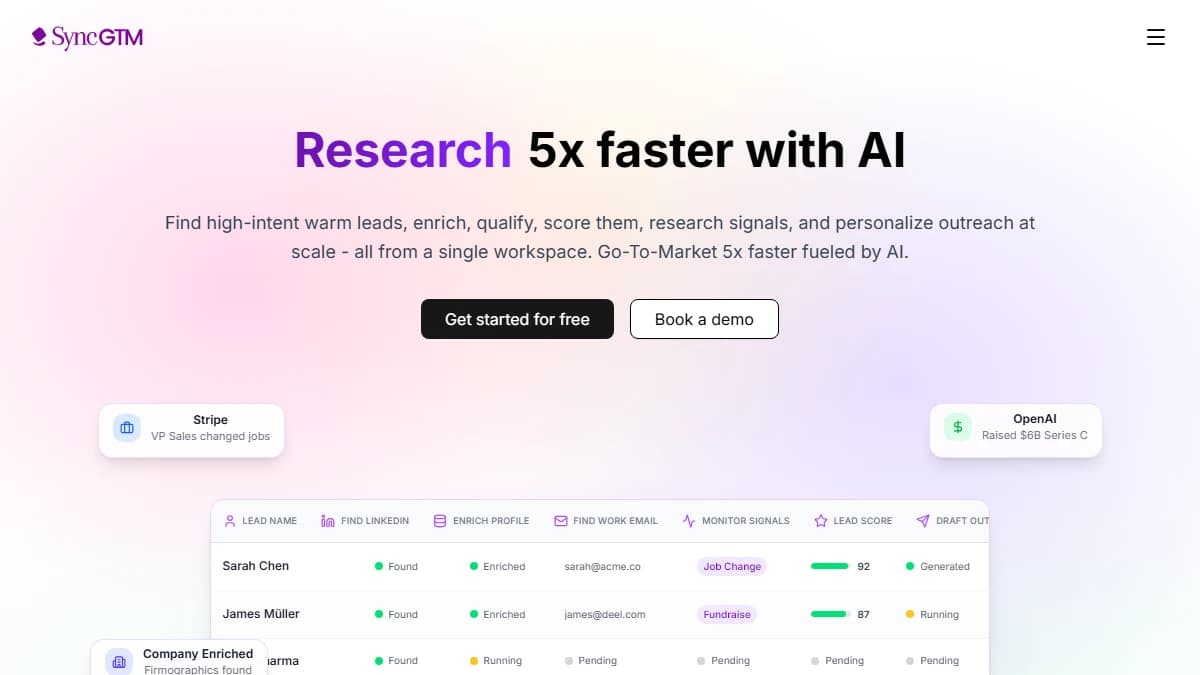
SyncGTM — tech-stack lookup plus waterfall enrichment across 50+ providers and integrated outreach
SyncGTM is a B2B prospecting platform where technographic lookup is one input into a much larger enrichment pass, not the end product. Point it at a target company and it returns the technologies that company runs alongside verified email, direct dial, LinkedIn, and 76+ firmographic and technographic data points — sourced through waterfall enrichment across 50+ providers queried in sequence.
That's the core difference from WebTechSurvey: SyncGTM doesn't stop at a scraped contact-page email. Every returned address is run through waterfall verification before it reaches you, and enrichment runs on demand rather than waiting on a monthly crawl cycle.
Buying-signal detection layers on top of the technographic data to flag in-market accounts before competitors reach them. Native CRM sync (HubSpot, Salesforce, Pipedrive, Attio, Zoho) and built-in outreach sequencing close the loop from "found the signal" to "contacted the buyer" without a second or third tool.
SyncGTM pulls technographic and firmographic data from 50+ data providers rather than a single proprietary crawler, which internal benchmarks show delivers 20–40% higher contact coverage than any single data source alone.
Pros
- • Tech-stack lookup feeds directly into contact enrichment — no second tool needed to reach a match
- • Waterfall enrichment across 50+ providers, 76+ data points per lead
- • Every contact runs through verification — no scraped, unconfirmed emails
- • Outreach and native CRM sync included (HubSpot, Salesforce, Pipedrive, Attio, Zoho)
- • AI research agents for custom enrichment beyond standard fields
- • Free tier with 200 credits/month, no credit card required
Cons
- • Not a public single-technology market-share report — WebTechSurvey's free reports are simpler for one-off research
- • $99/mo starting price is higher than free tools like WhatRuns or Datanyze's Nyze Lite tier
- • No 18-year historical technology-trend archive comparable to BuiltWith's
Best for: B2B teams that want to act on a technology signal immediately — identify the stack, enrich the account, and reach a verified contact in one workflow.
Pricing: Free tier (200 credits/mo). Starter $99/mo. Pro $249/mo. Business $649/mo.
2. BuiltWith
BuiltWith — technology profiling across 491.9M+ domains with 18+ years of trend history
BuiltWith is the most direct upgrade from WebTechSurvey's monthly crawl cycle: free single-site lookups for casual research, plus a paid tier with near real-time alerts when a tracked account changes its stack. It covers 491.9 million domains with technology-adoption history stretching back 18+ years, the deepest trend archive of any tool in this comparison.
Where WebTechSurvey exports a static CSV once a month, BuiltWith flags stack changes as they happen and lets you filter by technology, keyword, and even estimated ecommerce revenue on its Retail Reports.
The gap versus SyncGTM is what happens after the list. BuiltWith exports company and domain data with CRM integration, but it has no verified email, phone, or outreach layer built in — you still need a separate enrichment and sequencing tool to turn a BuiltWith list into contacted pipeline.
Pros
- • 491.9M+ domains tracked with 18+ years of historical technology-trend data
- • Free individual site lookups forever — no account required for basic research
- • Real-time alerts when a target company adopts or drops a technology
- • Retail Reports add estimated ecommerce revenue to technology filters
- • CRM export to Salesforce, HubSpot, Dynamics 365, Zoho, and more
- • The most recognized brand in technographics — widely cited as the category benchmark
Cons
- • Steep jump from free to $295/mo for the entry paid plan (Basic, 2 technologies/2 keywords)
- • Unlimited technology and keyword tracking requires Pro at $495/mo
- • No verified contact data — email, phone, and LinkedIn are out of scope
- • No outreach or sequencing layer — lists still need a downstream tool
Best for: Teams that need the deepest historical technology-adoption data and near real-time change alerts, and already have a separate contact-enrichment tool.
Pricing: Free (single lookups). Basic $295/mo. Pro $495/mo. Team $995/mo.
3. Wappalyzer

Wappalyzer — browser extension and API for technographic lead lists, free tier available
Wappalyzer started as a browser extension for identifying what a single site is built with, and it's still the fastest way to check one URL. The paid product builds on that same detection engine to generate lead lists filtered by technology, giving small teams a lighter-weight alternative to BuiltWith's enterprise pricing.
The free tier is genuinely useful: 50 technology lookups and email verifications a month, plus 5 website alerts, with no credit card required — noticeably more accessible than WebTechSurvey's paid-only bulk lists.
Pricing scales by seat and API credit rather than flat tiers, which keeps Pro accessible at $250/mo for a single user but adds up quickly for teams — Business jumps to $450/mo for 5 users and unlimited lookup targets, and API credits expire within 60–365 days depending on how they were purchased.
Pros
- • Free tier with 50 lookups/mo and 5 website alerts — no card required
- • Browser extension for instant single-site checks, same engine that powers the API
- • Lead lists filterable by specific technology or technology combination
- • CRM enrichment available on Business and Enterprise plans
- • Annual billing saves 17% versus monthly
- • Widely embedded — many other SaaS tools license Wappalyzer's detection data
Cons
- • Per-user seat pricing scales fast — Business is $450/mo for just 5 users
- • API credits expire (60 days on plan credits, 365 on bundle purchases)
- • No direct-dial phone data or outreach/sequencing layer
- • Pro tier limits lookup targets to 2 — a real ceiling for active prospecting
Best for: Small teams that want a browser extension for quick checks and a lighter-weight paid tier for building technology-filtered lead lists.
Pricing: Free (50 lookups/mo). Pro $250/mo. Business $450/mo. Enterprise from $850/mo.
4. WhatRuns
WhatRuns — completely free browser extension that detects the technologies behind any website
WhatRuns is a free Chrome extension, full stop — no paid tier, no credit card, no account wall. Click the icon on any site and it lists the CMS, hosting, analytics, fonts, and dozens of other technologies detected on that page, with 450,000+ active users and 50–100 new technologies added to its database daily.
That makes it the cheapest possible upgrade from WebTechSurvey for someone who just wants a fast, free answer without a paid plan: WebTechSurvey requires payment for bulk lookups, WhatRuns tells you exactly what one site runs at zero cost. You can also "follow" a site and get notified when its stack changes.
The limitation is scale. WhatRuns has no bulk search, no lead-list export, no API, and no way to find companies matching a technology filter — it only works one URL at a time, in a browser tab you have to visit manually.
Pros
- • 100% free with no paid tier, no signup, and no usage limits
- • One-click detection covering CDN, hosting, analytics, CMS, plugins, and fonts
- • Site-follow feature alerts you when a tracked site's stack changes
- • 450,000+ active users and a database updated daily
- • Zero learning curve — install the extension and click
Cons
- • No bulk search or lead-list building — one site at a time only
- • No API, so it can't plug into an automated prospecting workflow
- • No contact data, firmographics, or outreach features of any kind
- • Chrome-only browser extension, no standalone web app for teams
Best for:Individual marketers, developers, or founders who need to check a handful of sites manually and don't need list-building or contact data.
Pricing: Free. No paid plans.
5. Datanyze
Datanyze — budget technographic and contact-reveal Chrome extension, free tier included
Datanyze is one of the original technographic data providers, still operating as an independently priced Chrome extension. It pairs technology detection with credit-based contact reveals — email and phone — directly inside the browser, which is closer to a complete prospecting loop than WebTechSurvey's CSV export ever gets.
Pricing is the standout: a free Nyze Lite plan ships 10 credits a month for 90 days with basic technographic data, and paid tiers start at $21/mo (billed annually) for 80 credits with full technology detection, contact reveals, and list building.
The tradeoff is volume. A rep prospecting seriously needs Pro 2 at $55/mo for 160 credits — roughly 8 contact reveals per working day, which heavy prospectors hit fast. Datanyze also has no built-in outreach sequencing and no waterfall verification across multiple sources the way SyncGTM does.
Pros
- • Free Nyze Lite tier with 10 credits/mo, no card required for a business email signup
- • Entry paid plan starts at $21/mo (annual) — one of the cheapest paid technographic tools
- • Contact reveals (email and phone) built into the same Chrome extension as tech detection
- • List building and lead segmentation included from the entry paid tier
Cons
- • Free-tier credits expire after 90 days — no ongoing free access
- • Credit ceiling hits fast at real prospecting volume, even on Pro 2 ($55/mo)
- • Per-user seat pricing — a 3-person team on Pro 2 runs $165/mo
- • No native outreach sequencing or CRM-native workflow automation
Best for: Individual SDRs or small teams that want budget-friendly technographic data with contact reveals built into a browser extension.
Pricing: Free (Nyze Lite, 10 credits/90 days). Pro 1 $21/mo annual ($29/mo). Pro 2 $55/mo.
Side-by-Side Comparison
| Tool | Best For | Free Tier | Starting Price | Standout Feature |
|---|---|---|---|---|
| SyncGTM | B2B technographic + contact enrichment | Yes (200 credits/mo) | $99/mo | Tech-stack lookup + waterfall enrichment across 50+ providers, CRM sync + outreach |
| BuiltWith | Historical tech-adoption trend data | Yes (single lookups) | $295/mo | 491.9M+ domains across 18+ years of technology trend history |
| Wappalyzer | Browser extension + lead-list combo | Yes (50 lookups/mo) | $250/mo | Same engine powers browser extension and API lead lists |
| WhatRuns | Free single-site technology checks | Yes (unlimited, free) | Free | 450,000+ users, zero cost, no paid tier at all |
| Datanyze | Budget contact reveals for individual reps | Yes (10 credits/90 days) | $21/mo (annual) | Tech detection + email/phone reveals in one Chrome extension |
How to Choose the Right WebTechSurvey Alternative
The right alternative depends on what you do after you identify a company's tech stack.
- If you need to reach a verified contact the moment you spot a tech signal → choose SyncGTM (tech-stack lookup plus waterfall enrichment and outreach in one pass).
- If you need the deepest historical technology-adoption archive and near real-time alerts → choose BuiltWith.
- If you want a browser extension and a lighter-weight paid lead-list tier → choose Wappalyzer.
- If your budget is $0 and you just need to check a handful of sites → choose WhatRuns — completely free, no paid tier.
- If you're an individual rep who wants cheap contact reveals alongside tech detection → choose Datanyze, starting at $21/mo.
- If you need the full workflow — tech signal, enrichment, verified contact, outreach — in one subscription → choose SyncGTM. Waterfall enrichment from 50+ providers, 76+ data points, and outreach from $99/mo.
Final Verdict
WebTechSurvey does the basic job of technology profiling at scale — 100M+ sites indexed, filterable by technology, geography, and language. For a one-off, self-serve lookup, it still works, uncertain live status notwithstanding.
The problem is everything downstream of the list: contact emails scraped from a page rather than verified, a monthly refresh cycle instead of live tracking, CSV-only exports with no CRM sync, and credits that expire within one to three months. All five alternatives above close at least one of those gaps. Most close several.
For B2B prospecting teams, the strongest pick is SyncGTM — not because it's the deepest technographic archive (that's BuiltWith), but because it's the only tool here that turns a tech-stack match directly into a verified, reachable person. Tech-stack lookup, waterfall enrichment across 50+ providers, 76+ data points, and outreach ship in one subscription from $99/mo, with 200 free credits to test before committing.
If you need the deepest historical trend data and already own an enrichment tool, BuiltWith at $295/mo is the direct fit. If your budget is zero and you just need occasional single-site answers, WhatRuns costs nothing. And if you're an individual rep who wants cheap contact reveals bundled with tech detection, Datanyze starts at $21/mo.
Ready to turn tech-stack signals into pipeline?
SyncGTM identifies a target company's tech stack, then enriches it with 76+ data points and verified contacts in the same pass — 50+ providers, CRM sync, and outreach built in. Start with 200 free credits, no credit card required.
Start for FreeThis post was last reviewed in September 2026. Pricing and features change — always verify on the vendor's pricing page before purchasing.