Actively AI Review 2026: B2B Data Coverage, Pricing & SyncGTM Comparison

By Kushal Magar · June 18, 2026 · 12 min read
Key Takeaway
Actively AI delivers genuine AI account prioritization for enterprise teams with mature Salesforce data — but no public pricing, no contact enrichment, no outreach, and a multi-week setup mean it is not the right fit for most GTM teams. SyncGTM covers enrichment, signals, and outreach at $99/mo with transparent pricing.
Actively AI is an enterprise B2B sales intelligence platform that uses per-account AI agents to prioritize which accounts your reps should work next. Founded in 2022 by Stanford AI researchers and backed by $45M from Bain Capital Ventures and First Round Capital, it serves enterprise GTM teams at companies like Ramp and Samsara. Pricing is custom-only with no published plans — expect $20K–$150K+ per year. Our rating: 3.8/5.
Actively AI solves a specific problem: in large sales organizations, reps waste hours deciding which accounts to work. Actively AI's Per-Account Agents analyze your CRM history, closed-won deal patterns, and Gong call transcripts to surface accounts that look most likely to convert — and tell reps exactly what to do next.
The gap is equally specific. Actively AI is a prioritization layer, not a complete GTM platform. It does not enrich contacts with emails or phone numbers. It does not send outreach sequences. It does not monitor real-time external signals like hiring surges or funding rounds. After Actively AI tells you who to target, you still need a separate stack to find their contact info and actually reach them.
This review covers what Actively AI actually does, what it does not, how the pricing compares to transparent alternatives, and where SyncGTM fills the gaps — for teams that need enrichment, buying signals, and outreach without a six-figure commitment.
What Is Actively AI?
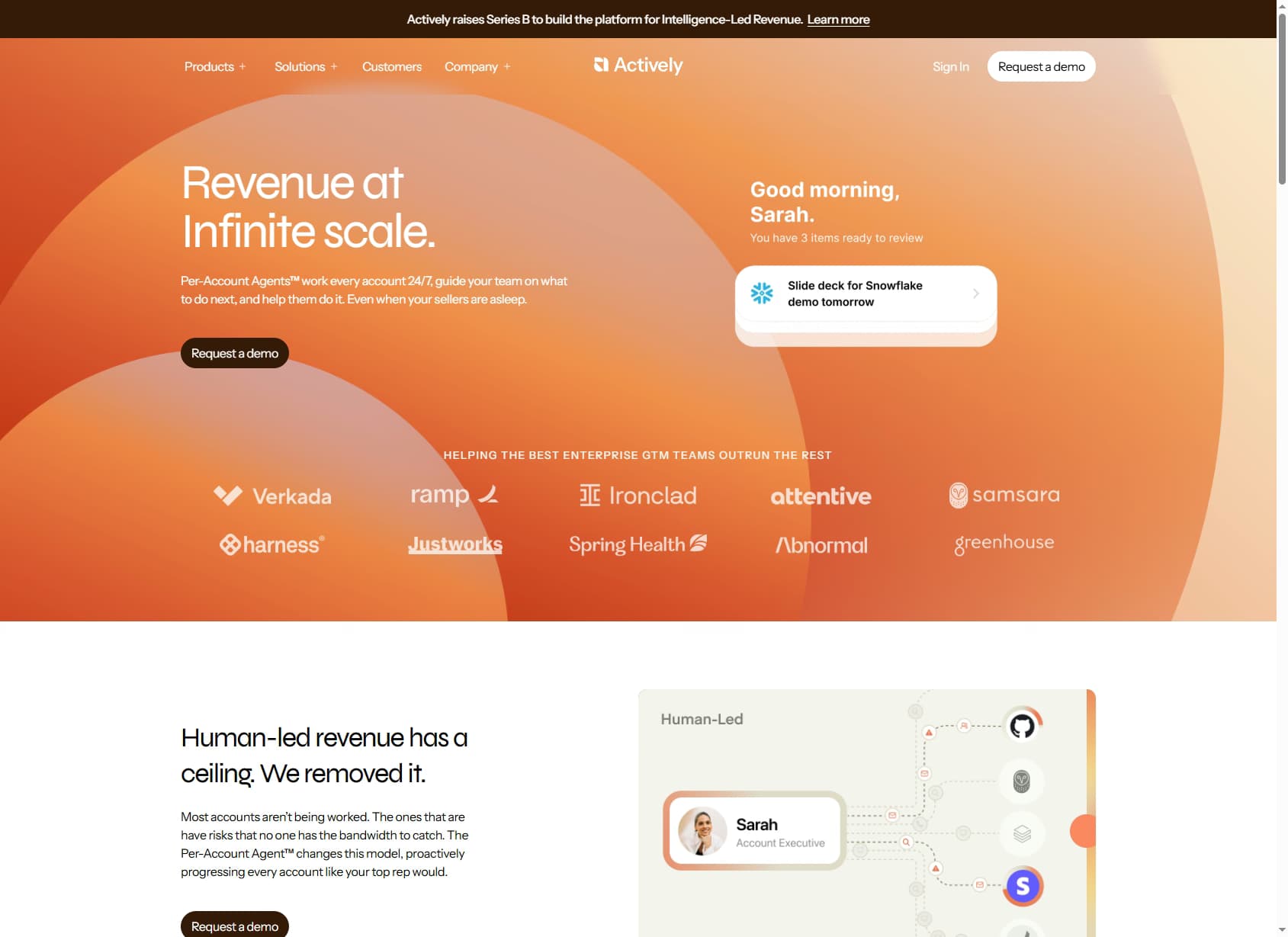
Actively AI — Intelligence-Led Revenue platform for enterprise GTM teams
Actively AI is a GTM intelligence platform that deploys dedicated AI agents across every account in your CRM. Each Per-Account Agent works continuously — analyzing deal history, activity data, and external context to answer one question: which accounts should your reps prioritize right now?
The platform ingests two primary data sources: Salesforce (CRM pipeline history, contact activity, opportunity stages) and Gong (sales call transcripts and deal coaching data). It learns what winning deals look like at your company — not generic best practices, but patterns specific to your sales motion — and scores accounts against those patterns in real time.
The output surfaces in an Agent Inbox: a prioritized list of recommended actions, accounts, and personas for each rep. Ramp used Actively AI to scale past 50,000 customers. Samsara uses it as a core component of their GTM transformation program.
| Capability | What Actively AI Provides | What Is Missing |
|---|---|---|
| Account Prioritization | AI ranks accounts by conversion likelihood using CRM + Gong data | Does not factor real-time external signals (hiring, funding) |
| Contact Enrichment | Not core — persona matching helps identify best-fit roles | No verified emails, mobile numbers, or firmographic data |
| Outreach Execution | None — Actively AI does not send emails or messages | Requires separate sequencer (Outreach, Salesloft, Apollo) |
| Buying Signals | CRM-derived signals from deal history and engagement | No hiring surge, funding round, or tech stack change alerts |
| CRM Integration | Deep native Salesforce + Gong integration | HubSpot not supported at same depth |
Actively AI Pricing: What You Actually Pay
Actively AI does not publish pricing. There are no plan tiers, no credit models, and no self-serve signup. Evaluation begins with a discovery call followed by a custom quote based on team size, CRM data scope, and modules required.
Based on comparable enterprise GTM intelligence platforms and user reports across G2 and OMR Reviews, estimated annual spend:
| Team Size | Estimated Annual Cost | Notes |
|---|---|---|
| Small enterprise (25–50 reps) | $20,000–$40,000/yr | Entry-level; limited module access |
| Mid-enterprise (50–200 reps) | $40,000–$80,000/yr | Most common deal range reported |
| Large enterprise (200+ reps) | $80,000–$150,000+/yr | Full platform; dedicated CS team |
For context: SyncGTM starts at $99/mo ($1,188/yr) with published pricing, no sales call required, and includes waterfall enrichment, buying signals, and outreach in one platform. Apollo starts at $59/mo. The pricing opacity is not a bug for Actively AI — it is deliberate positioning as an enterprise consultative sale.
There is no free trial, no freemium tier, and no monthly billing option. The minimum commitment is annual. Budget evaluation requires speaking to their sales team directly.
Actively AI Key Features
Per-Account Agents
The core product. Each account in your Salesforce instance gets a dedicated AI agent that monitors it continuously. The agent analyzes CRM activity, deal stage history, contact engagement, and Gong transcript data to answer: is this account ready to move? What should the rep do next?
The intelligence compounds over time. As reps close deals, the AI updates its model of what success looks like at your company. Reps who start with weak CRM data see limited early value — the model needs history to learn from.
Agent Inbox
Surfaces completed agent work for each rep in a prioritized feed. Instead of logging into Salesforce and manually triaging 200 accounts, a rep opens Agent Inbox and sees 5–10 accounts to work today, each with a reason and recommended next action.
The value is focus. Enterprise reps with large territories spend significant time deciding what to work. Agent Inbox answers that question automatically.
Persona Matching
Actively AI identifies the best-fit contact persona within a target account — filtering out weak job title matches so reps reach decision-makers faster. This does not provide contact details; it identifies the right role. You still need a separate enrichment tool to find the actual email or phone number.
Watchtower
A monitoring layer that tracks changes across your account universe. Specifics are not publicly documented, but customer references describe it as alerting reps to meaningful account changes — deal stage shifts, engagement drops, key contact role changes — that warrant immediate action.
Salesforce + Gong Integration
The two integrations that matter most to Actively AI's model. Salesforce provides pipeline history and CRM activity. Gong provides call transcripts and deal coaching signals. The combination gives the AI both quantitative deal data and qualitative conversation data — more context than either system provides alone.
Actively AI Data Coverage
Actively AI is fundamentally different from data providers like FullEnrich, BookYourData, or Apollo. It does not maintain a database of contacts. It does not provide email addresses or phone numbers at scale. Its "data coverage" is the quality of insights derived from your own CRM and call data — not external contact databases.
What Actively AI surfaces (CRM-derived)
- Account conversion likelihood score based on CRM history
- Best-fit persona within each account (role, seniority match)
- Next-best-action recommendation (call, follow-up, re-engage)
- Deal risk signals from Gong transcript analysis
- Engagement recency and rep activity analysis
What Actively AI does NOT provide
- Verified work email addresses — you need a separate enrichment tool
- Mobile phone numbers — not a feature
- Real-time external buying signals (hiring surges, funding rounds, tech stack changes, job changes) — SyncGTM covers all four
- Firmographic data (industry, headcount, revenue, tech stack) for net-new prospects
- Contact discovery for accounts not already in your CRM
The implication: Actively AI is a tool for working your existing pipeline more intelligently, not for expanding your prospecting universe. Teams using Actively AI still need waterfall enrichment to fill contact gaps and a signal monitoring tool to catch net-new buying triggers outside their CRM.
Actively AI Pros — What It Does Well
- ✓Genuine AI prioritization, not rule-based scoring. Unlike lead scoring tools that use simple filters (company size + industry = score), Actively AI uses machine learning trained on your actual deal outcomes. The model learns your specific ICP — not a generic one.
- ✓Reduces rep decision fatigue. Enterprise reps with 200+ accounts in territory waste hours deciding what to work. Agent Inbox cuts that to 5–10 daily prioritized actions. G2 reviewers consistently cite time savings on account research as the top value.
- ✓Strong enterprise customer validation. Ramp scaled to over 50,000 customers using the platform. Samsara (publicly traded, $2B+ ARR) uses it as a core GTM transformation tool. These are high-proof-bar enterprise customers with mature RevOps standards.
- ✓Deep Salesforce + Gong integration. Pulling from both deal data and conversation intelligence gives the AI more context than CRM-only tools. The Gong integration is a meaningful differentiator — most prioritization tools ignore call transcript data entirely.
- ✓Compounds over time. The model improves as more deals close. For enterprise orgs with 3+ years of CRM history, the AI has rich training data to work with — and the prioritization accuracy improves measurably as deal patterns accumulate.
Actively AI Cons — Where It Falls Short
- No public pricing — every evaluation starts with a sales call. You cannot calculate ROI before committing to a demo.
- Enterprise-only positioning means teams under 50 reps or with modest CRM data get limited value from the AI model.
- No contact enrichment. Actively AI surfaces who to target but does not provide emails, mobiles, or firmographics. A separate enrichment tool is mandatory.
- No native outreach. After Actively AI tells you to contact someone, you need a separate sequencer to actually send emails or LinkedIn messages.
- Heavy CRM dependency — the AI model's accuracy is directly tied to Salesforce data quality. Poor CRM hygiene means poor prioritization.
- Multi-week onboarding rated 'Senior' complexity. Requires involvement from sales leadership, RevOps, and IT.
- Salesforce-centric — HubSpot teams do not get the same native integration depth.
- No real-time external signals. Hiring surges, funding rounds, and tech stack changes are not monitored. Prioritization relies on your existing CRM history, not live market signals.
Actively AI vs Alternatives (inc. SyncGTM)
Actively AI sits in a different category than most tools teams compare it against. It is not a contact database. It is not a sequencer. It is an account prioritization layer for teams that already have a mature GTM stack and want AI reasoning on top of it. Here is how it stacks up against the platforms buyers most often evaluate alongside it.
| Feature | Actively AI | SyncGTM | Apollo | Clay |
|---|---|---|---|---|
| Starting Price | Custom (est. $20K–$150K+/yr) | $99/mo (published) | $59/mo (Basic) | $149/mo (Starter) |
| Pricing Transparency | None — demo-gated | Published on website | Published | Published |
| Core Use Case | Account prioritization | Enrichment + signals + outreach | Enrichment + outreach | Enrichment orchestration |
| Data Providers | Proprietary AI model | 50+ cascaded waterfall | Single database | 75+ providers |
| Buying Signals | CRM-derived only | Hiring, funding, tech changes, job changes | Basic (Bombora intent) | None native |
| Contact Enrichment | Limited — not core feature | 75–90% hit rate (waterfall) | 60–75% (own DB) | 75–90% via providers |
| Native Outreach | None | Yes — sequencing built-in | Yes — sequences included | None |
| CRM Integration | Salesforce native (Gong also) | HubSpot, Salesforce, Pipedrive, Attio | HubSpot, Salesforce native | Via Zapier/API |
| Target Market | Enterprise only | SMB to enterprise | SMB to enterprise | SMB to mid-market |
| Setup Complexity | High — multi-week onboarding | Low — self-serve | Low — self-serve | Medium |
The honest take on each option
Actively AI is the right choice for one specific scenario: enterprise sales org with 50+ reps, mature Salesforce + Gong data, and a budget above $40K/year. If your problem is rep focus and territory management at scale, the AI prioritization layer delivers real value. Everything else in your stack (enrichment, signals, sequencing) still needs to be handled separately.
SyncGTM covers the full pre-outreach workflow in one platform — waterfall enrichment across 50+ providers (75–90% email hit rate), real-time buying signals (hiring surges, funding rounds, tech stack changes, job changes), and built-in outreach sequencing. Starts at $99/mo with published pricing, self-serve onboarding, and no enterprise commitment required. For teams that need enrichment + signals without a dedicated IT project, SyncGTM eliminates the stack complexity Actively AI requires you to build elsewhere. You can read more about how real-time B2B data platforms compare in our side-by-side guide.
Apollo combines a contact database with outreach sequences, published pricing from $59/mo, and a single-source enrichment model. Its prioritization intelligence is basic compared to Actively AI, but it handles prospecting-to-outreach in one tool without an enterprise commitment.
Clay is the most flexible enrichment orchestration platform (75+ providers) for technical RevOps teams. It has no built-in outreach and no prioritization intelligence, but for custom waterfall workflows, it is best-in-class.
Who Should Use Actively AI?
Actively AI is worth evaluating in a narrow but real set of circumstances. The AI prioritization is genuinely powerful — for the teams it is designed for.
Use Actively AI if:
- You run enterprise outbound with 50+ reps and 200+ accounts per rep in territory.
- Your Salesforce data is clean and dense — 3+ years of deal history with consistent CRM hygiene.
- You use Gong and want call intelligence to feed your account prioritization model.
- You have a dedicated RevOps team to manage a multi-week implementation.
- Budget is above $40K/year and you have procurement/legal bandwidth for enterprise vendor evaluation.
Do not use Actively AI if:
- You need contact enrichment (emails, phones). Actively AI does not provide this — you will need to add a separate tool like SyncGTM or FullEnrich.
- Your team is under 50 reps or your CRM history is thin. The AI model needs volume to learn from.
- You want real-time external signals (hiring, funding, tech changes). SyncGTM's signal-based prospecting covers all four signal types.
- You cannot commit to a six-figure annual contract without a self-serve trial.
- Your CRM is HubSpot, Pipedrive, or Attio — Salesforce is the primary supported platform.
Actively AI Review: Frequently Asked Questions
What is Actively AI and how does it work?
Actively AI is a B2B sales intelligence platform that uses AI to prioritize accounts for outbound sales teams. Founded in 2022 by Stanford AI researchers and backed by $45M in funding (Bain Capital Ventures, First Round Capital), the platform deploys Per-Account Agents that continuously monitor each account in your CRM and surface next-best-action recommendations. It works by ingesting your Salesforce data, past deal patterns, Gong call transcripts, and external signals, then using machine learning to rank which accounts look most likely to convert. Actively AI does not enrich contacts at scale, send emails, or run sequences — it tells your reps who to call and why. Ramp used it to scale past 50,000 customers; Samsara uses it for GTM transformation. The platform is enterprise-only with custom pricing and a multi-week onboarding process.
What does Actively AI cost in 2026?
Actively AI does not publish pricing. All plans are custom-quoted after a discovery call and demo. Based on comparable enterprise GTM intelligence platforms and user reports, expect $20,000–$150,000+ per year depending on team size, CRM data volume, and which modules you license. There is no self-serve trial or free tier. Evaluation requires a formal sales process with a dedicated onboarding team. For teams with a budget under $20K/year, SyncGTM ($99–$649/mo) and Apollo ($59–$149/mo) are the more accessible alternatives with published pricing.
Does Actively AI provide contact data (emails and phone numbers)?
No. Actively AI's core function is account prioritization — telling you which accounts to pursue and which personas to target within those accounts. Contact enrichment (finding verified work emails, mobile numbers) is not a primary feature. To get contact data for the accounts Actively AI surfaces, you still need a separate enrichment tool such as SyncGTM, Apollo, or FullEnrich. This two-tool dependency is one of the main friction points users flag in reviews: Actively AI identifies the account, but you still need another system to find the actual contact and execute outreach.
How does Actively AI compare to SyncGTM?
Actively AI and SyncGTM solve adjacent but different problems. Actively AI focuses exclusively on account prioritization — ranking your existing pipeline and target accounts by conversion likelihood using CRM history and AI reasoning. It does not enrich contacts, run outreach, or monitor real-time external signals (hiring surges, funding rounds, tech stack changes). SyncGTM combines waterfall enrichment across 50+ providers (75–90% email hit rate), real-time buying signal monitoring, and built-in outreach sequencing in one platform starting at $99/mo with published pricing. For enterprise teams that already have rich CRM data and just need AI-driven prioritization, Actively AI adds a layer of intelligence. For teams that need enrichment, signals, and outreach without a $50K+ commitment, SyncGTM delivers more of the stack at a fraction of the cost.
Is Actively AI worth it for small or mid-sized teams?
Probably not. Actively AI is built for enterprise sales organizations with clean, dense CRM data — think 500+ accounts, mature Salesforce hygiene, and a dedicated RevOps function. The AI model needs historical deal data to learn what good looks like. Small teams with thin CRM history get limited value from the prioritization layer. Setup complexity is rated 'Senior' by independent reviewers — it requires coordination across sales, RevOps, and IT over several weeks. For teams under 50 sales reps or without enterprise CRM maturity, SyncGTM, Apollo, or Clay deliver comparable signal intelligence with far lower setup friction and cost.
What integrations does Actively AI support?
Actively AI integrates natively with Salesforce (primary CRM) and Gong (call intelligence). These are the two main data sources that feed its AI model. The platform also offers an API for custom integrations. HubSpot and other CRMs are not natively supported in the same depth — Salesforce is the primary and recommended CRM. Gong transcripts feed the AI model with deal context that improves prioritization accuracy over time.
Verdict: Is Actively AI Worth It in 2026?
Actively AI delivers on a specific promise: AI-driven account prioritization for enterprise sales teams with mature CRM data. For organizations like Ramp and Samsara — with hundreds of reps, clean Salesforce hygiene, and Gong transcripts feeding the AI model — the prioritization intelligence is genuinely valuable.
The limitations are equally clear. No published pricing. No contact enrichment. No outreach layer. No real-time external signals. A multi-week enterprise onboarding. For most GTM teams — especially those under 100 reps or without enterprise budgets — the tool requires too much additional stack to be practical.
If you need enrichment, buying signals, and outreach without building a separate enrichment tool, signal platform, and sequencer on top of Actively AI, SyncGTM covers the complete pre-outreach workflow from $99/mo — with 50+ waterfall providers, four real-time signal types, and built-in sequences. No enterprise commitment. No six-figure budget. No Salesforce requirement.
Our rating for Actively AI: 3.8/5 — excellent for the enterprise scenario it was built for, limited outside it.