

Artisan (Ava) 2026 Review: The AI Sales Agent — Pricing and Real Performance

By Kushal Magar · March 18, 2026 · 12 min read · Last updated: September 30, 2026
Key Takeaway
Artisan is an AI-first sales platform built around Ava, an autonomous AI BDR that finds and enriches leads, writes and sends personalized outreach, handles replies, and books meetings. It includes a 300M+ B2B contact database with email verification, automated email warmup, and LinkedIn automation. Pricing is credit-based with plan tiers, and user reports put typical spend at $2,000 to $5,000 or more per month, with annual contracts standard. Artisan now lists intent signals as part of the platform, but its public pages do not explain how Ava uses them to prioritize prospects. Database accuracy varies by region, with thinner coverage in EMEA and APAC markets, and personalization quality degrades at high volume.
Artisan built Ava, an AI sales agent that handles outbound prospecting from lead sourcing to email sending. The platform includes a 300M+ B2B contact database, built-in email warmup, LinkedIn automation, and campaign management. The promise: replace your SDR team with an AI agent that scales instantly.
You are probably here because you are evaluating whether an AI agent can replace the manual work of outbound prospecting. Ava handles the mechanics well. The question is whether mechanics alone drive pipeline.
According to Gartner, 80% of B2B sales interactions will occur in digital channels by 2025. That means more noise in every inbox. Standing out requires timing and relevance, not just volume.
This Artisan review covers what Ava does well, where autonomous outreach falls short, what it costs, how the workflow runs day to day, and which teams it fits.
Artisan Review: What You Get (and What You Don't)
Artisan is an AI-first sales platform. Ava, the AI SDR, handles prospecting, research, email writing, warmup, and campaign management. The 300M+ contact database means you do not need a separate data provider.
| Feature | What's Included | Limitations |
|---|---|---|
| Ava AI SDR | Autonomous prospecting, email writing, follow-ups | Targeting starts from ICP fit; how signals are weighted is not documented publicly |
| Contact Database | 300M+ B2B contacts with email verification | Accuracy varies by region and industry |
| Email Warmup | Automated sender reputation building | Warmup quality depends on network size |
| LinkedIn Automation | Connection requests and InMails | LinkedIn compliance risks at high volume |
| Intent Signals | Listed as part of the platform (as of September 2026) | Which signals are tracked is not detailed publicly |
The takeaway: Artisan bundles everything you need for outbound mechanics. The open question is how well it decides who to contact and when.
Ava AI SDR: Autonomous Outbound Tested
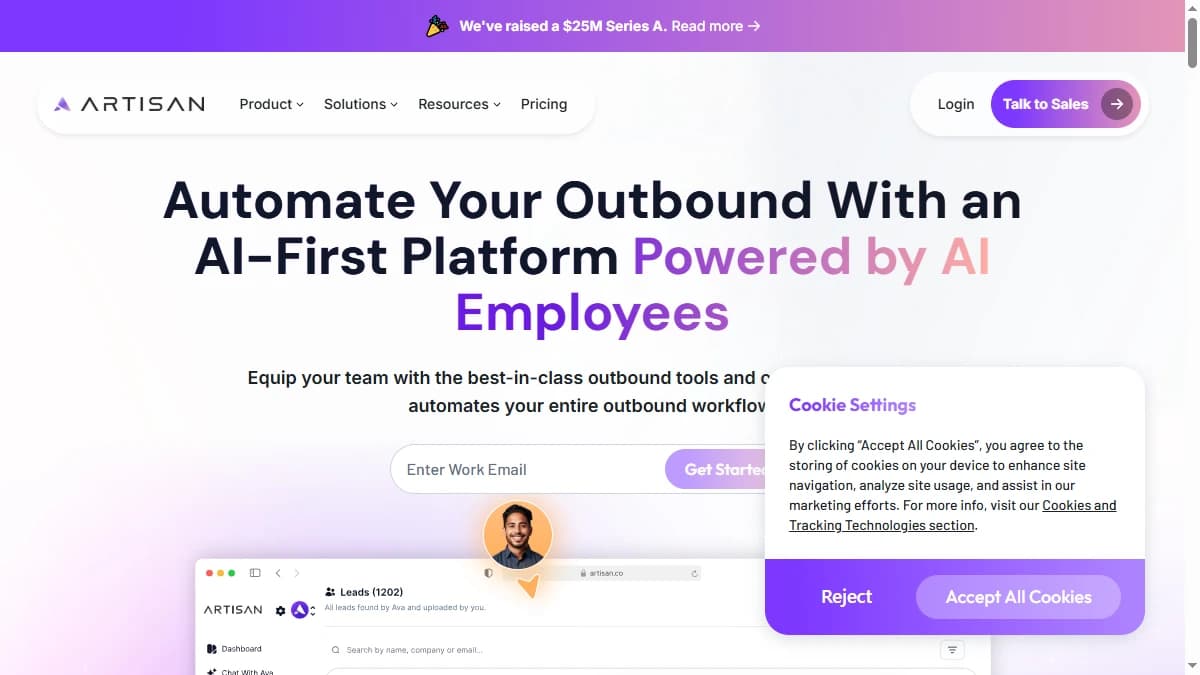
Ava works by taking your ICP definition, searching the 300M+ database, researching prospects, writing personalized emails, and managing the full campaign cycle. She optimizes send times, A/B tests subject lines, and handles follow-ups.
The autonomous workflow saves significant time. Instead of building lists, writing emails, and managing sequences manually, you define the ICP and Ava handles the rest.
What works well
The end-to-end automation is genuinely useful. No list building. No manual email drafting. No follow-up management. Ava also handles LinkedIn outreach alongside email, creating a basic multichannel flow.
Where it falls short
Ava's targeting starts from ICP fit. Artisan now lists intent signals as part of the platform (as of September 2026), but its public pages do not explain how Ava weighs them. A CFO whose company just raised $50M should get different priority and messaging than a CFO at a stable company with no growth signals, so test that on your own accounts before you rely on it.
300M+ Contact Database: Accuracy Check
Artisan's built-in database is a selling point. 300M+ contacts means you do not need Apollo, ZoomInfo, or another data provider. Email verification is included.
However, database accuracy varies. North American contacts tend to be more accurate. EMEA and APAC coverage is thinner. Niche industries and small companies have more gaps. If much of your ICP sits outside North America, ask for a coverage check on a sample of your target accounts before you sign.
Artisan Pricing Breakdown
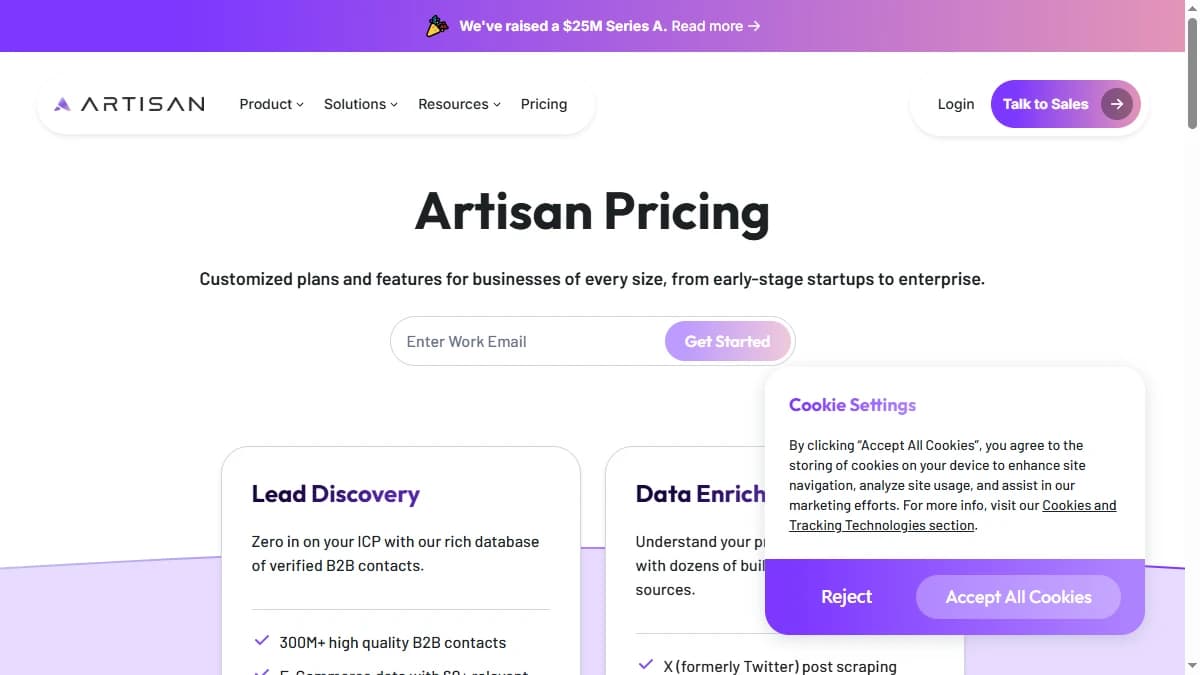
As of September 2026, Artisan's pricing page describes credit-based pricing with plan tiers from startups through enterprise. We could not confirm current list prices, so the figures below are estimates based on G2 reviews and user reports:
- --Estimated range: $2,000–$5,000+/mo depending on features and contact volume
- --Contract type: Annual commitments standard
- --Free trial: Demo available but no self-serve trial
What you actually pay at scale
At $3,000/mo, Artisan needs to generate enough qualified meetings to justify the cost. Work backward from your own numbers: divide the monthly cost by the qualified meetings you expect Ava to book, then compare that cost per meeting with what a human SDR or an outbound agency costs you today. Because pricing is credit-based, confirm what a credit covers before you model volume.
Hidden costs to watch
- Credit-based pricing that needs volume modeling
- Annual contracts with no monthly option
- Database quality varies by region
- Intent signal coverage not detailed publicly — confirm what is included
What Are the Downsides of Using Artisan?
Unclear signal depth
Artisan lists intent signals as part of the platform (as of September 2026), but its public pages do not say which signals are tracked or how Ava weighs them against ICP fit. A prospect who just signed a 3-year contract with your competitor should not get the same outreach as one actively evaluating solutions, so ask for a walkthrough of how Ava picks and prioritizes targets.
Database accuracy gaps
300M+ contacts sounds impressive. But single-source databases always have gaps. G2 reviewers report inconsistent data quality for international contacts and smaller companies.
Pricing takes work to model
Artisan prices on credits, with plan tiers from startups through enterprise. Reported spend runs $2,000–$5,000+/mo with annual commitments, so RevOps teams need an expected lead volume and a written quote before they can build an internal business case.
Personalization at scale
Ava's emails are decent in small batches. At thousands of prospects per month, the personalization starts to repeat. Without unique context for each prospect, the AI falls back on generic research snippets.
How Artisan Works: From ICP to Booked Meetings
Artisan is built to take outbound off your team's plate, but the setup still decides how good the output is. Here is how a typical rollout runs, based on Artisan's own product description and the workflow covered above.
- Scope volume and credits. Pricing is credit-based with plan tiers, so the first conversation with Artisan is about how many leads you want Ava to work each month and what that costs.
- Define your ICP. Ava works from your ideal customer profile. The tighter the definition, the less Ava has to guess about who belongs in a campaign.
- Ava sources and enriches leads. Ava searches the 300M+ contact database, enriches the records, and verifies email addresses before anyone is contacted.
- Ava researches and writes. For each prospect, Ava turns its research into a personalized email, then optimizes send times and A/B tests subject lines.
- Deliverability runs in the background. Built-in email warmup builds sender reputation on your sending accounts, which matters most when you are sending from new domains.
- Sequences go multichannel. Ava runs follow-ups by email and adds LinkedIn connection requests and InMails. Keep LinkedIn volume modest; high-volume automation carries compliance risk.
- Replies turn into meetings. Ava handles replies and books meetings, and contacts and meetings sync to CRMs such as Salesforce and HubSpot.
What stays with your team is the input and the review. Someone has to own the ICP definition, the offer, and a weekly check of the meetings Ava books: are they with the right accounts, and do they convert? Treating Ava as set-and-forget is where the personalization problems covered above tend to show up.
Before you commit, ask for a pilot on a slice of your real ICP and check three things: how many contacts in your target accounts the database actually covers, how varied Ava's emails are across 50 or more prospects, and whether intent signals change who Ava contacts first.
Who Should Use Artisan (and Who Shouldn't)
Artisan's value is the bundle: data, writing, warmup, sequencing, and reply handling in one platform. That makes the fit question mostly about budget, market, and how much control you want over targeting and copy.
Artisan is a good fit for
- Teams without SDR headcount that want one platform instead of stitching together a data provider, a writer, a warmup tool, and a sequencer.
- Companies selling mainly into North America, where the database's accuracy is strongest.
- Teams with deal sizes that justify a $2,000–$5,000+/mo commitment and a clear way to measure cost per qualified meeting.
Artisan is a poor fit for
- Early-stage teams that need low monthly costs or month-to-month flexibility, since annual commitments are standard.
- Teams whose ICP sits mostly in EMEA, APAC, niche industries, or small companies, where coverage is thinner.
- Teams that win on highly tailored messaging at volume, because personalization starts to repeat at thousands of prospects per month.
- Teams that already run a data provider and a sequencer they like. Artisan's value is the bundle, so you would pay for overlap.
Is Artisan Worth It?
Artisan is a capable all-in-one AI outbound platform. Ava handles prospecting, writing, warmup, and campaign management in one place. The 300M+ database means less vendor stacking. For teams that want full automation without managing multiple tools, Artisan delivers.
Artisan is a harder sell for teams where timing and relevance decide deals. Until you have seen how Ava uses intent signals on your own ICP, treat the autonomous workflow as a volume engine rather than a precision one.
The verdict: a slick autonomous agent at a premium price. It earns its cost when your ICP is tightly defined, your market sits where the database is strongest, and your deal sizes justify a $2K–5K+/mo commitment.
Comparing other outreach tools? Read our in-depth reviews of 11x.ai, AiSDR, Reply.io, Instantly, and Lemlist.
If not knowing which intent signals drive Ava's targeting is a dealbreaker, SyncGTM is one alternative worth a look: it tracks real-time buying signals such as job changes, funding, hiring, and web traffic, and scores leads against your ICP.