

7 Best Bright Data Alternatives for B2B Enrichment in 2026

By Kushal Magar · June 9, 2026 · 13 min read · Last updated: September 30, 2026
Key Takeaway
Bright Data is a best-in-class web-scraping and proxy infrastructure platform — but it is the wrong tool for most B2B revenue teams that try to use it for prospecting. It ships raw scraped data with no contact-verification waterfall, no verified phone numbers, no CRM sync, and no outreach, so every workflow needs engineering. SyncGTM is our top pick for revenue teams that want verified, CRM-ready contacts without engineering. Apollo.io is the cheapest contacts-plus-sequences bundle. ZoomInfo wins on verified direct dials. Explorium.ai is best for piping company, contact, and signal data into AI agents. Coresignal and People Data Labs are the closest raw-data API swaps. Crustdata is best for real-time multi-source intelligence.
The best Bright Data alternatives for B2B enrichment replace raw web scraping with verified, CRM-ready contacts. Bright Data is a world-class scraping and proxy infrastructure platform, but it leaves contact verification, phone discovery, deduplication, and outreach entirely to you.
That makes Bright Data excellent for data teams collecting web data at scale. It makes Bright Data painful for sales and GTM teams that just want enriched contacts pushed into a CRM.
There is no contact-verification waterfall. There are no guaranteed verified emails or direct dials. And there is no outreach, no buying signals, and no native CRM sync — it is data infrastructure, not a go-to-market tool.
We evaluated seven Bright Data alternatives across enrichment depth, contact verification, CRM-readiness, and fit for different teams. For broader context, see our roundup of the best waterfall contact providers and our deep dive on Clearbit alternatives.
According to G2 and Gartner, reviewers evaluating Bright Data for sales use cases consistently flag the engineering effort, lack of verified contact data, and absence of an outreach layer as the top reasons they look at alternatives.
Want a wider field of enrichment tools? See our roundups of Coresignal alternatives and RocketReach alternatives.
TL;DR
| Tool | Best For | Starting Price | Free Tier |
|---|---|---|---|
| SyncGTM | Revenue teams that want waterfall enrichment and buying signals in one tool | Free to start | Yes |
| Apollo.io | Outbound-led teams that want contacts and sequences in one product | $59/user/mo | Yes |
| ZoomInfo | Enterprise teams that need verified direct dials and intent data | Custom (~$15K+/yr) | Trial only |
| Explorium.ai | Teams that want B2B data and signals delivered to AI agents | $29.99/pkg | Trial (100 credits) |
| Coresignal | Data teams building enrichment pipelines on raw firmographics | $49/mo | Trial |
| Crustdata | Teams that want real-time multi-source company intelligence | Custom API | Trial |
| People Data Labs | Engineers building products on raw person and company records | $0.005/record | Yes (limited credits) |
Verdict: SyncGTM is the best overall Bright Data replacement for revenue teams — waterfall enrichment across 50+ providers, buying signals, and native CRM sync, free to start. Apollo.io is the cheapest contacts-plus-sequences bundle. ZoomInfo wins on verified phone data. Explorium.ai is the best fit for AI agents that need B2B data over an API or MCP server. Coresignal and People Data Labs are the closest raw-data API swaps. Crustdata is the strongest pick for real-time multi-source intelligence.
Why Teams Look for Bright Data Alternatives
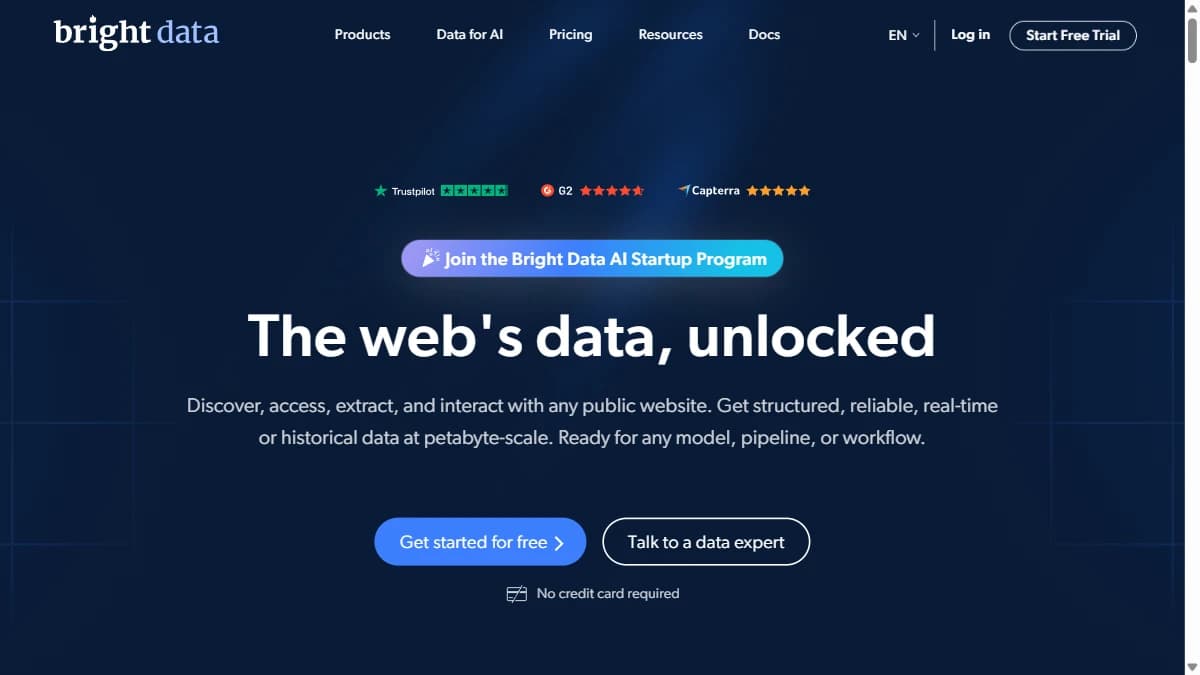
Bright Data — web scraping and proxy infrastructure platform for large-scale data collection
Bright Data is a serious scraping product for serious data teams. Three structural patterns keep pushing B2B revenue buyers toward Bright Data alternatives.
- Engineering tax on every workflow. Bright Data ships raw scraped data and datasets. Verifying emails, finding phone numbers, deduplicating against existing leads, and pushing records into a CRM all require engineering time. Revenue teams without a developer never get workflows live.
- No contact-verification waterfall. Bright Data collects data — it does not chain providers to verify a contact. Email bounce rates and missing direct dials are the predictable result for teams using scraped data straight in outbound.
- No outreach, signals, or CRM sync. Bright Data is data infrastructure. Teams that want enriched contacts plus action either bolt on a separate enrichment and sequencing stack or replace it entirely with a waterfall enrichment tool.
For more on building a CRM-ready enrichment stack without an engineering team, see our roundup of People Data Labs alternatives and our breakdown of 6sense alternatives.
1. SyncGTM
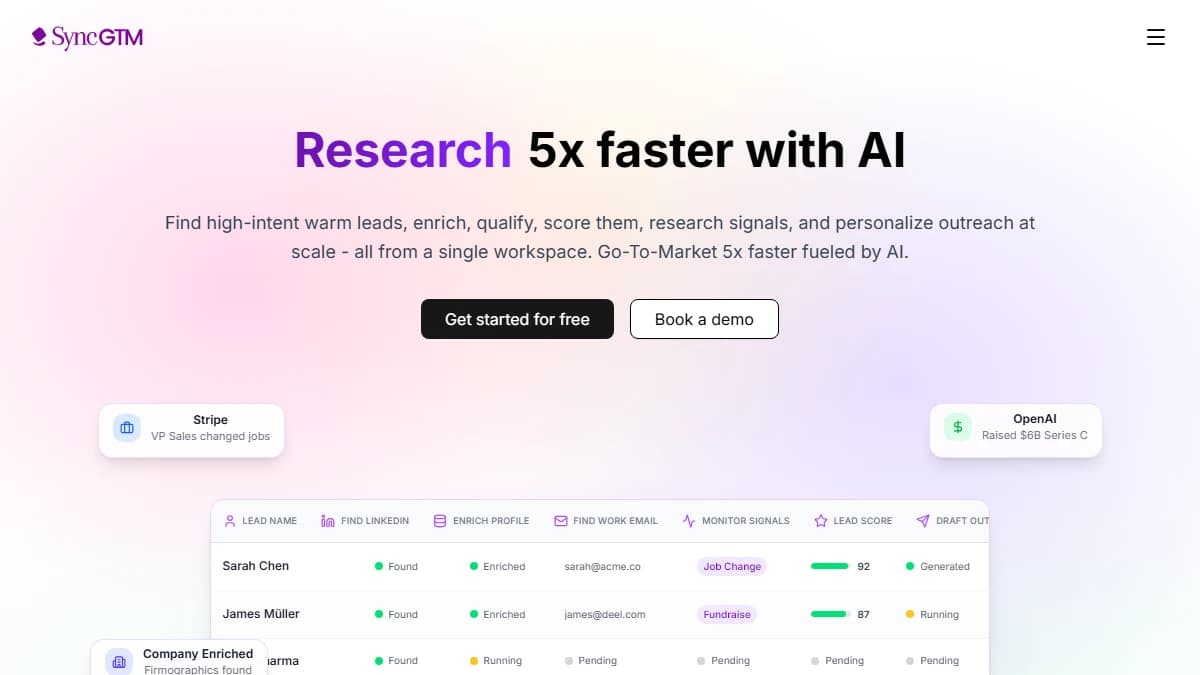
SyncGTM — waterfall enrichment across 50+ providers with buying signals and native CRM sync
SyncGTM is a B2B data enrichment platform best suited for revenue teams that want enriched leads in their CRM without building scrapers, offering waterfall enrichment across 50+ providers and buying signals, with a free plan to start.
Where Bright Data ships raw scraped data and leaves verification and orchestration to your engineering team, SyncGTM runs each lookup through a waterfall of 50+ providers for verified emails, phone numbers, and firmographics.
No scrapers to build. No proxy pools to manage. Native integrations with Salesforce, HubSpot, Pipedrive, Attio, and Close push enriched records into your CRM.
The signal layer is the real differentiator. SyncGTM tracks buying signals — job changes, funding, headcount growth, hiring, and web traffic — and uses AI lead scoring to rank leads against your ICP.
MCP access from Claude, ChatGPT, and Cursor lets you run lookups from the AI tools your team already uses. See the plan breakdown on the pricing page.
Pros
- Waterfall enrichment across 50+ providers — verified emails, phone numbers, and firmographics
- Verified contact data — not raw scraped records
- Native Salesforce, HubSpot, Pipedrive, Attio, and Close integrations
- No scrapers, no proxies, no engineering team required
- Buying signals — job changes, funding, headcount growth, hiring, and web traffic
- AI lead scoring against your ICP
- MCP access from Claude, ChatGPT, and Cursor
- Free to start
Cons
- Not a raw web-scraping or proxy product — built for record-level enrichment
- Smaller brand footprint than ZoomInfo in legacy enterprise procurement
- Not designed for general-purpose web data collection
Best for: Revenue teams that want waterfall enrichment, buying signals, and native CRM sync in one platform without building and maintaining scrapers.
Pricing: Free to start · paid plans on the pricing page
2. Apollo.io
Apollo.io — 275M+ contact database bundled with sequences, dialer, and basic enrichment
Apollo.io is a B2B sales engagement platform best suited for outbound-led teams that want contacts, sequences, and a dialer in one product, offering a 275M+ profile database with enrichment from $59/user/month and a free tier.
Apollo is the cheapest Bright Data swap for teams whose actual problem was contact lookup plus outreach, not raw data collection. The published per-seat pricing and free tier make it accessible to founders and small teams from day one — no scrapers, no procurement.
Where Bright Data ships raw scraped data, Apollo collapses the entire outbound motion into one workspace — contact lookup, list building, sequences, and a power dialer all run from the same tool. A pre-built contact database means no scraping at all.
The tradeoff is depth. Apollo's enrichment is single-source, so the data hit rate on direct dials and international contacts can be uneven. See our Seamless.AI alternatives roundup for more all-in-one options.
Pros
- Cheapest entry point — free tier and $59/user/mo
- 275M+ contact database — no scraping needed
- Bundled sequences and dialer — no integration project
- Works with any CRM
- Self-serve onboarding for revenue teams
Cons
- Single-source enrichment — no waterfall
- Direct dial and international hit rates trail ZoomInfo
- Heavy use of credit-style limits on free and starter tiers
- Not a raw web-scraping product like Bright Data
Best for: Outbound-led teams and founders that want contacts, sequences, and a dialer in one cheap product.
Pricing: Free tier · Basic $59/user/mo · Professional $99/user/mo · Custom enterprise
3. ZoomInfo
ZoomInfo — enterprise B2B intelligence platform with verified phone data and intent signals
ZoomInfo is an enterprise B2B sales intelligence platform best suited for mid-market and enterprise revenue teams that need verified direct dials and intent data, with annual contracts typically starting around $15K and a first-class MCP server for AI workflows.
ZoomInfo is the Bright Data swap for teams whose actual gap was verified contact data, not scraping infrastructure. ZoomInfo's contributory network, manual verification team, and decades of data investment produce verified emails and direct dials at hit rates raw scraping cannot match.
The MCP server is the 2026 differentiator. ZoomInfo ships a production Model Context Protocol server that plugs verified contact and intent data directly into AI agents — meaningfully more useful for teams building agent-driven outbound than a raw scraping layer that requires an engineering integration.
The tradeoff is price and procurement. ZoomInfo annual contracts typically land in the $15K–$80K+/yr range with no published self-serve tier, and the procurement cycle measures in weeks. See our Demandbase alternatives roundup for other enterprise-grade options.
Pros
- Verified direct dial phone numbers — gap that raw scraping does not fill
- Production MCP server for AI agent workflows
- Intent data and buying-signal coverage
- Enterprise procurement-ready
- Deep CRM integrations across Salesforce, HubSpot, and others
Cons
- Annual contracts typically $15K+/yr — no published self-serve
- Procurement cycle measured in weeks, not days
- Aggressive auto-renewal clauses flagged by G2 reviewers
- Per-seat pricing makes small teams uneconomical
Best for: Mid-market and enterprise revenue teams that need verified direct dials, intent data, and MCP-first delivery — and can absorb annual enterprise pricing.
Pricing: Custom annual contracts (~$15K+/yr) · No published self-serve tier
4. Explorium.ai
Explorium.ai — B2B company, prospect, and event data through one API and a hosted MCP server
Explorium.ai is a B2B data and infrastructure platform best suited for GTM engineers and AI SDR teams that want structured company and prospect data on demand, delivered through one REST API and a hosted MCP server instead of scrapers.
Explorium is the Bright Data swap for teams who were scraping to feed an AI agent or internal tool. Instead of collecting pages and parsing them, you call AgentSource to resolve, enrich, and monitor companies and prospects. Explorium reports 146M+ business entities, 767M+ professional profiles, and 4,000+ data signals drawn from 100+ sources.
The signal layer is the differentiator. Explorium tracks funding rounds, job changes, hiring, and tech changes as events, and returns firmographics, technographics, and workforce trends per company. Non-technical users get Vibe Prospecting, which builds and enriches lists from plain-English prompts and installs from the Claude and ChatGPT connector directories.
The tradeoff is scope. Explorium has no outreach sending and no spreadsheet-style workflow builder, and the API and MCP paths assume some technical comfort. Credit cost also varies by enrichment type. See our roundup of Clearbit alternatives for simpler enrichment options.
Pros
- One REST API plus a hosted MCP server for AI agents
- 146M+ companies and 767M+ professional profiles (self-reported)
- 4,000+ data signals, including funding, hiring, and job changes
- Vibe Prospecting for plain-English list building without code
- Bulk enrichment of up to 50 records per request
Cons
- No outreach sending, inbox, or dialer
- No spreadsheet-style workflow builder
- API and MCP paths assume some technical comfort
- Credit cost varies by enrichment type
Best for: GTM engineers and AI SDR teams that want structured B2B data and buying signals piped into agents or internal tools, without maintaining scrapers.
Pricing: Free trial (100 credits) · Lite $29.99 (500 credits) · Starter $149.99 (5,000) · Growth $749.99 (30,000) · Scale $7,499.99 (500,000) · Enterprise custom
5. Coresignal

Coresignal — multi-source firmographic API with 1.6B+ profile and 100M+ company records
Coresignal is a B2B data infrastructure platform best suited for data teams building enrichment pipelines on raw firmographic records, offering 1.6B+ profile records, 100M+ company records, and 300+ data points per company via API and bulk datasets.
Coresignal is the closest raw-data Bright Data swap for engineering-led teams that want structured B2B records instead of general web scraping. Both ship API access plus bulk datasets, and both expect your team to handle deduplication, orchestration, and CRM push.
The differentiator versus Bright Data is structure. Where Bright Data delivers general scraped web data, Coresignal ships pre-structured company and employee records with firmographic depth — friendlier for data teams building market-intelligence products.
The tradeoff is the same engineering tax, plus a monthly refresh cadence and no direct dial phone numbers. Revenue teams without a data engineer get nothing actionable out of the box. See our Coresignal alternatives roundup for the deep dive.
Pros
- Pre-structured firmographic records — not raw web data
- 1.6B+ profile records and 100M+ company records
- 300+ data points per company
- Self-serve Starter tier from $49/mo
- Strong fit for data teams and market-intelligence products
Cons
- Same engineering tax — no native CRM sync
- Monthly refresh cadence lags contact-verification tools
- No direct dial phone numbers in standard datasets
- No outreach, no signals, no workflow layer
Best for: Data teams and engineers building enrichment pipelines or market-intelligence products on structured B2B records.
Pricing: Starter from $49/mo · Pro from $800/mo · Premium from $1,500/mo
6. Crustdata

Crustdata — real-time multi-source company intelligence API with headcount velocity signals
Crustdata is a real-time B2B company data API best suited for teams that need multi-source intelligence without building scrapers, aggregating from 10+ sources including LinkedIn headcount, app store reviews, and web traffic patterns.
Crustdata is the Bright Data swap for teams whose pain was building and maintaining scrapers to track companies. Instead of scraping yourself, Crustdata delivers structured, real-time signals — headcount velocity, app review trends, traffic data — through one API.
The multi-source aggregation is the differentiator. Crustdata pulls from 10+ sources that general scraping setups have to stitch together manually — app store reviews flag product momentum, headcount velocity flags growth-stage shifts, web traffic flags brand momentum.
The tradeoff is the same engineering tax as Bright Data on the action side. Crustdata is API-first, developer-focused, no native CRM sync, no outreach. Revenue teams that want signals plus action in one tool will need to add their own CRM sync and outreach layer.
Pros
- Real-time multi-source data (10+ providers) — no scrapers to maintain
- Headcount velocity and growth-stage signals
- App store and web traffic data general scraping misses
- Strong fit for account-based intelligence strategies
- Self-serve API onboarding
Cons
- API-first — no native CRM sync or no-code workflow builder
- No outreach or sequencing layer
- Limited contact data depth — company-side focused
- Custom pricing — no published self-serve tiers
Best for: Account-based intelligence teams that need real-time multi-source signals without building scrapers.
Pricing: Trial available · Custom API pricing based on call volume
7. People Data Labs
People Data Labs — developer-first B2B data API with 1.5B+ person and 70M+ company records
People Data Labs (PDL) is a B2B data infrastructure platform best suited for engineers building products on raw person and company records, offering 1.5B+ profile records, 70M+ company records, and self-serve pricing from $0.005 per record.
PDL is the developer-first Bright Data alternative for teams that want structured person-and-company data instead of running their own scrapers. You get clean API access to a massive dataset and skip the scraping infrastructure entirely.
The self-serve entry point is the differentiator. PDL self-serve starts at $0.005 per record — friendly for small data teams prototyping a pipeline before committing to production volume, and far simpler than maintaining a Bright Data scraping setup.
The tradeoff is the same engineering tax — no native CRM sync, no outreach, no workflow layer, and single-source data with no waterfall logic. See our People Data Labs alternatives roundup for the deep dive.
Pros
- Structured person-and-company API — no scrapers to build
- 1.5B+ profile records and 70M+ company records
- Broad SDK coverage (Python, JS, Ruby, Go, Rust)
- Self-serve pricing from $0.005 per record
- Built for data teams and product engineering
Cons
- Same engineering tax — no native CRM sync
- Per-record credit math scales aggressively at volume
- Single-source data — no waterfall logic
- No outreach, no signals, no workflow layer
Best for: Engineers building enrichment pipelines, ML scoring models, or third-party data products on raw B2B records.
Pricing: Self-serve from $0.005/record · Custom enterprise contracts
Side-by-Side Comparison
| Tool | Standout | Starting Price | G2 |
|---|---|---|---|
| SyncGTM | 50+ provider waterfall, buying signals, AI lead scoring, native CRM sync | Free to start | N/A |
| Apollo.io | 275M+ contacts, built-in sequences and dialer | $59/user/mo | 4.7 |
| ZoomInfo | Verified phone data, intent signals, MCP server | Custom (~$15K+/yr) | 4.5 |
| Explorium.ai | One API + hosted MCP server, 4,000+ data signals | $29.99/pkg | N/A |
| Coresignal | 1.6B+ profile records, 300+ data points per company | $49/mo | 4.3 |
| Crustdata | 10+ data sources, headcount velocity, app review signals | Custom API | 4.6 |
| People Data Labs | 1.5B+ profile records, raw API for developers | $0.005/record | 4.4 |
How to Choose the Right Bright Data Alternative
The right swap depends on what you actually used Bright Data for. Five decision points cover most cases.
- You are a revenue team that wants enriched leads in your CRM without engineering. Pick SyncGTM. Waterfall enrichment across 50+ providers, buying signals, and native CRM sync, free to start.
- You are outbound-led and want one cheap tool for contacts and sequences. Pick Apollo.io. Free tier and $59/user/mo with 275M+ contacts and a built-in dialer.
- You need verified direct dials and enterprise procurement is fine. Pick ZoomInfo. Fills the verified-phone gap raw scraping does not, with first-class MCP support.
- You are building AI agents that need B2B data on demand. Pick Explorium.ai. One API and a hosted MCP server for company, contact, and event data, with credit packages from $29.99.
- You are a data team that needs raw API records to build a product or pipeline. Pick Coresignal or People Data Labs. Structured B2B records without running your own scrapers.
For a broader breakdown of the modern enrichment stack, see our roundup of the best waterfall contact providers.
Final Verdict
Bright Data is a best-in-class scraping and proxy product. It is also the wrong tool for the majority of B2B teams that try to use it for prospecting — because most teams want enriched, verified contacts in their CRM, not raw scraped web data and an engineering project.
For revenue teams searching for a Bright Data replacement, the answer is to unbundle from raw scraping, pick a waterfall enrichment layer that includes verified contact data, and run outreach on top.
SyncGTM is the best overall pick for that motion — waterfall enrichment across 50+ providers for verified emails and phone numbers, buying signals, and native CRM sync to Salesforce, HubSpot, Pipedrive, Attio, and Close, free to start.
Apollo.io is the cheapest contacts-plus-sequences bundle. ZoomInfo wins on verified direct dials. Explorium.ai is the best fit for AI agents that need B2B data over an API or MCP server. Coresignal and People Data Labs are the closest raw-data API swaps. Crustdata is the strongest pick for real-time multi-source intelligence. Pick the one that maps to the job you actually used Bright Data for.