

6 Competitive Intelligence Tools for B2B Sales in 2026

By Kushal Magar · October 31, 2026 · 14 min read
Key Takeaway
The best competitive intelligence tools for B2B sales in 2026 are SyncGTM, Klue, Crayon, Owler, Similarweb, and Kompyte by Semrush. SyncGTM ranks first for sales teams because it turns competitive intel into pipeline: tech stack detection, a Techstack Change signal, job listings, and headcount growth flag the accounts already using a competitor, from $49/mo. It is not a battlecard or win-loss platform. For that, Klue (CI plus win-loss) and Crayon (automated monitoring) are the leaders, both quote-only at a reported median of about $30,000 a year. Owler ($39/mo billed annually) is the budget pick for news and alerts, Similarweb ($125/mo billed annually) benchmarks competitor traffic, and Kompyte sells battlecard plans sized by competitors tracked.
Competitive intelligence tools track what your rivals do and turn it into something a rep can use in a deal: a battlecard, an alert, or a reason to call. For B2B sales, the right one depends on whether you need to beat a competitor in an open deal or find the accounts that already pay that competitor.
That pressure is constant. Crayon's State of Competitive Intelligence 2025 survey found sellers go head-to-head with a competitor in 68% of deals.
Most lists ranking for this keyword skip prices and mix social listening tools in with sales tools. This one ranks six tools on what a B2B sales team needs: battlecards, competitor tracking, alerts, win-loss, and price.
Every price was checked in October 2026, and quote-only tools are labelled as such.
TL;DR
- SyncGTM: best for finding accounts that use a competitor, via tech stack, tech change, and hiring signals. Not a battlecard tool. Free plan, then $49/mo.
- Klue: best for a full CI and win-loss program. Quote-only, about $30,000 a year median per Vendr.
- Crayon: best for automated competitor monitoring and battlecards. Quote-only, about $30,000 a year median per Vendr.
- Owler: best budget pick for competitor news and alerts. Free plan, Pro $39/mo billed annually.
- Similarweb: best for benchmarking competitor web traffic. From $125/mo billed annually.
- Kompyte by Semrush: battlecards and win-loss reporting with plans sized by competitors tracked. Quote-only.
What Competitive Intelligence Tools Do for B2B Sales
Competitive intelligence tools do two different jobs for a sales team. Most buyers only think about the first one.
- Win the deal you are in.Track competitors' websites, pricing, launches, and reviews, then package it as battlecards and objection handling. Win-loss interviews tell you whether it worked.
- Find the deals you are not in yet.Identify companies that run a competitor's product, just adopted one, or just dropped one. This is competitor displacement, and it runs on account data rather than competitor data.
Klue, Crayon, and Kompyte are built for the first job. Owler and Similarweb sit in between: they watch companies and markets, not deals.
The second job needs technographic signals and hiring signals, which is why a signal platform tops this list for sales teams that measure CI by pipeline.
How We Ranked These Tools
We scored each tool on five things a B2B sales team cares about:
- Sales output: does it produce something a rep uses, such as battlecards, alerts, or account lists?
- Competitor tracking: which sources it watches and how much noise reaches the team.
- Pipeline impact: can it point to accounts to work, not just facts about rivals?
- Workflow fit: CRM, Slack, and enablement integrations.
- Price transparency: a public price, or credible buyer data when there is none.
We did not run a scored accuracy test across vendors. Feature details come from each vendor's own pages, vendor statistics are labelled as claims, and quote-only prices are third-party estimates.
1. SyncGTM
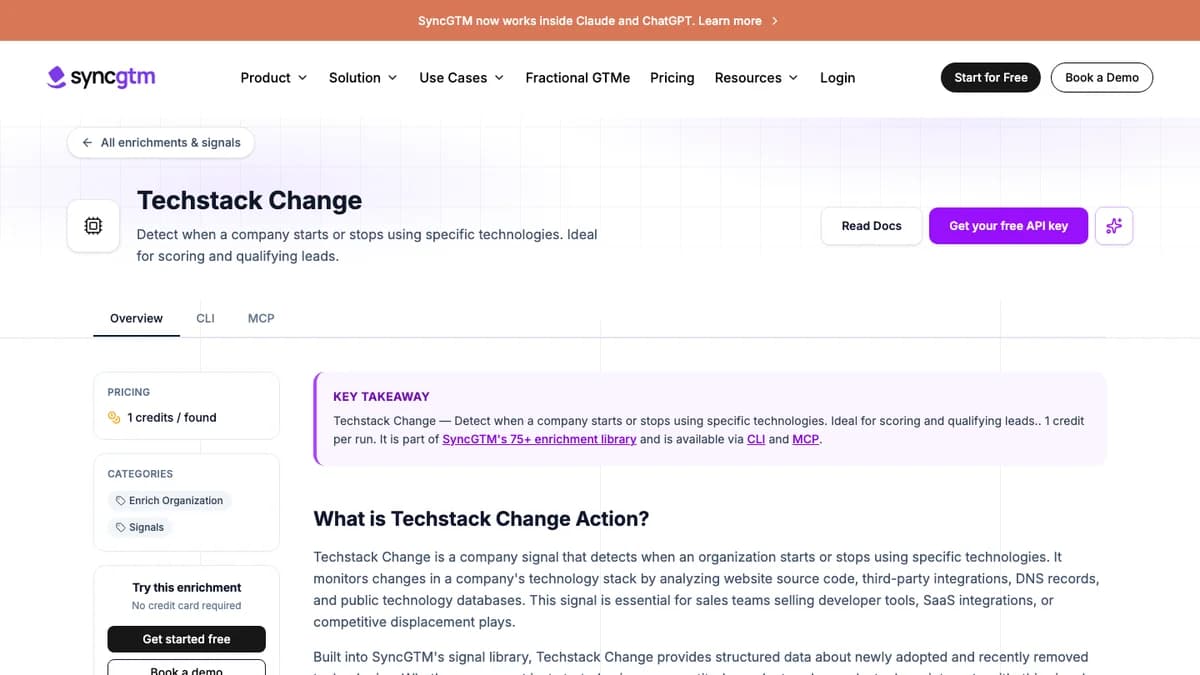
SyncGTM — the Techstack Change signal flags accounts that add or drop a competitor's product, 1 credit per run
SyncGTM is a GTM data platform for company and contact enrichment and buying signals. On this list it does a different job from the rest: it does not tell you what your competitor is doing, it tells you which of your target accounts use your competitor.
The core is technographics. A tech stack lookup costs 1 credit per domain, and the Techstack Change signal (1 credit per run) returns newly adopted technologies, recently removed ones, and the full current stack.
Hiring data adds context. Company job listings (5 credits) often name the tools a team runs, and headcount growthby function (2 credits) shows whether the team that owns the competitor's product is growing.
Results land in one table and sync to HubSpot or Salesforce. Pair the list with a battlecard from a CI platform and the rep knows both who to call and what to say.
- What it tracks
- Tech stack, tech stack changes, job listings, headcount growth by function, website traffic, news, and product launches for any domain
- What sales gets
- Lists of target accounts that run, adopt, or drop a competitor's product, synced to the CRM
- Integrations
- Two-way sync with HubSpot and Salesforce; Pipedrive, Attio, and Close integrations; API; MCP server
- Free option
- Free plan with 50 credits a month
Pros
- ✓ Finds the accounts already paying a competitor, which battlecard tools do not do
- ✓ Techstack Change returns newly added and removed technologies for 1 credit
- ✓ Job listings and headcount growth show which teams are scaling around a tool
- ✓ Public per-action credit pricing, so you pay only for the checks you run
- ✓ Two-way HubSpot and Salesforce sync puts the flag on the account record
Cons
- ✗ Not a battlecard or win-loss platform: no battlecard editor, no buyer interviews
- ✗ Does not monitor competitors' own websites, pricing pages, or messaging
- ✗ Tech detection only sees tools that leave a web footprint, so back-office software can be missed
- ✗ No Chrome extension yet (it is on the public roadmap)
Best for: Sales teams that want competitive intelligence to produce pipeline: lists of accounts using, adopting, or dropping a rival product.
Pricing: Free plan with 50 credits a month. Solo is $49/mo for 1,000 credits, Growth $99/mo for 3,000, and Pro $249/mo for 10,000. See SyncGTM pricing.
2. Klue
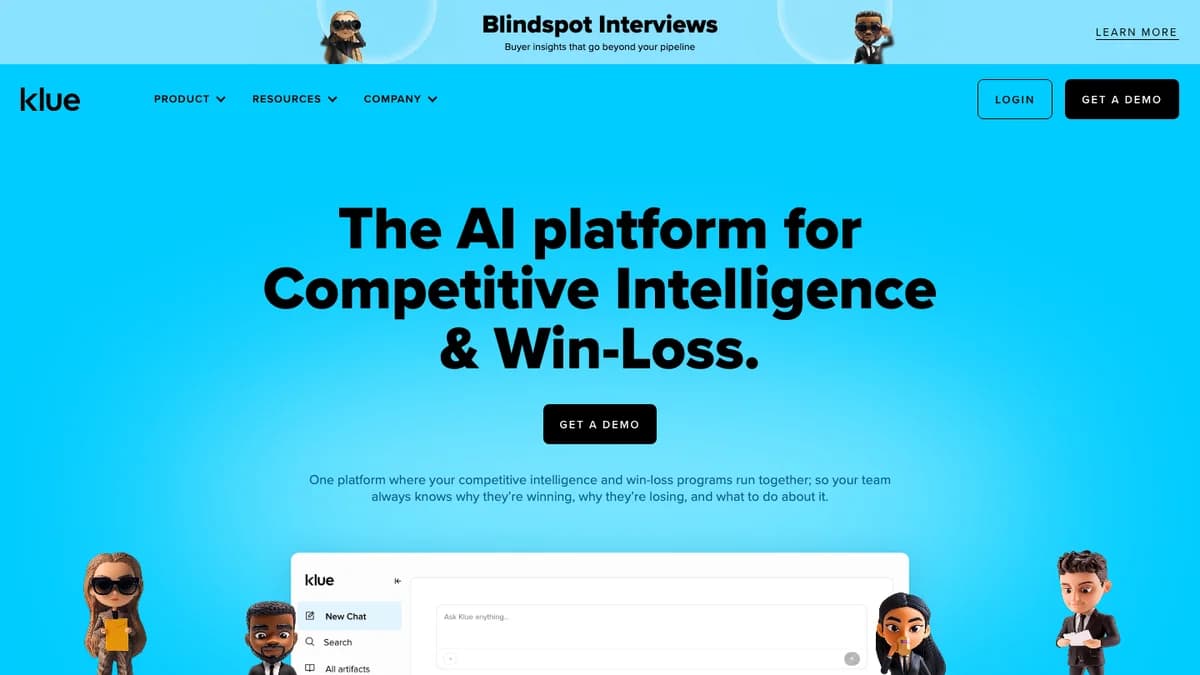
Klue — competitive intelligence and win-loss programs in one AI platform
Klue calls itself the AI platform for competitive intelligence and win-loss. Its Compete Agent collects and curates competitor intel, and Auto Insights drafts research content for the CI team to review.
The win-loss suite is the differentiator. Klue runs buyer interviews through an AI Interviewer or human experts, adds Blindspot interviews with buyers outside your pipeline, and writes Win & Loss Stories from the results.
Klue says more than 250,000 people use the platform and reports a 28% win-rate lift against top competitors. Those are vendor claims, but they match its positioning as the tool for teams that run CI as a formal program.
- What it tracks
- Competitor news, websites, and field intel collected by Compete Agent; buyer interviews for win-loss
- What sales gets
- Battlecards, Ask Klue answers on positioning and objections, Win & Loss Stories
- Integrations
- Salesforce, Slack, Gong, Highspot, Showpad, and Glean are referenced on Klue's site
- Free option
- None; demo only
Pros
- ✓ Combines CI and win-loss, so battlecards reflect why deals are actually lost
- ✓ Ask Klue answers positioning and objection questions with linked sources
- ✓ Win-loss offers an AI Interviewer as well as human-expert interviews
- ✓ Delivers intel where reps already work, such as Slack, Salesforce, and Highspot
Cons
- ✗ Quote-only; Vendr reports a $30,000 median annual contract
- ✗ Vendr says onboarding fees can run low-to-mid five figures
- ✗ Needs a product marketing or CI owner to curate content
- ✗ Does not show which prospects already use a competitor
Best for: Mid-market and enterprise teams with a dedicated CI or product marketing owner and frequent head-to-head deals.
Pricing: Quote-only; Klue's pricing page lists products, not prices. Vendr's Klue buyer guide reports a median of $30,000 a year (range $16,000 to $60,000). Treat these as estimates.
3. Crayon
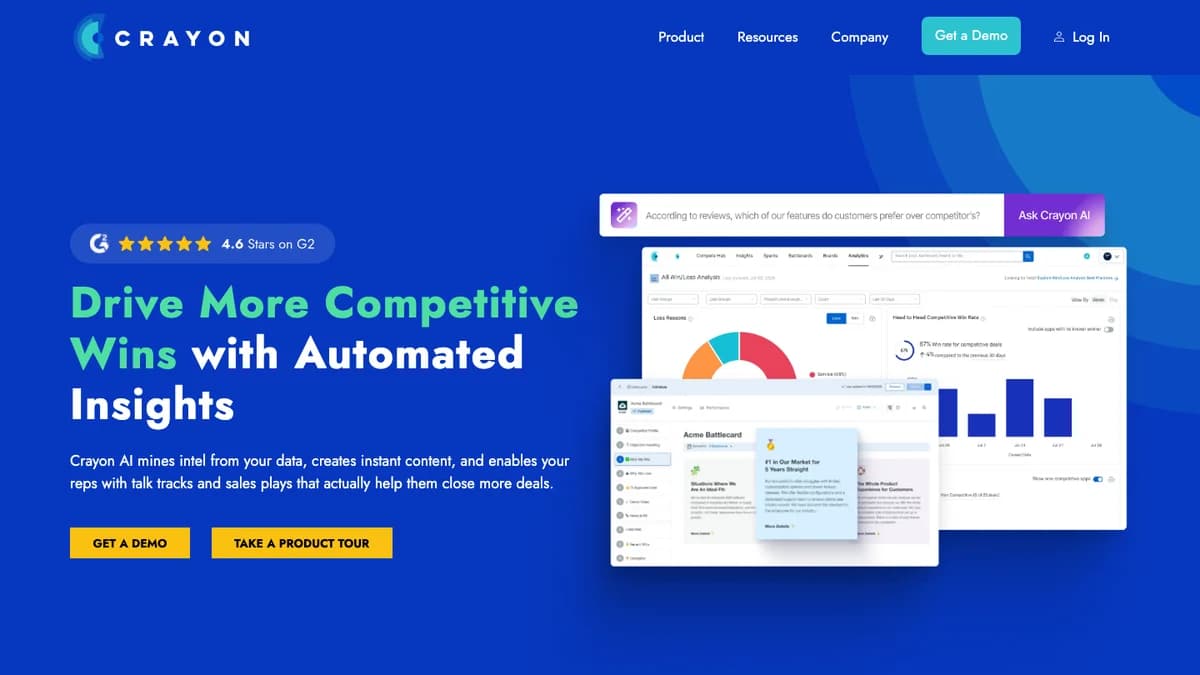
Crayon — automated competitor monitoring, battlecards, and win/loss analytics
Crayon is competitive intelligence software built around automated tracking. It monitors competitor websites, news, social media, and PR, then sends alerts and a daily digest of the insights its AI rates as most important.
Crayon AI and Sparks summarize competitor moves and run recurring reports. The content tools turn that into battlecards, announcements, and newsletters, and sales enablement pushes them into Salesforce, Slack, Teams, and Highspot.
Measurement is a strength. Crayon tracks battlecard engagement, win/loss analysis, and influenced revenue, and its customer stories cite results such as a 22% competitive win-rate increase at Salsify.
- What it tracks
- Competitor websites, news, social media, and PR, prioritized by Crayon AI and Sparks
- What sales gets
- Battlecards, competitive newsletters, talk tracks, and a daily digest of priority insights
- Integrations
- Salesforce, Slack, Microsoft Teams, and Highspot
- Free option
- None; demo and product tour
Pros
- ✓ AI scores which competitor changes matter before they reach the team
- ✓ Battlecards, newsletters, and announcements built from the same intel
- ✓ Measures battlecard engagement, win/loss, and influenced revenue
- ✓ Crayon's homepage shows a 4.6-star G2 rating
Cons
- ✗ Quote-only; Vendr reports a $30,000 median annual contract
- ✗ Broad monitoring means someone has to tune what reaches reps
- ✗ Value depends on a CI owner keeping battlecards current
- ✗ Does not show which prospects already use a competitor
Best for: Product marketing teams that want competitor changes collected automatically and turned into battlecards and newsletters.
Pricing: Quote-only; Crayon's pricing page says pricing is tailored to your CI program. Vendr's Crayon buyer guide reports a $30,000 median across 93 purchases (range $12,700 to $46,000). Treat these as estimates.
4. Owler
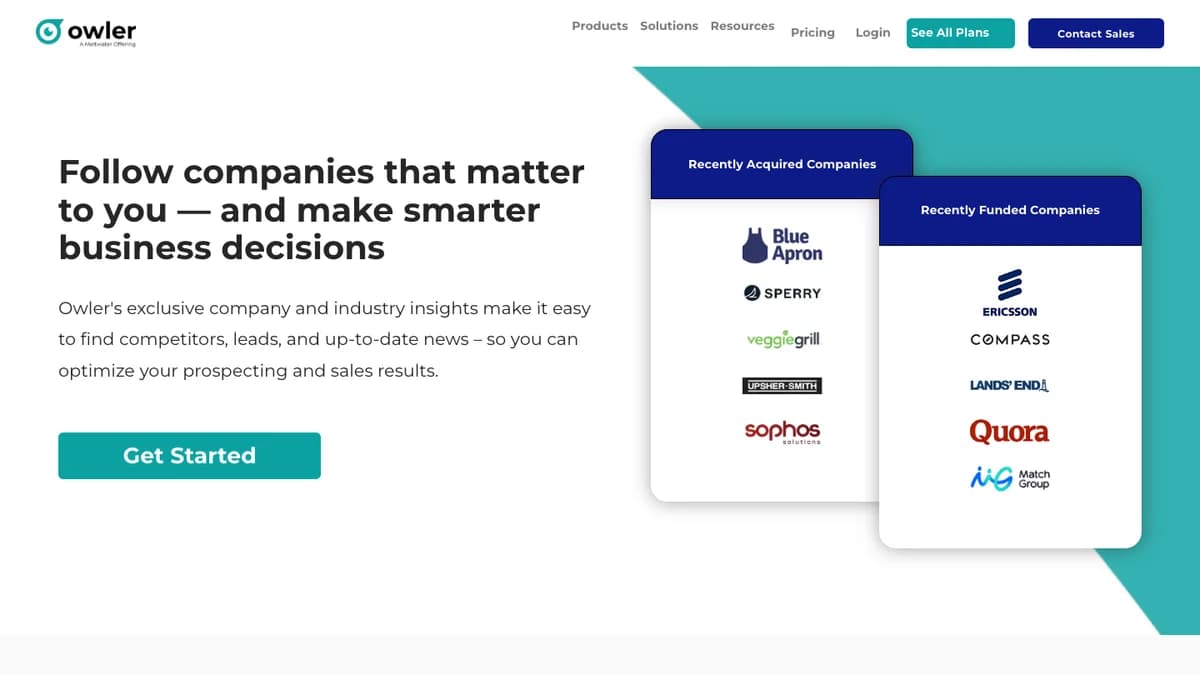
Owler — company news, competitor lists, and alerts on the companies you follow
Owler is a company intelligence and news platform, now part of Meltwater. You follow companies, and Owler sends a daily snapshot plus alerts on funding, acquisitions, leadership hires, and other news.
Its standout for competitive work is the competitor graph. Owler says it maps more than 45 million competitive relationships, so you can see who a rival competes with and spot lookalike companies quickly.
Treat the revenue and headcount numbers as directional, not exact. Our Owler review covers data quality and plan limits in detail.
- What it tracks
- News, funding, acquisitions, leadership changes, and estimated revenue and headcount for followed companies
- What sales gets
- A Daily Snapshot email, real-time alerts, and competitor lists for each company
- Integrations
- CRM integrations and API on the custom-priced Enterprise plan
- Free option
- Community plan: follow 5 companies, 1 full company profile a month
Pros
- ✓ Cheapest paid option on this list
- ✓ Competitor graph lists each company's rivals in one click
- ✓ Daily Snapshot keeps reps current without logging in
- ✓ Setup takes minutes: follow a company and alerts start
Cons
- ✗ Revenue and headcount figures are estimates, partly community-sourced
- ✗ No battlecards, win-loss, or competitor website tracking
- ✗ CRM integrations and API need the Enterprise plan
- ✗ Free plan is too limited for a full competitor set
Best for: Founders, reps, and small teams that want a daily feed of competitor and account news on a budget.
Pricing: Community is free, Pro is $39/mo billed annually, and Enterprise is custom, per PricingSaaS's tracking of Owler's plans. Owler's own pricing page has the current terms.
5. Similarweb
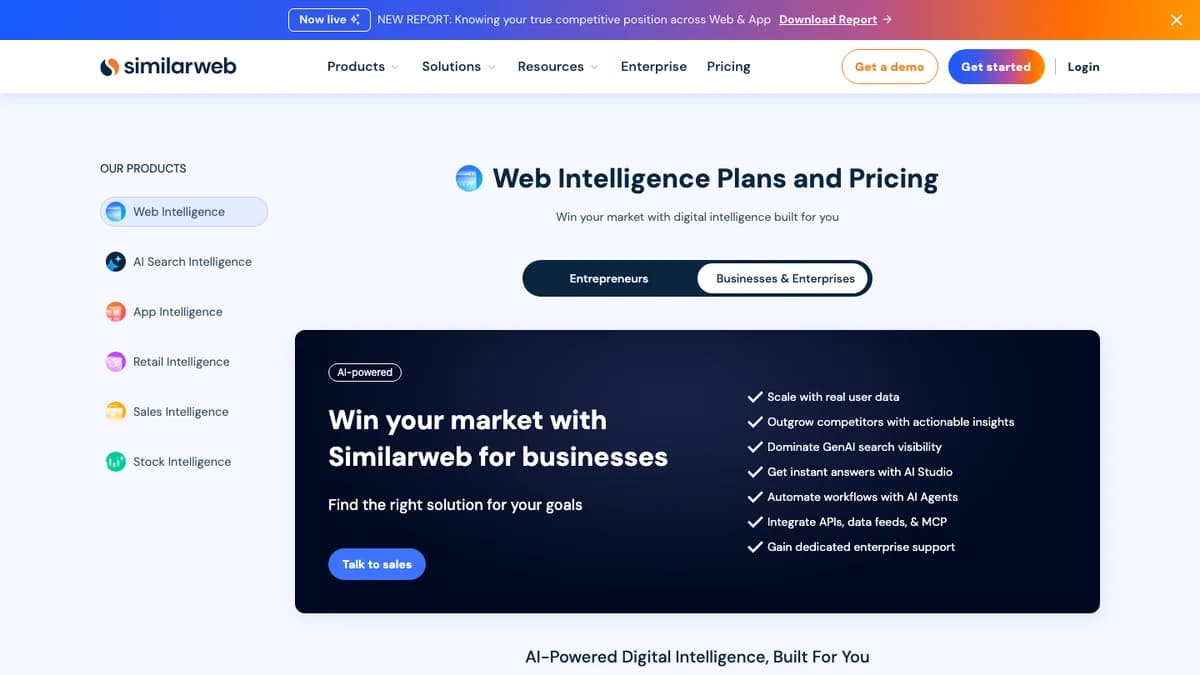
Similarweb — web intelligence plans for benchmarking competitor traffic, SEO, and ads
Similarweb is a digital intelligence platform that estimates traffic and engagement for any website. Its Competitive Intelligence plan covers website performance, traffic and engagement, demographics, and competitor alerts.
For a sales team, that answers questions like which competitor is growing fastest and where their traffic comes from. It does not tell you what the competitor changed on its pricing page or how to handle its objections.
Our Similarweb review covers data accuracy and the Sales Intelligence product, and our list of Similarweb alternatives covers cheaper options.
- What it tracks
- Competitor website traffic, engagement, traffic sources, and audience demographics; SEO, AEO, and ads on higher plans
- What sales gets
- Traffic benchmarks, market share views, and competitor alerts
- Integrations
- API, data feeds, and MCP on business plans
- Free option
- Free trial
Pros
- ✓ The clearest view of how competitors' websites perform
- ✓ Public self-serve pricing, unlike the dedicated CI platforms
- ✓ Competitor alerts are included in the entry plan
- ✓ Higher plans add SEO, AI search (AEO) visibility, and ad intelligence
Cons
- ✗ Traffic is modeled, so low-traffic B2B sites get rough estimates
- ✗ Covers digital performance only, not pricing, product, or messaging changes
- ✗ SEO and ads data need the $333/mo or $542/mo plans
- ✗ No battlecards or win-loss
Best for: Teams competing for digital demand who need to benchmark competitors' traffic, channels, and audience.
Pricing: Competitive Intelligence is $125/mo billed annually or $199/mo monthly. Competitive Intel, SEO & AEO is $333/mo billed annually, and adding Ads is $542/mo billed annually, per Similarweb's pricing page.
6. Kompyte by Semrush
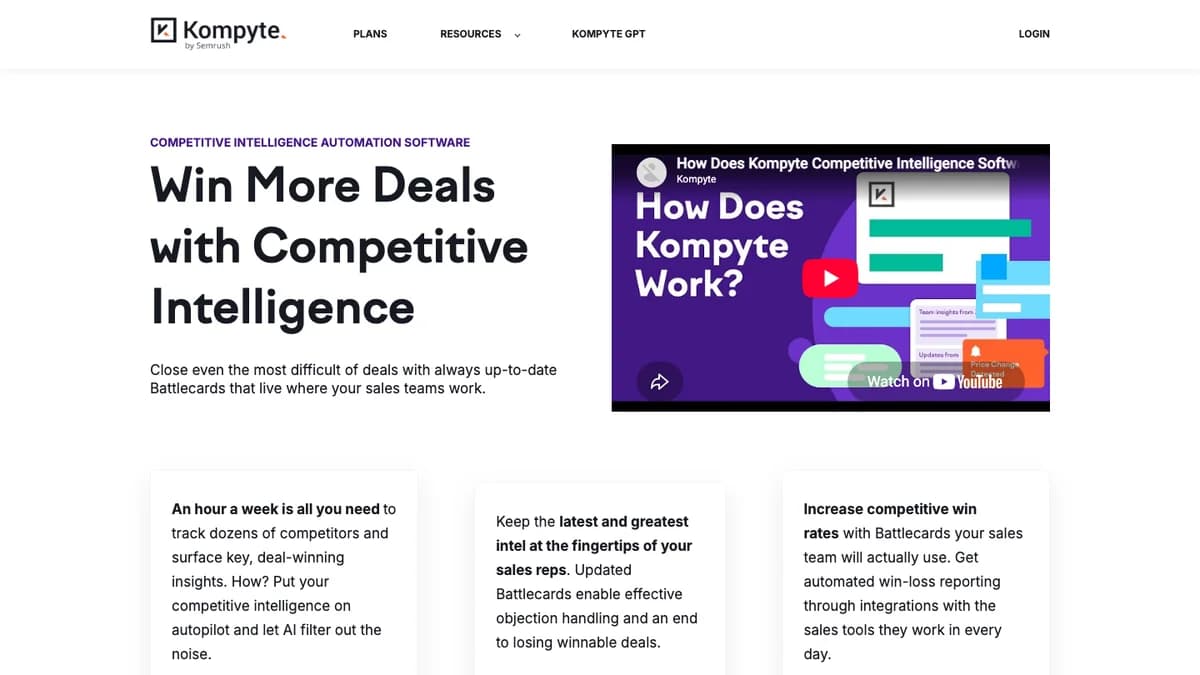
Kompyte by Semrush — competitor tracking, battlecards, and automated win-loss reporting
Kompyte is competitive intelligence automation software owned by Semrush. It tracks competitor changes across websites, reviews, social, ads, and job postings, and uses AI to filter the noise into daily summaries.
The output is aimed at sellers. Battlecards stay current and appear inside the sales tools reps already use, and automated win-loss reporting connects the intel to outcomes.
Plans scale by how many competitors you track and how many people use them. That makes Kompyte a practical fit for a team with a defined competitor set.
- What it tracks
- Competitor websites (50 to 150 URLs per company), reviews, social, job posts, app stores, and search ads and keywords
- What sales gets
- Battlecards inside sales tools, AI daily summaries, and automated win/loss reporting
- Integrations
- Salesforce, HubSpot, Slack, Microsoft Teams; Kompyte browser extension
- Free option
- None listed; product tour available
Pros
- ✓ Tracks job posts and review sites alongside websites and social
- ✓ Every plan includes integrations, onboarding, and a dedicated CSM
- ✓ Unlimited battlecards, reports, and listening alerts on all plans
- ✓ Plans are sized by competitors tracked, which makes scope easy to plan
Cons
- ✗ Prices are not published
- ✗ Essentials tracks only 10 competitors
- ✗ Mentions are capped at 20,000 a month on every plan
- ✗ Keyword tracking starts at 25 keywords on Essentials
Best for: Mid-market teams that want battlecards and win-loss reporting without building a large CI function.
Pricing: Quote-only. Kompyte's plans page lists Essentials (10 companies tracked, 25 users), Professional (20 companies, 100 users), and Unlimited, without prices.
Competitive Intelligence Tools Compared
The six tools split into two groups. Three build battlecards; one finds accounts using a competitor; two track companies and markets.
| Tool | Best for | Battlecards | Win-loss | Flags accounts using a competitor | Starting price |
|---|---|---|---|---|---|
| SyncGTM | Finding accounts that use a competitor | No | No | Yes: tech stack, tech changes, hiring | Free; $49/mo |
| Klue | CI plus win-loss programs | Yes | Yes: AI and human interviews | No | Quote-only (~$30k/yr median per Vendr) |
| Crayon | Automated competitor monitoring | Yes | Win/loss analysis | No | Quote-only (~$30k/yr median per Vendr) |
| Owler | Budget news and alerts | No | No | No | Free; Pro $39/mo billed annually |
| Similarweb | Competitor traffic benchmarks | No | No | No | $125/mo billed annually |
| Kompyte | Mid-market battlecard programs | Yes | Automated win/loss reporting | No | Quote-only |
What Each Tool Costs per Year
The price gap is roughly 60x. A dedicated CI platform runs to five figures a year, while the lighter tools cost a few hundred to about $1,500.
| Tool | Entry cost per year | Source |
|---|---|---|
| Owler | $468 (Pro, billed annually) | Published price |
| SyncGTM | $588 (Solo, 1,000 credits a month) | Published price |
| Similarweb | $1,500 (Competitive Intelligence, billed annually) | Published price |
| Kompyte | Not published | Quote; plans sized by competitors tracked and seats |
| Crayon | About $30,000 median ($12,700 to $46,000 range) | Vendr buyer data, 93 purchases |
| Klue | About $30,000 median ($16,000 to $60,000 range) | Vendr buyer data, plus onboarding fees |
Quote-only figures come from Vendr's reported purchases and vary with seats, competitors tracked, and modules. Ask each vendor for a written quote before you compare.
How to Find Accounts Using a Competitor
None of the top-ranking guides for this keyword cover the pipeline side of competitive intelligence. Here is the account-level check we run in SyncGTM, with the credit cost of each step.
| Step | Action | Credits | What it tells you |
|---|---|---|---|
| 1 | Tech stack lookup | 1 | Whether the competitor's script, tag, or DNS record is on the account's site today |
| 2 | Techstack Change signal | 1 | Whether the account recently added or removed the competitor (or a tool you integrate with) |
| 3 | Company job listings | 5 | Open roles that name the competitor's product or will own the category you sell into |
| 4 | Headcount growth by function | 2 | Whether the team that uses the competitor is growing, which raises the cost of switching later |
Run step 1 on every account and steps 2 to 4 only on the matches. Example: 1,000 accounts at 1 credit is 1,000 credits; if 150 of them run the competitor, steps 2 to 4 add 150 x 8 = 1,200 credits.
That 2,200-credit check fits inside the Growth plan ($99/mo for 3,000 credits). Running all four steps on all 1,000 accounts would take 9,000 credits, which fits the Pro plan ($249/mo for 10,000).
Read the results by signal:
- Competitor removed: the switch already happened or is in progress. Reach out now.
- Competitor added recently: they just signed. Log the date and plan outreach before the renewal, often about 12 months out.
- Hiring for a role that owns the tool: a new owner is the best moment to question the current vendor.
Tech detection misses tools with no web footprint, so confirm high-value accounts by hand or with AI Research Agentsreading the account's integrations and case study pages. Our guide to buying signals tools covers more triggers to stack on top.
How to Choose
- You have a CI owner and lose head-to-head deals: Klue, for battlecards backed by win-loss interviews.
- You want competitor changes collected automatically: Crayon, for AI-ranked monitoring and newsletters.
- You have a fixed competitor set and a mid-market budget: Kompyte, with plans sized by competitors tracked.
- You need news and alerts on a budget: Owler, from free.
- You compete for web traffic: Similarweb, from $125/mo billed annually.
- You want pipeline from your competitor's customer base: SyncGTM, then hand reps a battlecard from any of the above.
Many teams end up with two tools: one for the deal (battlecards) and one for the account list (signals). Our roundups of company research tools and buying intent data tools cover the account side in more depth.
Final Verdict
The best competitive intelligence tool depends on which job you are hiring it for. For enablement, Klue leads on win-loss and Crayon on automated monitoring, but both cost about $30,000 a year.
For pipeline, SyncGTM is the pick: it flags the accounts that use, adopt, or drop a competitor for a few credits each, from $49/mo. Owler and Similarweb are the budget ways to watch competitors' news and traffic.
Start with the job that moves revenue fastest for your team. Then try SyncGTM free and run a tech stack check on your top 50 accounts to see how many already pay a competitor.