

5 Best DeBounce Alternatives for B2B Enrichment in 2026

By Kushal Magar · June 11, 2026 · 13 min read · Last updated: September 28, 2026
Key Takeaway
DeBounce is a bulk email verification tool — it cleans lists you already have at $0.00045/email but does not find contacts, enrich data, or send outreach. The 5 best DeBounce alternatives for B2B enrichment in 2026 are: SyncGTM (waterfall enrichment across 50+ providers with verified emails, 76+ data points, and CRM sync from $49/mo), ZeroBounce (higher accuracy bulk verification with AI scoring and spam-trap detection from $18/mo), Apollo.io (275M+ contact database with built-in sequences from $49/mo), Explorium.ai (company, contact, and signal data for AI agents via API and MCP from $29.99 per credit package), and Kickbox (email verification with Sendex quality scoring from $5 per 500 verifications).
The best DeBounce alternatives solve a problem that DeBounce does not: they find and verify emails together, rather than only cleaning a list you already own.
DeBounce built its reputation on price. At $0.00045 per email check, it is among the cheapest bulk verifiers available — and the 20+ ESP integrations make it easy to plug into Mailchimp, HubSpot, or ActiveCampaign without custom code.
The problem is scope. DeBounce has no contact database, no email finder, no enrichment layer, and no outreach functionality. For B2B teams doing prospecting — building lists from ICP accounts, enriching with firmographic data, and sequencing outreach — that is three additional tools you still have to stitch together yourself.
Independent benchmarks show DeBounce delivers 93–96% deliverability accuracy on mixed B2B lists. Catch-all domain handling — a critical weakness for enterprise-heavy pipelines — returns a high proportion of unknown results, leaving valid addresses suppressed.
According to Gartner's B2B data quality research, contact data decays at roughly 30% per year. A tool that only verifies what you already have cannot keep pace with that decay. This guide compares five alternatives that close the gaps — three of them make DeBounce's standalone cleaning step unnecessary.
Quick Summary
The best DeBounce alternatives in 2026 are SyncGTM, ZeroBounce, Apollo.io, Explorium.ai, and Kickbox. SyncGTM is the top pick for most B2B teams — waterfall enrichment across 50+ providers, 76+ data points per verified person, buying signals, and native CRM sync from $49/mo.
TL;DR: Best DeBounce Alternatives in 2026
- SyncGTM — Best overall for B2B prospecting. Waterfall enrichment across 50+ providers, verified emails + phones, 76+ data points, buying signals, and CRM sync from $49/mo with a free tier.
- ZeroBounce — Best like-for-like DeBounce upgrade. Higher accuracy, AI catch-all scoring, and spam-trap detection from $18/mo.
- Apollo.io — Best all-in-one. 275M+ contact database with built-in email sequences and in-platform verification from $49/mo.
- Explorium.ai — Best for AI-agent list building. 146M+ companies and 767M+ profiles with funding, hiring, and job-change signals. Free trial (100 credits), then from $29.99 per credit package.
- Kickbox — Best for quality scoring. Proprietary Sendex score (0–1) per address, 25+ ESP integrations, from $5 per 500 verifications.
Why Teams Look for DeBounce Alternatives
DeBounce is a list hygiene tool, not a prospecting platform. It answers "is this email deliverable?" — not "who should I email and what is their direct dial?" That scope gap drives three recurring pain points for B2B teams.
Verification-only, no contact finding. DeBounce cleans the list you bring it. It has no database, no enrichment API, and no way to generate a contact list from target accounts. Every B2B team using DeBounce still needs a separate tool to build the list in the first place.
Catch-all domain handling. A significant share of B2B email addresses sit on catch-all domains — servers that accept mail to any address pattern. DeBounce returns these as unknown or risky, suppressing valid addresses. Alternatives with waterfall enrichment cross-reference catch-all addresses across multiple providers to recover meaningful coverage.
No outreach layer. DeBounce exports a cleaned CSV. It has no sequences, no CRM sync, and no analytics. Every verified contact still needs a separate tool to reach.
According to G2's sales intelligence category data, teams that switch to continuous waterfall enrichment report 35–50% higher deliverability and spend 60% less time on manual list hygiene. The five alternatives below each address one or more of these gaps — and three of them make DeBounce's standalone cleaning step unnecessary.
1. SyncGTM
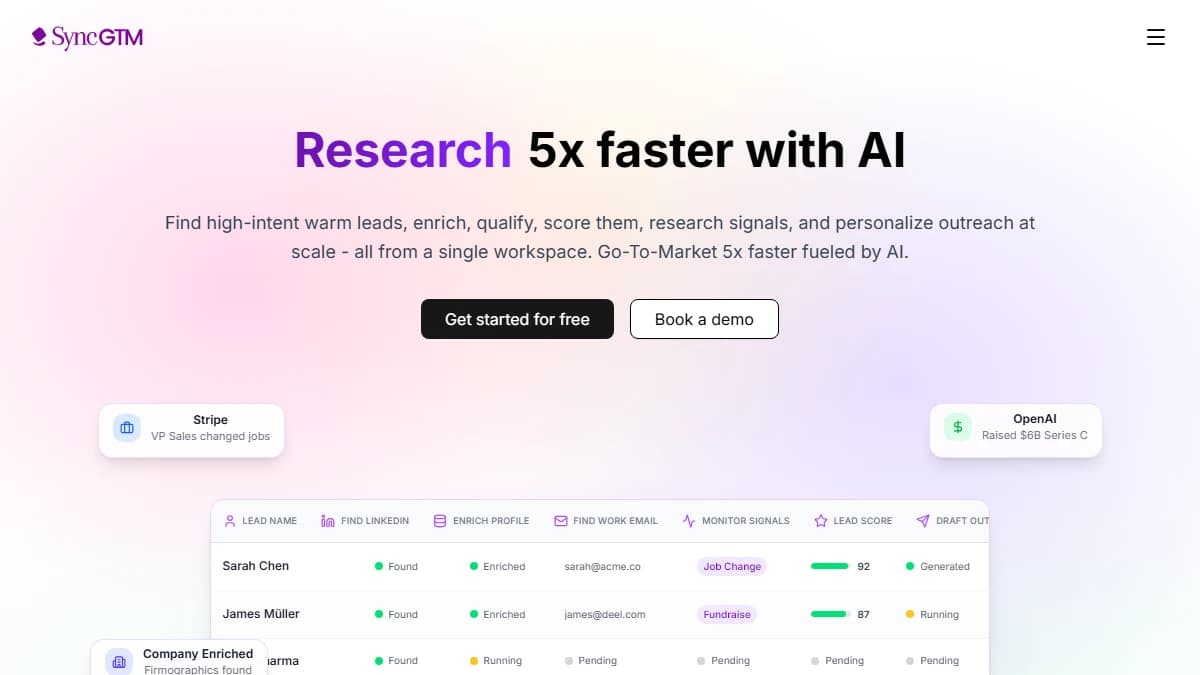
SyncGTM — waterfall enrichment across 50+ providers with verified emails, phones, and integrated outreach
SyncGTM is a B2B prospecting platform built around waterfall enrichment — querying 50+ data providers in sequence until verified contact data is found. Where DeBounce cleans a list you already have, SyncGTM builds and verifies that list from scratch: verified email, direct dial, LinkedIn, and 76+ firmographic and technographic data points in one pass from a target account or company name.
The key distinction for B2B teams is that verification is embedded in the enrichment output. Every email SyncGTM returns has been cross-referenced across multiple providers before delivery — making a separate DeBounce cleaning step redundant. You do not pay $0.00045/email to verify a list after the fact; verified deliverability is the baseline.
SyncGTM also covers the entire workflow DeBounce leaves open. Buying signal detection surfaces in-market accounts before competitors reach them. Native CRM sync (HubSpot, Salesforce, Pipedrive, Attio, Zoho) routes enriched leads without Zapier. Built-in outreach sequencing closes the loop without a third tool.
According to SyncGTM's internal benchmarks, waterfall enrichment across 50+ providers delivers 20–40% higher contact coverage than any single data source. On catch-all domains — where DeBounce marks addresses as unknown — SyncGTM cross-references across providers to recover a meaningful portion of those addresses as confirmed deliverable.
Pros
- • Waterfall enrichment across 50+ providers — verification is built into the output, not a separate step
- • 76+ data points per verified person: email, direct dial, LinkedIn, firmographics, technographics, buying signals
- • Outreach included — no additional sequencing tool needed
- • Native CRM sync to HubSpot, Salesforce, Pipedrive, Attio, Zoho
- • AI research agents for custom enrichment beyond standard fields
- • Free tier with 200 credits/month, no credit card required
Cons
- • Not designed for bulk cleaning of pre-built lists at DeBounce's ultra-low per-email rate
- • Solo plan at $49/mo is a higher floor than DeBounce's pay-as-you-go entry
Best for: B2B teams doing outbound prospecting — building lists from ICP accounts, enriching with 76+ data points, and routing verified buyers to CRM or outreach sequences.
Pricing: Free tier (200 credits/mo). Solo $49/mo. Growth $99/mo. Pro $249/mo. Business $649/mo.
2. ZeroBounce

ZeroBounce — bulk email verification with AI scoring, spam-trap detection, and email finder
ZeroBounce is the most direct DeBounce replacement for teams that specifically need better bulk list verification. It validates emails against 30+ data points, uses AI scoring to classify addresses DeBounce marks as unknown, and claims 99%+ accuracy on deliverability — above DeBounce's 93–96% in independent tests.
Where DeBounce leaves catch-all addresses as risky, ZeroBounce's AI scoring system attempts to classify them as safe or unsafe using engagement history and behavioral signals. On enterprise B2B lists where catch-all domains can represent 10–30% of addresses, that distinction recovers a meaningful share of valid contacts DeBounce would suppress.
ZeroBounce also includes an email finder — covering one gap DeBounce leaves entirely: building a list from scratch. Pricing starts at $18/mo for 2,000 monthly verifications. For teams whose primary use case is still bulk verification rather than full enrichment, ZeroBounce is the clear upgrade.
For a deeper breakdown, see our email verification tool comparison and the NeverBounce review for context on where verification-only tools fit in the B2B stack.
Pros
- • 99%+ claimed accuracy — above DeBounce's 93–96% in independent tests
- • AI scoring for catch-all and unknown addresses — fewer suppressed valid B2B emails
- • Spam-trap detection: 30+ trap networks checked per address
- • Email finder included — builds lists DeBounce cannot
- • 100 free verifications per month; pay-as-you-go from $0.008/email
- • Activity data layer — appends engagement signals to validated addresses
Cons
- • Still a verification-first tool — no waterfall enrichment, no firmographic data, no CRM sync
- • Email finder is domain-based — not a full contact database
- • No outreach layer — verified contacts still need a separate sending tool
- • More expensive than DeBounce at comparable volumes (DeBounce wins on per-email rate)
Best for: Teams whose primary need is accurate bulk list cleaning — the like-for-like DeBounce upgrade with higher accuracy, AI catch-all handling, and spam-trap detection.
Pricing: Free (100 verifications/mo). Monthly plans from $18/mo (2,000 verifications). Pay-as-you-go from $0.008/email.
3. Apollo.io
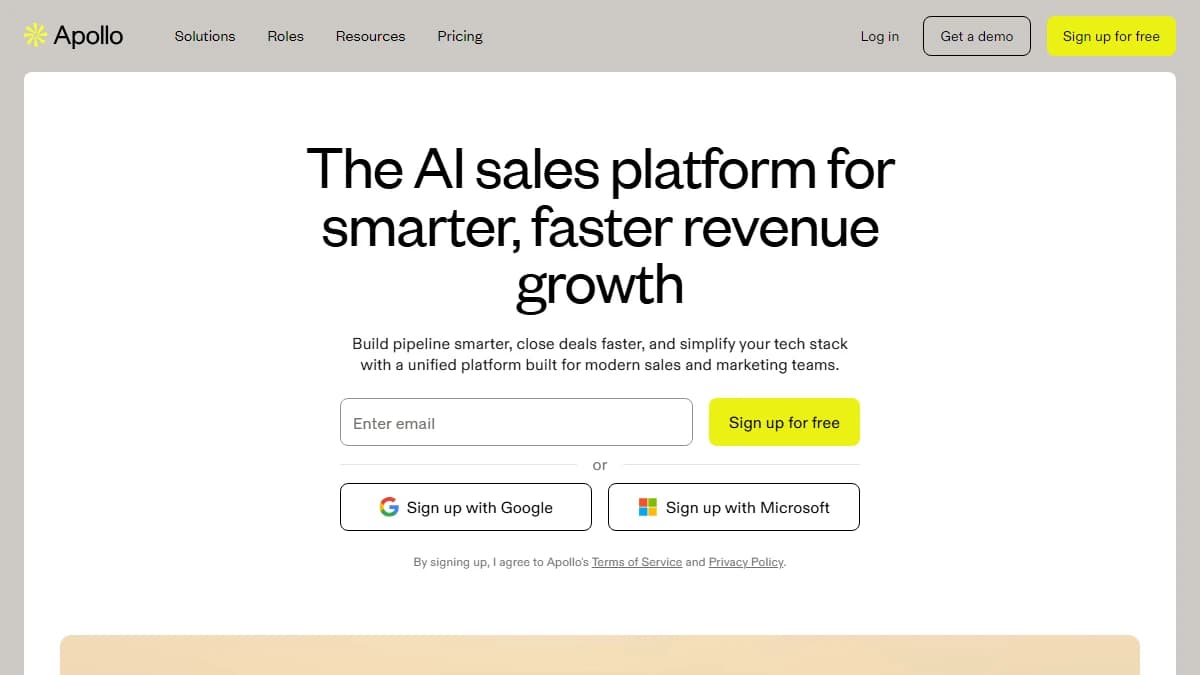
Apollo.io — 275M+ contact database with built-in verification and outreach sequences
Apollo.io is a prospecting platform built around a 275M+ contact database with built-in email verification and sequencing. It replaces DeBounce's entire workflow — finding contacts, verifying deliverability, and sending outreach — in one platform.
Where DeBounce requires you to bring a pre-built list, Apollo lets you search by job title, company size, industry, technographics, and intent signals, then export verified contacts directly into a sequence. Verification happens in-platform at the moment of export — not as a downstream cleaning step.
Apollo's free plan includes 10,000 email exports per month — one of the most generous free tiers in the space. The Basic plan at $49/mo adds unlimited email finding and 250 mobile credits per month. For teams graduating from DeBounce's list-cleaning workflow to a full prospecting stack, Apollo is the most accessible starting point.
Pros
- • 275M+ contacts and 73M+ companies with 65+ searchable filters
- • Built-in email verification — no separate DeBounce cleaning step needed
- • Native sequencing and call recording — full outreach stack in one tool
- • Generous free plan: 10,000 email exports/month
- • Native HubSpot, Salesforce, and Pipedrive integrations on paid plans
Cons
- • Single data source — no waterfall fallback means lower coverage on harder-to-find contacts
- • Mobile phone coverage weaker than Cognism or SyncGTM
- • CRM integrations locked to Professional plan ($79/mo) and above
- • European contact coverage thinner than North American data
Best for: SDR teams that want prospecting, verification, and outreach in one platform — the most complete DeBounce replacement at the lowest entry price.
Pricing: Free (10,000 email exports/mo). Basic $49/mo. Professional $79/mo. Organization $119/mo.
4. Explorium.ai
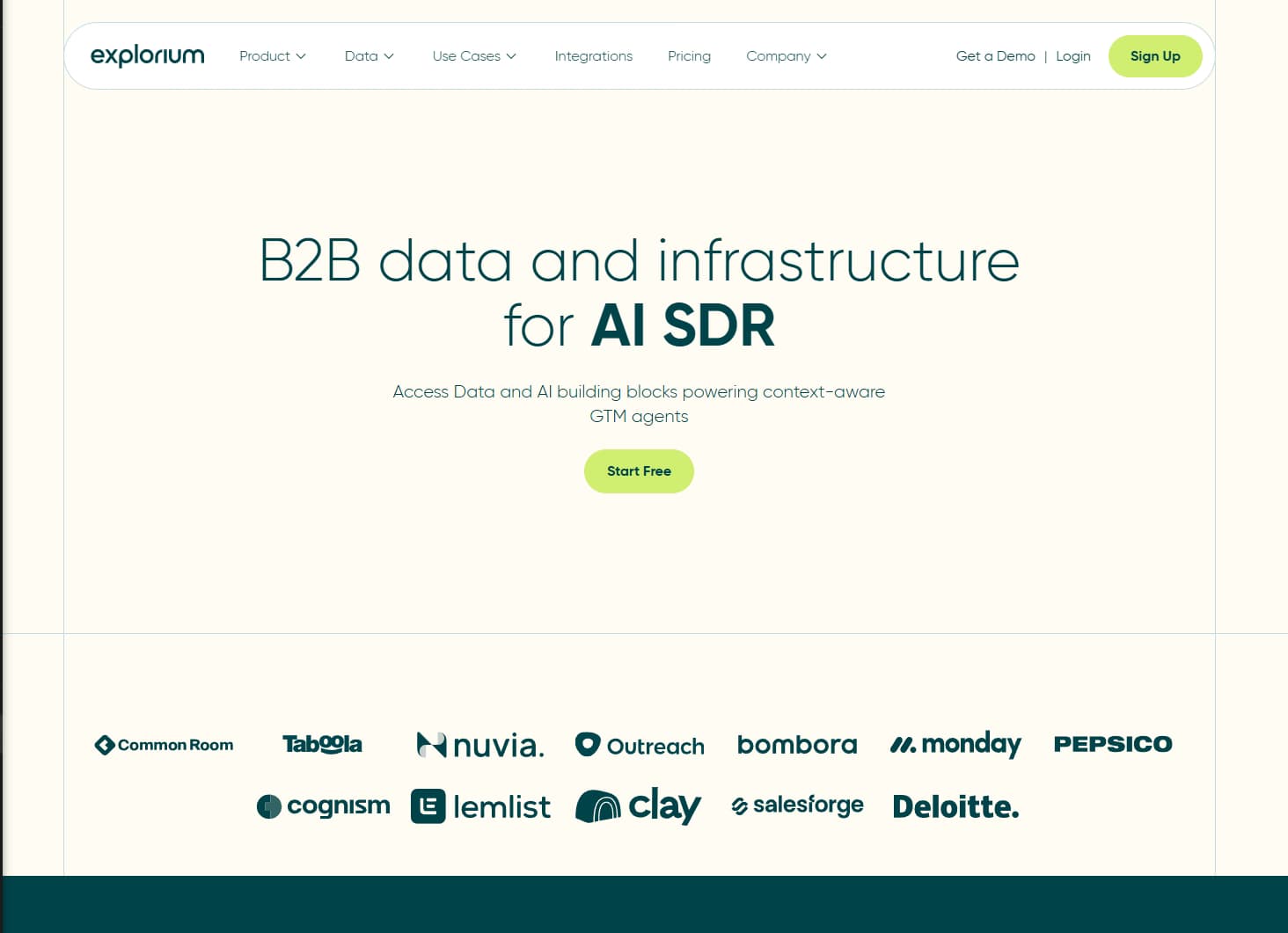
Explorium.ai — B2B company and contact data with real-time signals, served by API, MCP, and plain-English prompts
Explorium.ai is a B2B data platform built for AI agents and GTM teams. For teams that use DeBounce to clean lists they bought or scraped elsewhere, Explorium changes the starting point: you build the list from its own data on 146M+ companies and 767M+ professional profiles, with work emails, phone numbers, and firmographics attached.
You can reach that data through one API with a hosted MCP server (AgentSource), or through Vibe Prospecting, where you describe the list in plain English and it builds and enriches it for you. Real-time events such as funding rounds, job changes, and new hiring show which accounts are worth contacting this week, something a verification-only tool like DeBounce cannot see.
Pricing runs on credit packages, not seats: a 100-credit free trial, then Lite at $29.99 for 500 credits or Starter at $149.99 for 5,000. Explorium is not a dedicated list-cleaning tool, so high-volume senders may still run a final check before a campaign. See our waterfall enrichment guide for how this compares to SyncGTM's approach.
Pros
- • 146M+ companies and 767M+ professional profiles to build lists from, not just clean them
- • Work emails, phone numbers, and firmographics returned in one enrichment call
- • Real-time events for funding rounds, job changes, hiring, and tech changes
- • One API, a hosted MCP server, and the no-code Vibe Prospecting app
- • Credit packages from $29.99 with no per-seat fees
Cons
- • Not a dedicated bulk list-cleaning tool like DeBounce
- • No built-in email sequencing, inbox, or dialer — needs a separate outreach tool
- • API and MCP paths assume some technical comfort
- • Credit cost varies by enrichment type (1-5 credits per record)
Best for: Teams that want to stop cleaning bought lists and start building them from company, contact, and signal data, especially teams running AI SDRs or agent workflows.
Pricing: Free trial (100 credits). Lite $29.99 (500 credits). Starter $149.99 (5,000 credits). Growth $749.99 (30,000 credits). Scale $7,499.99. Enterprise custom.
5. Kickbox
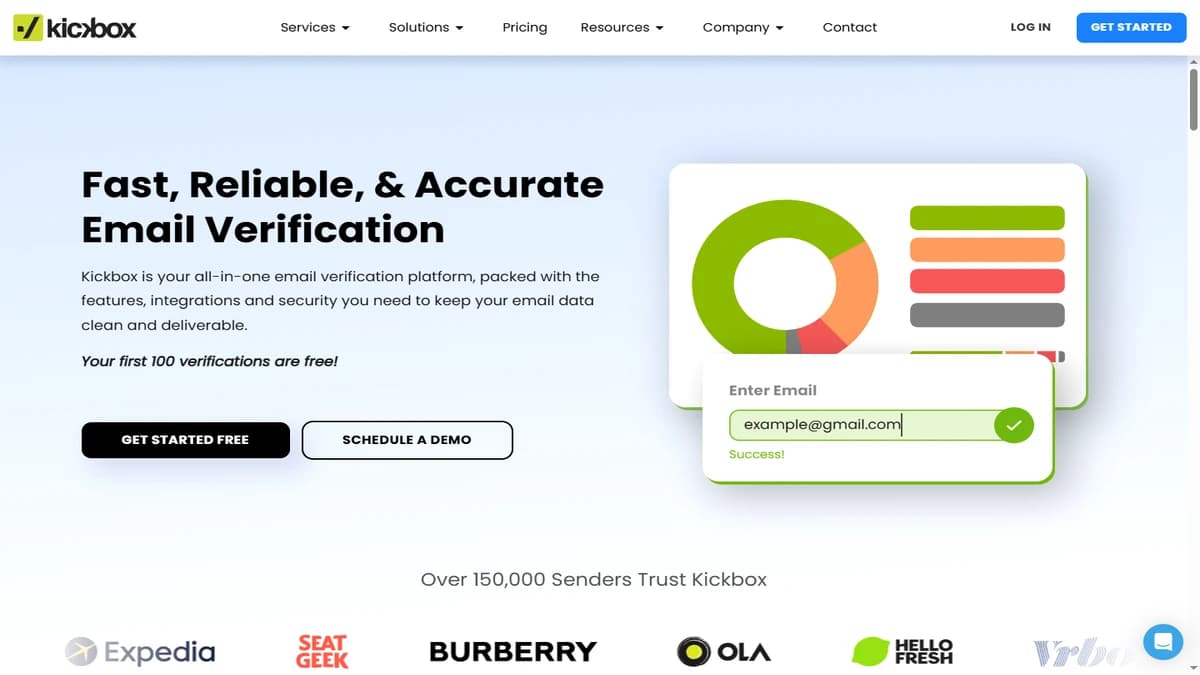
Kickbox — email verification with Sendex proprietary quality scoring
Kickbox is an email verification platform with one meaningful differentiator over DeBounce: a proprietary Sendex score (0–1) that rates each email address on quality and deliverability risk, not just binary valid/invalid status.
Where DeBounce returns a pass/fail for most addresses, Kickbox layers a quality score on top of verification results. A Sendex score of 0.8+ is considered safe to send; scores below 0.4 flag high-risk addresses worth suppressing even if technically valid. This is useful for teams that want to segment campaigns by risk tier rather than applying an all-or-nothing filter.
Kickbox integrates with 25+ ESPs including Mailchimp, SendGrid, HubSpot, and Salesforce. Pricing starts at $5 per 500 verifications — more expensive than DeBounce's $0.00045/email at scale, but the Sendex score adds real value for teams managing sender reputation carefully. See our full Kickbox review 2026 for a detailed breakdown.
Pros
- • Proprietary Sendex score (0–1) — quality rating per address beyond binary valid/invalid
- • 96–97% accuracy on standard deliverability checks
- • 25+ ESP integrations including Mailchimp, SendGrid, HubSpot
- • Real-time API for point-of-entry verification
- • Clear, simple pricing with no subscription lock-in
Cons
- • More expensive than DeBounce at scale — Kickbox's per-email rate is higher
- • No contact finding or enrichment — verification-only like DeBounce
- • Credits expire after 12 months (DeBounce credits do not expire)
- • No spam-trap detection (ZeroBounce advantage)
- • No outreach layer or CRM sync
Best for: Teams that want a quality score per address — not just pass/fail — to segment campaigns by risk tier and protect sender reputation.
Pricing: Pay-as-you-go from $5 per 500 verifications ($0.01/email). No monthly minimum.
Side-by-Side Comparison
| Feature | SyncGTM | ZeroBounce | Apollo.io | Explorium.ai | Kickbox |
|---|---|---|---|---|---|
| Starting Price | $49/mo (free tier available) | $18/mo (2K credits) | Free / $49/mo | $29.99/pkg (100-credit trial) | $5 per 500 verifications |
| Contact Finding | Yes — 50+ providers waterfall | Domain-based finder | Yes — 275M+ database | Yes — 767M+ profiles | No |
| Email Verification | Built into enrichment output | Yes — 99%+ claimed accuracy | Yes — in-platform | No standalone verifier | Yes — 96–97% accuracy |
| Catch-All Handling | Waterfall retries across providers | AI scoring with confidence level | Flagged — partial resolution | Not a verification focus | Returns "unknown" — no scoring |
| Spam Trap Detection | Via enrichment providers | Yes — 30+ trap networks | No | No | No |
| B2B Enrichment | Yes — 76+ data points | Email + activity data only | Yes — contact + company data | Yes — firmographics, technographics, funding | No |
| Buying Signals | Hiring, funding, tech changes, job changes | None | Intent signals on paid plans | Funding, job changes, hiring, tech changes, intent | None |
| Native Outreach | Yes — built-in sequencing | None | Yes — built-in sequences | None — needs separate tool | None |
| CRM Sync | HubSpot, Salesforce, Pipedrive, Attio, Zoho | 35+ integrations | HubSpot, Salesforce (Professional+) | HubSpot, Salesforce (custom CRMs on Enterprise) | 25+ ESP integrations |
How to Choose the Right DeBounce Alternative
Your choice depends on where DeBounce is failing you and what you need next.
- You only need better bulk verification. Choose ZeroBounce. It is the closest like-for-like upgrade — higher accuracy on B2B lists, AI catch-all scoring, spam-trap detection, and an email finder, from $18/mo.
- You want a quality score per address, not just pass/fail. Choose Kickbox. The Sendex score (0–1) lets you segment sends by risk tier — useful for teams managing sender reputation across multiple campaigns.
- You need prospecting + verification + outreach in one tool at the lowest entry price. Choose Apollo.io. The free plan's 10,000 monthly exports make it the easiest on-ramp from DeBounce's cleaning-only workflow.
- You want to build lists from company and signal data, or feed an AI agent. Choose Explorium.ai. 146M+ companies, funding and hiring events, and a hosted MCP server replace the buy-a-list-then-clean-it routine, from $29.99 per credit package.
- You want the full outbound workflow — enrichment, signals, CRM, outreach — from one platform. Choose SyncGTM. Waterfall enrichment across 50+ providers, 76+ data points per verified lead, buying signals, and built-in outreach from $49/mo. See also our B2B lead enrichment guide and waterfall enrichment explainer for how SyncGTM's approach works in practice.
Final Verdict
DeBounce is a low-cost email verifier. It does that one thing cheaply. It does not find contacts, enrich data, detect spam traps reliably on enterprise B2B lists, or connect to an outreach workflow.
For B2B prospecting in 2026, the workflow has moved well past CSV cleaning. Teams that win outbound are finding contacts, enriching with firmographic context, adding buying signals, and sequencing — in one integrated pass. DeBounce sits three steps behind that workflow by design.
SyncGTM is the best DeBounce alternative for most B2B teams. Waterfall enrichment across 50+ providers, 76+ data points per verified lead, buying signals to prioritize in-market accounts, and built-in outreach sequencing — from $49/mo with a free tier. Verification is not a separate step; it is built into every enrichment result.
If you only need better bulk list cleaning without changing your broader stack, ZeroBounce is the right move — higher accuracy, AI catch-all scoring, spam-trap detection, and an email finder for $18/mo.
For teams ready to replace DeBounce and their prospecting tool in one step, explore the best SDR tools for prospecting and the best B2B email finder tools to see how the full stack fits together.