
Emailable Review 2026: B2B Data Coverage, Pricing & SyncGTM Comparison

By Kushal Magar · June 13, 2026 · 12 min read
Key Takeaway
Emailable is a SOC 2 Type II certified email verifier with a 4.8/5 G2 rating (277 reviews), non-expiring pay-as-you-go credits from $30/5K, and a 99% deliverability guarantee. It bundles inbox placement and blacklist monitoring at no extra cost. It does not find contacts, has no B2B enrichment layer, and catch-all domains return unknown results (refunded). Best for teams with pre-built lists needing affordable, reliable bulk verification. For B2B outbound prospecting end-to-end, SyncGTM's waterfall enrichment across 50+ providers delivers verified contacts with no separate cleaning step — from $99/mo.
Emailable is an email verification platform that rebranded from TheChecker in 2021. It verifies email addresses at speed — up to 30,000 per minute — and bundles inbox placement monitoring and blacklist checks into the same credit account.
This review covers Emailable's pricing, accuracy, key features, and honest limitations — including how it stacks up against SyncGTM's waterfall enrichment approach for B2B outbound teams.
According to G2, Emailable holds a 4.8/5 rating across 277 reviews — the highest G2 score of any dedicated email verifier in this tier. Capterra rates it 4.7/5. Trustpilot scores sit lower at 3.3/5, where negative reviews cluster around edge cases in catch-all domain handling and the 2021 rebrand transition.
TL;DR
- What it is: SOC 2 Type II certified email verification platform with bulk, API, and real-time widget verification modes.
- Best for: Teams with pre-built lists needing affordable bulk verification; marketers cleaning consumer and B2B lists before campaigns.
- Pricing: Pay-as-you-go from $30/5K credits (never expire) or monthly from $19/mo. Unknowns and duplicates refunded.
- Accuracy: 99% deliverability guarantee on classified deliverable addresses. Catch-all corporate domains return unknown — refunded, but leaving B2B gaps.
- Key gap: No contact finding, no B2B enrichment, no dedicated spam-trap detection beyond quality scoring.
- SyncGTM vs Emailable: SyncGTM replaces Emailable for B2B outbound teams — waterfall enrichment across 50+ providers delivers verified contacts with deliverability built in, no cleaning step needed.
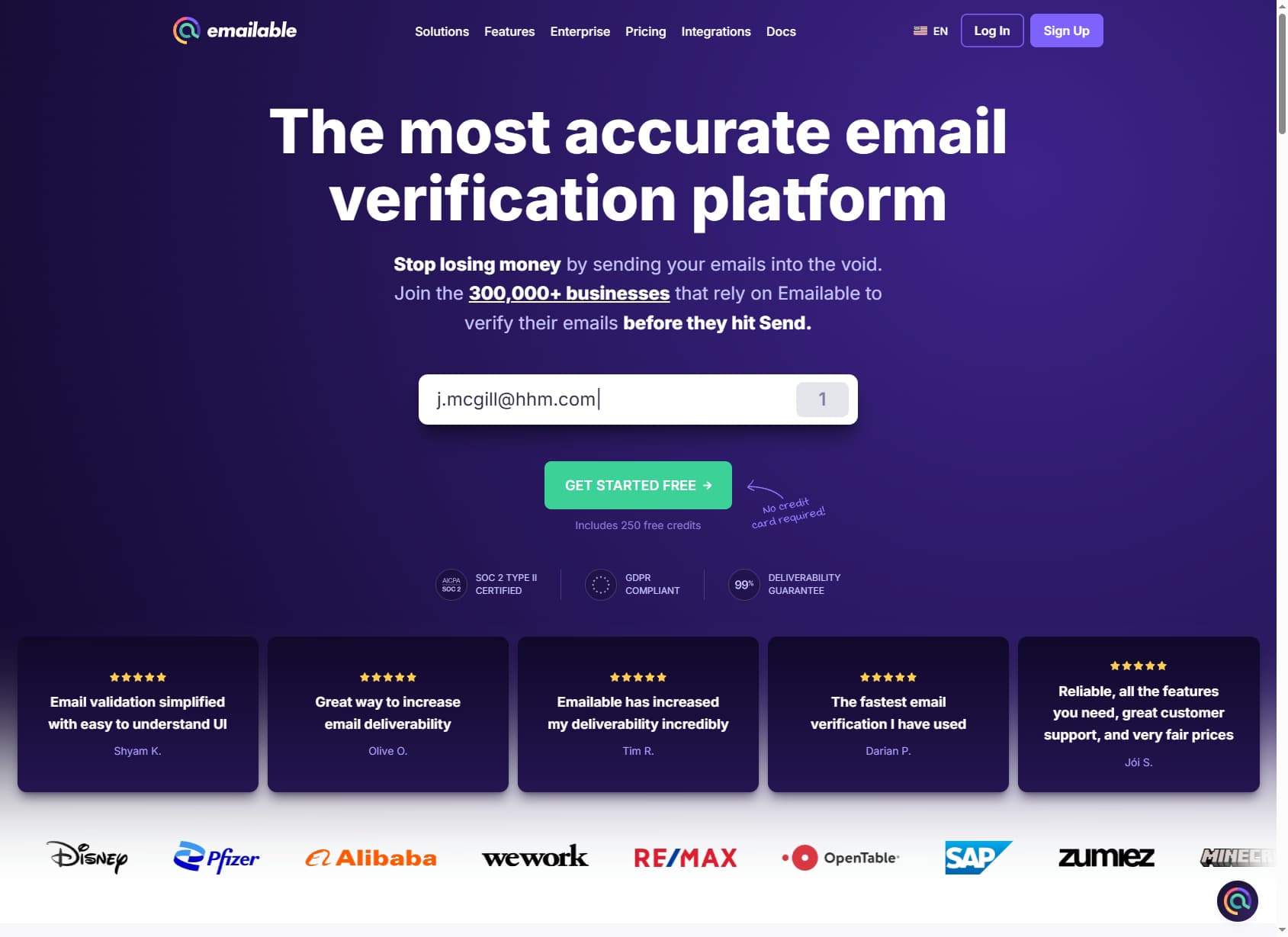
Emailable homepage — bulk and real-time email verification with 99% deliverability guarantee
What Is Emailable?
Emailable is a dedicated email verification platform built for two primary audiences: marketers cleaning contact lists before campaigns, and developers embedding real-time email validation into signup flows or CRM pipelines. It rebranded from TheChecker in 2021 — the underlying verification technology is the same product with an updated interface and expanded monitoring features.
The platform handles verification across four channels: bulk CSV upload, a REST API, a real-time embeddable widget, and an inbox verifier. All four draw from the same credit pool, and credits purchased on pay-as-you-go plans never expire — an explicit differentiator the company promotes compared to ZeroBounce (12-month expiry) and Bouncer (12-month expiry).
Emailable classifies each address into four buckets: deliverable, undeliverable, risky, or unknown. Unknown results — typically catch-all corporate servers that cannot confirm whether a specific mailbox exists — are automatically refunded. Duplicates in a batch are also refunded. This pricing transparency is one of the most consistently praised aspects in G2 reviews.
Beyond verification, Emailable bundles deliverability monitoring into the same account: inbox placement reports (100 credits each), blacklist monitoring (5 credits per check), and DMARC authentication checks. Most standalone verifiers either exclude monitoring entirely or charge separately. Emailable's approach packages these together — relevant for teams managing sender reputation at scale across multiple domains.
The platform is SOC 2 Type II certified and GDPR-compliant, with global infrastructure and 99.99% uptime SLA. For teams in regulated sectors that need documented security compliance, this certification matters alongside ZeroBounce's SOC 2 posture — though Emailable lacks the ISO 27001 certification held by Email Hippo.
Emailable Pricing: Plans, Credits, What You Actually Pay
Emailable pricing is straightforward and fully public — no sales call required at any volume up to 1M credits. Two models exist: pay-as-you-go (credits never expire) and monthly subscription (15% discount, unused credits roll over).
| Credits | Pay-As-You-Go | Monthly Subscription | Per Email |
|---|---|---|---|
| 5,000 | $30 | $19/mo | $0.004–0.006 |
| 10,000 | $60 | ~$45/mo | $0.004–0.006 |
| 50,000 | $150 | $119/mo | $0.002–0.003 |
| 250,000 | Volume discount | Volume discount | ~$0.001–0.002 |
| 1M+ | Contact sales | Contact sales | Custom |
The free trial provides 250 credits — enough to test accuracy on a small sample before purchasing. Credit consumption: 1 credit per email verification (bulk, API, widget), 100 credits per inbox placement report, 5 credits per blacklist check.
Unknown results and duplicates are refunded automatically. This is meaningful for B2B lists where catch-all addresses are common — you pay only for actionable results. The trade-off: those refunded unknowns are still unresolved contacts.
Compared to competitors, NeverBounce charges $0.008/email pay-as-you-go with no expiry, and Kickbox starts at $0.01/email — making Emailable 25–40% cheaper per verification at comparable volumes.
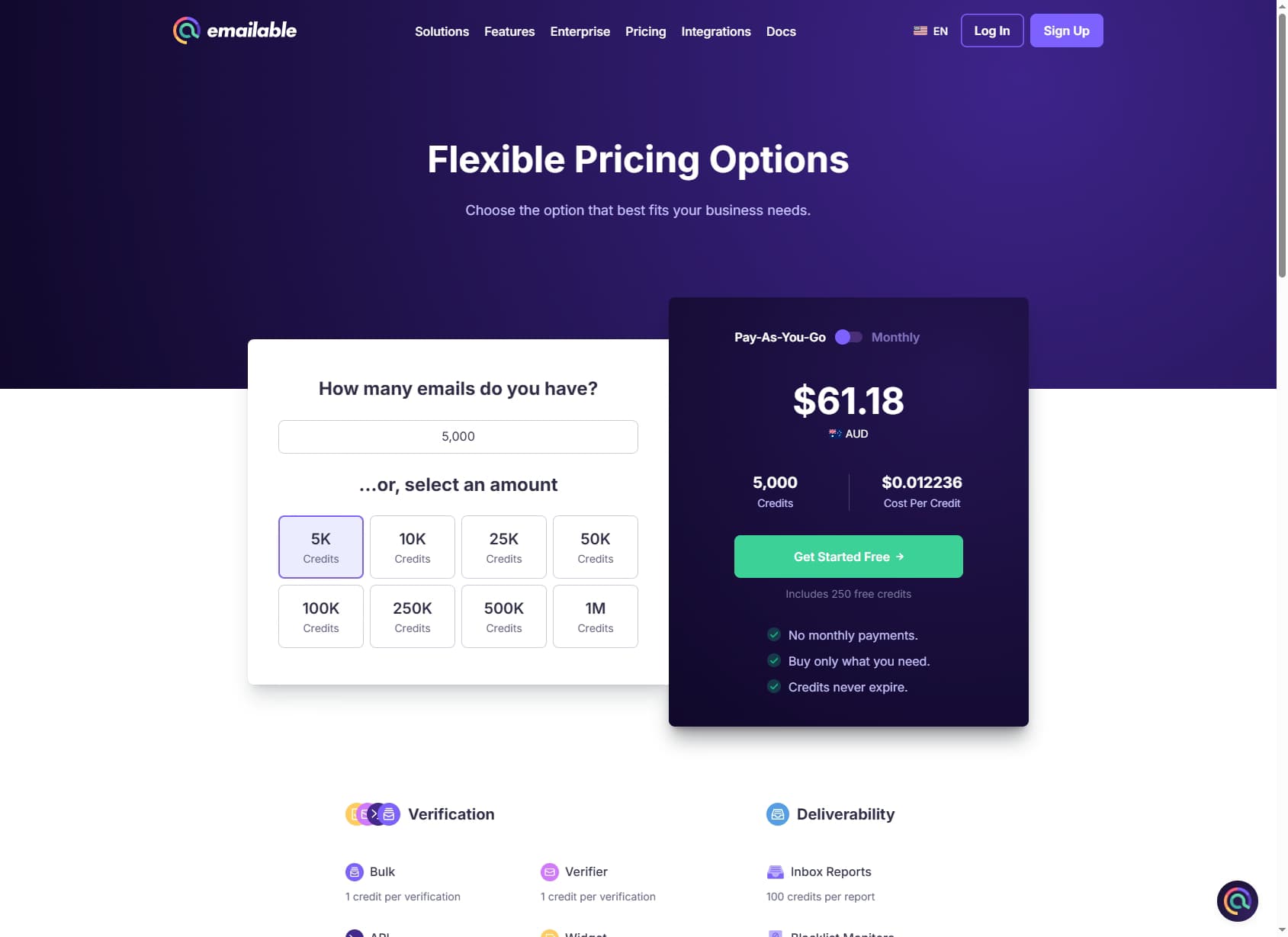
Emailable pricing page — pay-as-you-go credits from $30/5K, never expire
Emailable Key Features
Multi-Layer Email Verification
Emailable runs SMTP-level checks, syntax validation, DNS/MX record lookup, disposable email detection, and role-based address identification on every address. Output includes a four-category classification (deliverable, undeliverable, risky, unknown) plus a numeric quality score from 0–100. The quality score surfaces addresses that are technically deliverable but carry elevated risk — useful for compliance-sensitive sends where even deliverable addresses with low scores should be suppressed.
Speed: 30,000 Emails Per Minute
Emailable processes bulk lists at 30,000+ addresses per minute — the platform claims 8x faster than unnamed competitors. Independent user reports on G2 confirm a 10,000-email list completes in 2–3 minutes. For teams running periodic database hygiene on large lists before campaign sends, this speed is practically meaningful: a 100K contact refresh takes under 5 minutes versus 30+ on slower platforms.
Anti-Greylisting Technology
Emailable uses proprietary anti-greylisting technology to improve accuracy on servers that temporarily reject first-contact SMTP handshakes. Greylisting is a common anti-spam technique that causes single-attempt verifiers to misclassify valid addresses as undeliverable. Emailable's retry logic reduces this false-negative rate — relevant for B2B domains where conservative mail server configurations are common.
Inbox Placement and Blacklist Monitoring
Most standalone verifiers stop at address-level validation. Emailable extends into deliverability monitoring: inbox placement reports show whether your sending domain reaches the inbox, promotions tab, or spam across major mailbox providers. Blacklist monitoring checks your sending IP and domain against known spam blacklists (5 credits per check). DMARC checks flag authentication errors before they affect sender reputation. These tools cost credits from the same pool — no separate subscription required.
Real-Time Verification Widget
Emailable provides an embeddable JavaScript widget for real-time validation at form submission. The widget intercepts email input, validates in real time, and blocks or warns on invalid addresses before the form submits. This is the most common integration pattern for SaaS signup forms and B2B gated content — catching typos and disposable addresses before they pollute the CRM.
Developer API and Integrations
Emailable's REST API supports real-time single-address verification and bulk batch submission. Official client libraries exist for Node.js, Ruby, and Python. The platform integrates natively with 50+ apps including HubSpot, Salesforce, Mailchimp, Klaviyo, and ActiveCampaign. A WordPress plugin handles form-level validation for WordPress sites. API documentation is serviceable but thinner on examples than Email Hippo's developer documentation.
Data Enrichment on Verification Output
Emailable returns enriched metadata alongside each verification result: SMTP provider, MX record details, corrected domain suggestions (e.g. "gmai.com" → "gmail.com"), name inference, and gender detection. This is not B2B contact enrichment — it does not return job titles, company data, or phone numbers. But the metadata is useful for list hygiene: identifying domain typos, grouping contacts by mail provider, and segmenting by inferred name fields.
Emailable Pros: What It Does Well
- ✓Strongest G2 rating in its tier — 4.8/5 across 277 reviews. More reviews and higher scores than NeverBounce (4.4/5) and comparable to ZeroBounce (4.7/5 across 549 reviews). High review volume gives the score statistical weight.
- ✓Non-expiring pay-as-you-go credits — credits purchased never expire, unlike ZeroBounce (12-month expiry) and Bouncer (12-month expiry). Teams with irregular verification volumes avoid losing unused credits at renewal.
- ✓Unknown results refunded automatically — catch-all and unresolvable addresses return credits to your balance. Transparent pricing where you pay only for actionable results.
- ✓Affordable per-address pricing — $0.002–0.006/email is 25–40% cheaper than NeverBounce ($0.008) and Kickbox ($0.01) at comparable volumes. At 50K monthly verifications, Emailable saves $200–$400/mo versus those alternatives.
- ✓Bundled deliverability monitoring — inbox placement reports, blacklist monitoring, and DMARC checks included in the same credit account. No separate subscription required for sender reputation monitoring.
- ✓Fast bulk processing — 30,000 emails/minute means a 100K-contact list processes in under 5 minutes. Practical for teams running pre-campaign hygiene on large lists under time pressure.
- ✓SOC 2 Type II certified and GDPR-compliant — security certification meaningful for teams in regulated industries or with enterprise procurement requirements.
- ✓Clean, simple UI — the most consistent praise in G2 and Capterra reviews. Non-technical team members can run bulk verifications without training; no complex dashboard navigation required.
Emailable Cons: Where It Falls Short
- ✗Catch-all domains return unknown — not scored — enterprise B2B domains commonly use catch-all configurations (often 15–30% of a prospecting list). Emailable classifies these as unknown and refunds the credits, but the addresses remain unresolved. ZeroBounce and Clearout offer AI-based catch-all scoring that recovers actionable verdicts on many of those addresses.
- ✗No contact finding or B2B enrichment — pure verification tool. No contact database, no email finder, no firmographic or technographic data. Every team using Emailable still needs a separate upstream tool to build the list being verified.
- ✗No dedicated spam-trap detection— Emailable's quality score (0–100) flags risky addresses but does not explicitly identify known spam-trap addresses the way ZeroBounce's 30+ spam-trap network integration does. High-volume cold outbound teams with purchased or aged lists face residual sender reputation risk.
- ✗30-day bulk file deletion — uploaded CSV files are deleted from the platform 30 days after processing. Teams that lose access to results before downloading need to re-verify. Not a blocker, but a workflow friction point flagged in user reviews.
- ✗Minimum $30 purchase threshold — pay-as-you-go requires buying at least 5,000 credits. Teams with sub-5,000 monthly verification needs overpay relative to per-credit pricing. NeverBounce has no minimum purchase.
- ✗Basic API documentation — developer reviewers note fewer integration examples and thinner error-handling documentation compared to Email Hippo and ZeroBounce. The API works, but onboarding for complex integrations requires more experimentation.
- ✗Lower brand recognition post-rebrand — the 2021 TheChecker → Emailable rebrand created confusion in comparison sites and legacy integrations. Some third-party tools still reference the old brand, and the Trustpilot score (3.3/5) reflects lingering rebrand-era complaints.
Emailable vs Alternatives: Comparison Table
Emailable competes with ZeroBounce, NeverBounce, Kickbox, and Bouncer on accuracy and pricing — and against SyncGTM when teams evaluate replacing their verification workflow entirely. Here is how Emailable stacks up across the dimensions that matter for B2B teams. For a broader comparison, see our Emailable alternatives guide.
| Feature | Emailable | SyncGTM | ZeroBounce | NeverBounce |
|---|---|---|---|---|
| Starting Price | $30 for 5,000 verifications | $99/mo | $15/mo (2K credits) | $0.008/email (pay-as-you-go) |
| Pricing Transparency | Public pricing page with calculator | Public pricing page | Public pricing page | Public pricing page |
| Deliverability Guarantee | 99% — fewer than 1% verified emails bounce | Waterfall cross-reference across 50+ providers | 96–98% real-world accuracy | 97–99% accuracy claimed |
| Catch-All Handling | Classified as risky/unknown — refunded if unknown | Waterfall retries alternate providers | AI catch-all scoring with confidence | Flagged as catch-all — no scoring |
| Spam Trap Detection | Via quality score (0–100) | Via enrichment providers | Yes — AI spam trap scoring | No |
| Inbox Placement Monitoring | Yes — included in credit account | Embedded in waterfall output | Yes — Email Quality Score | No |
| Risk Scoring | Yes — 0–100 quality score per address | Via enrichment providers | AI-based Quality Score | No |
| B2B Contact Enrichment | None — verification only | Yes — email, phone, firmographics | Email append (US B2C only) | None — verification only |
| Buying Signals | None | Hiring, funding, tech changes, job changes | None | None |
| SOC 2 / Security Certification | SOC 2 Type II certified | N/A (enrichment platform) | SOC 2 Type II | ZoomInfo security compliance |
| Native Outreach | None | Yes — built-in sequencing | None | None |
| Free Tier | 250 credits on signup | 200 enrichment credits/month | 100 free credits | 1,000 free verifications |
| Credit Expiry | Never expire (pay-as-you-go) | No expiry (subscription) | 12 months | No expiry |
| G2 Rating | 4.8/5 (277 reviews) | N/A | 4.7/5 (549 reviews) | 4.4/5 (200+ reviews) |
SyncGTM vs Emailable: The Core Difference
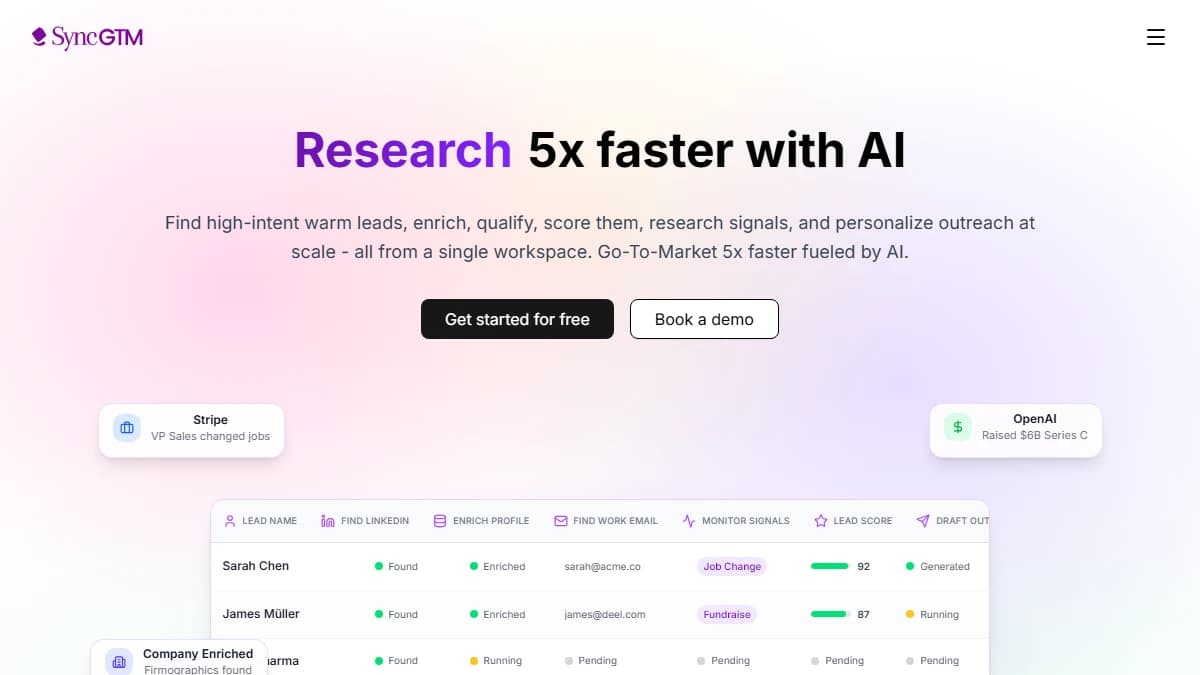
SyncGTM — waterfall enrichment across 50+ providers with verified contacts built in
SyncGTM is not an email verifier — it is a B2B prospecting platform built around waterfall enrichment. The comparison matters because the two tools solve adjacent problems that most B2B outbound teams need to solve together.
Emailable validates a list you already have. SyncGTM builds and verifies that list from scratch: verified email, direct dial, LinkedIn, and 76+ firmographic and technographic data points from a target account or company name. Verification is embedded in the enrichment output — cross-referenced across 50+ providers before delivery — making a separate Emailable validation step redundant for teams doing B2B prospecting end-to-end.
The workflow difference is concrete. A typical B2B outbound team using Emailable needs: (1) a contact-finding tool to build the list, (2) Emailable to verify it, (3) a CRM or outreach tool to sequence it. SyncGTM handles all three. Internal benchmarks show waterfall enrichment across 50+ providers delivers 20–40% higher contact coverage than any single data source, with verified deliverability as the baseline output.
Where Emailable wins: pure list cleaning at affordable per-address rates with non-expiring credits, strong G2 social proof, and no monthly minimum for teams with variable volumes. For teams with pre-built lists that need reliable verification at the lowest cost — and nothing else — Emailable is the strongest standalone choice in this tier.
For a full breakdown of Emailable alternatives including SyncGTM, ZeroBounce, NeverBounce, and Bouncer, see our Emailable alternatives guide.
Who Should Use Emailable?
Emailable is the right choice in four specific scenarios:
- Marketers cleaning consumer and mixed lists before campaigns. G2 reviewers consistently flag Emailable as the best price-for-quality option for newsletter operators, e-commerce brands, and marketing teams with large consumer lists (Gmail, Yahoo, Outlook addresses). At $0.002–0.006/email with non-expiring credits, it delivers strong ROI for high-volume list hygiene.
- Teams with variable verification volumes. Non-expiring pay-as-you-go credits mean teams that verify 50K emails one month and 5K the next pay for exactly what they use — no credits forfeited at billing period end. ZeroBounce and Bouncer expire unused credits after 12 months; Emailable does not.
- Developers embedding real-time validation in product flows. The API, WordPress plugin, and embeddable widget cover the most common integration patterns. While API documentation is thinner than Email Hippo, the supported languages (Node.js, Ruby, Python) and 50+ native integrations cover most stacks.
- Teams that need sender reputation monitoring alongside verification. The bundled inbox placement reports, blacklist monitoring, and DMARC checks save the cost and complexity of a separate deliverability monitoring tool. For teams managing multiple sending domains, this combination in a single credit pool is operationally cleaner than paying for verification and monitoring separately.
Emailable is not the right choice for B2B outbound prospecting teams that need to find contacts before verifying them. It is not the right choice for teams with heavy enterprise-domain lists where catch-all scoring matters. And it is not the right choice for teams that need the strongest available spam-trap detection for aged or purchased lists.
For B2B outbound teams evaluating email verification as part of a broader enrichment workflow, see our BriteVerify review and MillionVerifier review for direct verifier comparisons. For replacing the entire verification workflow with waterfall enrichment, see SyncGTM.