

BriteVerify Review 2026: Pricing, Accuracy, Features & Alternatives

By Kushal Magar · June 12, 2026 · 12 min read · Last updated: September 30, 2026
Key Takeaway
BriteVerify is a Validity-owned email, phone, and address verification platform with claimed 99% accuracy and deep CRM integrations. The key friction points: pricing is not public (requires a sales call), credits expire after 12 months, there is no free trial, and catch-all handling is domain-level only with no confidence scoring. For teams embedded in the Validity ecosystem, it fits naturally. For teams evaluating standalone email verification, NeverBounce offers equivalent per-email pricing with transparent rates, no-expiry credits, and a 1,000-email free trial.
BriteVerify is a Validity-owned email verification platform that cleans contact lists before sends. It claims 99%+ accuracy through direct inbox provider relationships, processes up to 4,000 emails per minute, and integrates natively with Salesforce, Marketo, and DemandTools. Our rating: 3.7/5.
The case for BriteVerify is strongest for marketing teams already inside the Validity ecosystem. If you use Everest for inbox monitoring or DemandTools for Salesforce data hygiene, BriteVerify slots in as the list-cleaning layer without extra integration work. The Validity stack is a coherent suite for enterprise marketing operations teams.
The friction shows up for everyone else. BriteVerify does not publish pricing — you must contact sales to get a quote. Independent estimates put the cost at approximately $0.008 per credit, comparable to NeverBounce and Kickbox. But unlike either competitor, BriteVerify credits expire after 12 months and there is no free trial to evaluate before buying.
This review covers BriteVerify's pricing structure, accuracy on standard and catch-all addresses, multi-channel verification (email, phone, address), integration depth, and a direct comparison with NeverBounce and ZeroBounce for teams choosing a verification tool in 2026.
According to G2, BriteVerify holds a 4.2/5 rating across 74 reviews, and Capterra gives it 4.5/5 across 18 reviews. The most cited strength is simplicity and reliability. The most cited weakness is pricing and cost relative to volume.
What Is BriteVerify?
BriteVerify is an email verification platform built for marketing and sales operations teams who need to clean contact lists before campaign sends. It is part of the Validity product suite, alongside Everest (email deliverability intelligence) and DemandTools (Salesforce data management). As of September 2026, Validity markets it as "Contact Data Quality powered by BriteVerify" inside Validity Engage, its AI email platform, and the product page still lists no public pricing or free trial.
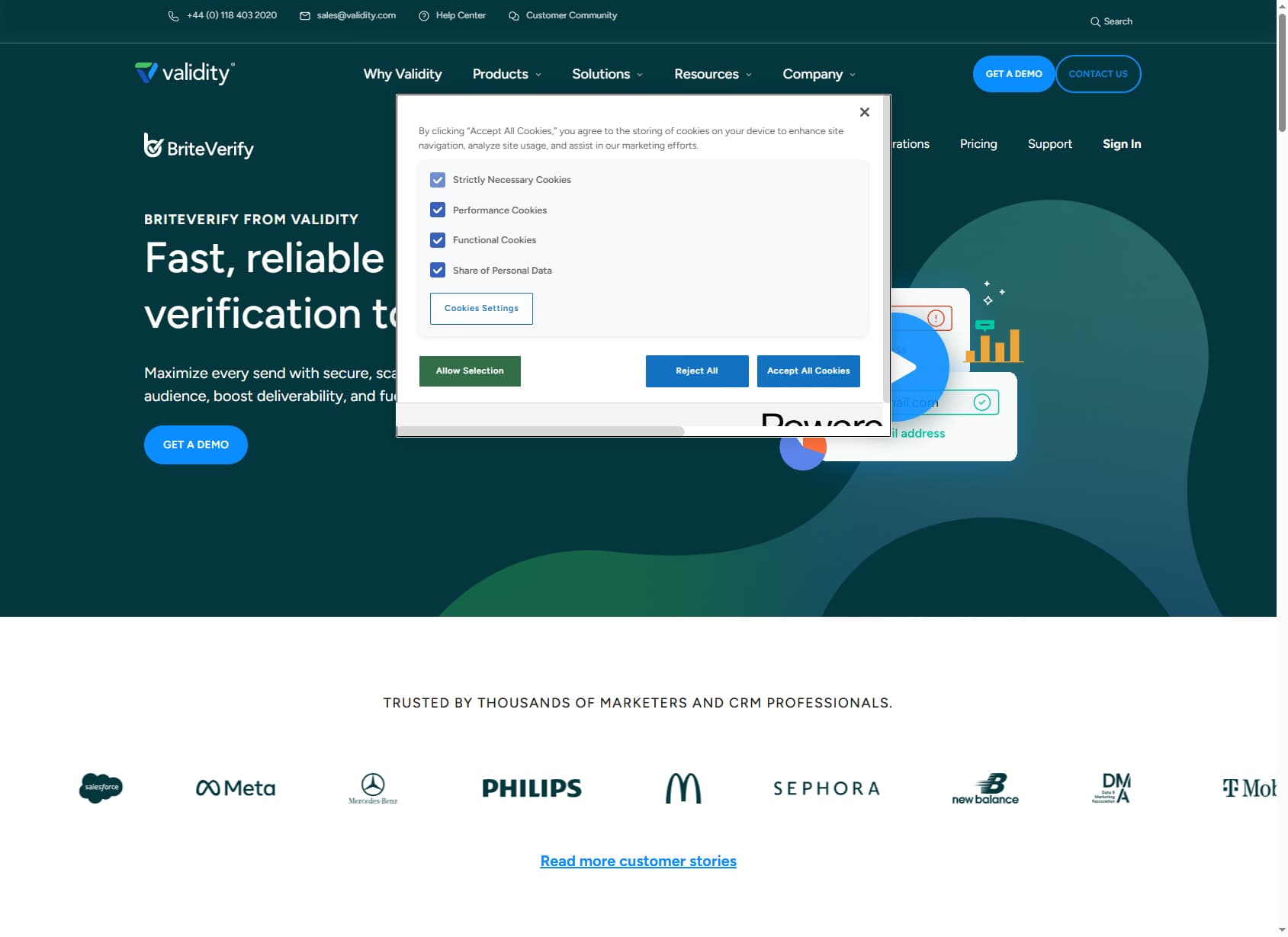
BriteVerify by Validity — email, phone, and address verification for marketing and sales teams
BriteVerify validates each email address through a multi-stage pipeline: syntax check → domain and MX record lookup → disposable address detection → SMTP handshake. Each verified address returns one of four statuses:
- Valid — safe to send; mailbox confirmed
- Invalid — does not exist; remove from list
- Accept All — domain accepts all mail (catch-all); specific mailbox deliverability unknown
- Unknown — server did not respond or timed out; cannot be confirmed
BriteVerify also verifies phone numbers (format, carrier, line type, active status) and physical addresses (checked against USPS CASS-certified databases). This multi-channel verification distinguishes it from pure email verifiers like NeverBounce and Kickbox, which cover email only.
BriteVerify is not a prospecting tool. It has no contact database, no email finder, and no enrichment capabilities. For teams that need to build lists from target account data and then verify them, see our email verification comparison or the waterfall enrichment guide.
Customers include Freshfields, Thornburg Investment Management, and Clear Capital — enterprise accounts that already operate in the Validity data ecosystem. The platform claims to have helped one customer improve deliverability from under 90% to 99%.
BriteVerify Pricing: Plans, Credits, What You Actually Pay
BriteVerify does not publish pricing on its website. All plans require contacting the Validity sales team. This is the single biggest usability gap compared to every direct competitor.
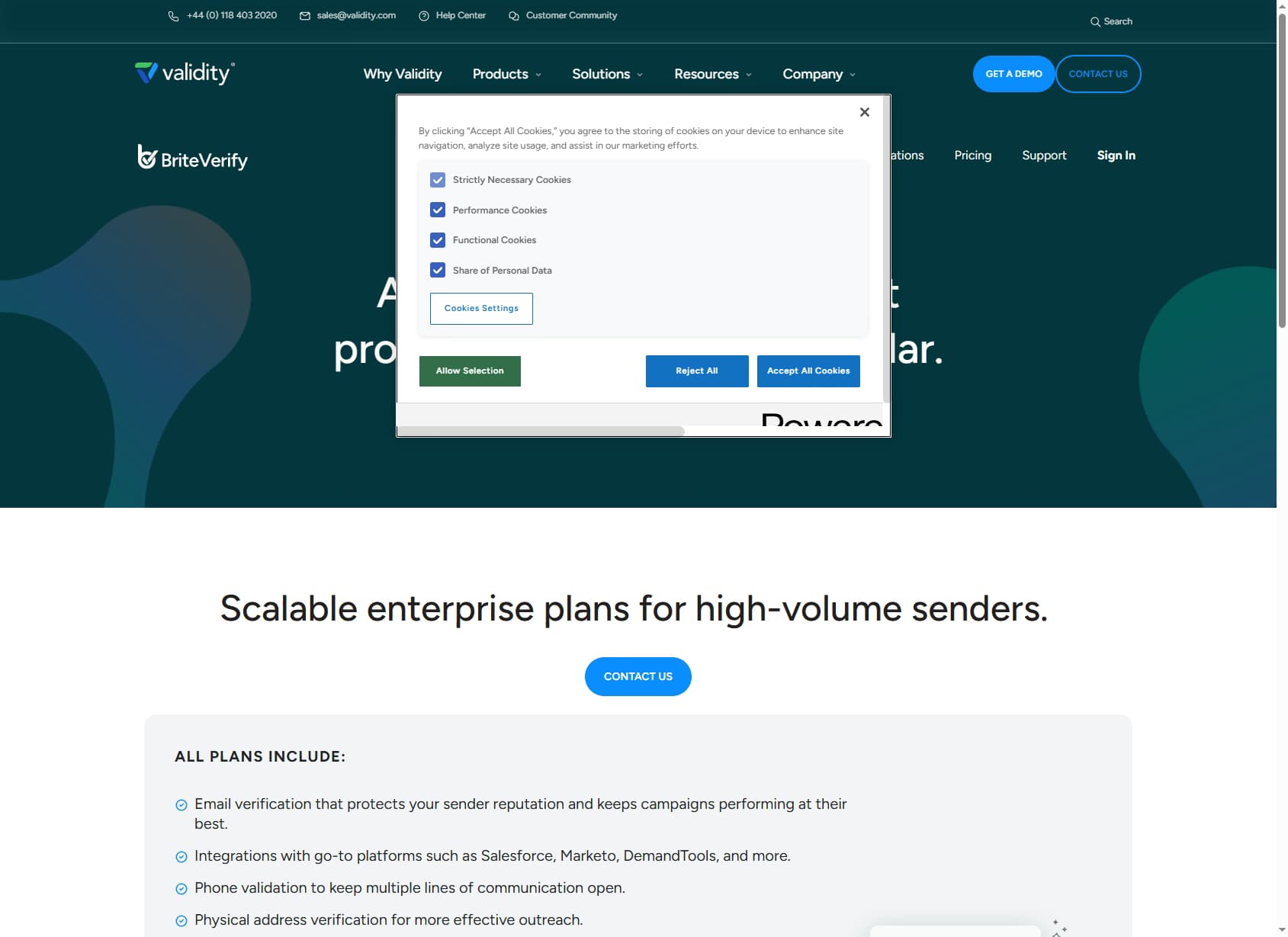
BriteVerify pricing — requires a sales call; no public per-email or volume tiers
What We Know About BriteVerify Pricing
| Volume | Estimated Price per Credit | Estimated Total Cost |
|---|---|---|
| Up to 10,000 | ~$0.010 | ~$100 for 10K |
| 10,001–100,000 | ~$0.007 | ~$700 for 100K |
| 100,001–500,000 | ~$0.005 | ~$2,500 for 500K |
| 500,000+ | Custom | Contact Validity sales |
Pricing estimates based on independent user reports and third-party comparisons. Actual quotes from Validity may differ. Always confirm with a sales call.
Credit Expiry Policy
BriteVerify credits expire after 12 months. This is a direct cost for teams that buy in bulk but use credits across multiple campaigns over time. A team that purchases 100K credits for a Q1 campaign and has 20K remaining in Q2 of the following year loses those credits permanently.
NeverBounce has no credit expiry — purchased credits retain value indefinitely. ZeroBounce also imposes a 12-month window, matching BriteVerify. For volume buyers who want long-term credit retention, NeverBounce is structurally cheaper in practice.
No Free Trial
BriteVerify does not offer a free trial or free credit tier. NeverBounce provides 1,000 free verifications with no credit card. ZeroBounce and Kickbox each offer 100 free credits. For teams that want to validate their list quality before committing to a paid plan, BriteVerify's lack of a free trial is a meaningful friction point.
Validity Ecosystem Pricing
Teams that bundle BriteVerify with Everest or DemandTools through Validity's enterprise contracts may get BriteVerify at preferential pricing or as part of a package. For these buyers, the standalone per-credit economics matter less than the consolidated contract value. Outside this ecosystem, BriteVerify competes on per-email pricing where competitors offer equal or better economics with more transparency.
BriteVerify Key Features
Bulk Email List Verification
Upload a CSV and BriteVerify processes it in batch. The platform claims 4,000 emails per minute throughput — meaning a 100K-email list completes in roughly 25 minutes. Independent tests have measured real-world throughput closer to 200/minute, putting that same 100K list at 8 hours. For most marketing use cases, next-day results are standard.
Real-Time API Verification
BriteVerify provides a REST API for verifying emails at the point of form submission or CRM record creation. This prevents invalid data from entering your systems in the first place. The API is well-documented and used in production at enterprise scale by customers like Freshfields and Thornburg Investment Management.
Phone Number Verification
BriteVerify verifies phone numbers in bulk and real-time — checking format, carrier, line type, and whether the number is currently active. This is a direct differentiator from NeverBounce and ZeroBounce, which do not verify phone numbers. For teams managing multi-channel outreach lists with both email and phone data, this reduces manual cleaning steps.
Physical Address Verification
BriteVerify offers real-time postal address verification against USPS standards. Addresses are standardized, corrected, and validated at point of entry or in batch. This is useful for direct mail operations or any workflow where physical addresses are collected alongside emails.
Salesforce and Marketo Integrations
BriteVerify integrates natively with Salesforce and Marketo — enabling verification directly within CRM records without export/import cycles. The Salesforce integration is particularly deep for teams using DemandTools, where BriteVerify verification can be triggered as part of a data management workflow. Zapier covers additional integration needs.
Point-of-Capture Verification
BriteVerify supports real-time validation at the moment of data entry — form submissions, CRM record creation, or inbound lead flows. This prevents bad data from entering systems in the first place, eliminating retroactive cleaning for new contacts. The real-time API supports sub-second response times for form validation use cases.
BriteVerify Pros: What It Does Well
- Multi-channel verification in one platform. BriteVerify verifies emails, phone numbers, and physical addresses — three data types in a single tool. NeverBounce, Kickbox, and ZeroBounce cover email only. For operations teams managing multi-channel contact records, this reduces the number of vendors.
- Deep Validity ecosystem integration. For teams already using Everest (inbox deliverability) or DemandTools (Salesforce data hygiene), BriteVerify integrates natively. The combined workflow — clean data via BriteVerify, monitor inbox placement via Everest — is coherent and reduces integration overhead.
- Enterprise-grade infrastructure and compliance. Validity serves enterprise marketing operations at companies including Freshfields, Thornburg Investment Management, and Clear Capital. For procurement teams with strict security, data handling, and compliance requirements, Validity's enterprise posture delivers the documentation they need.
- Simple, intuitive interface. G2 and Capterra reviewers consistently cite BriteVerify's ease of use as a strength. Uploading a CSV and getting results requires minimal training. The interface is deliberate in scope — it does one job and surfaces results clearly.
- Strong Salesforce and Marketo native connections. The depth of the Salesforce integration — particularly when combined with DemandTools — means CRM admins can trigger verification as part of existing data management workflows without leaving the Salesforce environment.
- Real-time API for point-of-capture prevention. Preventing bad data from entering systems is more efficient than retroactive cleaning. BriteVerify's real-time API blocks invalid emails, phone numbers, and addresses at the form or record creation event — before they become a list hygiene problem.
BriteVerify Cons: Where It Falls Short
- No transparent pricing. BriteVerify does not publish its pricing — you must contact Validity sales to get a quote. Independent estimates put the cost at ~$0.008/credit, but there is no public pricing page. This makes budget planning difficult and adds friction compared to NeverBounce, ZeroBounce, and Kickbox, which all publish tiered pricing.
- Credits expire after 12 months. BriteVerify's 12-month credit expiry penalizes teams that buy in bulk for seasonal campaigns. NeverBounce offers no credit expiry — a direct structural advantage for high-volume buyers who use credits across multiple campaigns over time.
- No free trial. BriteVerify does not offer a free tier or trial verification. NeverBounce provides 1,000 free verifications; ZeroBounce and Kickbox each offer 100. Teams cannot evaluate real list quality before committing to a paid plan.
- Catch-all handling is domain-level only. BriteVerify returns an 'Accept All' status for catch-all domains but cannot determine whether a specific mailbox exists within that domain. ZeroBounce offers catch-all scoring with confidence levels. On enterprise B2B lists where catch-alls can represent 10–30% of records, this leaves a large batch unresolved.
- No spam trap detection. BriteVerify does not detect spam traps. ZeroBounce uses AI-powered spam trap scoring. For teams with older cold-acquired lists or high-risk data sources, the absence of spam trap detection increases deliverability risk.
- No B2B contact discovery. BriteVerify verifies emails you provide — it cannot find new prospects, enrich records with phone numbers, or return firmographic data. For B2B outbound teams building lists from a target account set, this means a separate tool is required upstream.
- Accuracy gap between claim and independent audits. Validity claims 99%+ accuracy via direct inbox provider relationships. Independent audits by Bouncer measured real-world accuracy at 95.19% on standard lists. A 4% gap on a 100K-email list means 4,000 addresses classified differently than expected.
BriteVerify vs Alternatives: Comparison Table
BriteVerify is a multi-channel verification tool. The table below compares it against the two verifiers most often shortlisted alongside it: NeverBounce (verification with no-expiry credits) and ZeroBounce (verification with spam trap detection).
| Feature | BriteVerify | NeverBounce | ZeroBounce |
|---|---|---|---|
| Starting Price | ~$0.008/credit (contact sales) | $0.008/email (pay-as-you-go) | $15/mo (2K credits) |
| Pricing Transparency | Opaque — requires sales call | Public pricing page | Public pricing page |
| Verified Email Accuracy | 99% claimed (95% audited) | 97–99% | 96–98% |
| Catch-All Handling | Domain-level only, no scoring | Flagged as catch-all, no scoring | Catch-all scoring with confidence |
| Spam Trap Detection | No | No | Yes — AI spam trap scoring |
| B2B Contact Enrichment | None — verification only | None — verification only | Email append (US B2C only) |
| Phone Verification | Yes — bulk and real-time | No | No |
| Address Verification | Yes — USPS CASS-certified | No | No |
| Native Integrations | Salesforce, Marketo, DemandTools | 80+ (Mailchimp, HubSpot, Salesforce) | 35+ |
| Credit Expiry | 12 months | No expiry | 12 months |
| Free Trial | None | 1,000 free verifications | 100 free credits |
| Validity Ecosystem | Yes — part of Validity Engage | ZoomInfo ecosystem | No |
BriteVerify vs NeverBounce
NeverBounce and BriteVerify are priced similarly per email at standard volumes. NeverBounce has four concrete advantages: published pricing (no sales call required), no credit expiry, a 1,000-email free trial with no credit card, and 80+ native integrations versus BriteVerify's Salesforce/Marketo/DemandTools focus. BriteVerify's advantages are phone and address verification (NeverBounce does email only) and deeper Validity ecosystem integration. For teams needing multi-channel data cleaning, BriteVerify adds genuine value. For teams needing email verification only, NeverBounce is easier to evaluate, cheaper to test, and structurally better on credit retention. See our NeverBounce review for the full breakdown.
BriteVerify vs ZeroBounce
ZeroBounce has two features BriteVerify lacks entirely: AI-powered spam trap detection and catch-all domain scoring with confidence levels. Both impose 12-month credit expiry. ZeroBounce publishes transparent pricing starting at $15/mo for 2,000 credits. BriteVerify requires a sales call. For teams with older or cold-acquired lists where spam trap risk is a concern, ZeroBounce is the stronger choice. For teams needing phone and address verification alongside email, BriteVerify covers more data types.
For teams with an existing database of 500K emails needing a clean before a campaign send, BriteVerify (or NeverBounce) at ~$0.005–0.008/email is cost-effective. The choice comes down to data types and ecosystem: BriteVerify if you also clean phone and address data or already run Validity tools, NeverBounce or ZeroBounce if you only verify email and want public pricing. Learn more in our Verifalia review, DeBounce review, and MailerCheck review for more email verification benchmarks in 2026.
Who Should Use BriteVerify?
BriteVerify is a strong fit for:
- Teams inside the Validity ecosystem. If you already use Everest for inbox monitoring or DemandTools for Salesforce hygiene, BriteVerify integrates without additional setup. The combined workflow is more coherent than bolting on a separate verifier.
- Marketing ops teams needing multi-channel cleaning. BriteVerify cleans email, phone, and address data in a single platform. If your contact database has all three data types and needs periodic hygiene across all of them, BriteVerify reduces vendor count.
- Enterprise marketing teams with compliance needs. Validity's enterprise security posture, documentation, and customer base (Freshfields, Clear Capital) gives procurement teams confidence. For enterprise accounts with strict vendor evaluation processes, Validity's pedigree matters.
- Salesforce-heavy operations teams. The native Salesforce integration — especially combined with DemandTools — lets CRM admins run verification inside existing data management workflows without leaving Salesforce or managing CSV exports.
BriteVerify is not the right fit for:
- Teams who want to evaluate before buying. No free trial means you commit before you test. NeverBounce's 1,000-email free tier lets you validate accuracy on a real subset of your list before purchasing credits.
- Teams buying credits in bulk across multiple campaigns. The 12-month expiry means unused credits are lost. NeverBounce's no-expiry policy is structurally cheaper for teams with seasonal or irregular verification needs.
- Teams with spam trap risk. Older cold-acquired lists need spam trap detection. BriteVerify does not offer it. ZeroBounce's AI spam trap scoring is the right choice for high-risk lists.
- B2B outbound teams building lists from scratch. BriteVerify cannot find contacts. For teams starting with a target account list and zero contact data, use Apollo.io or another prospecting or enrichment platform first.
- Teams that want transparent, self-serve pricing. If you need to get budget approval without a sales conversation, BriteVerify's non-public pricing adds friction. NeverBounce, ZeroBounce, and Kickbox all publish public tiered pricing pages.
If a verifier that cannot find new contacts is a dealbreaker, SyncGTM is one alternative worth a look: it finds verified emails, phone numbers, and firmographics through waterfall enrichment across 50+ data providers.