

FindThatLead Review 2026: B2B Data Coverage, Pricing & Accuracy

By Kushal Magar · May 25, 2026 · 12 min read · Last updated: September 30, 2026
TL;DR: FindThatLead Review 2026 Verdict
FindThatLead is a Barcelona-built all-in-one B2B lead generation tool that bundles email finder, 8-step verifier, Prospector list builder, and cold email sender starting at $49/mo. Hit rates land 55–70% on clean US/EU lists, bounce rates run 4–8% post-verification, and Starter is one of the cleanest single-vendor SMB packages in the email-finder category. Single-source database caps the ceiling, credits do not roll over, and the Email Sender is lighter than dedicated cold email tools. Our rating: 3.9/5.
The case for FindThatLead is bundling. One subscription, one login, one billing line — email finding, verification, list building, and cold email all in one tool. For solo founders and small agencies that hate stitching four vendors together, the simplicity is real.
The case against it is structural. Single-source databases cap hit rates, credits that expire monthly punish episodic motions, no buying signals means you can't time outreach to a real trigger, and international coverage outside US/EU is documented as inconsistent. For modern outbound running 1,000+ contacts/month, the unit economics and workflow ceiling stop scaling.
This review covers the real Starter/Ultimate pricing math, hit rates by region, what the Email Sender does and does not do well, integrations and missing features, and a direct comparison with Apollo and Hunter.io for teams evaluating their B2B data stack in 2026.
What Is FindThatLead?
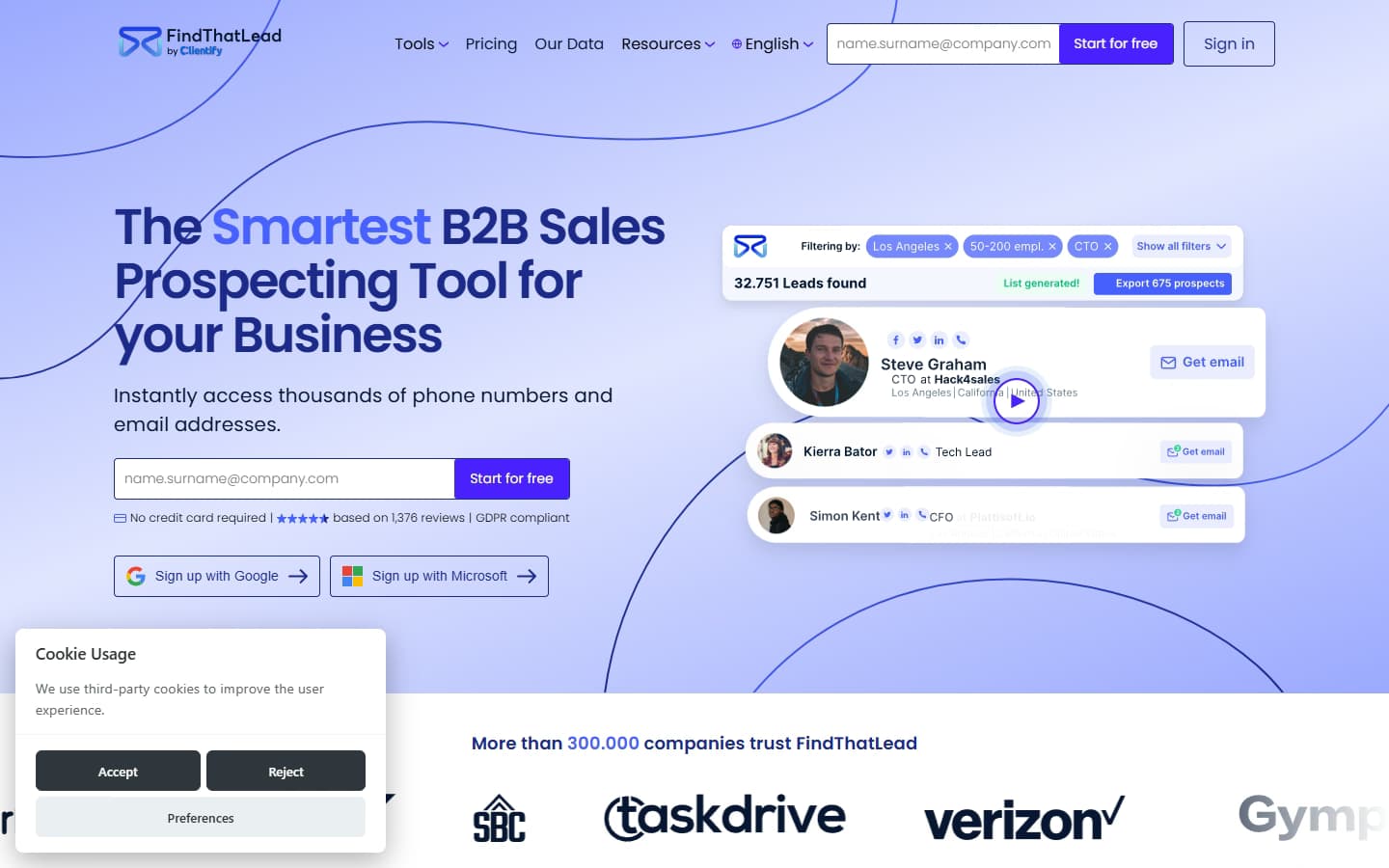
FindThatLead is a B2B lead generation platform founded in Barcelona that packages four prospecting tools under one subscription: an Email Finder that returns professional emails from a name and company domain, an 8-step Email Verifier that strips bounces pre-export, a Prospector that builds segmented lists from industry/title/geography/technology filters, and a Cold Email Sender for outbound campaigns with follow-ups.
The target user is a solo founder, freelance sales rep, small agency, or two-person SDR team — anyone who wants one vendor instead of stitching ZoomInfo for data, NeverBounce for verification, Apollo for prospecting, and Instantly for sending. FindThatLead bundles all four functions at price points starting at $49/mo, which is genuinely competitive at the SMB tier.
The Chrome extension scrapes contact data from LinkedIn profiles and company websites, and there is a lightweight internal CRM for tracking replies. The product is not a waterfall enrichment tool — it queries its own single-source database — which is the most important architectural fact for anyone evaluating it against waterfall tools such as Clay or FullEnrich.
| Capability | What FindThatLead Provides | Notable Gaps |
|---|---|---|
| Database | Single-source proprietary index + Chrome scrape; standard firmographic + person attributes per record. | No waterfall — missing records mean dead ends, no fallback. |
| Email Finder | Lookup by name + domain, bulk CSV upload, Chrome scrape from LinkedIn and websites. | Hit rate is capped by what the single database holds. |
| Verification | 8-step Email Verifier bundled at no extra cost. | Cannot recover stale records the underlying database missed. |
| Mobile Direct Dial | 50/mo at Starter, 100/mo at Ultimate. | Tight allocation vs. mobile-first tools like Lusha or Kaspr. |
| Cold Email Sender | Built-in campaigns, sequences, follow-ups, basic CRM. | Inbox rotation, warm-up, deliverability tooling lighter than Instantly/Smartlead. |
| Buying Signals | Not available. | No hiring, funding, tech-change, or intent monitoring. |
| Integrations | HubSpot, Salesforce, Pipedrive, Zapier, API. | No native continuous CRM enrichment — manual re-runs only. |
FindThatLead Pricing: How Much Do Credits Actually Cost?
FindThatLead simplified its public pricing in 2026 to two paid tiers plus a free trial. The big behavioral catch: credits do not roll over month to month. Unused email and mobile credits expire at end of billing period, which structurally punishes anyone with uneven outbound volume.
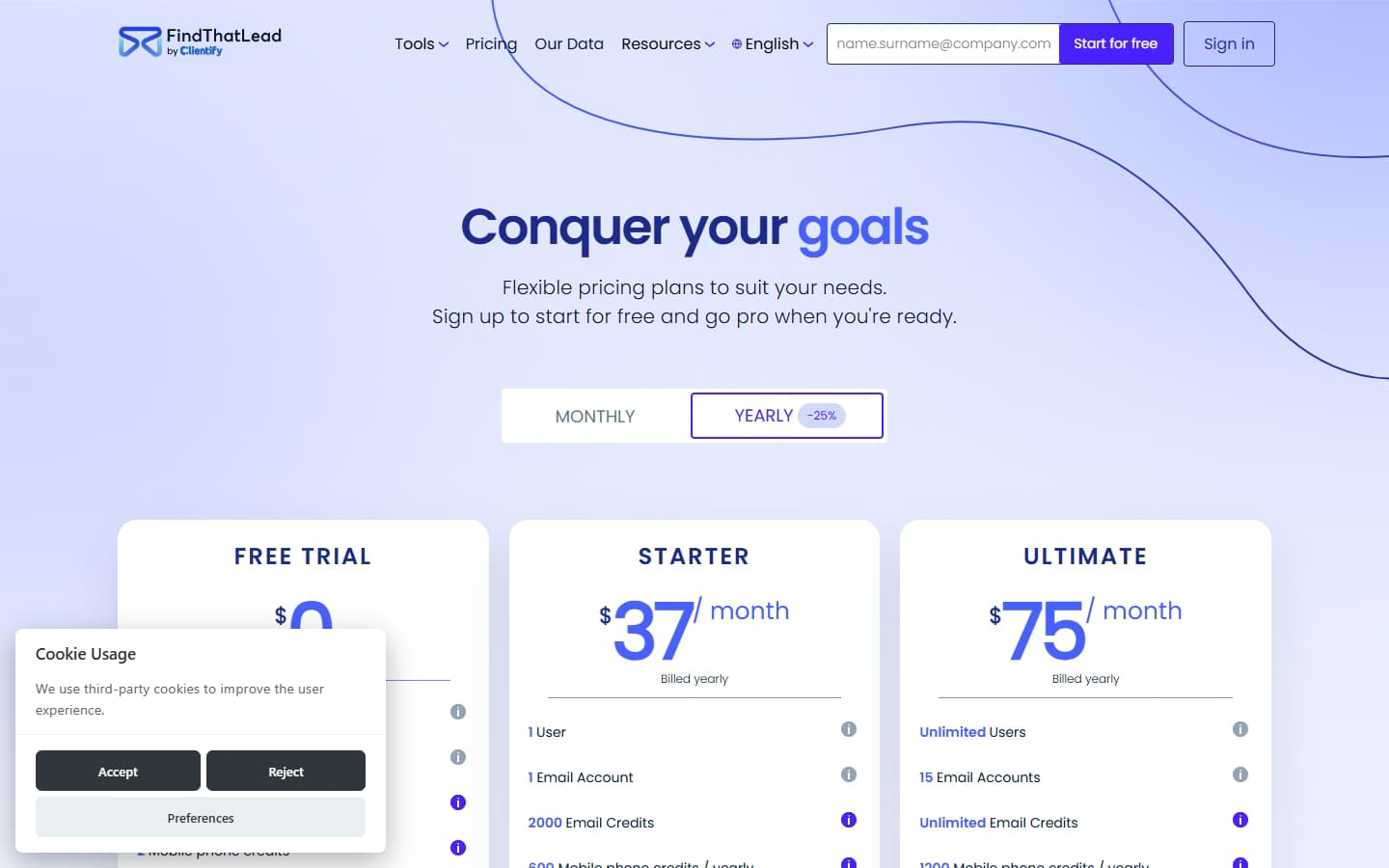
| Plan | Monthly / Annual | Email Credits | Mobile / Sender / Seats |
|---|---|---|---|
| Free Trial | $0 (7 days) | 50/mo | 2 mobile · 150 emails/day · 1 user · 1 sending account |
| Starter | $49/mo · $37/mo annual | 2,000/mo | 50 mobile · 400 emails/day · 1 user · 1 sending account |
| Ultimate | $99/mo · $75/mo annual | Unlimited* | 100 mobile · Unlimited sender · Unlimited users · 15 sending accounts |
*Ultimate "unlimited" allowances are subject to FindThatLead's fair use policy. Older pricing tiers (Growth $150/mo, Suite $399/mo) still appear in third-party reviews but are not live on the current pricing page.
The real cost math
At Starter ($49/mo for 2,000 email credits), effective cost per verified contact is $0.02–$0.025 — competitive with the entry tier of most email finders. At Ultimate ($99/mo unlimited under fair-use), it can fall below $0.01 if you actually hit volume. The killer caveat: credits expire monthly. If you pull 500 contacts in month one and 0 in month two, you have effectively paid $0.10 per contact because the unused 1,500 are gone.
Ultimate also includes expert onboarding (two sessions on monthly billing, four on annual) and a dedicated account manager. That matters more for agencies setting up client workspaces than for a solo founder, who will usually get more value from Starter billed annually at $37/mo, provided monthly volume stays close to the 2,000-credit allocation.
FindThatLead Data Coverage: Email, Mobile, and Prospector
FindThatLead does not publish a database headcount the way BookYourData (250M) or ZoomInfo (320M+) do. Independent reviews on G2 and Capterra place the coverage in the "solid for US/EU SMB to mid-market, patchy elsewhere" band. Each contact record carries the standard set: work email, mobile (when available), job title, company name, headcount, industry, and LinkedIn URL.
Coverage in practice is regionally uneven. The database is strongest in US and Western European mid-market, where FindThatLead has been actively sourcing for years. International and SMB coverage thins meaningfully.
| Region / Segment | Coverage Quality | Notes |
|---|---|---|
| US Mid-Market | Strong | Highest hit rates; densest sourcing pipeline. |
| UK & Western Europe | Strong | Spanish/French/German coverage solid given Barcelona roots. |
| US Enterprise (500+ emp) | Solid | Decent on title coverage; thinner on direct mobile dials. |
| US SMB (<50 emp) | Mixed | Reviewers cite outdated records on small-business domains. |
| APAC | Weak | Japan/Korea/SEA inconsistent; expect credit waste. |
| LATAM / MENA / Africa | Weak | Brazil/Mexico passable, rest inconsistent per reviewer reports. |
Single-source databases face the same structural problem regardless of vendor: B2B data decays roughly 2.1% per month, or ~22.5% annually, so even a freshly sourced record loses meaningful accuracy between refresh cycles. If you are weighing FindThatLead against waterfall enrichment models, test both on the same sample list rather than trusting headline accuracy claims.
FindThatLead Accuracy: Hit Rates and Bounce Rates Tested
FindThatLead's headline accuracy claim sits in the "up to 95%" band, backed by the 8-step Email Verifier that runs on every export — pattern check, MX lookup, SMTP handshake, catch-all detection, role-account filter, disposable address filter, domain reputation, and final pattern validation. The verifier holds up. The harder question is the upstream hit rate — how often the email finder actually returns a result.
Independent user reports across G2, Capterra, and TrustRadius paint a consistent picture by tier:
- US enterprise + Western Europe mid-market: 55–70% hit rate, 4–8% bounce rate post-verification. Best-case scenario.
- US SMB + secondary EU markets: 40–55% hit rate, 6–12% bounce rate. Outdated records start to appear.
- APAC + LATAM: 30–45% hit rate, 10–18% bounce rate. Coverage gaps drive both numbers.
- MENA + Africa: 20–35% hit rate, often higher bounces. Expect significant credit waste in these regions.
The most-cited complaint across review sites is outdated records: valid email syntax that no longer reaches the intended recipient because the database refresh cycle lagged behind real-world role changes. The 8-step verifier cannot detect a still-valid syntax for someone who left the company three months ago. This is the structural cap on any single-source database: a verifier can confirm that an address exists, not that the person still works there. Re-verify any list that sits for more than a few weeks before a campaign sends to it.
Key Features: Email Finder, Verifier, Prospector, Sender
Email Finder
The headline feature. Provide a name + company domain (or job title + company), receive a professional email. Bulk CSV upload handles list jobs of any size up to credit allocation. The companion Chrome extension extracts emails directly from LinkedIn profiles and visited company sites — the workflow most SMB SDRs actually want. Quality is competitive at the SMB tier; ceiling is set by the single-source database.
Email Verifier
The 8-step pipeline runs on every export and on standalone bulk verification jobs. Cost is bundled into the credit price — no separate verification billing. For teams cleaning lists from other sources (an old CRM dump, a webinar registration export, a purchased list), the standalone verifier is a legitimate value-add. Catches obviously bad records reliably; cannot recover stale records the database missed.
Prospector
The list-building tool. Filter by industry, job title, seniority, location, company size, and technologies in use; export a segmented target list. Filter set is comparable to Apollo or ZoomInfo on paper, but the underlying database is smaller, so result counts are lower for the same filter combination. Useful for narrow ICP queries (e.g., "Heads of RevOps at 50–200 employee SaaS in Germany") when the count is manageable.
Cold Email Sender
The bundled outbound tool — campaigns, sequences, follow-ups, basic open/click tracking. Functional for solo founders who don't want a separate sender. Notably lighter than dedicated cold email tools: inbox rotation across multiple sending accounts only available at Ultimate, no advanced warm-up automation, no spintax-level personalization, no native unibox for reply management. For 1–2 sending accounts and modest volume, it works. For teams running 5+ inboxes or 10K+ sends/month, Instantly or Smartlead deliver substantially more deliverability tooling.
Chrome Extension + Internal CRM
Chrome extension extracts contact data from LinkedIn profiles and company websites — a meaningful productivity boost for SDRs who live on LinkedIn. The internal CRM is genuinely lightweight: deal stages, reply tracking, follow-up reminders. It is not a replacement for HubSpot or Pipedrive; it is a place to hold leads while the cold email runs.
What's missing
No buying signals — no hiring surges, no funding rounds, no tech stack changes, no job-change alerts. No intent data. No native real-time CRM enrichment that keeps records fresh automatically. No advanced segmentation for behavioral or engagement signals. FindThatLead is intentionally a data + sending tool, not a workflow platform — and the missing pieces define who FindThatLead fits and who it doesn't.
FindThatLead Pros: What It Does Well
- ✓Genuine all-in-one bundle at SMB pricing. Email finder, verifier, Prospector, cold email sender, Chrome extension, lightweight CRM — all under $49/mo at Starter. For solo founders who hate stitching four vendors together, this is the cleanest packaged tool in the SMB email-finder category.
- ✓8-step verifier bundled at no extra cost. Verification runs on every export and on standalone bulk jobs. Catches obviously bad records, holds bounce rates at 4–8% on clean US/EU lists — competitive with dedicated verification tools like NeverBounce or ZeroBounce.
- ✓Strong Spanish/French/German coverage. Barcelona roots show up in real database quality across Spanish-speaking markets, France, DACH, and the Nordics — better than most US-built tools at the same tier.
- ✓Chrome extension that works. LinkedIn + website scrape directly from the browser is the workflow most SMB SDRs actually want. Faster than logging into the web app for every prospect lookup.
- ✓Native CRM push integrations. Direct connectors to HubSpot, Salesforce, Pipedrive, and any tool via Zapier or API. One-shot push at export is clean and predictable for SMB workflows.
- ✓10+ years in market with active product team. FindThatLead has been shipping since 2015. Long product history, active blog, and a responsive support team — better signals than the average SMB lead-gen tool.
FindThatLead Cons: Where It Falls Short
- Single-source database. If your prospect isn't in FindThatLead's index, you get nothing — there is no fallback provider to try next.
- Credits do not roll over. Unused email and mobile credits expire at the end of each billing period, which structurally penalizes seasonal outbound, agency project work, and any team with uneven monthly volume.
- Accuracy degrades outside US and Western Europe. G2, Capterra, and TrustRadius reviewers consistently flag outdated or inaccurate records — especially for APAC, LATAM, MENA, and African contacts, and for SMB domains without strong LinkedIn presence.
- No buying signals, no intent data. There are no hiring-surge alerts, funding round triggers, tech-stack change notifications, or job-change tracking — so you can't time outreach to a real moment.
- Email Sender is functional but basic. Inbox rotation, warm-up automation, deliverability monitoring, and personalization tokens are all weaker than dedicated cold email tools like Instantly, Smartlead, or Apollo's built-in sequencer.
- Mobile credit allocation is small. 50–100 mobile credits per month at Starter/Ultimate tiers limits direct-dial workflows. Dedicated mobile-data tools such as Lusha, Cognism, or Kaspr are built for deeper direct-dial coverage.
- No native real-time CRM enrichment. Pushing exports to HubSpot, Salesforce, or Pipedrive works through native connectors, Zapier, or API, but there's no automated continuous back-fill of CRM records — every refresh is a manual re-run.
FindThatLead vs Apollo vs Hunter.io
The B2B contact data market splits into four categories: domain-first email finders (Hunter.io), all-in-one SMB bundles (FindThatLead), all-in-one outbound platforms (Apollo), and waterfall enrichment platforms (such as Clay and FullEnrich). Here's how FindThatLead stacks up against the closest alternatives in two of those categories.
| Feature | FindThatLead | Apollo | Hunter.io |
|---|---|---|---|
| Pricing Model | Tiered subscription | Per-seat subscription | Tiered subscription |
| Entry Price | $49/mo (Starter) | $59/seat/mo (Basic) | $34/mo (Starter) |
| Cost Per Verified Contact | $0.02 – $0.05 | $0.05 – $0.12 | $0.03 – $0.07 |
| Database Source | Single-source + Chrome scrape | 275M contacts (own DB) | Domain crawl + verification |
| Mobile Direct Dial | 50–100/mo (limited) | Per credit allocation | Not available |
| Buying Signals | None | Basic intent (Bombora) | None |
| Native Outreach Sender | Built-in cold email | Yes — sequences included | Campaigns (basic) |
| Credits Expiration | Monthly — do not roll over | Monthly allocation | Monthly allocation |
| Best For | SMB founders, freelancers | Full-stack outbound teams | Domain-based prospecting |
The honest take on each option
FindThatLead wins on bundled SMB simplicity. One login, one bill, one product team — email finder, verifier, Prospector, and cold email sender all in one $49/mo Starter plan. Best fit for solo founders, freelancers, and 2-person teams.
Apollo bundles a 275M-contact database with native sequencing, basic intent data (Bombora), and a stronger Chrome extension starting at $59/seat/mo. Best for full-stack outbound teams that want enrichment, signals, and outreach in one tool with deeper data than FindThatLead. Single-source database limits the ceiling on hit rate vs. waterfall tools.
Hunter.io is the domain-first specialist starting at $34/mo. Best when you have target domains in hand and need clean email patterns. Lacks Prospector-style discovery, mobile credits, and sequencer depth — narrower fit than FindThatLead but cleaner execution within that fit. See the broader Hunter.io alternatives roundup.
If hit rate matters more to you than bundling, the 6 best waterfall email finders roundup covers the multi-provider side of the market. Whichever direction you lean, run the same 100-contact sample through each tool's trial and compare verified results before you commit.
Who Should Use FindThatLead?
FindThatLead is the right tool in one specific scenario: you are a solo founder, freelance sales rep, or small agency that wants one packaged tool for email finding, verification, list building, and cold sending — at SMB pricing — without stitching four vendors together. It is genuinely useful for that workflow.
Use FindThatLead if:
- You're a solo founder, freelance SDR, or 1–2 person team running consistent monthly outbound — and you want one bill instead of four.
- Your ICP is primarily US, UK, Western Europe (especially Spain, France, DACH, Nordics) at mid-market or larger — coverage holds up here.
- You want a working Chrome extension for LinkedIn-driven prospecting and an internal CRM for lightweight pipeline tracking.
- Monthly credit allocation matches your real usage — you can pull ~2,000 contacts/month consistently without leaving credits on the table.
- The basic Cold Email Sender is enough — you don't need advanced inbox rotation, warm-up, or unibox features yet.
Do not use FindThatLead if:
- You're running sustained outbound at 5,000+ contacts/month — the single-source ceiling starts to cost real pipeline.
- Your outbound motion is seasonal or project-based — credits expire monthly, so you'll routinely overpay.
- You want buying signals (hiring, funding, tech changes, job changes) to time outreach to a real moment.
- Your ICP is heavily APAC, LATAM, MENA, or Africa — coverage gaps waste credits.
- You run 5+ sending inboxes or 10K+ sends/month and need a dedicated cold email tool with deeper deliverability tooling (Instantly, Smartlead).
- You need automated continuous CRM enrichment that keeps records fresh without manual re-runs.
Conclusion: Is FindThatLead Worth It in 2026?
FindThatLead is a competent, well-bundled SMB lead generation tool. The Email Finder is competitive at the entry tier, the 8-step Verifier is genuinely strong, the Prospector is functional, and the bundled Cold Email Sender saves the cost of a separate outbound tool. For solo founders, freelancers, and small agencies with US/EU ICPs, the $49/mo Starter plan is a defensible choice.
But the structural limits show up the moment your motion gets serious. Single-source data means a missing record is a dead end. Credits that expire monthly punish uneven outbound volume. No buying signals means you can't time outreach to a real trigger. International coverage outside US/EU is documented as inconsistent. The Cold Email Sender is fine for 1–2 inboxes; it stops scaling beyond that.
Our recommendation:Try the 7-day free trial to test data quality against your specific ICP. If you're a solo founder with US/EU prospects and want one tool instead of four, FindThatLead Starter is a clean fit. If you're running outbound at scale and need wider coverage, buying signals, or deeper deliverability tooling, compare the 6 best waterfall email finders and a dedicated sender like Instantly or Smartlead before committing. External benchmarks worth reading before deciding: G2 reviews, Capterra, and Software Advice.
If FindThatLead's single-source database is a dealbreaker, SyncGTM is one alternative worth a look: it runs waterfall enrichment across 50+ data providers for verified emails and phone numbers.