

7 Best Firecrawl Alternatives for B2B Enrichment in 2026

By Kushal Magar · July 3, 2026 · 12 min read · Last updated: September 28, 2026
Key Takeaway
Firecrawl is a web scraping API — not a B2B enrichment tool. Teams using it to extract prospect data are building scrapers they will have to maintain. SyncGTM gives you verified emails, direct dials, and 76+ data points per lead from 50+ providers under one subscription, with AI outreach sequences built in — from $89/mo.
Firecrawl is a powerful web crawling API for turning websites into clean markdown — but it is not built for B2B enrichment. It has no contact database, no email finder, and no outreach automation. Teams that reach for Firecrawl to get prospect data end up maintaining brittle scrapers that break every time a target site updates its layout.
This guide covers 7 Firecrawl alternatives ranked by use case fit for B2B teams — whether you need direct contact enrichment, LinkedIn automation, enterprise proxy infrastructure, or a scraping platform with less maintenance overhead.
Every tool has been evaluated against real B2B prospecting workflows in 2026. Pricing is current as of July 2026. For a broader look at web crawling options, see our best API for web crawling in AI lead gen guide.
TL;DR
- Best all-in-one Firecrawl alternative for B2B: SyncGTM — waterfall enrichment + AI outreach from $89/mo
- Best managed scraping platform: Apify — 4,000+ actors, JavaScript rendering, from $49/mo
- Best B2B data API for AI agents: Explorium.ai — 146M+ companies via API and MCP server; free trial (100 credits), then from $29.99 per credit package
- Best enterprise proxy + datasets: Bright Data — 150M+ IPs, ready-made B2B datasets, from $500+/mo
- Best for LinkedIn automation: PhantomBuster — connection requests, profile scraping, from $59/mo
- Best B2B database alternative: Apollo.io — 270M+ contacts, built-in sequencer, free tier available
- Best for Google Maps and local business data: Outscraper — pay-as-you-go from $3/1k results
Why Teams Switch from Firecrawl for B2B Data
Firecrawl excels at one thing: converting web content into clean, LLM-ready markdown or JSON. It is well-suited for AI applications that need to ingest website content at scale.
Four reasons B2B teams look elsewhere for prospecting data:
- No contact data layer. Firecrawl returns raw HTML or markdown — not verified emails, direct dials, or LinkedIn profiles. Converting scraped web content into usable contact records requires additional parsing, cleaning, and verification pipelines.
- LinkedIn is off-limits.LinkedIn actively blocks scraping. Any tool that claims to scrape LinkedIn at scale either gets rate-limited quickly or violates LinkedIn's Terms of Service. B2B teams that need LinkedIn data need purpose-built tools that use compliant data partnerships.
- Maintenance burden. Web scrapers break when target sites change layouts, add bot detection, or move behind authentication walls. According to G2 user reviews on web scraping tools, maintenance overhead is the top reason teams move to managed enrichment platforms.
- No outreach integration. Even if Firecrawl returns useful data, it does not connect to sequencers, CRMs, or email senders. Every pipeline step requires a custom integration.
The web scraping market is expected to reach $2.23 billion by 2031 — but the growth is driven by AI data pipelines and ready-made enrichment APIs, not custom scrapers. The shift in 2026 is away from "build your own scraper" and toward "query a provider that already has the data." See our best waterfall contact providers comparison for the full landscape.
1. SyncGTM
SyncGTM — waterfall enrichment across 50+ providers with integrated AI outreach sequences
SyncGTM is a B2B enrichment platform that replaces the Firecrawl scraping approach entirely. Instead of scraping websites for contact data, SyncGTM queries 50+ verified data providers in waterfall sequence — cascading through each until it finds a verified email, direct dial, or LinkedIn profile for a given prospect.
The result: 76+ data points per lead including verified work email, direct dial, LinkedIn URL, job title, seniority, company size, tech stack, funding status, and buying signals — returned in milliseconds without a single scraper to maintain. It then routes that data directly into AI-powered outreach sequences, covering email and LinkedIn without leaving the platform.
For B2B teams, this replaces three separate workflows — scraping, data cleaning, and outreach setup — with one subscription. For a broader comparison of enrichment options, see our best waterfall contact providers guide.
Pros
- Waterfall enrichment across 50+ providers — highest email hit rate available
- 76+ data points per lead: verified email, direct dial, LinkedIn, firmographics, technographics, intent signals
- No scrapers to build or maintain — all data is queried from compliant provider networks
- AI-powered outreach sequences — email and LinkedIn automation built in
- Native CRM sync: HubSpot, Salesforce, Pipedrive
- Free tier: 50 enrichment credits, no credit card required
Cons
- Not a web scraping tool — cannot extract arbitrary web content for LLM pipelines
- Smaller brand recognition than Apollo for enterprise procurement sign-off
Best for: B2B teams that want verified contact data without building or maintaining scrapers
Pricing: From $89/mo (annual); 50 free credits to start
2. Apify
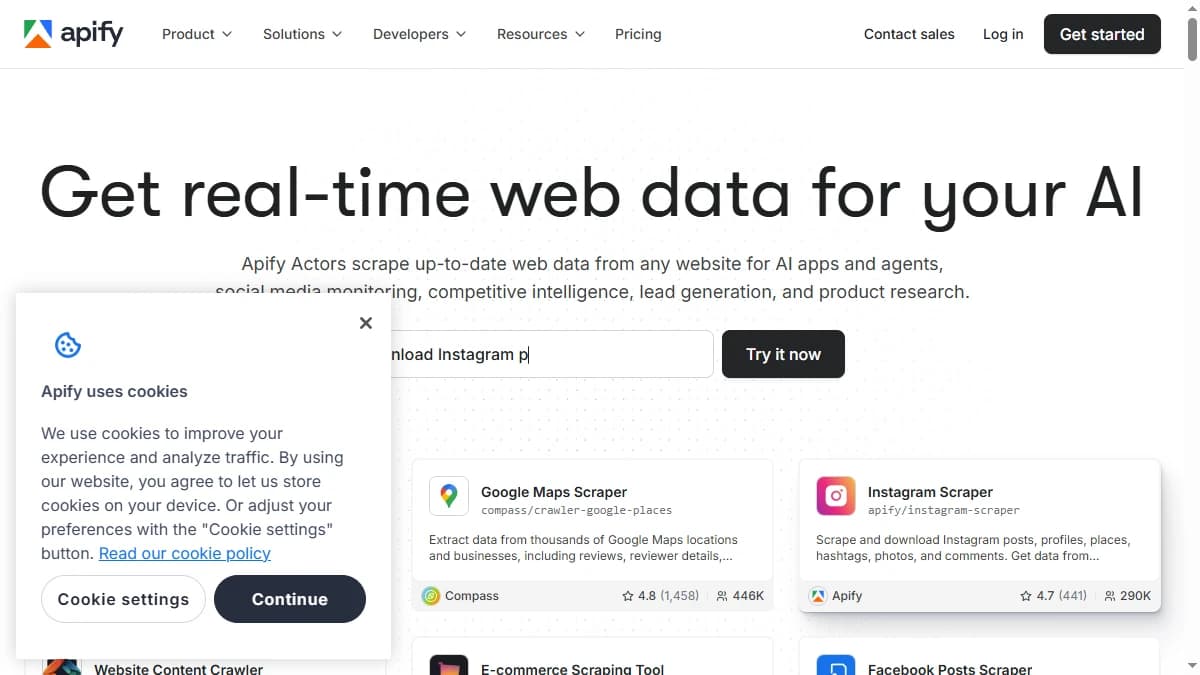
Apify — managed scraping platform with 4,000+ pre-built actors and cloud execution
Apifyis the most direct technical replacement for Firecrawl if your use case genuinely requires web scraping. It offers a cloud-based platform for building, deploying, and scheduling scrapers — plus a marketplace of 4,000+ pre-built "Actors" that handle common data extraction tasks without writing code.
For B2B use cases, Apify Actors cover Google Maps business listings, LinkedIn profiles (within ToS limits), company websites, and job boards. Its managed cloud handles JavaScript rendering, rotating proxies, and anti-bot bypasses better than a self-hosted Firecrawl instance. The pay-as-you-go model (compute units) makes it cost-efficient for irregular scraping needs.
Pros
- 4,000+ pre-built Actors — no coding required for most common scraping tasks
- Managed cloud: JavaScript rendering, rotating proxies, and retry logic handled automatically
- Pay-as-you-go pricing model — no commitment for sporadic scraping jobs
- Webhooks, API, and scheduling for automation without extra tooling
- Free tier with $5 platform credits — enough for initial testing
Cons
- Still requires scraping — no built-in B2B contact database or email verification
- Scraped data needs additional cleaning and enrichment before use in outreach
- Compute costs scale up quickly for large-volume extraction jobs
- LinkedIn scraping Actors are rate-limited and frequently break when LinkedIn changes structure
Best for: Technical teams that need flexible web scraping with managed infrastructure and low setup overhead
Pricing: Free tier ($5 credits); paid plans from $49/mo
3. Explorium.ai
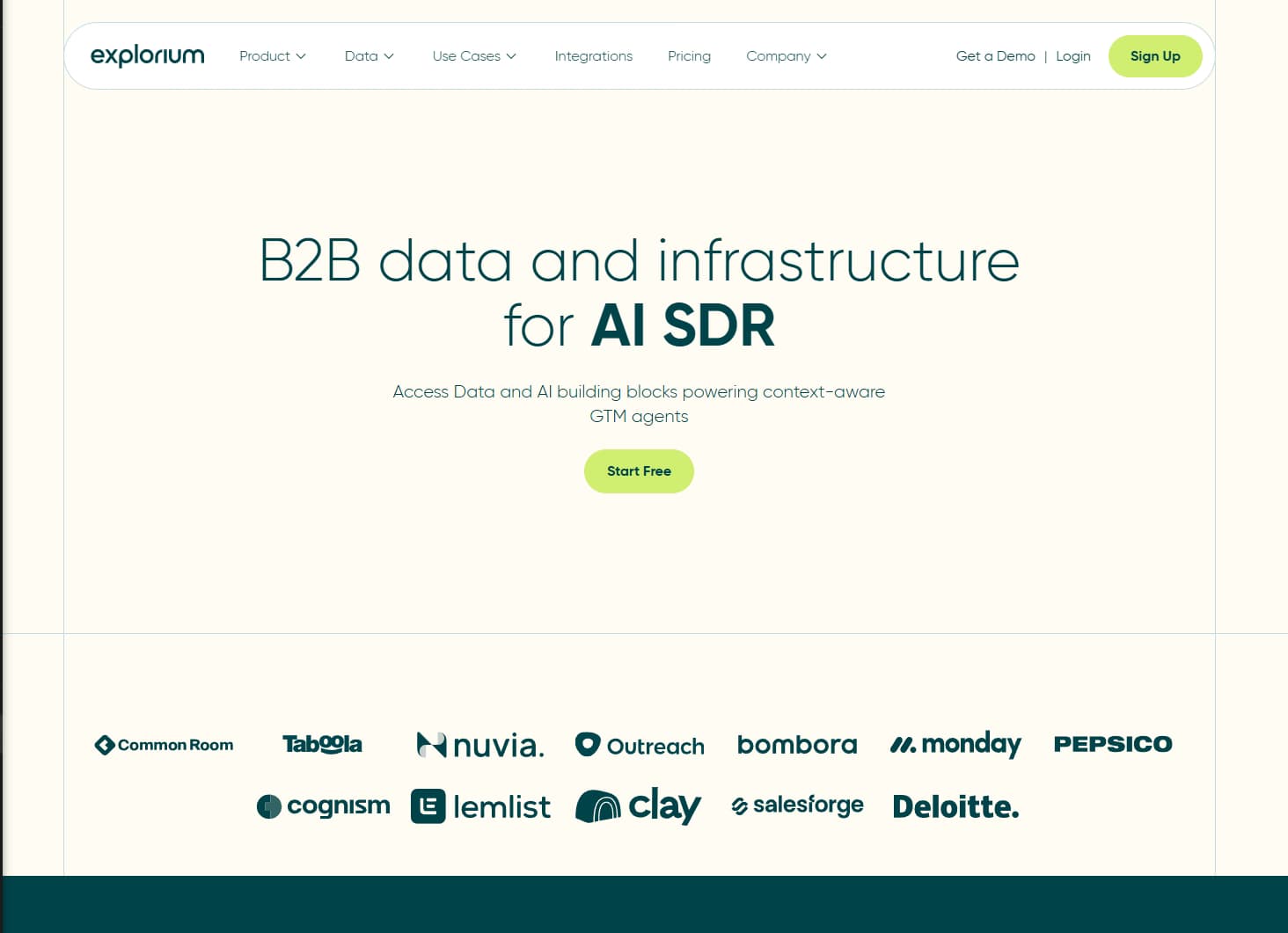
Explorium.ai — B2B data foundation for AI agents, served through one REST API and a hosted MCP server
Explorium.ai is a B2B data platform built for AI agents. Instead of crawling company websites and asking an LLM to parse the markdown, you query structured records for 146M+ companies and 767M+ professional profiles through one REST API or a hosted MCP server.
For teams that picked Firecrawl to feed an AI agent company context, this is the closer fit. Company enrichment returns firmographics, technographics, funding data, workforce trends, and website changes as clean fields, and prospect enrichment adds work emails, phone numbers, and professional history. Events such as funding rounds, hiring, and tech changes arrive in real time. Non-technical teammates can use the Vibe Prospecting app, which installs from the Claude and ChatGPT connector directories and builds lists from plain-English prompts.
Pros
- Structured company and contact data for AI agents — no crawling or parsing
- One REST API and a hosted MCP server; bulk enrichment of up to 50 records per request
- 146M+ companies, 767M+ professional profiles, and 4,000+ data signals
- Website-change, funding, hiring, and tech-change events for signal-based workflows
- Credit packages from $29.99; a search costs 1 credit
Cons
- Not a general-purpose web crawler — it serves its own B2B data, not arbitrary page content
- No built-in outreach sequencer, inbox, or dialer
- Credit cost varies by enrichment type (1-5 credits per record)
- API and MCP paths assume some technical comfort
Best for: Teams building AI agents or LLM apps that need structured B2B company and contact data without maintaining crawlers
Pricing: Free trial (100 credits); credit packages from $29.99 (500 credits) to $7,499.99 (500,000 credits)
4. Bright Data
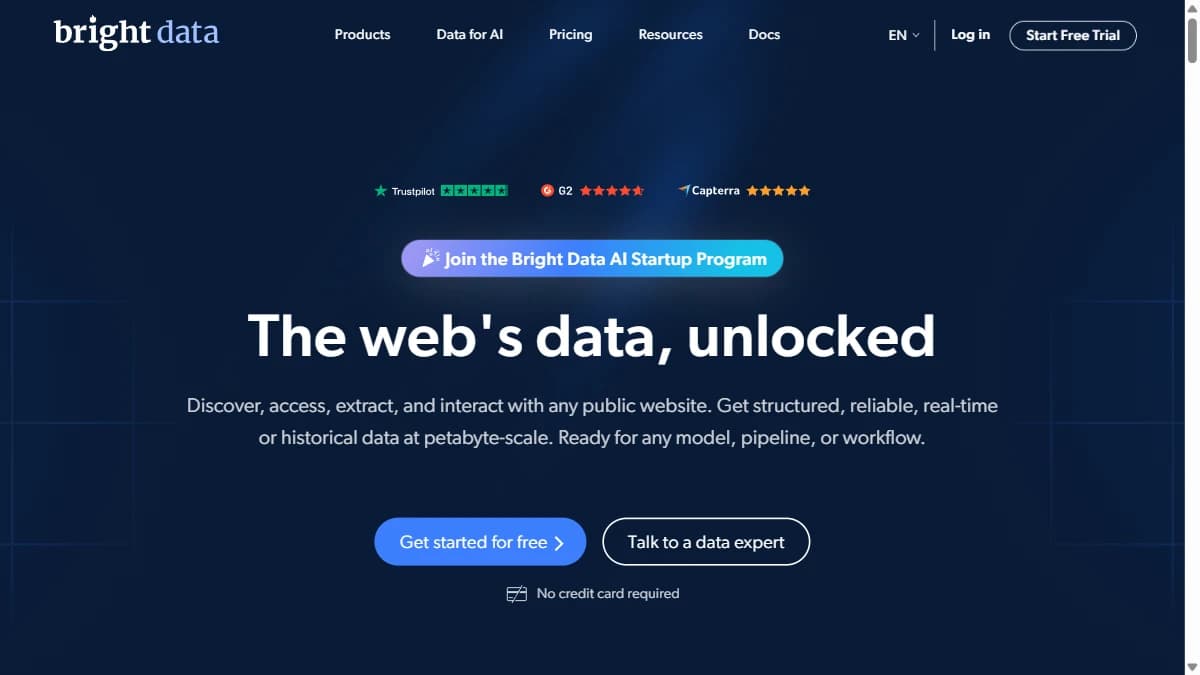
Bright Data — enterprise proxy network and ready-made B2B datasets for large-scale data needs
Bright Data is the largest commercial proxy network with 150M+ IPs across 195 countries — nobody matches that infrastructure. Beyond proxies, it offers a Scraping Browser, SERP API, Web Scraper IDE, and a ready-made dataset marketplace including B2B company and contact data.
For teams that hit Firecrawl's limits on anti-bot protected sites, Bright Data's proxy infrastructure and residential IP rotation solve that at the infrastructure layer. Its ready-made B2B datasets (company profiles, LinkedIn data, job listings) let teams skip the scraping step entirely and buy pre-extracted data. Read the full Bright Data review for pricing breakdowns by product.
Pros
- 150M+ IPs across 195 countries — best-in-class for bypassing geo-blocks and bot detection
- Ready-made B2B datasets: company data, LinkedIn profiles, job listings — no scraping needed
- Scraping Browser for JavaScript-heavy sites — handles dynamic content better than Firecrawl
- Proxyway benchmark: 93% success rate vs. Firecrawl's 34% on bot-protected sites
- GDPR-compliant proxy sourcing via opt-in residential network
Cons
- Enterprise pricing — starts at $500+/mo, not practical for small teams or early-stage startups
- Complex product suite — proxies, datasets, and scraping tools are separate products with separate billing
- Requires technical integration — no no-code UI for non-developers
Best for: Enterprise data engineering teams that need reliable infrastructure for large-scale web data extraction
Pricing: From $500+/mo; ready-made datasets priced per record
5. PhantomBuster
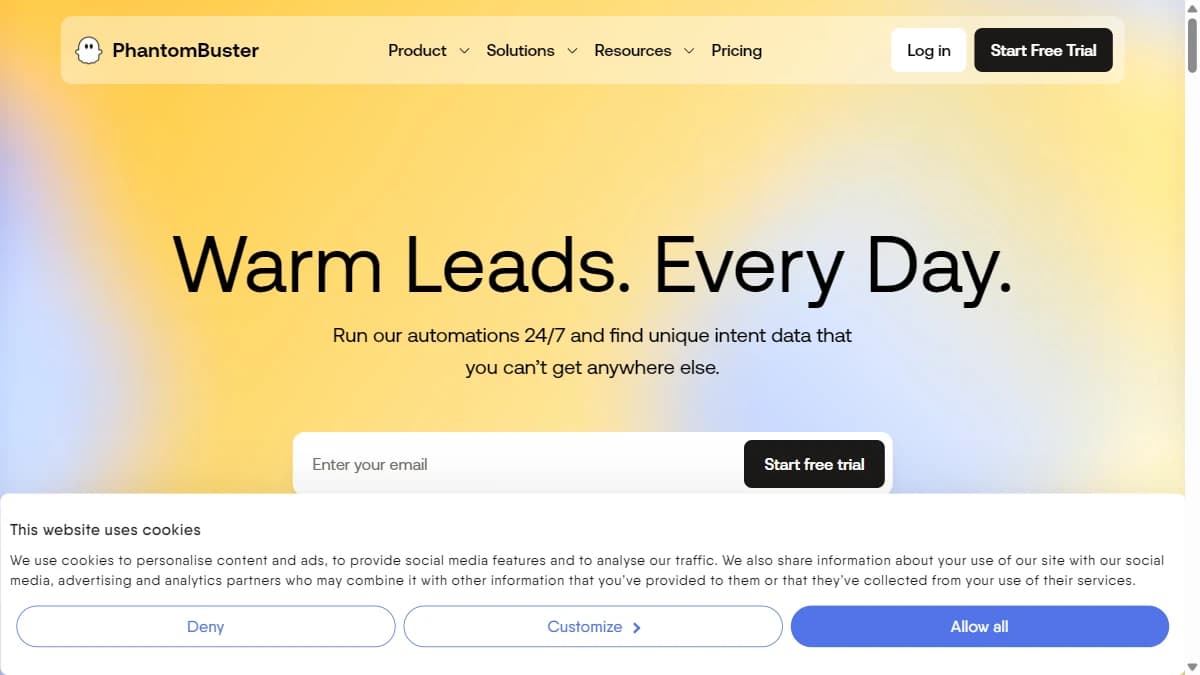
PhantomBuster — LinkedIn and social media automation for B2B outreach and data extraction
PhantomBusteris a LinkedIn and social media automation platform with 100+ pre-built "Phantoms" — automated sequences for profile scraping, connection requests, message sending, and Sales Navigator exports.
For B2B teams whose primary data source is LinkedIn, PhantomBuster solves the gap that Firecrawl cannot: it interacts with LinkedIn through a connected session (your cookie), allowing it to extract data and automate actions within LinkedIn's session-level access controls. It is not a proxy scraper — it automates your browser session, which keeps it within LinkedIn's tolerated automation range. For a full breakdown of what it can and cannot do, see our PhantomBuster review.
Pros
- 100+ pre-built Phantoms — LinkedIn profile scraper, Sales Navigator export, connection automation
- Session-based automation — accesses LinkedIn through your connected account, not proxy scraping
- AI-powered personalized message generation for connection requests
- 14-day free trial — no credit card required
- Zapier and Make integrations for downstream automation
Cons
- LinkedIn account risk — automation at high volumes can trigger LinkedIn account restrictions
- No built-in email verification — scraped profiles require a separate enrichment tool to get work emails
- LinkedIn-only focus — no data from other B2B sources like company websites or job boards
- Usage limits per day to avoid LinkedIn flagging — limits throughput at scale
Best for: Sales teams doing LinkedIn-first prospecting who need profile data and connection automation in one tool
Pricing: 14-day trial; paid plans from $59/mo
6. Apollo.io
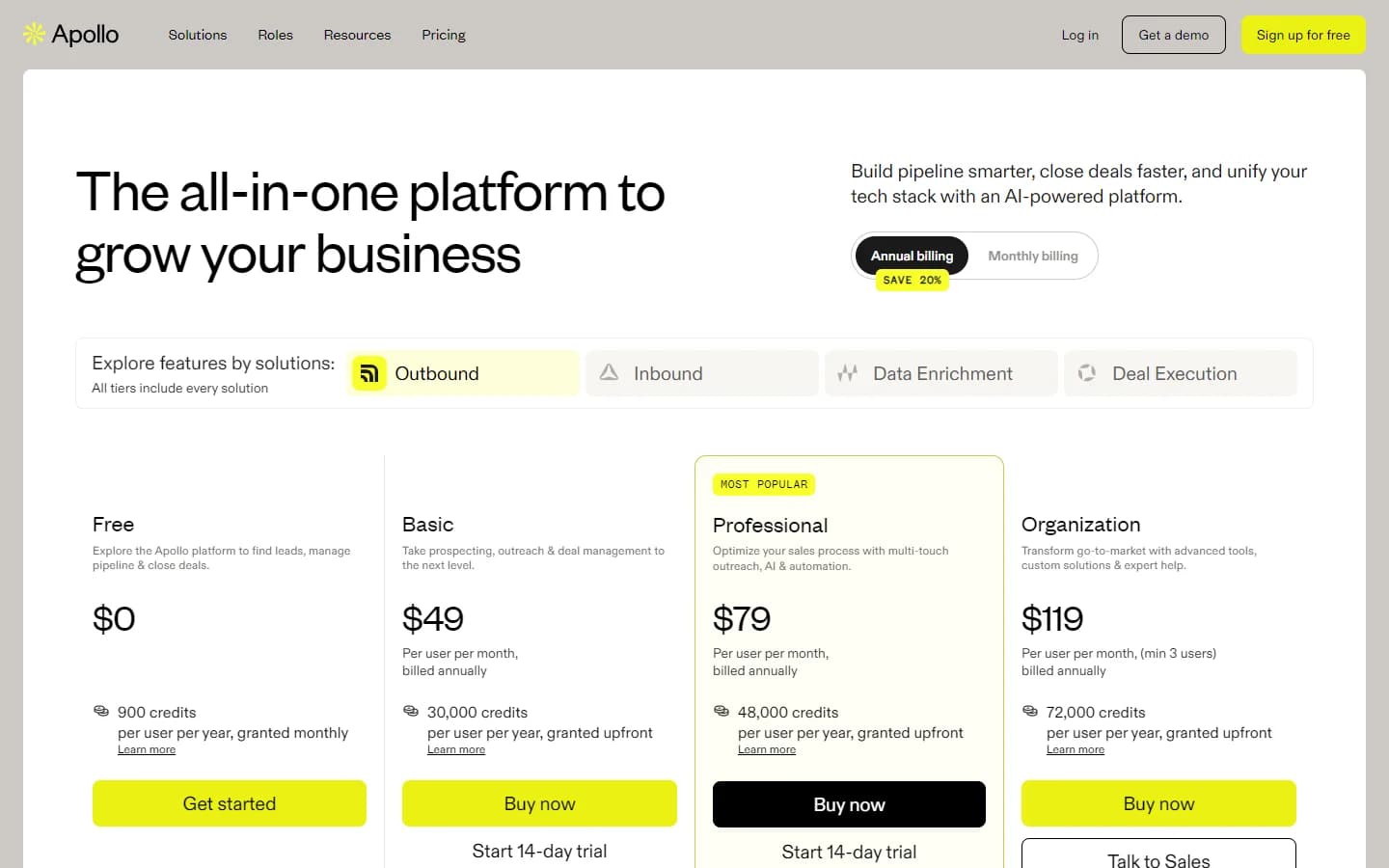
Apollo.io — 270M+ contact database with built-in email sequencer and Chrome extension
Apollo.io is an all-in-one sales intelligence and engagement platform with a 270M+ contact database, built-in email sequencing, a dialer, and a Chrome extension for LinkedIn prospecting.
For teams switching from Firecrawl because they realize they need contact data — not web content — Apollo is the fastest path to a working outbound pipeline. No scraping, no parsing, no data cleaning. You search the database by role, industry, company size, and 65+ other filters, export the contacts, and trigger sequences directly in the platform. The free tier (50 email credits/mo, no credit card) makes it the lowest-friction entry point on this list.
Pros
- 270M+ verified contacts with 65+ filter dimensions for precise ICP targeting
- Built-in email sequencer with A/B testing, reply detection, and task management
- Free tier with 50 email credits/mo — no credit card required
- Chrome extension for LinkedIn and Gmail prospecting
- Native Salesforce and HubSpot integrations
Cons
- Single data source — no waterfall enrichment to maximize email hit rates across providers
- Email accuracy reported at 70–80% in independent tests — below waterfall enrichment tools
- Intent data and dialer are paid add-ons, not included in base plans
- Contact data freshness is inconsistent for niche industries or smaller companies
Best for: B2B teams that want a ready-to-use contact database and sequencer without building any data pipeline
Pricing: Free tier (50 credits/mo); paid from $49/user/mo
7. Outscraper
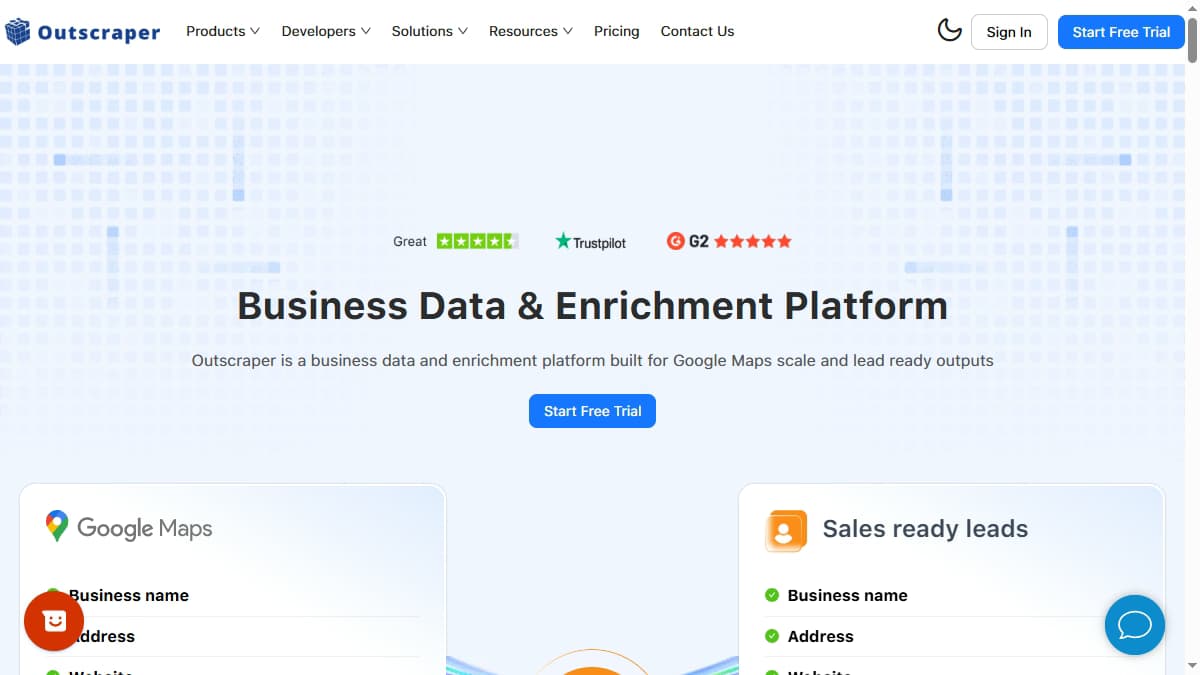
Outscraper — pay-as-you-go web scraping service for Google Maps, business directories, and review platforms
Outscraper is a managed web scraping service that specializes in Google Maps, Google Search, business directories, and review platforms — all without requiring any scraping code or infrastructure setup.
For B2B teams prospecting local or SMB markets, Outscraper solves the use case that Firecrawl makes hard: extracting structured business data (name, address, phone, website, email) from Google Maps at scale. It offers a no-code UI for one-off exports and an API for programmatic access. Pay-as-you-go pricing with $2.50 free credits makes it easy to test. Read our full Outscraper review for coverage and accuracy details.
Pros
- Google Maps scraping at scale — extract business listings, reviews, contact info without code
- No infrastructure to maintain — managed service with automatic anti-bot handling
- Pay-as-you-go pricing from $3/1,000 results — no monthly commitment
- Free $2.50 credits to test — no credit card required
- API access for programmatic extraction and automation workflows
Cons
- Limited to public data sources — cannot access authenticated or paywalled content
- No built-in email finder or contact enrichment — returns website URLs, not verified emails
- Niche coverage: strongest for local/SMB data, weaker for enterprise B2B prospecting
Best for: B2B teams prospecting local and SMB markets via Google Maps and business directory data
Pricing: Pay-as-you-go from $3/1,000 results; free $2.50 starter credits
Side-by-Side Comparison
| Tool | Best For | Free Tier | Starting Price | Standout Feature |
|---|---|---|---|---|
| SyncGTM | Waterfall B2B enrichment + AI outreach automation | Yes (50 credits) | $89/mo (annual) | 50+ providers, 76+ data points, built-in sequences |
| Apify | Custom web scraping with pre-built actors | Yes ($5 credits) | $49/mo | 4,000+ actors, managed cloud, JavaScript rendering |
| Explorium.ai | Structured B2B data for AI agents and LLM apps | Free trial (100 credits) | $29.99/pkg | 146M+ companies, API + hosted MCP server, website-change and funding signals |
| Bright Data | Enterprise proxy infrastructure + B2B datasets | No | $500+/mo | 150M+ IPs, ready-made B2B datasets, scraping browser |
| PhantomBuster | LinkedIn scraping and outreach automation | 14-day trial | $59/mo | LinkedIn Phantoms, connection request automation |
| Apollo.io | B2B database + built-in email sequencer | Yes (50 credits/mo) | $49/user/mo | 270M+ contacts, built-in sequencer, Chrome extension |
| Outscraper | Google Maps and business directory scraping | Yes ($2.50 credits) | Pay-as-you-go from $3/1k results | Google Maps scraping, reviews, local business data |
How to Choose the Right Firecrawl Alternative
- Your goal is verified contact data, not web content. Skip scraping entirely. SyncGTM or Apollo.io give you enriched B2B leads in minutes — no pipeline to build or maintain. SyncGTM leads on email hit rates (waterfall across 50+ providers). Apollo.io leads on database breadth (270M+ contacts with built-in sequences).
- You need flexible web scraping with less setup than Firecrawl. Apify is the upgrade — managed cloud infrastructure, 4,000+ pre-built Actors, and better anti-bot handling. It is still a scraping tool, but one with far less maintenance overhead.
- You are feeding company data to an LLM or AI agent. Explorium.ai returns structured firmographics, funding data, and website changes through an API and hosted MCP server, so your agent queries clean fields instead of crawling pages. Best for teams building AI SDRs that need data without scrapers.
- Your primary source is LinkedIn. PhantomBuster handles LinkedIn-first workflows — profile scraping, connection requests, and outreach through a connected session. Pair it with SyncGTM to enrich the LinkedIn profiles it finds with verified work emails and direct dials.
- You need enterprise-grade proxy infrastructure. Bright Data is the only option that matches its scale (150M+ IPs, 93% success rate on bot-protected sites). But its $500+/mo floor makes it impractical for most SMBs and early-stage teams.
- You are prospecting local or SMB markets via Google Maps. Outscraper is purpose-built for this. Pay-as-you-go pricing and a no-code UI make it the lowest-friction option for one-off Google Maps extractions.
Final Verdict
Firecrawl is a good tool for what it does — converting websites into LLM-ready content. But B2B enrichment is not what it does. Teams using it to find contact data are solving the wrong problem with the wrong tool.
For contact enrichment: SyncGTM is the strongest direct replacement — waterfall across 50+ providers, 76+ data points per lead, and integrated outreach sequences. It removes the entire scraping-and-parsing pipeline and replaces it with one API call. Start with 50 free credits at SyncGTM pricing.
For flexible scraping: Apify beats Firecrawl on anti-bot handling, managed infrastructure, and pre-built Actors. If you genuinely need web scraping (not B2B contact data), Apify is the better managed platform.
For AI agents and LLM apps: Explorium.ai serves structured company and contact data through an API and MCP server, so agents skip the crawl-and-parse step. Credit cost that varies by enrichment type is the tradeoff.
For LinkedIn-first teams: PhantomBuster handles the LinkedIn layer. Pair it with SyncGTM for work email enrichment on the profiles it extracts.
The pattern across every successful B2B team in 2026 is the same: spend less time building data pipelines and more time in conversations with prospects. The tools on this list — especially SyncGTM — make that shift possible.