

Bright Data Review 2026: B2B Data Coverage, Pricing & Datasets

By Kushal Magar · June 9, 2026 · 11 min read · Last updated: September 30, 2026
Key Takeaway
Bright Data is web-data infrastructure — proxies, scrapers, and public datasets — not a verified B2B contact source. Its LinkedIn datasets carry public profile fields but no verified emails or direct dials, so sales teams must add an email finder, a verifier, and a phone provider on top.
This Bright Data review covers what the platform actually is in 2026: web-data infrastructure — proxy networks, a Web Scraper API from $1.5/1K records, and pre-built datasets — not a verified B2B contact database. Bright Data's LinkedIn datasets return public profile fields, but no verified work emails or direct dial numbers. Our rating: 4.1/5 for what it is, far lower as a sales prospecting tool.
Bright Data is genuinely excellent at one thing: collecting public web data at scale. With 400M+ residential IPs and a full scraping stack, it is the default infrastructure for data engineering teams that need to gather, parse, and structure web data programmatically.
The problem starts when a sales or RevOps team mistakes it for an enrichment tool. Bright Data hands you raw public data. It does not verify emails, find phone numbers, detect buying signals, or sync anything into your CRM — those are all separate problems you have to solve yourself.
This review breaks down Bright Data's pricing across products, its real B2B data coverage, where accuracy holds and where it doesn't, and a direct comparison with Clay and Apollo for teams deciding how to build their data stack in 2026.
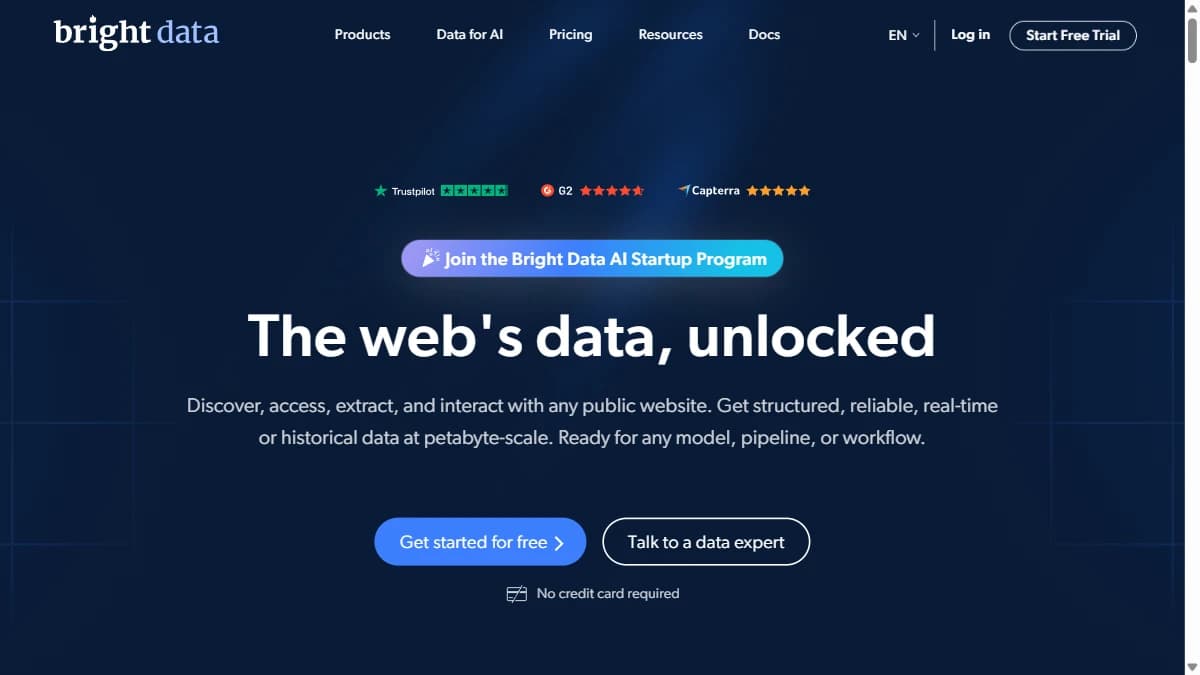
Bright Data — web data platform with proxies, scraper APIs, and pre-built datasets.
What Is Bright Data?
Bright Data is a web-data collection platform — the largest commercial proxy and scraping provider in the market. Its business is giving you the infrastructure to gather public web data programmatically, then structure it however you need.
The product suite spans seven core offerings: residential and datacenter proxies, a Web Scraper API, Scraping Functions, a Scraping Browser, a SERP API, a Web Unlocker, and pre-built Datasets. For B2B use cases, the Datasets product is the relevant one — it offers structured data pulled from LinkedIn, Crunchbase, Indeed, Glassdoor, G2, and Yelp.
The critical distinction: Bright Data sells the means to collect public data, not finished contact records. A LinkedIn people dataset gives you name, job title, current company, location, about text, and posts. It does not give you a verified work email or a direct dial. That gap defines who Bright Data is — and isn't — for.
| Capability | What Bright Data Provides | Notable Gaps |
|---|---|---|
| Proxy Network | 400M+ residential IPs, datacenter and mobile proxies, granular geo-targeting. | Infrastructure only — no sales-ready output. |
| Web Scraper API | Pre-built scrapers, auto IP rotation, pay-per-success at $1.5/1K records. | Returns raw page data — you parse and verify it. |
| Datasets (B2B) | 1B+ business records from LinkedIn, Crunchbase, Indeed, G2, Yelp. | Public profile fields only — no verified emails or phones. |
| Verified Contacts | Not a product. | No email verification, no direct dial enrichment. |
| Buying Signals | Raw data you could engineer signals from. | No packaged hiring, funding, or tech-change detection. |
| Outreach | Not a product. | No sequencing, no CRM-native push. |
Bright Data Pricing: Proxies, Scraper API, and Datasets
Bright Data pricing is usage-based and split across product lines, so there is no single "plan price." What you pay depends on which combination of proxies, scrapers, and datasets you use, and at what volume.
| Product | Entry Pricing | Scale Pricing | Notes |
|---|---|---|---|
| Web Scraper API | $1.5 / 1K records (PAYG) | $499/mo for 384K records; $1.3/1K extra | Pay only for successful records |
| Residential Proxies | $4.00 / GB (PAYG) | $3.50–$2.50 / GB on $499–$1,999/mo plans | Largest IP pool; rate drops with plan size |
| Datacenter Proxies | $1.40 / IP (10 IPs) | $0.90 / IP at 1,000 IPs | Cheapest tier; lower success on hard targets |
| Pre-built Datasets | ~$250 / 100K records | Volume tiers for large pulls | Public fields only — verification not included |
| Free Tier | 5K Web Scraper API records / month | No credit card | Prices as of September 2026 |
The hidden cost: the layers you still have to buy
On paper, $1.5 per 1,000 records looks cheap. In practice, a Bright Data record of a prospect is a public profile, not a usable contact. To make it outbound-ready you still need an email finder, an email verifier, and a phone provider — each with its own per-record cost.
By the time you stack those tools and the engineering hours to wire them together, the effective cost per verified, sales-ready contact is far above the scraper headline. Model the full stack, not the scraper line item, before you compare Bright Data against tools that return verified contacts directly.
Bright Data B2B Data Coverage: What You Actually Get
Bright Data's coverage is broad — 1B+ business records across its dataset catalog — but breadth is not the same as usefulness for sales. The question that matters is what fields each record actually contains.
LinkedIn datasets
LinkedIn people records include ID, name, city, country code, position, about, posts, and current company. Company records include ID, name, country code, locations, follower count, employee count, about, and specialties. Useful for building a firmographic and persona map — but every one of those fields is public.
What is missing is the data that drives outbound: verified work email, direct dial, and validated job-change timing. Bright Data hands you the public skeleton of a prospect, not the contact details you can actually email or call.
Other dataset sources
Crunchbase, Indeed, Glassdoor, G2, and Yelp datasets add funding, hiring, review, and local-business signals in raw form. A skilled data team can engineer buying signals from these — for example, inferring a hiring surge from Indeed job-posting volume. But that is a build, not a feature.
Other scraping tools, such as Outscraper, face the same ceiling: scraping gets you raw public data, and the verification plus signal layer is always a separate problem. With Bright Data, that layer is a project your data team scopes, builds, and maintains.
Bright Data Accuracy: Public Data vs Verified Contacts
Accuracy for a web-data platform means two different things, and it's important not to conflate them. The first is collection accuracy — does the scraper return the page data correctly? The second is contact accuracy — is the email or phone number deliverable? Bright Data is strong on the first and absent on the second.
On collection, Bright Data is among the most reliable in the category. Its proxy quality and Web Unlocker keep error rates low and success rates high even on hard targets, which is why G2 reviewers consistently rate its reliability highly. If you ask it to scrape a page, it returns that page faithfully.
On contact accuracy, there is nothing to measure — Bright Data does not produce verified emails or phones, so there is no hit rate, no deliverability score, and no bounce-rate guarantee. This is the opposite of a verified-contact tool, where the entire value proposition is a measurable hit rate on deliverable contacts.
If you do build a prospecting pipeline on Bright Data, contact accuracy is decided downstream, by the email finder, verifier, and phone provider you stack on top of the scraped profiles. Measure hit rate and bounce rate at that layer, and refresh your data on a schedule: public profiles go stale as people change jobs, and a one-off dataset pull ages with them.
Bright Data Pros: What It Does Well
- ✓Largest, most reliable proxy network. 400M+ residential IPs with granular geo-targeting and the lowest error rates in the category. For raw collection at scale, nothing else is as dependable.
- ✓Complete scraping stack. Web Scraper API, Scraping Browser, SERP API, and Web Unlocker cover the full pipeline from request to parsed data. No other single vendor matches the breadth.
- ✓Pay-for-success pricing on scraping. The Web Scraper API charges only for successful records at $1.5/1K, which keeps collection cost predictable for engineering teams that know their volume.
- ✓Huge dataset catalog. 1B+ business records across LinkedIn, Crunchbase, Indeed, G2, and Yelp give data teams a flexible foundation to build custom pipelines from.
- ✓Strong support and enterprise tooling. Dedicated account management, SLAs, and responsive support make it a safe choice for large, mission-critical data operations.
Bright Data Cons: Where It Falls Short for GTM Teams
- No verified contact data. Datasets return public LinkedIn profile fields — name, title, company — but no verified work emails or direct dial phone numbers. You cannot run outbound from Bright Data alone.
- Requires engineering to use for GTM. Turning proxies and scraped data into a sales-ready list means building scrape, verify, enrich, and CRM-sync pipelines. There is no no-code path for sales teams.
- No buying signals out of the box. You get raw data, not hiring surges, funding alerts, or tech-stack change detection. Any signal layer is something you have to engineer yourself.
- No native outreach or sequencing. Bright Data ends at data collection. You need a separate sequencer and a separate CRM integration to actually reach prospects.
- Pricing complexity at scale. Usage-based billing across proxies, scraper records, and datasets makes total cost hard to predict, and effective per-lead cost rises once you stack the missing verification and enrichment tools.
- Compliance and ToS overhead. Large-scale scraping of platforms like LinkedIn carries terms-of-service and data-privacy considerations that your team owns and must manage.
Bright Data vs Clay and Apollo
The clearest way to frame this Bright Data review is to put it next to the tools sales teams actually compare it against. Bright Data is infrastructure; the others are finished GTM products. Here is how they stack up across the dimensions that decide an enrichment purchase in 2026.
| Feature | Bright Data | Clay | Apollo |
|---|---|---|---|
| Primary Product | Proxies + web scraping infra | Enrichment orchestration | Contact DB + sequencer |
| Starting Price | $1.5/1K records (PAYG); free tier | $167/mo (Launch); free plan | $59/mo (Basic) |
| Verified Work Emails | No — public profile data only | Yes — via provider routing | Yes — own database |
| Direct Dial / Mobile Numbers | No | Yes — via provider selection | Limited direct dials |
| Buying Signals | Raw data only — you build them | Job changes (Launch); web intent (Growth) | Basic intent (Bombora) |
| Native Outreach | None | Built-in sequencer (Launch and up) | Yes — sequences included |
| CRM-Native Enrichment | None — API/dev work required | CRM auto-sync on Growth ($446/mo) | HubSpot/Salesforce native |
| Setup Effort | High — engineering required | Medium–high | Low |
| Best Fit | Data engineering teams at scale | Technical RevOps | SDR teams |
The honest take on each option
Bright Data wins on raw collection scale. If you run a data engineering team and need to gather public web data programmatically, it is the most capable infrastructure available — but it is not a sales tool.
Clay sits in the middle: a flexible enrichment orchestrator that routes lookups across 150+ data providers and returns verified emails and phones without a scraping pipeline, but it requires real setup time. As of September 2026, paid plans start at $167/mo (Launch), and native CRM sync requires the $446/mo Growth plan. It suits technical RevOps teams comfortable building tables.
Apollo bundles a contact database with sequencing from $59/mo, the easiest on-ramp for SDR teams — though a single database can miss enterprise contacts that multi-provider tools like Clay find. If you are weighing scraping tools more broadly, our DataMiner review covers the same build-vs-buy tradeoff.
Who Should Use Bright Data?
Bright Data is the right tool when collecting public web data at scale is the actual job — and you have the engineering to turn that data into something usable.
Use Bright Data if:
- You run a data engineering or research team that needs petabyte- scale public web data collection.
- You are building custom datasets, training data, or market- intelligence pipelines from public sources.
- You need a reliable, granular proxy network and can absorb the dashboard complexity and enterprise sales process.
- You have developers ready to parse, verify, and enrich raw scraped data into a finished product.
Do not use Bright Data if:
- You need a sales-ready list with verified emails and direct dials today — Bright Data provides neither.
- You want buying signals and outreach without building a data pipeline. That is a GTM platform's job, not an infrastructure vendor's.
- You are a sales or RevOps team without dedicated data engineering support.
- You want predictable per-lead pricing instead of stacked usage-based billing across multiple products and add-on tools.
If Bright Data's lack of verified emails and direct dials is a dealbreaker, SyncGTM is one alternative worth a look: it runs waterfall enrichment across 50+ data providers to return verified emails, phone numbers, and firmographics.