

6 Best Lead Nurturing Tools for B2B Sales Teams in 2026

By Kushal Magar · October 31, 2026 · 15 min read
Key Takeaway
The best lead nurturing tools for B2B sales teams in 2026 are HubSpot Marketing Hub, ActiveCampaign, Salesforce Account Engagement, Customer.io, Brevo, and Mailchimp. HubSpot is the strongest all-round pick because CRM, scoring, and workflows share one database, but full nurture workflows start at $800/mo on Professional. ActiveCampaign is the best value from $15/mo for 1,000 contacts, Account Engagement suits Salesforce orgs from $1,250/mo, Customer.io nurtures on product behavior from $100/mo, Brevo prices by emails sent from $9/mo, and Mailchimp is the simplest email-first option from $13/mo for 500 contacts. None of them can see account-level buying signals, so pair your nurture tool with a signals layer that tells you when a lead is ready for sales.
Most B2B leads are not ready to talk to sales when they first fill in a form. Lead nurturing tools keep them warm with useful, timed messages until they are. The hard part is not sending the emails. It is knowing the week a nurtured lead turns into a buyer.
Buyers are doing more of that journey alone. In a Gartner survey of 632 B2B buyers, 61% said they prefer a rep-free buying experience, and 73% said they actively avoid suppliers who send irrelevant outreach. Nurture has to be relevant, and the handoff has to be well timed.
We compared six lead nurturing tools on the three things B2B sales teams care about: segmentation, lead scoring, and multichannel nurture. We also normalized pricing, because every vendor counts differently (contacts, profiles, seats, or emails sent). At the end, we show how to add a buying-signal layer so your CRM knows when a nurtured lead is ready.
TL;DR
- HubSpot Marketing Hub: best all-round B2B pick. CRM, scoring, and workflows in one database. Real nurture workflows need Professional at $800/mo for 2,000 marketing contacts.
- ActiveCampaign: best value. Branching automation from $15/mo for 1,000 contacts, with unlimited automation actions from Plus at $49/mo.
- Salesforce Account Engagement: best for Salesforce orgs. Scoring plus grading from $1,250/mo for 10,000 contacts, annual contract.
- Customer.io: best for product-led SaaS. Nurtures on in-app events and account objects from $100/mo for 5,000 profiles.
- Brevo: best budget option for large lists. Priced by emails sent, from $9/mo for 5,000 emails. Scoring needs Professional at $499/mo.
- Mailchimp: easiest email-first nurture. $13/mo for up to 500 contacts, but no lead scoring and a B2C lean.
- The gap: all six score engagement, none see account-level buying signals. Feed hiring, funding, tech change, job change, and headcount growth into your CRM to decide when to hand off.
What Lead Nurturing Tools Do
Lead nurturing tools automate the follow-up between a lead's first touch and a sales conversation. They group leads into segments, send behavior-triggered sequences, score engagement, and pass qualified leads to the CRM. A typical flow: a lead downloads a guide, gets a five-email education sequence, visits the pricing page, crosses a score threshold, and lands in a rep's queue.
For a B2B sales team, four capabilities decide whether a tool is worth paying for:
- Segmentation: can you split leads by role, company size, industry, and behavior, and keep segments updating automatically?
- Lead scoring: can you score both engagement (opens, clicks, page visits) and fit (title, company), and on which plan?
- Multichannel nurture: email is table stakes. SMS, push, in-app, and ads matter when your buyers ignore inboxes.
- CRM handoff: does the score, and the reason for it, reach the rep in the CRM they already use?
How We Picked and Compared These Tools
We started from the tools that rank for "lead nurturing tools" and kept six with live B2B nurture features and public pricing (or, for Salesforce, published list prices). We left out CRMs that only send one-off sequences and sales engagement tools built for cold outreach.
- Pricing:taken from each vendor's pricing page in October 2026. Every price lists the contact, profile, or email volume it assumes.
- Plan gates: we note the plan where scoring and branching automation actually unlock, because the entry price rarely includes both.
- B2B fit: account-level data, CRM sync, and scoring on fit as well as engagement.
SyncGTM is not on this list. It is not an email marketing or nurture platform. It sits next to your nurture tool and supplies the buying signals covered in the signals layer section.
1. HubSpot Marketing Hub
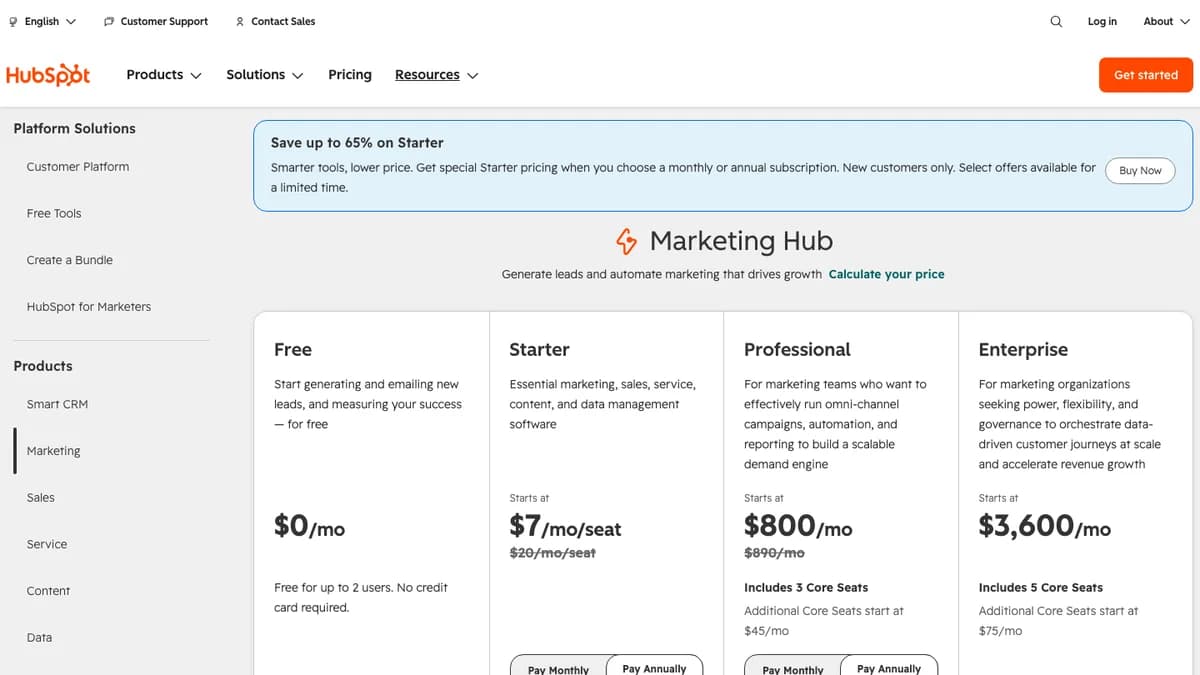
HubSpot Marketing Hub pricing, October 2026. Starter shows a limited-time new-customer offer.
HubSpot is the default lead nurturing tool for B2B teams for one reason: the nurture lives inside the CRM. When a lead opens three emails and hits the pricing page, the rep sees it on the same record, and a workflow can move the lifecycle stage from MQL to SQL and assign an owner in one step.
The catch is the plan gate. Starter includes lead scoring (up to 5 scores) but only limited automation. Branching, multi-step nurture workflows start on Professional, which means $800/mo billed annually plus a one-time $3,000 onboarding fee. For a full breakdown of every Hub and the hidden costs, see our HubSpot review.
Nurture only works if it lands in the inbox. If your nurture emails are slipping to spam, our guide to HubSpot email deliverability covers authentication, list hygiene, and sending limits.
- Segmentation
- Active lists on any contact, company, or deal property, plus page views, form fills, and email engagement
- Lead scoring
- Starter: up to 5 scores. Professional: up to 50 scores with AI recommendations. Enterprise: predictive lead scoring
- Nurture channels
- Email, ads, social, and omni-channel workflows (up to 300 on Professional)
- CRM handoff
- Native. Marketing Hub runs on the HubSpot CRM, so scores and lifecycle stages are visible to reps without a sync
Pros
- ✓ CRM, scoring, nurture, and reporting share one database
- ✓ Marketing contacts pricing: non-marketing contacts are stored free
- ✓ Lifecycle stages make the MQL to SQL handoff explicit
- ✓ Huge app marketplace, including signal and enrichment tools
Cons
- ✗ Full nurture workflows need Professional at $800/mo
- ✗ Required onboarding: $3,000 on Professional, $7,000 on Enterprise
- ✗ Cost climbs with every marketing contact tier
Best for: B2B teams that want CRM and nurture in one system and have budget for Professional.
Pricing: Free for up to 2 users. Starter lists at $20/seat/mo with 1,000 marketing contacts (shown at $7/seat/mo on a limited-time offer for new customers). Professional is $800/mo billed annually ($890 monthly) with 3 core seats and 2,000 marketing contacts, plus $3,000 onboarding. Enterprise is $3,600/mo with 5 core seats and 10,000 marketing contacts, plus $7,000 onboarding. Source: HubSpot pricing.
2. ActiveCampaign
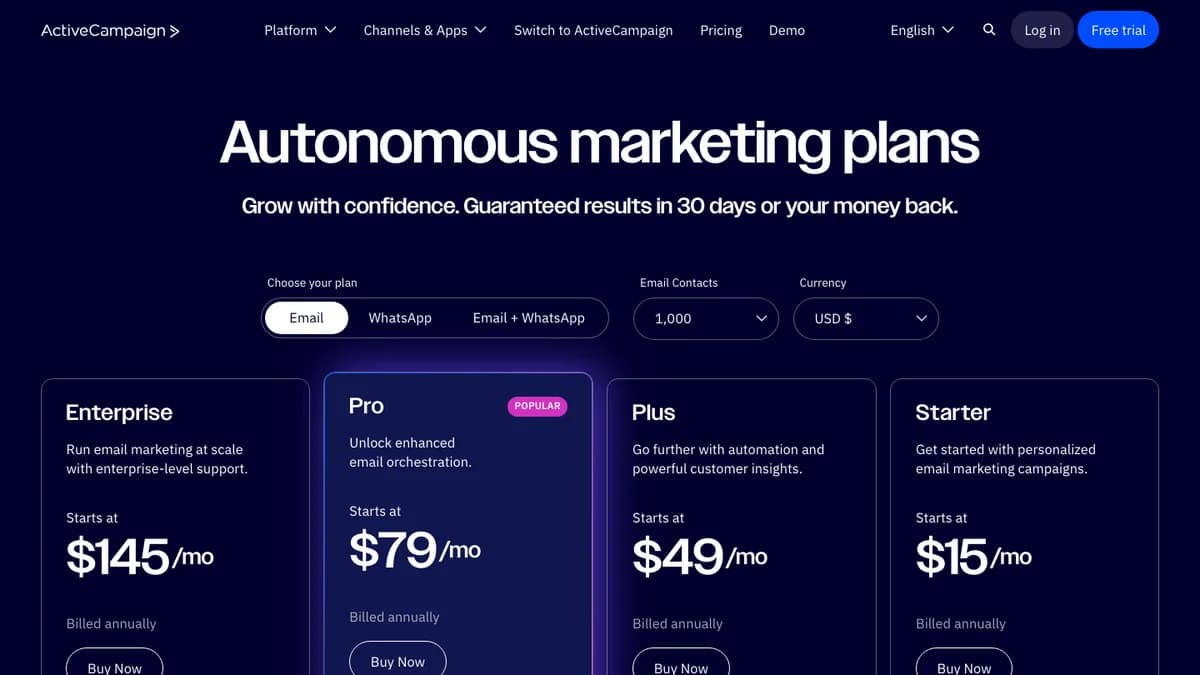
ActiveCampaign pricing at 1,000 email contacts, billed annually, October 2026.
ActiveCampaign is the best value lead nurturing tool on this list. Its automation builder handles the branching most B2B nurture needs: wait for a page visit, split on job title, add points for a demo-page click, and notify the owner when the score crosses a line.
Its help center lists contact scoring on Starter, Plus, Pro, and Enterprise. Scores are rules that add or subtract points, and an automation can adjust a score at any step. Deal scoring and sales pipelines come with the Pipelines add-on.
Watch the Starter limit. At 5 actions per automation, a real nurture branch runs out of room fast. Plus at $49/mo (1,000 contacts) is the realistic starting point.
- Segmentation
- Limited on Starter, standard on Plus, advanced on Pro, premium on Enterprise
- Lead scoring
- Rule-based contact scoring that automations can adjust; deal scoring with the Pipelines CRM add-on
- Nurture channels
- Email, WhatsApp plans, SMS as an add-on on Plus and above
- CRM handoff
- Pipelines add-on for deals; standard CRM integrations on every plan
Pros
- ✓ Strong visual automation builder with if/else branching
- ✓ Unlimited automation actions from Plus at $49/mo
- ✓ Scores can be raised or lowered inside an automation
- ✓ Predictive and conditional content on Pro
Cons
- ✗ Starter caps each automation at 5 actions
- ✗ Sales CRM features are add-ons, not included
- ✗ Price rises with every contact band
Best for: Small and mid-size B2B teams that want serious branching nurture without HubSpot Professional pricing.
Pricing: At 1,000 contacts, billed annually: Starter $15/mo (1 user), Plus $49/mo (1 user), Pro $79/mo (3 users), Enterprise $145/mo (5 users). Prices rise with each contact band. Source: ActiveCampaign pricing.
3. Salesforce Marketing Cloud Account Engagement
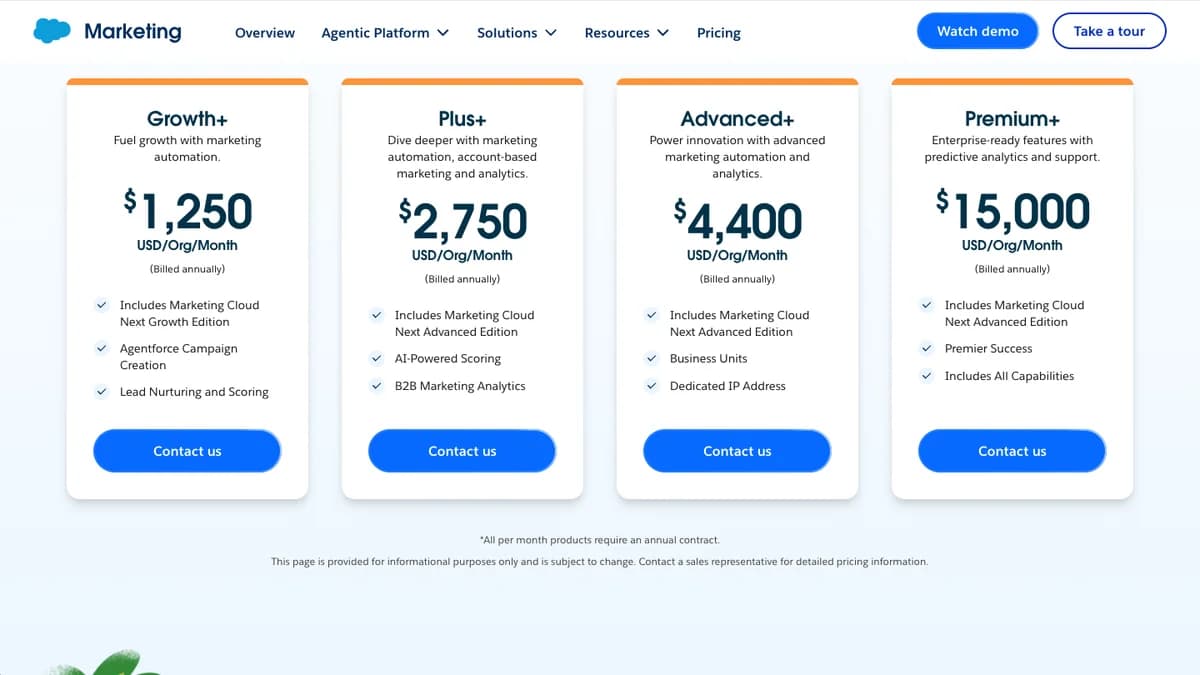
Account Engagement (formerly Pardot) editions, billed annually, October 2026.
Account Engagement, still widely called Pardot, is the B2B nurture tool for Salesforce shops. Its best idea is splitting qualification into two numbers. The score tracks how engaged a prospect is. The grade tracks how well they fit your ideal customer. A high score with a low grade is a student downloading everything. A high score with a high grade is a buyer.
Because Salesforce builds the connector, prospect activity, scores, and grades land on lead and contact records without a third-party sync. Reps see nurture history where they already work. Read our Salesforce review for how the CRM side is priced.
The price is the barrier. Growth+ is $1,250/mo for 10,000 contacts, billed annually, so the floor is $15,000 a year before services.
- Segmentation
- Dynamic lists on prospect fields and synced Salesforce lead, contact, and account data
- Lead scoring
- Scoring (engagement) and grading (fit) from Growth+; AI-powered scoring on Plus+
- Nurture channels
- Email, forms, landing pages, with nurture programs built in Engagement Studio
- CRM handoff
- Native Salesforce connector, built and maintained by Salesforce
Pros
- ✓ Separates interest (score) from fit (grade)
- ✓ Native sync with Salesforce leads, contacts, and campaigns
- ✓ B2B marketing analytics and account-based features on Plus+
Cons
- ✗ $15,000/yr minimum on an annual contract
- ✗ Only makes sense if your CRM is Salesforce
- ✗ Needs an admin; setup is not self-serve
Best for: Mid-market and enterprise teams on Salesforce with a marketing ops owner.
Pricing: Growth+ $1,250/org/mo, Plus+ $2,750, and Advanced+ $4,400, each with 10,000 contacts. Premium+ is $15,000/mo with 75,000 contacts. All billed annually on an annual contract. Source: Salesforce pricing.
4. Customer.io
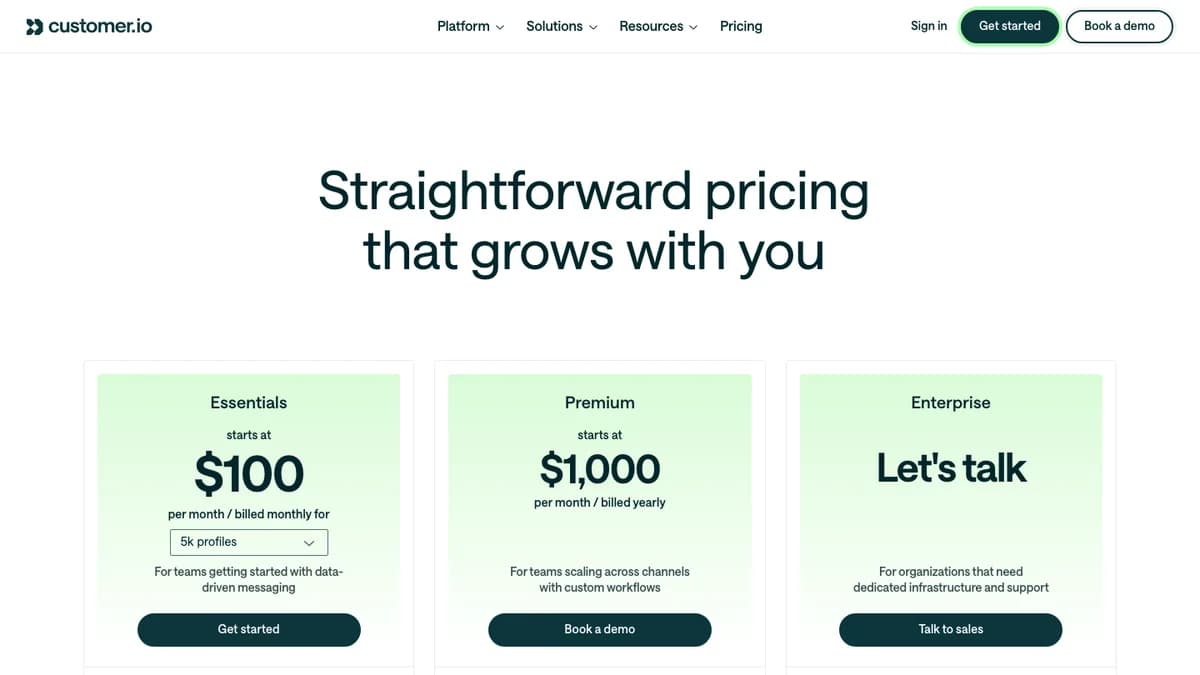
Customer.io pricing, October 2026. Essentials starts at 5,000 profiles.
Customer.io nurtures on what people do in your product. A trial user who connects an integration but never invites a teammate gets a different sequence from one who invited five. That is a better signal of intent than an email open, and it is why product-led companies pick it.
For B2B, the key feature is objects. You can model accounts or workspaces as objects, link people to them, and trigger nurture when an account crosses a usage threshold. Objects count toward your profile total, so budget for them.
The trade-off is setup. Customer.io expects you to send events from your app or warehouse. It is a poor fit if you only have form fills and email engagement to work with.
- Segmentation
- Data-driven segments on attributes and events, plus objects such as accounts or workspaces
- Lead scoring
- No packaged lead score; teams compute one from events and store it as an attribute
- Nurture channels
- Email, push, and in-app (unlimited on paid plans), plus SMS
- CRM handoff
- Through data pipelines, API, or warehouse sync rather than a native CRM
Pros
- ✓ Triggers on real product usage, not just email clicks
- ✓ Objects let you nurture at the account level
- ✓ 1M emails a month included on Essentials
- ✓ Free first year for startups that raised under $10M, per its pricing page
Cons
- ✗ Needs engineering to send events
- ✗ No built-in CRM or lead scoring model
- ✗ $100/mo floor even for small lists
Best for: Product-led SaaS teams nurturing trial and free users on in-app behavior.
Pricing: Essentials from $100/mo billed monthly for 5,000 profiles (people plus objects), with 1 million emails a month and $0.009 per extra profile. Premium from $1,000/mo billed yearly. Enterprise is custom. Source: Customer.io pricing.
5. Brevo
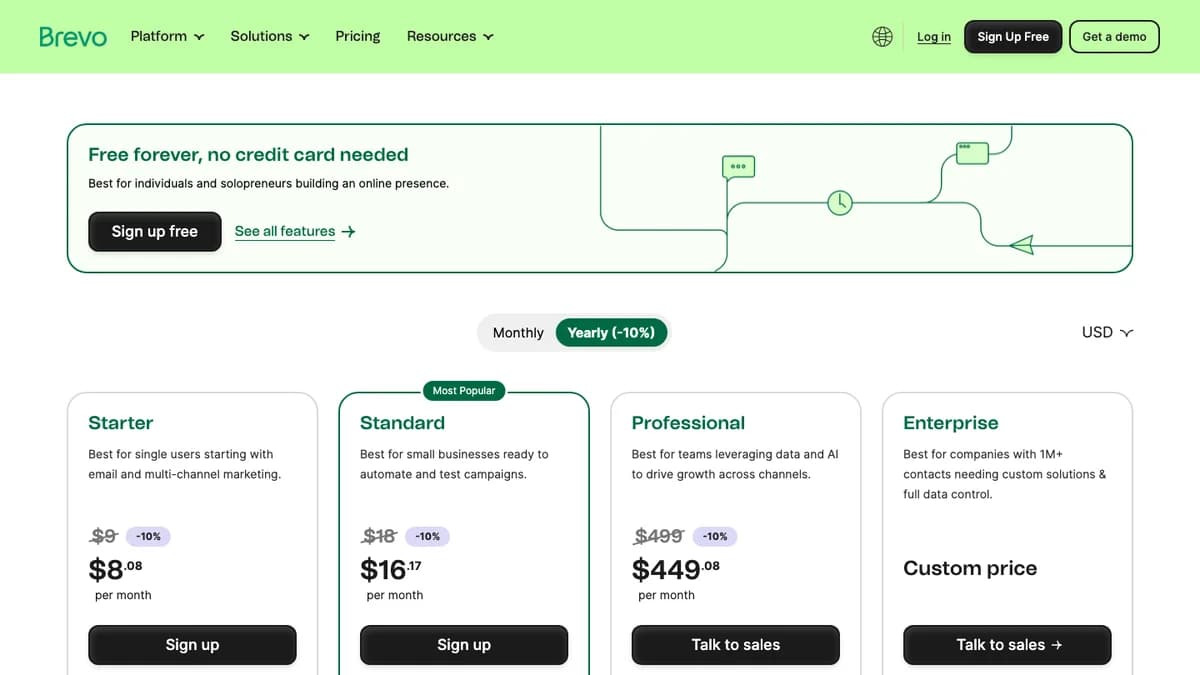
Brevo pricing at 5,000 emails a month, yearly billing shown, October 2026.
Brevo flips the pricing model. Instead of charging per contact, it charges for the emails you send each month. If you have 40,000 leads but only nurture a few thousand at a time, that is far cheaper than a contact-based tool.
Segmentation is solid from Starter: you can filter on website activity, engagement, and custom events, and automation unlocks on Standard at $18/mo. Contact scoring, though, is a Professional feature at $499/mo, which is a steep jump for teams that only want a score.
- Segmentation
- Segments on demographics, website activity, campaign engagement, and custom events
- Lead scoring
- Contact scoring on Professional, based on engagement, purchases, and behavior
- Nurture channels
- Email, SMS, WhatsApp, and web push
- CRM handoff
- Built-in Sales CRM with a free tier (1 seat)
Pros
- ✓ Priced by emails sent, so large lists stay cheap
- ✓ Free plan with 300 emails a day
- ✓ Marketing automation from Standard at $18/mo
- ✓ Includes a basic sales CRM
Cons
- ✗ Lead scoring only on Professional at $499/mo
- ✗ High-frequency nurture pushes you into bigger send tiers
- ✗ Fewer B2B fit-scoring options than HubSpot or Account Engagement
Best for: Budget-conscious teams with large lists and a moderate send cadence.
Pricing: Free with 300 emails a day. Starter $9/mo for 5,000 emails a month ($8.08 billed yearly). Standard $18/mo ($16.17 yearly) adds marketing automation. Professional $499/mo ($449.08 yearly) starts at 150,000 emails a month and adds contact scoring. Source: Brevo pricing.
6. Mailchimp
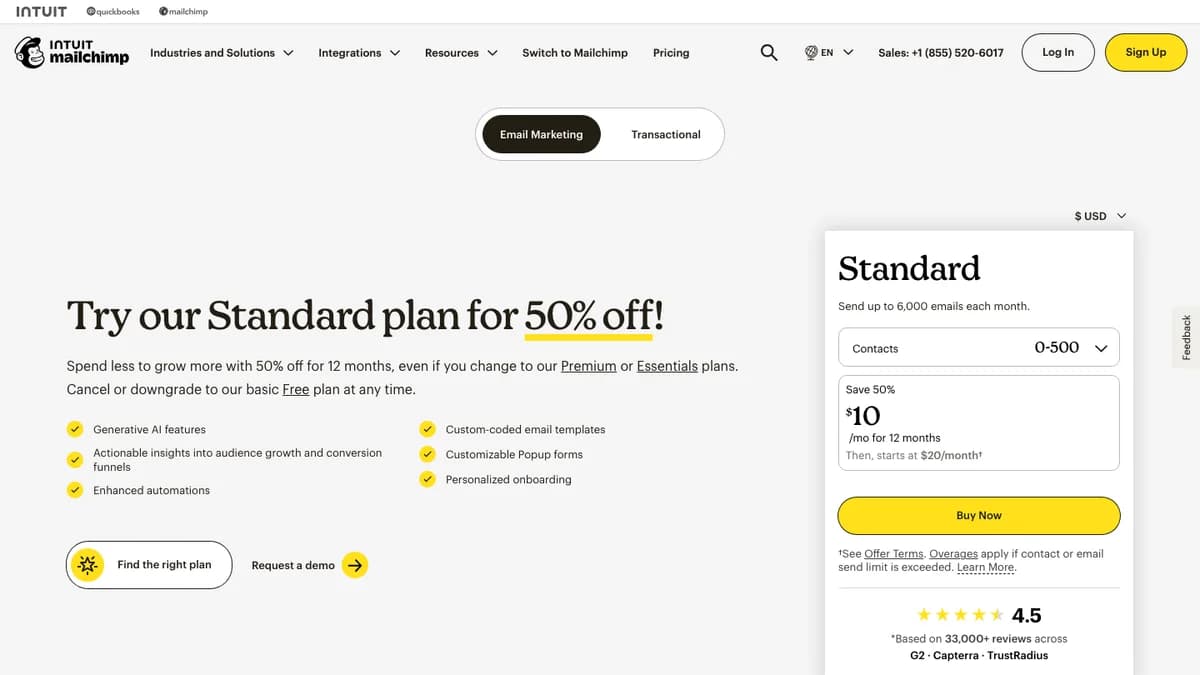
Mailchimp pricing at 0-500 contacts with the 50% intro offer, October 2026.
Mailchimp is where many teams start, and for a small list that is fine. Its automation flows (formerly the Customer Journey Builder) handle welcome series and simple branching, and Standard adds predictive segments.
It is the weakest B2B fit here. The pricing page lists no lead scoring, and most of its proof points are about connected stores and orders. Once sales needs a score and a CRM handoff, teams usually graduate to ActiveCampaign or HubSpot.
- Segmentation
- Tags, groups, and segments; predictive segments on Standard and Premium
- Lead scoring
- No lead scoring on the pricing page; engagement-based contact ratings only
- Nurture channels
- Email, with SMS as a paid add-on in select countries
- CRM handoff
- Integrations through its app marketplace
Pros
- ✓ Easiest builder on this list
- ✓ Up to 200 automation flows on Standard
- ✓ Free plan for lists under 250 contacts
Cons
- ✗ No lead scoring for sales handoff
- ✗ Built around ecommerce; its own benchmarks cite orders and store revenue
- ✗ Intro discounts double after 12 months, and overages apply
Best for: Early-stage teams with small lists that need simple email nurture first.
Pricing: Free under 250 contacts. At 0-500 contacts: Essentials $13/mo (up to 4 flow steps) and Standard $20/mo (up to 200 flows, 6,000 emails a month), both 50% off for the first 12 months. Premium starts at $350/mo for 10,000 contacts. Source: Mailchimp pricing.
Lead Nurturing Tools Compared
Here is how the six lead nurturing tools line up on segmentation, scoring, channels, and CRM handoff. Prices are entry points from each vendor's pricing page in October 2026.
| Tool | Best for | Segmentation | Lead scoring | Channels | CRM handoff | Starting price |
|---|---|---|---|---|---|---|
| HubSpot Marketing Hub | CRM and nurture in one database | Lists on any CRM property or behavior | Starter: up to 5 scores; Professional: up to 50 with AI recommendations | Email, ads, social; omni-channel workflows on Professional | Native HubSpot CRM | Free; Pro $800/mo for 2,000 marketing contacts |
| ActiveCampaign | Deep automation under $100/mo | Limited (Starter) to premium (Enterprise) | Rule-based contact scoring; deal scoring with Pipelines add-on | Email, WhatsApp plans, SMS add-on | Pipelines add-on; standard CRM integrations | From $15/mo for 1,000 contacts (annual) |
| Salesforce Account Engagement | Teams already on Salesforce | Dynamic lists on prospect and Salesforce fields | Scoring and grading from Growth+; AI-powered scoring on Plus+ | Email, forms, landing pages | Native Salesforce connector | $1,250/mo for 10,000 contacts (annual contract) |
| Customer.io | Nurture on product behavior | Segments on attributes, events, and account objects | No packaged score; compute one as an attribute | Email, push, in-app, SMS | Via data pipelines, API, or warehouse sync | From $100/mo for 5,000 profiles |
| Brevo | Big lists on a small budget | Demographics, site activity, engagement, custom events | Contact scoring on Professional only | Email, SMS, WhatsApp, web push | Built-in Sales CRM (free tier) | Free (300 emails/day); Starter $9/mo for 5,000 emails |
| Mailchimp | Simple email-first nurture | Tags and segments; predictive segments on Standard | No lead scoring listed on pricing page | Email; SMS add-on | App integrations | Free under 250 contacts; Essentials $13/mo for 500 contacts |
What the Entry Price Actually Buys
Lead nurturing tool prices are not comparable until you check what each price counts and which plan unlocks scoring and branching automation. HubSpot counts seats and marketing contacts, ActiveCampaign and Mailchimp count contacts, Customer.io counts profiles, Brevo counts emails sent, and Salesforce prices per org with a contact allowance.
| Tool | Priced by | Entry price and what it assumes | Scoring unlocks on | Real nurture automation on |
|---|---|---|---|---|
| HubSpot Marketing Hub | Seats plus marketing contacts | Starter $20/seat/mo list ($7 on a new-customer offer), 1,000 marketing contacts | Starter (5 scores) | Professional, $800/mo annual + $3,000 onboarding |
| ActiveCampaign | Contacts | $15/mo at 1,000 contacts, billed annually | All current plans (contact scoring) | Plus, $49/mo (unlimited automation actions) |
| Salesforce Account Engagement | Org, with a contact allowance | $1,250/mo at 10,000 contacts, annual contract | Growth+ | Growth+ |
| Customer.io | Profiles (people + objects) | $100/mo at 5,000 profiles, 1M emails | None packaged | Essentials |
| Brevo | Emails sent per month | $9/mo for 5,000 emails ($8.08 annual) | Professional, $499/mo | Standard, $18/mo |
| Mailchimp | Contacts | $13/mo at 0-500 contacts ($6.50 intro for 12 months) | Not listed | Standard, $20/mo (up to 200 flows) |
The practical takeaway: the cheapest plan that has both scoring and branching automation is ActiveCampaign Plus at $49/mo for 1,000 contacts. On HubSpot it is Professional at $800/mo, on Brevo it is Professional at $499/mo, and Mailchimp does not offer scoring at any listed tier.
Know When a Nurtured Lead Is Ready: The Signals Layer
Every tool above scores what a lead does in your emails and on your site. None of them can see what is changing at the lead's company. A VP who opens every nurture email may still have no budget. A quiet lead whose company just raised a round and opened three roles in your category may be ready today.
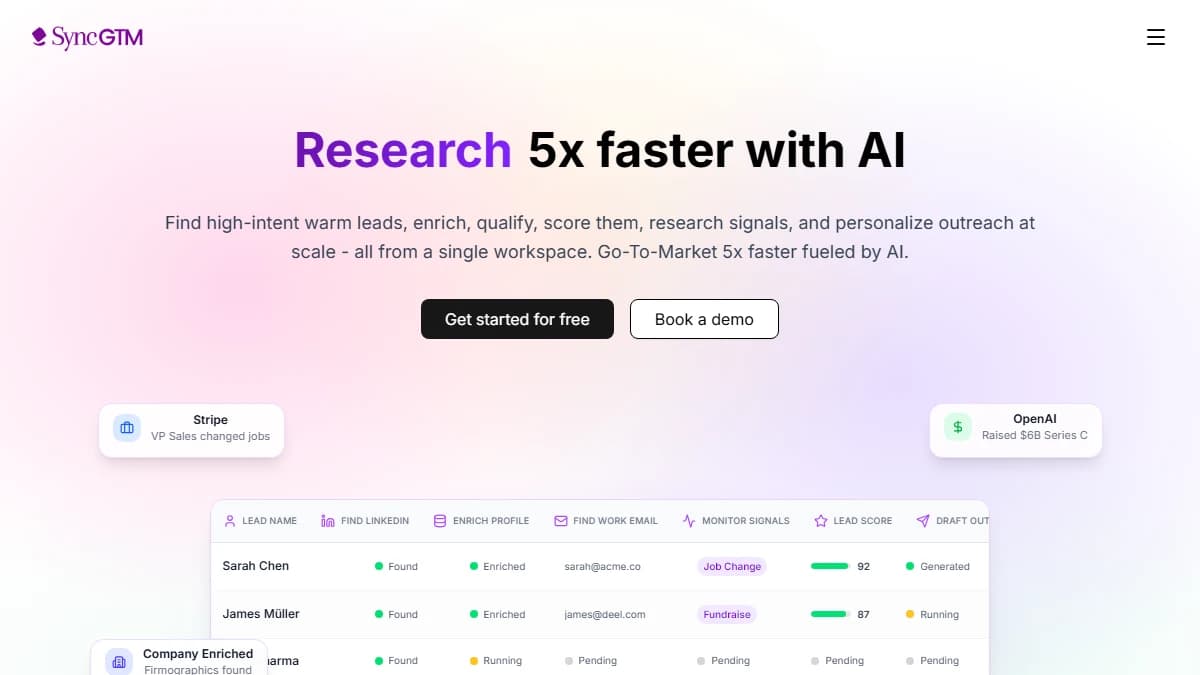
SyncGTM sits next to your nurture tool and writes buying signals into the CRM.
SyncGTM is that signals layer. It is not a nurture or email platform, and it does not replace any tool on this list. It watches the accounts you are nurturing for buying signals and writes them to the CRM your nurture tool already reads.
Signals worth watching on nurtured accounts
| Signal | Why it means "ready" | What SyncGTM checks | Credits |
|---|---|---|---|
| Hiring in the function you sell to | New headcount needs tools, and a budget line usually comes with it | Company job openings filtered by title | 5 per company lookup |
| Funding round | Fresh budget and pressure to hit growth targets | Company enrichment (firmographics incl. funding) | 2 per company |
| Technology change | A tool was added or removed, so a stack decision is open | Tech stack lookup | 1 per company |
| Champion job change | A past user now has a new budget and no incumbent vendor | Job change check (new role in the past 2 months) | 2 per person |
| Headcount growth | The team is scaling faster than its processes | Headcount growth over 6 and 12 months, by function | 2 per company |
| New executive hire | New leaders review vendors in their first months | Recently hired Director-and-above profiles | 0.5 per profile returned |
How the signal reaches your nurture
SyncGTM has two-way sync with HubSpot and Salesforce. It reads the companies and contacts you are nurturing, runs the checks on a schedule, and writes the result back as properties, for example "Buying signal: hiring SDRs" and "Signal date." HubSpot workflows and Account Engagement automation can then use those fields like any other property. Pipedrive, Attio, and Close are supported as integrations too.
When a nurtured lead has no owner yet, SyncGTM can push it to a sending tool such as Instantly, Smartlead, or HeyReach with the signal as a merge field. SyncGTM does not send email or LinkedIn messages itself. If you run Instantly alongside HubSpot, our Instantly HubSpot integration guide covers the sync.
What it costs to watch a nurture list
Say you nurture 500 accounts and want a monthly check on tech stack (1 credit) and headcount growth (2 credits). That is 1,500 credits a month. Add a job-change check on 250 champions (2 credits each) and you reach 2,000 credits, which fits the Growth plan at $99/mo for 3,000 credits. SyncGTM is free for 50 credits, then Solo is $49/mo for 1,000 credits and Pro is $249/mo for 10,000. See SyncGTM pricing for details.
For a wider look at intent sources, see our roundup of the best buying intent data tools.
A Nurture-to-Sales Handoff in 5 Steps
A good handoff rule needs two conditions: enough engagement from the nurture tool and a fresh buying signal at the account. Here is a setup that works with HubSpot or Salesforce and any of the six tools above.
- Set an engagement threshold in your nurture tool. For example, a score of 60 or more, or a pricing-page visit plus two email clicks in 14 days.
- Sync nurtured accounts into SyncGTM. Pull the companies and contacts in your nurture lists from HubSpot or Salesforce, and fill missing firmographics with waterfall enrichment.
- Schedule the signal checks. Use the workflow builder to run hiring, funding, tech stack, job change, and headcount checks weekly or monthly, and write the signal and its date back to the CRM.
- Branch the nurture on the signal. In your nurture tool, add a rule: if the engagement threshold is met and a signal date is within the last 30 days, exit the nurture, set the lifecycle stage to SQL, assign an owner, and create a task that names the signal.
- Close the loop. Track which signal-plus-score combinations turn into meetings, and tighten the threshold every quarter.
Speed matters once the rule fires. Research published in Harvard Business Review on online sales leads found most companies do not respond nearly fast enough. Route the task to a named rep, not a shared queue.
Clean CRM data makes every step more reliable. Our guide to the best CRM data enrichment tools covers how to keep the fields your nurture rules depend on filled in.
How to Choose
- You want CRM and nurture in one place and can fund Professional: HubSpot Marketing Hub.
- You need branching nurture and scoring for under $100/mo: ActiveCampaign Plus or Pro.
- Your CRM is Salesforce and you have a marketing ops owner: Account Engagement.
- Your best intent data is in-product behavior: Customer.io.
- You have a large list and a tight budget: Brevo, accepting that scoring costs $499/mo.
- You have under 500 contacts and need a simple welcome series: Mailchimp.
Whichever you pick, test it on one real segment before migrating. Build one nurture branch, one scoring rule, and one CRM handoff, and check that a rep sees the lead with the reason attached.
Final Verdict
The best lead nurturing tool for most B2B sales teams is HubSpot Marketing Hub, because scores, lifecycle stages, and nurture workflows live on the same record reps already use. ActiveCampaign is the best value, Account Engagement is the natural pick on Salesforce, and Customer.io wins when product usage is your strongest signal.
Whichever you choose, the nurture tool tells you how engaged a lead is, not whether the company is ready to buy. Add a signals layer that writes hiring, funding, tech change, job change, and headcount growth into HubSpot or Salesforce, and let your nurture hand off only when both line up.
Start with SyncGTM's free 50 credits and check signals on your 20 most engaged nurtured accounts. See plans and credit costs when you are ready to run it on your whole list.