

LeadFuze Review 2026: B2B Data Coverage, Pricing & Alternatives

By Kushal Magar · May 28, 2026 · 11 min read · Last updated: September 30, 2026
Key Takeaway
LeadFuze built its name as a US-focused, automation-first list-builder (269M+ profiles, Fuzebot auto-prospecting), but as of September 2026 it has shut down direct software access and only sells a full data license at $1,500–$2,000/month. The data remains US-centric, there is no built-in outreach, and bounce-prone lists often need a second verification pass.
This LeadFuze review covers everything a 2026 buyer needs: a 269 million+ profile database, double-verified emails, the Fuzebot automation that made its name, and the switch from self-serve plans to a $1,500–$2,000/month full data license. LeadFuze's data is strong for US-focused list-building — but it is US-centric and there is no built-in outreach. Our rating: 3.9/5.
Update (September 2026):LeadFuze's pricing page now says it has “shut down direct software access” and is “exclusively offering a full data license” with monthly updates, priced at $1,500 to $2,000 per month depending on the term. The self-serve plans and free trial are gone, and the Fuzebot workflow described below is how the product worked before the change. We cover what the license includes in its own section below.
LeadFuze built its reputation as a search engine for B2B contacts, and that framing was accurate. You defined an ICP by job title, company size, industry, tech stack, or funding status, and LeadFuze returned matching people with verified emails and, where available, phone numbers.
The automation was the real draw. Fuzebot kept adding fresh prospects that matched your criteria on a schedule, de-duplicating against contacts you already had — genuinely hands-off list-building that saved hours each week.
The catch is structural. LeadFuze pulls from one database, so when a contact is missing or an email bounces, there is no second source to fall back on. This review walks through the pricing change, data coverage, real accuracy, and a direct comparison with Apollo and Seamless.AI for teams evaluating their options.
What Is LeadFuze?
LeadFuze is a B2B data provider that helps sales teams, recruiters, and marketers find decision-maker contact data at scale. It indexes a database of 269 million+ profiles, which its self-serve app exposed through two search modes: account-based search for named-company targeting, and market-based search for role-and-firmographic prospecting.
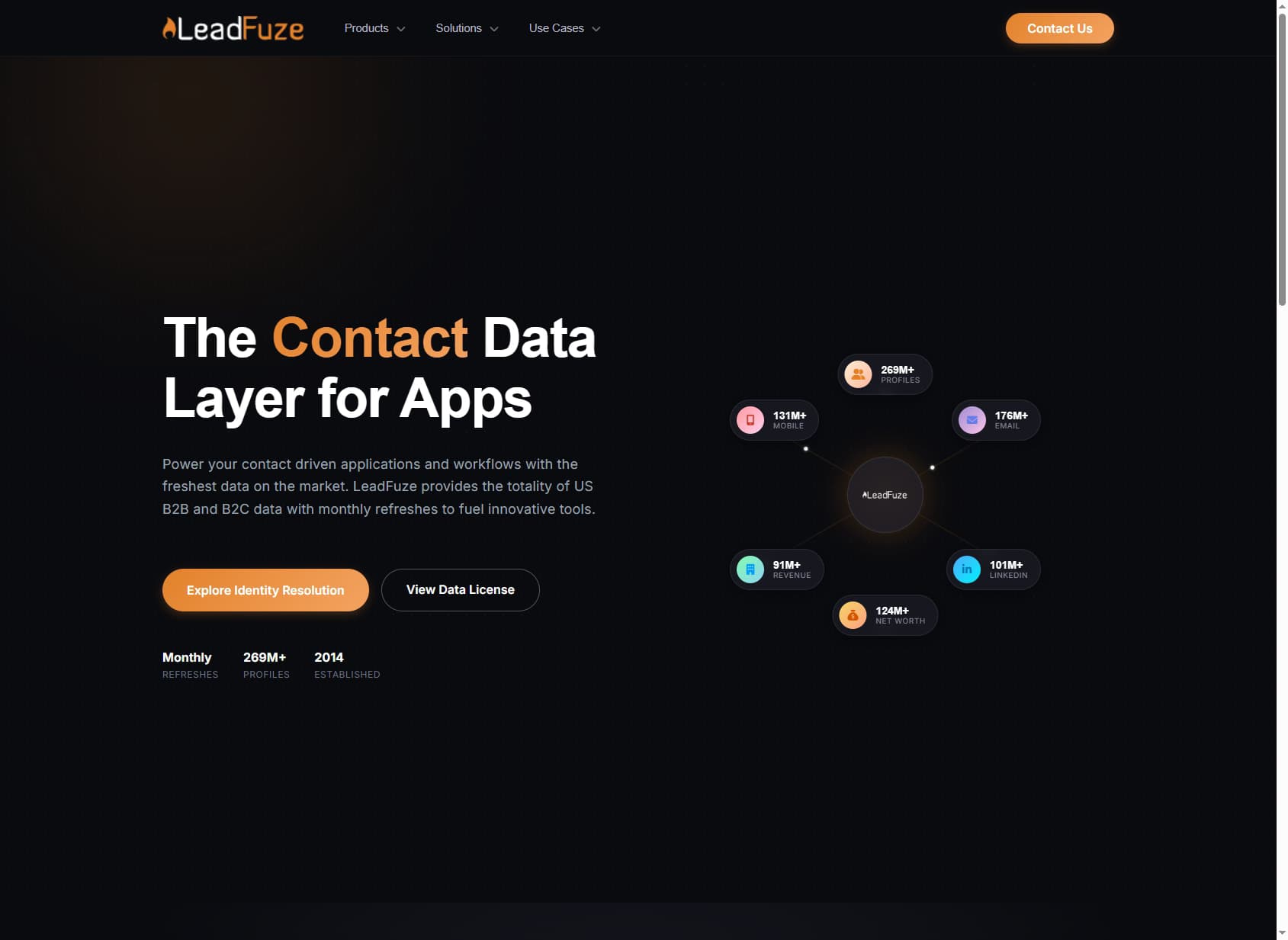
Founded as an automation-first prospecting tool, LeadFuze targeted users who wanted to reduce manual research. Its filters went deep: beyond the usual title and industry, you could segment by technology used, AdWords spend, and funding stage — which made it a fit for highly specific ICPs.
The app was squarely a list-builder. It found and verified contacts, then handed them off to your CRM or sequencer through native integrations with HubSpot, Pipedrive, Salesforce, and Zapier. There has never been an email engine inside LeadFuze — outreach is always a separate step. For a single-source review of a comparable email finder, see our FindThatLead review.
LeadFuze in 2026: From Prospecting App to Data License
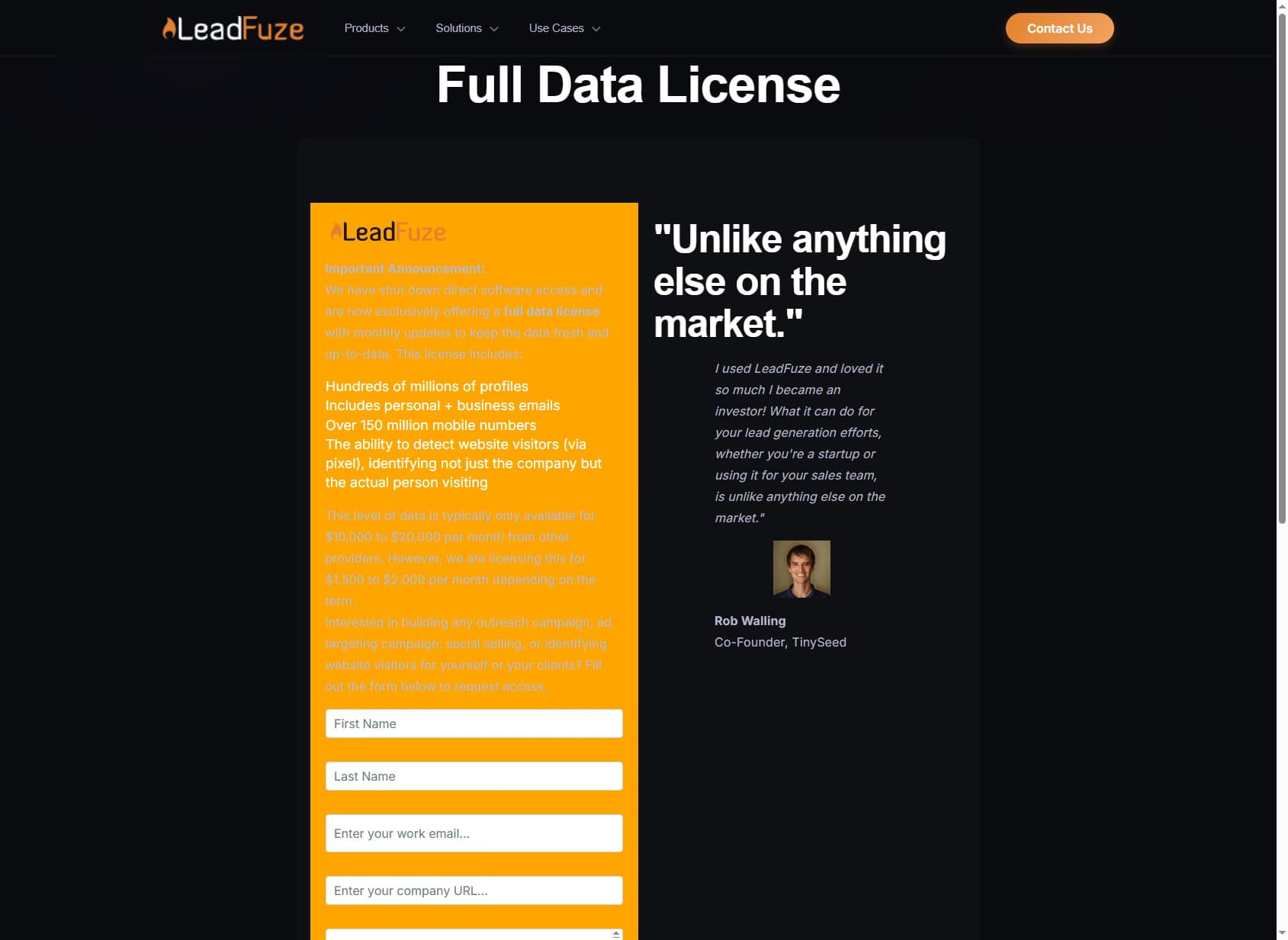
The biggest change to LeadFuze is not a feature. As of September 2026, its pricing page carries an announcement: “We have shut down direct software access and are now exclusively offering a full data license with monthly updates to keep the data fresh and up-to-date.” Instead of logging in to search and build lists, buyers now license the dataset itself.
What the license includes
- Profiles: hundreds of millions of records; the homepage cites 269M+ profiles with 50+ data fields each.
- Contact data: personal and business email addresses, plus over 150 million mobile numbers.
- Website visitor detection: a pixel that identifies the person visiting your site, not just the company.
- Delivery: monthly refreshes delivered as S3 and Parquet files.
- Related products: an enrichment API for real-time lookups and intent data, listed without separate public prices.
The price is $1,500 to $2,000 per month depending on the term, and access is requested through a form rather than bought at a self-serve checkout.
What it means for buyers
The license suits a different buyer than the old app did. It makes sense for agencies, data teams, and RevOps functions with the engineering capacity to load monthly Parquet files into a warehouse or CRM, deduplicate them, and build their own search and routing on top. For a solo SDR or a small sales team that wants to type in an ICP and get a list back, there is no longer a LeadFuze product to buy.
Two cautions carry over from the app era. The data is still US-heavy, so check coverage for your non-US segments before signing. And personal emails bring extra compliance work: decide how you will meet GDPR and CCPA obligations before you use them for outreach.
LeadFuze Pricing: Plans, Lead Credits & What You Actually Pay
As of September 2026, LeadFuze pricing is a single offer: a full data license at $1,500 to $2,000 per month depending on the term, requested through a form rather than bought at checkout. The self-serve plans below, built around lead credits (one credit per contact you unlocked), are no longer offered, but review sites still quote them, so they are worth knowing.
Former self-serve plans (discontinued)
| Plan | Monthly Price | Lead Credits | Best For |
|---|---|---|---|
| Free Trial | $0 | 25 leads (one-time) | Testing data quality |
| Scaling | $147/mo | 500/mo | SMBs and solo prospectors |
| Unlimited | $397/mo (annual) | Unlimited (~250/day soft cap) | High-volume teams |
| Custom | Variable | Custom pools | 5+ users, bespoke needs |
The real cost math
At $1,500 to $2,000 per month, the data license costs $18,000 to $24,000 a year before you spend anything on storage, engineering time, verification, or outreach tools. Whether that is good value depends on volume: spread across a large share of the dataset, the cost per contact is low, but a team that only needs a few hundred new leads a month would be paying for far more data than it uses.
For comparison, the old Scaling plan's $147/month for 500 leads worked out to roughly $0.29 per contact before bounces. If 25–30% of those emails bounced or needed re-verification, the effective cost per usable contact climbed toward $0.40, plus whatever you paid for a backup verification tool.
One caveat worth flagging: review aggregators like Capterra may still show the old self-serve prices, including an entry price near $132/month. As of September 2026, LeadFuze's own pricing page lists only the data license, so confirm directly before budgeting. For context on credit-efficient enrichment, see our Icypeas review, which breaks down a lower-cost pay-per-result model.
LeadFuze Data Coverage & Accuracy
LeadFuze's 269M+ profile database is large, but raw size is less important than hit rate and geography. In practice, LeadFuze is strongest for US-based mid-market and enterprise companies in common industries, where double verification pushes email accuracy into the ~60–75% verified range.
Where coverage thins out
| Segment | LeadFuze Coverage | Notes |
|---|---|---|
| US mid-market / enterprise | Strong | Best hit rates; double-verified emails |
| US small business | Moderate | Thinner data for sub-10-employee firms |
| Europe & UK | Weak | Limited; GDPR-region gaps common |
| APAC & LATAM | Thin | Significant coverage gaps for global ICPs |
The recurring theme in G2 reviews (4.7/5 across ~97 reviews) is positive sentiment on US data paired with complaints about bounce rates and international gaps. This is the predictable limitation of any single-database tool: there is no second source to recover a missed or stale contact. Teams with international or long-tail targets usually pair LeadFuze data with a second source to recover those contacts.
LeadFuze Key Features
These are the features of LeadFuze's self-serve app. With direct software access shut down as of September 2026, license buyers get the underlying data rather than these tools, but they explain why the product was so well reviewed.
- Fuzebot automation — continuously adds new prospects matching your saved criteria on a recurring schedule, and de-duplicates against your existing contacts and ignore lists.
- Account-based & market-based search — target named companies directly, or cast wide by role, industry, company size, technology used, AdWords budget, and funding status.
- Double email verification — every address is cross-checked against multiple sources before it enters your list, raising US email quality.
- LinkedIn matching — direct profile and URL lookups to tie contact records to LinkedIn identities.
- List management — de-duplication, customizable ignore lists, and CSV export for clean hand-off to other tools.
- Native CRM integrations — HubSpot, Pipedrive, Salesforce, plus Zapier for everything else.
LeadFuze Pros: What It Does Well
Most of these strengths come from the former self-serve app; the data-quality points still apply to the license.
- ✓Hands-off automation with Fuzebot. Recurring auto-prospecting that fills your list while you sleep — users consistently report saving 10+ hours per week on manual research.
- ✓Precise, deep targeting filters. Segment by technology used, AdWords spend, and funding stage — not just title and industry — for tightly defined ICPs.
- ✓Strong US email accuracy. Double verification cross-checks each address against multiple sources, keeping US mid-market and enterprise data quality high.
- ✓Praised customer support. Reviewers single out responsive, helpful support as a reason they stay — uncommon in the budget-to-mid data tooling tier.
LeadFuze Cons: Where It Falls Short
- US-centric database. European, APAC, and LATAM coverage is thin, so teams targeting international markets hit significant data gaps that LeadFuze cannot fill from its single source.
- No built-in outreach. LeadFuze builds and verifies lists but cannot send a single email — every workflow requires a separate sequencer, adding cost and integration overhead before you can prospect.
- Bounce rates require backup verification. Multiple G2 and Capterra reviewers report bounce rates high enough that they pay for a second verification tool, undercutting the value of buying a 'verified' list.
- Self-serve access is gone. As of September 2026, LeadFuze has shut down direct software access and only sells a full data license, so solo prospectors and small teams who relied on the old plans need a different tool.
- Premium pricing. The former plans ran $147–$397/month for lead generation alone, and the full data license that replaced them costs $1,500–$2,000/month. Outreach always costs extra in a separate tool.
- Single-source enrichment. Because LeadFuze queries one database rather than cascading across providers, a missed email is simply a missed email — there is no fallback source to recover the contact.
LeadFuze vs Apollo vs Seamless.AI
The B2B data category splits into single-database tools (LeadFuze, Apollo) and real-time scrapers (Seamless.AI). Here is how the three most-compared options stack up for teams choosing a data source in 2026.
| Feature | LeadFuze | Apollo | Seamless.AI |
|---|---|---|---|
| Starting Price | $1,500–$2,000/mo data license (as of Sept 2026) | $59/mo (Basic) | Custom (credit packs) |
| Database Size | 269M+ profiles | 275M+ contacts | Real-time engine (no fixed DB) |
| Enrichment Method | Single database + double verification | Own database + verification | Real-time web scraping |
| Email Hit Rate | ~60–75% (US), lower outside US | ~65% verified | Variable, real-time dependent |
| International Coverage | Weak — US-centric | Moderate | Moderate |
| Automation | Fuzebot (ended with software access) | Sequences built-in | Chrome extension + lists |
| Phone Numbers | Yes (150M+ mobiles in the license) | Yes | Yes |
| Built-in Outreach | No — data delivery only | Yes | No |
| CRM Integrations | S3/Parquet delivery + enrichment API | Native + API | Native + Chrome |
| Free Tier | None listed (license only) | Yes (limited credits) | Free trial |
The honest take on each option
LeadFuzewon on automation while its app was available: Fuzebot's recurring list-building was the most hands-off prospecting engine in this group. With direct software access shut down, it now competes as a bulk data license, which suits teams that want to load a large, US-heavy dataset into their own systems rather than prospect inside an app.
Apollo pairs a 275M+ contact database with built-in sequences, making it a strong all-in-one for US-heavy teams — though its data is also single-source and leans US.
Seamless.AI scrapes contact data in real time rather than serving a fixed database, which can surface fresh records but produces variable accuracy. It has no built-in outreach. For a deeper look at where it falls short, see our Seamless.AI alternatives roundup.
Who Should Use LeadFuze?
As of September 2026, LeadFuze fits a narrower scenario than it used to: a US-focused team with the data engineering capacity to license a bulk B2B dataset and run outreach in separate platforms.
Use LeadFuze if:
- Your ICP is concentrated in the United States, where data coverage and email accuracy are strongest.
- You can ingest monthly S3 or Parquet deliveries and keep them in sync with your CRM.
- You already have outreach and CRM tooling and want raw data to feed it.
- Your volume is high enough that $1,500–$2,000 per month for data works out to a low cost per contact.
Do not use LeadFuze as your only tool if:
- Your ICP is international — European, APAC, and LATAM coverage is thin, and there is no second source to fill the gaps.
- You need built-in outreach. LeadFuze delivers data but cannot send a single email.
- Bounce rates matter to your deliverability budget — plan for a backup verification tool.
- You want a self-serve prospecting app. Direct software access is gone, so compare the best B2B email finder tools instead.
If LeadFuze's shutdown of self-serve software access is a dealbreaker, SyncGTM is one alternative worth a look: it is free to start and runs waterfall enrichment across 50+ data providers for verified emails and phone numbers.