

LeadsGorilla Review 2026: Pricing, Data Coverage & Alternatives

By Kushal Magar · June 8, 2026 · 12 min read · Last updated: September 30, 2026
Key Takeaway
LeadsGorilla is a local lead generation tool — a Google, Facebook, and Yelp listing scraper that builds audit-report PDFs for local SEO agencies. It is not a B2B sales data tool. Monthly plans start at $57 (as of September 2026), but you supply your own Google API key, which adds $50–$200+/month in hidden costs. There is no verified decision-maker email or phone data, no buying signals, and only basic outreach automation. It earns its keep for agencies selling local SEO retainers; B2B sales teams need a different category of tool.
LeadsGorilla is a local lead generation tool that scrapes business listings from Google, Facebook, and Yelp, then generates audit-report PDFs that local SEO agencies use to pitch services. Monthly plans start at $57 (as of September 2026), but you run it on your own Google API key — which adds $50–$200+/month in hidden costs. It returns listing data (name, phone, address, and any listed email), not verified B2B emails or direct dials. Our rating: 3.2/5 for local agencies; 1.5/5 for B2B sales teams.
Most people reading a LeadsGorilla review fall into one of two camps. Local marketing agencies want to know if the listing scraper and audit reports are worth the subscription plus API fees. B2B sales teams sometimes land here while researching B2B sales prospecting tools — and quickly discover it is built for a completely different job.
This review covers both angles honestly. For agencies: what LeadsGorilla actually delivers, where it earns its price, and where the hidden costs and reliability issues bite. For sales teams: why it is the wrong fit, and why the waterfall enrichment and buying-signal use cases they need sit in a different category of tool.
Key facts upfront: LeadsGorilla does not maintain its own contact database — it queries Google, Facebook, and Yelp live. The $57/month entry price is not the real cost once Google Maps API usage is included. There is no verified email or phone data. And for outbound B2B sales, LeadsGorilla is simply the wrong tool.
What Is LeadsGorilla?
LeadsGorilla is a local lead generation platform that searches business listings on Google Business Profiles, Facebook, and Yelp by keyword and location, scores how “unoptimized” each listing is, and generates PDF audit reports an agency can send to a prospect. The pitch — “World's First AI Powered Lead Finder” — is built around helping digital agencies, local marketers, and freelancers find and close local SEO clients quickly.
The core workflow is prospect → audit → pitch. You search a niche and city, LeadsGorilla returns local businesses with weak or unclaimed listings, and you generate a branded audit PDF that highlights missing reviews, incomplete profiles, and SEO gaps. That report becomes the conversation starter for selling Google Business Profile optimization, review management, or local SEO retainers.
Critically, LeadsGorilla does not own a database. It queries Google Maps, Facebook, and Yelp in real time using your own API credentials, so the data it returns is whatever those platforms expose publicly — business name, phone, address, category, and review signals. According to user reviews on Capterra and G2, it holds a roughly 3.2/5 rating across a small review base, and the customer profile skews heavily toward solo operators and small agencies.
| Capability | What LeadsGorilla Provides | Notable Gaps |
|---|---|---|
| Lead Sourcing | Scrapes Google, Facebook, and Yelp listings by keyword and location. | No proprietary database. Limited to public listing fields. No verified individual contacts. |
| Contact Data | Business name, phone, address, category, review count. | No verified work emails, no direct dials, no job titles, no firmographics. |
| Audit Reports | AI-generated PDF audits flag unclaimed listings, weak reviews, SEO gaps. | Useful for local SEO pitches only — no relevance to B2B sales motions. |
| Outreach | AI email and description writing, review-response templates; email sequences on Premium and Advanced. | No deliverability tooling and no multichannel cadence. |
| Data Engine | Runs on your own Google API key (Google Cloud billing required). | Adds $50–$200+/month in hidden costs. Connection reliability is a recurring complaint. |
| B2B Sales Workflow | Not available. | No contact enrichment waterfall, no sales sequences, no buying signals for revenue teams. |
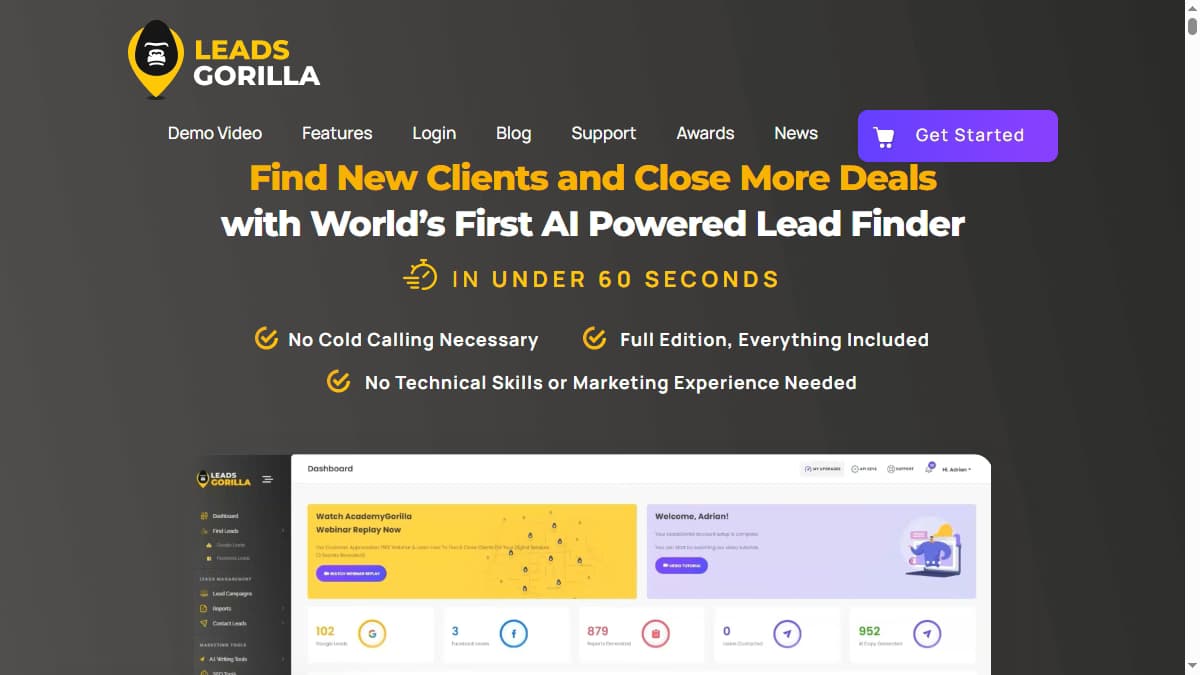
LeadsGorilla homepage — “World's First AI Powered Lead Finder” positioned for local marketers and agencies, not B2B sales teams.
LeadsGorilla Pricing: Plans, Costs, and What You Actually Pay
LeadsGorilla uses a funnel pricing model, so the number you see depends on which page you land on. As of September 2026, the homepage shows monthly plans from $57/month (presented as discounts from higher list prices), plus quarterly and yearly options, and reviewers report a stack of one-time upsells (OTOs) for the agency upgrade, AI add-ons, and lifetime bundles. The headline price is not the real cost — you also pay Google for API usage.
| Plan / Cost | Price | Notes |
|---|---|---|
| Standard (monthly) | $57/mo (list $77) | 5,000 leads and 1,000 searches per month; lead scoring, PDF audits, AI cold emails, email validation |
| Premium | $77/mo (list $107) or $127/quarter | 7,500 leads and 2,500 searches per month; adds SEO reports, PDF branding, email sequences, Google Local Ads validation |
| Advanced | $97/mo (list $137) or $187/quarter | 10,000 leads and 5,000 searches per month; adds citations analyzer, DFY agency website, CRM module, legal contracts |
| Professional (quarterly) | $247/quarter (list $310) | 15,000 leads per month and 20,000 searches per quarter |
| Starter (yearly) | $247/year | Up to 50,000 business leads per year |
| Agency Upgrade (OTO) | ~$47 one-time (normal ~$197/yr) | Client management, white-label reports, removed limits |
| AI Service Add-on (OTO) | ~$12.99 one-time | Optional AI writing / closing-email add-on at checkout |
| Google Maps API (hidden) | $50–$200+/mo (paid to Google) | Your own API key powers the searches — usage-billed by Google |
The most important pricing reality: the $57/month entry plan is not what you pay to run LeadsGorilla. Because searches consume your own Google Maps API quota, real-world usage adds $50–$200+/month in Google fees on top of the subscription — a cost most reviews of the tool flag as the true sticker shock.
There is no genuine free tier. LeadsGorilla leans on a 30-day money-back guarantee in place of a trial, and its own pricing notes that the guarantee is subject to limited platform usage for leads and reports. Reviewers on Capterra and prospeo report friction here — denied refunds tied to usage limits and, in some cases, double-charging without authorization. Treat the guarantee as a refund request, not an automatic exit.
The funnel structure is worth budgeting for. Between tier pricing, the agency OTO, and AI add-ons, the “full” LeadsGorilla setup costs more than the entry price suggests. For agencies closing $1,000+ local retainers, the math can work — but only after factoring the API bill and upsells.
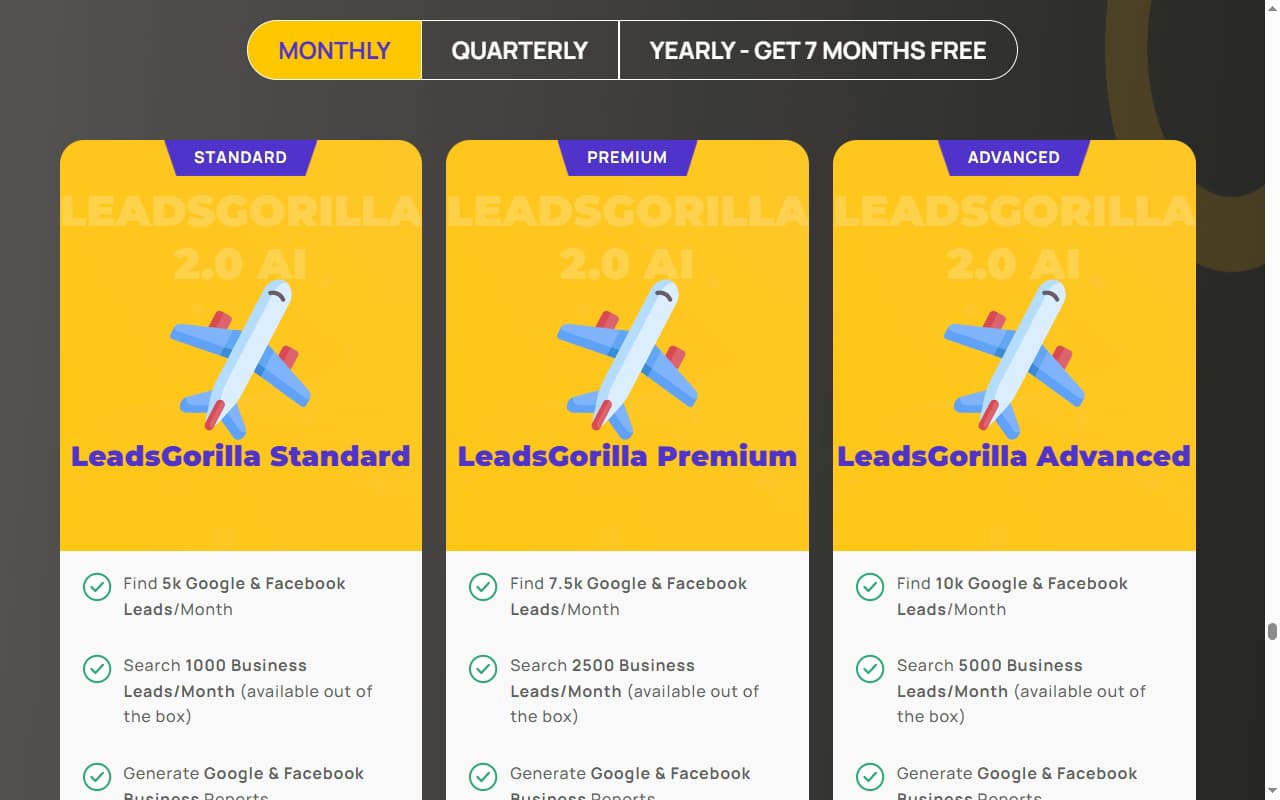
LeadsGorilla pricing 2026 — Standard, Premium, and Advanced plans with a monthly/quarterly/yearly toggle. Google Maps API costs are billed separately by Google.
LeadsGorilla Key Features
Local Listing Search and Lead Scoring
The core feature is local prospecting. You search a niche plus location, and LeadsGorilla pulls matching businesses from Google, Facebook, and Yelp, then assigns a lead score based on listing completeness, review volume, and optimization gaps. The goal is to surface the businesses most likely to need an agency's help.
Each result also flags whether a listing is claimed, whether the business website is mobile-responsive, whether it ranks in the Google 3-pack, and whether it runs ads. That is genuinely faster than manual Google Maps prospecting for local agencies. The trade-off is depth: the data is listing-level, not person-level, so you get a business and a phone number, not a decision maker and a verified email.
AI Audit-Report Generation
LeadsGorilla's signature feature is the PDF audit report. For any scraped business, it generates a branded report highlighting unclaimed listings, weak reviews, missing citations, and SEO gaps — a ready-made pitch asset for selling local optimization services.
Reviewers consistently say the audit reports “start conversations.” This is the strongest part of the product and the main reason local agencies buy it.
AI Writing and Outreach Templates
The platform includes AI tools for writing business descriptions, outreach emails, and review responses, plus a closing-email sequence generator. These help draft the pitch, but they are templates, not an outreach engine.
Premium and Advanced plans add email sequences and professional email templates, but there is no deliverability management and no multichannel cadence — a real limitation for any agency running volume outreach.
Geo-Targeting and Multi-Language Support
LeadsGorilla supports global geo-targeting and 14+ languages, which helps agencies prospect across regions. Because it sits on top of Google and Facebook data, coverage tracks whatever those platforms expose for a given market.
Email Validation
A built-in validation step checks any emails surfaced from listings to reduce bounces. Note the limitation: this validates listing-sourced emails — it does not find or verify a decision maker's direct work email the way a waterfall contact provider does.
Agency Extras on Higher Tiers
Premium and Advanced add SEO reports, branded PDFs, and Google Local Ads validation. Advanced-only extras include a citations analyzer (1,000+ citation sources across 80 niches and 24 countries), a done-for-you agency website, a CRM module for tracking clients, and legal contracts. For an agency that wants one tool to find, pitch, and onboard local clients, those extras are the main reason to pay for the top tier.
How LeadsGorilla Works: From Search to Signed Client
LeadsGorilla makes more sense once you see the order of operations, and where the costs and limits show up along the way.
- Connect a Google API key.LeadsGorilla's knowledge base has you create a Google Cloud project with billing enabled, turn on the Places, Maps JavaScript, Maps Static, PageSpeed Insights, and Custom Search APIs, and paste one API key into the app's settings. From here on, every search also runs up your Google bill.
- Search a niche and a city. Pull matching businesses from Google Business Profiles, Facebook, and Yelp. Each plan caps usage: Standard allows 5,000 leads and 1,000 searches a month, Premium 7,500 and 2,500, and Advanced 10,000 and 5,000.
- Triage by lead score. Sort by the AI lead score and the listing flags (unclaimed profile, weak reviews, no mobile-ready site, missing from the 3-pack) to find the businesses most likely to buy local SEO help.
- Generate the audit.Create the PDF audit report, branded with your agency's logo on Premium and up, with deeper SEO reports on the same tiers.
- Write and send the pitch. Draft the outreach with the AI cold email creator, validate listing emails, and use email sequences on Premium and Advanced for follow-ups.
- Close and onboard. On Advanced, track prospects in the CRM module, send legal contracts, and point clients to the done-for-you agency website.
Two practical tips. First, set a budget alert on the Google Cloud project before your first big search, since API usage is billed separately from the subscription. Second, keep your first month's usage light until you are sure the tool fits: the money-back guarantee is subject to limited platform usage for leads and reports.
LeadsGorilla Pros: What It Does Well
- Fast local prospecting. For agencies that sell local SEO, LeadsGorilla beats manual Google Maps prospecting. Search a niche and city, and it returns scored businesses with weak listings in seconds rather than hours of manual lookups.
- Audit reports that start conversations. The AI audit PDFs are the standout feature. They package real, visible problems — unclaimed listings, thin reviews, missing SEO — into a credible pitch asset that opens doors with small-business owners.
- Low entry subscription. Monthly plans start at $57 (as of September 2026), and the yearly Starter plan costs $247 for up to 50,000 business leads — cheap relative to enterprise sales-intelligence tools. For a solo operator testing local SEO as a service, the upfront cost is low (before API fees).
- Built for a specific buyer. LeadsGorilla knows exactly who it serves — local marketing agencies and freelancers. The workflow (find → audit → pitch) is purpose-built for that motion, which makes it easy to learn for its intended user.
- Multi-source and multi-language. Pulling from Google, Facebook, and Yelp across 14+ languages and global geos gives local agencies broad reach when prospecting different markets.
- Money-back guarantee. The 30-day guarantee lowers the risk of trying it — provided you understand it functions as a refund request, not a no-questions trial.
LeadsGorilla Cons: Where It Falls Short
- It is not a B2B sales data tool. LeadsGorilla scrapes Google, Facebook, and Yelp listings and returns business name, phone, and address — not verified work emails, direct dials, job titles, or firmographics. Sales teams searching for contact data will find the wrong product category.
- Hidden Google Maps API costs. LeadsGorilla runs on your own Google Maps API key. Real-world usage adds $50–$200+/month on top of the subscription, and the connection is a recurring setup complaint on G2 and Capterra. The $57/month entry plan is not the true cost of running the tool.
- Funnel pricing and aggressive OTOs. Pricing is layered with one-time offers — agency upgrade, AI add-ons, lifetime deals — and different prices appear on different pages. Reviewers cite this funnel model as a source of distrust and confusion about what they actually bought.
- Refund and billing friction. Capterra and prospeo reviewers report double-charging without authorization and denied refunds tied to usage limits. The 30-day money-back guarantee is the de facto free trial, and getting that money back is not always smooth.
- Basic, sporadic lead quality. Because data comes straight from public listings, output is shallow — name, phone, address, and an audit score. There is no verification step and no enrichment, so lead quality varies and many records need manual cleanup.
- Limited outreach automation. LeadsGorilla generates AI emails and audit PDFs, and Premium and Advanced plans add email sequences, but there is no deliverability tooling and no multichannel cadence — meaningful gaps for any volume outreach motion.
- Reliability and support complaints. Reviewers flag bugs, slow performance, Google API failures, and slow support responsiveness. For a tool an agency depends on daily, the reliability track record is a real risk.
LeadsGorilla vs Apollo vs Google Maps Scrapers
The comparison below covers LeadsGorilla against Apollo (B2B sales prospecting) and a typical Google Maps scraper (the local-prospecting alternative). These cover the two different jobs people evaluate LeadsGorilla for.
| Feature | LeadsGorilla | Apollo | Maps Scraper |
|---|---|---|---|
| Starting Price | $57/mo monthly or $247/yr (plus Google API costs) | $59/mo (Basic) | $0 (free, usage-billed) |
| Hidden Costs | Google Maps API $50–$200+/mo on you | None on published plans | Pay-per-record |
| Data Source | Scrapes Google, Facebook, Yelp listings | 275M+ contact database | Google Maps scrape |
| Primary Use Case | Local SEO agency prospecting + audit PDFs | B2B sales prospecting & outreach | Local business scraping |
| Verified Email + Phone | No — listing phone, address, and emails only | 60–75% (own DB) | Listing emails only — unverified |
| Buying Signals | No — listing audit scores only | Basic intent via Bombora | No |
| Outreach Automation | AI emails; sequences on Premium and up | Yes — sequences included | No |
| Free Tier | No — money-back guarantee instead | Yes — limited credits | Yes |
| CRM Integrations | CRM module on Advanced only, few native syncs | HubSpot, Salesforce native | Export CSV |
| B2B Sales Workflow | None — built for local SEO pitches | Full sales workflow | None — scraper only |
| Billing Model | Monthly, quarterly, or yearly (plus reported OTOs) | Monthly or annual | Pay-as-you-go |
LeadsGorilla vs Google Maps Scrapers
For pure local prospecting, generic Google Maps scrapers (Outscraper, D7 Lead Finder, and similar) pull comparable listing data — often cheaper and without the funnel upsells. What LeadsGorilla adds on top is the audit-report layer and the agency-focused workflow. If you only need raw listing exports, a plain scraper is leaner. If you want the pitch-ready audit PDFs, LeadsGorilla's packaging is its differentiator.
LeadsGorilla vs Apollo for Sales Teams
Apollo is the right comparison for B2B sales teams who mistakenly evaluate LeadsGorilla. Apollo has a 275M+ contact database, a free tier, built-in sequences, native CRM integrations (HubSpot and Salesforce), and buyer intent via Bombora. LeadsGorilla does none of this for sales use cases — it is not a competitor in this category. For SDR tooling and sales prospecting, start with a B2B database instead.
Who Should Use LeadsGorilla?
LeadsGorilla is the right fit for:
- Local SEO and marketing agencies that sell Google Business Profile optimization, review management, or local SEO retainers and want a fast way to find unoptimized listings.
- Freelancers and solo operators testing local services as an offer, who value the audit-report pitch asset and can absorb the Google API cost on a small number of searches.
- Agencies closing $1,000+ local retainers where one landed client easily covers the subscription, OTOs, and API bill — making the unit economics work.
LeadsGorilla is not the right fit for:
- B2B sales teams. No verified emails or direct dials, no waterfall enrichment, no buying signals, no sales sequences. The wrong tool category entirely — see the B2B sales prospecting tools guide if you need verified contact data.
- Teams that want predictable pricing. Funnel tiers, OTOs, and a variable Google Maps API bill make total cost hard to forecast. Budget-sensitive buyers will struggle to model real spend.
- Anyone needing person-level data. LeadsGorilla returns businesses, not decision makers. If you need a named contact, title, and verified email, this is the wrong product.
- High-volume outreach operations. With AI templates and basic email sequences but no deliverability tooling or multichannel cadences, LeadsGorilla cannot run real outbound at scale.
- Teams burned by refund friction. If a clean, cancel-anytime billing experience matters, the reported refund and double-charge complaints are a real risk to weigh.
The bottom line: LeadsGorilla is a reasonable buy for local SEO agencies that price in the Google API bill and value pitch-ready audit reports. For anyone who needs verified B2B contacts, it is the wrong category of tool.
If LeadsGorilla's listing-level data, with no verified decision-maker contacts, is a dealbreaker, SyncGTM is one alternative worth a look: it runs waterfall enrichment across 50+ data providers for verified emails, phone numbers, and firmographics.