

7 Best LoneScale Alternatives in 2026 (Compared)

By Kushal Magar · March 10, 2026 · 13 min read
If you're evaluating LoneScale alternatives, you already understand the value of signal-driven GTM. LoneScale built its product on a specific thesis: buying signals — job changes, new hires, hiring intent — should flow directly into the CRM tools your revenue team already lives in, without requiring a separate interface or manual workflows.
That thesis is right. The limitations teams hit are also specific. LoneScale's signal coverage centers on job changes and hiring patterns. Teams that need broader intent data — website activity, product engagement, community signals, funding events, tech stack shifts — find themselves assembling multiple point solutions. CRM write-back is strong for Salesforce and HubSpot, but teams on Pipedrive, Attio, or Zoho need workarounds. And the platform's UI-minimalist design, while intentional, limits the ability to run ad-hoc enrichment or customize signal logic without engineering support.
This guide covers 7 LoneScale alternatives in 2026 — with honest pros, cons, pricing, and a clear recommendation for who each tool actually fits. We evaluated each platform against LoneScale's core differentiators: champion tracking, job-change signals, hiring intent, and CRM sync depth.
Quick Summary
The best LoneScale alternatives in 2026 are SyncGTM, UserGems, Common Room, Warmly, Trigify, Koala, and Champify. SyncGTM is the top pick for GTM teams that want job-change alerts and hiring signals plus waterfall enrichment and AI agents — all synced to five CRMs from $49/mo. UserGems leads on pure champion tracking with the deepest alumni re-engagement network. Common Room is the strongest option for developer-led or community-driven businesses. Warmly owns website visitor identification and real-time intent orchestration. Trigify excels at social signal monitoring. Koala is the go-to for product-led growth teams tracking PQL signals. Champify is the most focused champion-tracking tool for Salesforce-native teams.
TL;DR: Best LoneScale Alternatives in 2026
- SyncGTM — Best overall. Job-change alerts, hiring intent, champion tracking, waterfall enrichment, and CRM sync on all plans from $49/mo. No separate point tools needed.
- UserGems — Best for alumni tracking. Deepest network for monitoring past customers and champions as they move companies.
- Common Room — Best for community-led GTM. Aggregates signals from GitHub, Slack, Discord, LinkedIn, and product usage into one signal layer.
- Warmly — Best for website intent. Identifies anonymous visitors in real time and triggers automated or human-assisted outreach.
- Trigify — Best for social signal intelligence. Monitors LinkedIn activity, job posts, and engagement patterns to surface intent signals.
- Koala — Best for PLG teams. Tracks product-qualified leads with session-level website and product intent data.
- Champify — Best for champion-only tracking. Purpose-built for Salesforce teams monitoring contact movements from a CRM-native workflow.
Why GTM Teams Look for LoneScale Alternatives
LoneScale has a well-defined niche: it surfaces job-change and hiring signals from your CRM and delivers them back into the same CRM without requiring sales reps to open a second tool. The product's CRM-native design is genuinely different from spreadsheet-based enrichment platforms — you don't export to CSV, you don't run manual imports, and signals appear where reps already work.
The friction teams report is signal breadth. LoneScale's core signals are job changes and hiring patterns — both powerful, but increasingly table stakes. Teams managing full-funnel GTM motions also need website intent (who is on your site right now), product engagement signals (who is hitting usage thresholds), funding and news events (who just closed a Series B), and community signals (who is active in your Slack or GitHub). Assembling those from separate tools adds integration overhead and creates signal silos.
Enrichment depth is another gap. LoneScale alerts you when a champion moves — it doesn't enrich the new contact record with verified email, phone, tech stack, or company firmographics. That step requires a separate tool, which adds cost and friction to the very workflow LoneScale simplifies. Teams that need enrichment alongside signals frequently look for alternatives that handle both. For context on what enrichment-native platforms look like, see our Clay alternatives guide or our breakdown of UserGems alternatives.
Finally, annual contract pricing and limited CRM coverage — Salesforce and HubSpot only — create friction for teams on modern CRMs like Pipedrive, Attio, or Zoho, or for teams that want month-to-month flexibility while evaluating signal tools. Here's what we found when we tested the best alternatives across all these dimensions.
1. SyncGTM: Signals + Enrichment + CRM Sync on Every Plan
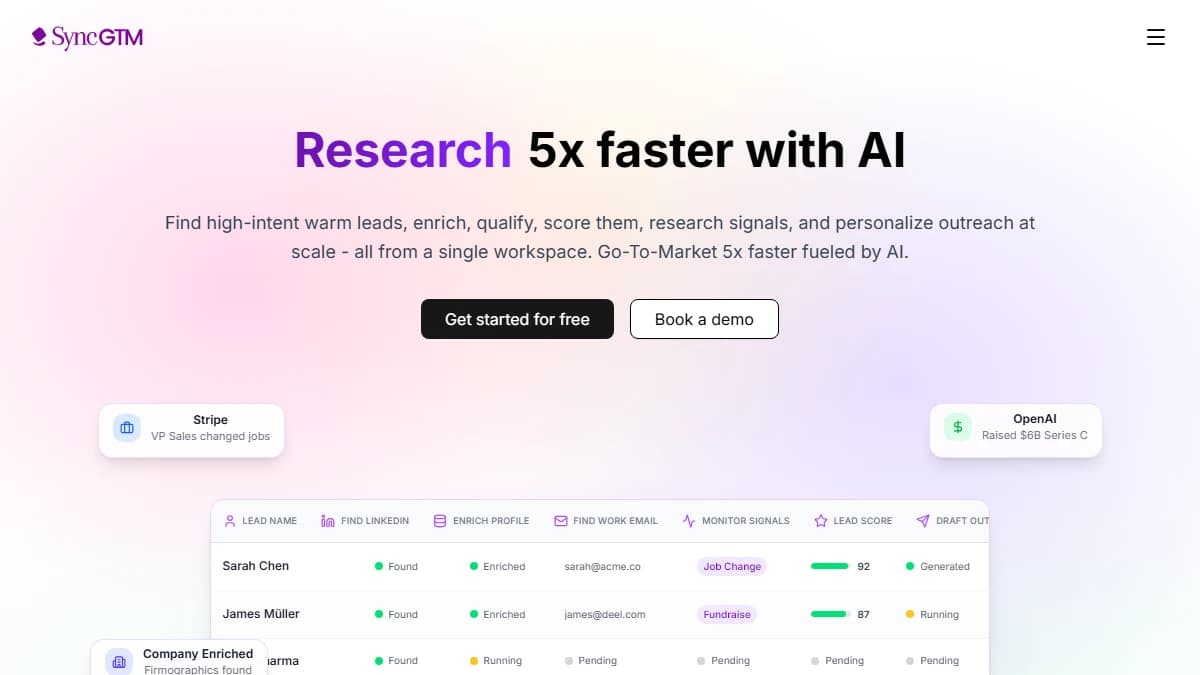
SyncGTM — job-change alerts, hiring intent, champion tracking, and waterfall enrichment synced to your CRM from $49/mo
SyncGTM is the most complete LoneScale replacement for GTM teams that need buying signals and enrichment in the same platform. Where LoneScale focuses narrowly on job-change and hiring signals, SyncGTM adds funding events, tech stack changes, news triggers, and executive move alerts — then enriches the triggered records with verified emails, phone numbers, and firmographics before writing everything back to your CRM.
The signal-to-enrichment pipeline is the key difference. When a champion changes companies, LoneScale alerts you. SyncGTM alerts you and enriches the new contact record immediately — pulling verified contact data from 40+ providers in a waterfall cascade — so your rep has a complete, actionable record instead of a half-populated alert. This eliminates the secondary enrichment step that LoneScale users typically run manually.
CRM coverage extends beyond LoneScale's Salesforce and HubSpot scope to include Pipedrive, Attio, and Zoho — all on every paid plan. AI research agents can investigate accounts, draft personalized outreach based on the triggering signal, and route records into workflows without additional configuration. Trigger columns let downstream enrichment run only when upstream signals fire, keeping credit consumption lean as signal volume scales.
SyncGTM customers report 42% more qualified meetings and 80% lower tool costs versus running separate signal, enrichment, and CRM automation tools. The free plan includes 200 credits per month with CRM integrations active — enough to validate the signal coverage before committing to a paid tier.
Pros
- Job-change, hiring intent, funding, and tech stack signals in one platform
- Waterfall enrichment fires automatically on signal triggers
- CRM sync to 5+ CRMs on all paid plans from $49/mo
- AI research agents for account investigation and outreach drafting
- Trigger columns reduce credit burn on high-volume signal feeds
- 200 free credits/mo with CRM integrations active
Cons
- More setup than LoneScale's CRM-native plug-in approach
- Smaller community and template library than Clay
Best for: GTM teams, RevOps, and growth teams that want job-change signals, hiring intent, and champion tracking combined with waterfall enrichment and multi-CRM sync — without stitching together multiple point tools. Take the product tour
Pricing: Free (200 credits/mo), $49/mo Solo, $99/mo Growth, $249/mo Pro, $649/mo Business. See full pricing
2. UserGems: The Deepest Alumni Tracking Network for Champion Re-Engagement
UserGems is LoneScale's most direct competitor in the champion-tracking category. The platform monitors your past customers, closed-won contacts, and power users across LinkedIn and company data sources — and alerts your team the moment a champion joins a new company, typically before the champion has even updated their LinkedIn headline.
Where LoneScale surfaces job changes from your CRM contacts, UserGems extends the tracking perimeter to include users who may have left your CRM — alumni from closed-lost deals, product users who never converted to paid, and stakeholders who changed companies during an active opportunity. The alumni network breadth is UserGems' clearest advantage over LoneScale.
UserGems enriches the triggered records before pushing to CRM, which addresses one of LoneScale's key gaps. The platform also supports automated outreach sequences triggered by job changes, reducing the time from signal to first touch. G2 reviewers consistently cite the quality of job-change detection and the speed of CRM write-back as UserGems' strongest attributes.
The tradeoff is pricing and scope. UserGems is priced for enterprise and mid-market teams — typically $20,000–$60,000+ annually — and is purpose-built for job-change tracking. If you need broader intent signals (website, product, funding) alongside champion tracking, you'll need to supplement UserGems with additional tools.
Pros
- Widest alumni tracking network — extends beyond CRM contacts
- Early job-change detection before LinkedIn updates
- Auto-enrichment of triggered contact records
- Automated outreach sequences on job-change signals
- Deep Salesforce and HubSpot integration with native objects
Cons
- Enterprise pricing — typically $20,000–$60,000+/yr
- Narrow signal focus — job changes only, no website or product signals
- No waterfall enrichment for non-triggered records
- Annual contract required — no month-to-month option
Best for: Enterprise and mid-market teams with high-value customer relationships and a defined champion re-engagement motion that justifies dedicated tooling and annual contract commitment.
Pricing: Custom annual contracts — typically $20,000–$60,000+/yr. Contact UserGems for current pricing.
3. Common Room: The Broadest Signal Layer for Community-Led GTM
Common Room takes a fundamentally different approach to buying signals than LoneScale. Where LoneScale monitors CRM contacts for employment changes, Common Room aggregates signals across GitHub, Slack, Discord, LinkedIn, X (Twitter), Stack Overflow, and product usage data — building a relationship intelligence layer that captures intent from wherever your buyers actually signal it.
For companies selling to technical buyers or developer communities, Common Room surfaces intent signals that are invisible to job-change-only tools: a prospect starring your GitHub repo, a community member asking a question that indicates evaluation intent, a developer showing high engagement in your Slack workspace before making a purchasing inquiry. These signals often precede job changes and formal buying processes.
Common Room also tracks job changes and enriches contact records, so the overlap with LoneScale's core use case is direct. The difference is signal breadth — Common Room's value compounds as you add community and product data sources. For teams with active developer communities, open-source projects, or product-led growth motions, Common Room provides signal coverage that job-change-only tools structurally cannot.
Pros
- Broadest signal sources — GitHub, Slack, Discord, LinkedIn, product data
- Community intent signals invisible to job-change tools
- Person-level identity resolution across platforms
- AI-powered signal scoring and account prioritization
- CRM sync to Salesforce and HubSpot with native workflows
Cons
- High pricing — typically $2,000–$5,000+/mo
- Full value requires active community — limited ROI for non-PLG teams
- No waterfall contact enrichment for net-new prospecting
- Complex implementation for teams without a community data strategy
Best for: Developer-tool companies, open-source businesses, and PLG teams with active communities where buying intent surfaces in GitHub, Slack, or Discord before it appears in a CRM or job change.
Pricing: Free tier for small communities; paid plans typically $2,000–$5,000+/mo depending on seats and data sources. Custom enterprise pricing.
4. Warmly: Real-Time Website Intent Identification and Orchestration
Warmly occupies a distinct niche in the signal intelligence space: website visitor identification. Where LoneScale monitors your CRM for job changes, Warmly monitors your website for the companies and contacts actively browsing right now — and triggers automated or human-assisted outreach while intent is highest.
The platform de-anonymizes website traffic at the person level where possible and at the company level universally, identifying which accounts are in an active evaluation cycle based on page visits, time on site, and content consumed. When a target account hits your pricing page three times in a week, Warmly can trigger a Slack alert, enrich the visitor's contact record, and initiate a personalized outreach sequence — all automatically.
Warmly's signal type is complementary rather than competitive to LoneScale's job-change signals. The strongest GTM stacks combine job-change intent (who is moving into a buying role) with website intent (who is actively evaluating your product). Teams migrating from LoneScale often add Warmly to cover the inbound intent layer, or choose a platform like SyncGTM that handles both.
Pros
- Real-time website visitor identification at company and person level
- Automated outreach sequences triggered by website intent signals
- Live chat and AI SDR for real-time engagement with hot visitors
- Intent data aggregated from 3rd-party sources alongside first-party signals
- Slack alerts for immediate rep response to high-intent accounts
Cons
- No job-change or champion tracking — different signal type from LoneScale
- $500–$2,000+/mo pricing — not accessible for early-stage teams
- ROI depends on traffic volume — low-traffic sites get limited value
- No waterfall enrichment for outbound prospecting
Best for: B2B SaaS teams with meaningful inbound traffic who want to convert website intent signals into outreach triggers — complementing job-change tracking tools rather than replacing them.
Pricing: Free tier available; paid plans from approximately $500/mo. Custom pricing for enterprise and high-traffic sites.
5. Trigify: AI-Powered Social Signal Intelligence for Outbound Teams
Trigify monitors LinkedIn posts, engagement patterns, job postings, and company news to surface intent signals that precede formal buying decisions. Where LoneScale waits for a contact to formally change their LinkedIn profile, Trigify detects the signals that often appear weeks earlier: a VP of Sales posting about hiring challenges, a CTO engaging heavily with content about your category, a company adding job descriptions for roles that indicate technology investment.
The platform's AI layer categorizes signals by intent type and urgency, scoring accounts by engagement intensity so reps know which targets to prioritize. Triggers can be configured for specific job titles, keywords, company sizes, and LinkedIn activity patterns — giving outbound teams a highly targeted signal feed rather than a raw activity stream.
Trigify's focus is signal detection and outreach initiation, not CRM-native enrichment. It surfaces signals and helps you act on them, but doesn't replace a waterfall enrichment tool for contact data or a CRM automation layer for workflow management. It works best as a complement to enrichment platforms — feeding high-quality trigger signals into a pipeline that SyncGTM or Clay then enriches and routes.
Pros
- Pre-move signal detection from LinkedIn activity before job changes confirm
- AI signal scoring and intent categorization by urgency
- Configurable triggers for titles, keywords, and engagement patterns
- Integrates with outreach tools for fast signal-to-sequence workflows
- More accessible pricing than LoneScale for smaller teams
Cons
- LinkedIn-focused — limited signal coverage beyond social activity
- No native CRM write-back — requires Zapier or API integration
- No contact enrichment or waterfall data capabilities
- Smaller dataset than job-change platforms with direct CRM contact graphs
Best for: Outbound-heavy SDR teams that prioritize social intent signals and want early-stage trigger detection before formal job changes register — especially effective paired with an enrichment platform for contact data.
Pricing: Starter plans from approximately $99/mo; Growth and Agency tiers available. Usage-based pricing for higher signal volumes.
6. Koala: Product-Qualified Lead Tracking for PLG and Self-Serve Teams
Koala is purpose-built for product-led growth teams that need to identify when free users or trial accounts are approaching conversion readiness. Where LoneScale surfaces external job-change signals from LinkedIn and hiring data, Koala surfaces internal product engagement signals — session depth, feature usage, plan limit approaches — and overlays them with firmographic and intent data from external sources.
The platform combines first-party product analytics with third-party intent data (G2 reviews, Bombora, website visits) to produce a composite PQL score for each account. Sales reps see which accounts are hot based on real product engagement rather than inferred buying signals — a fundamentally stronger signal for PLG motions where product usage directly predicts purchase intent.
Koala is not a LoneScale replacement for teams running a pure outbound or enterprise-motion. It doesn't track job changes, monitor champion movements, or enrich outbound contact lists. But for self-serve SaaS teams where the biggest revenue opportunity is converting engaged free users before they churn or stall, Koala provides signal coverage that job-change tools structurally cannot deliver.
Pros
- First-party product engagement signals — the strongest PLG intent data
- Composite PQL scoring combining product + external intent
- Generous free tier for small teams and early-stage startups
- Salesforce and HubSpot CRM sync with native objects
- Slack alerts for high-PQL accounts hitting engagement thresholds
Cons
- No job-change or champion tracking — different signal type from LoneScale
- Requires product analytics instrumentation to deliver full value
- No waterfall enrichment for outbound contact data
- Limited value for teams without a self-serve or free-tier motion
Best for: Product-led growth companies and self-serve SaaS teams that need to identify which free users or trial accounts are approaching purchase readiness based on real product engagement data.
Pricing: Free tier available; paid plans from approximately $300–$500/mo depending on seat count and MAU volume.
7. Champify: CRM-Native Champion Tracking for Salesforce Teams
Champify is arguably LoneScale's closest conceptual competitor: a CRM-native tool that monitors your contacts for job changes and creates warm re-engagement opportunities when champions move to new companies. Both platforms share the thesis that job changes are high-intent buying signals and that the alert should surface inside your CRM rather than in a separate dashboard.
Where Champify differentiates is Salesforce depth. The platform builds on Salesforce native objects — Activities, Tasks, Opportunities — rather than creating parallel data structures. When a champion changes jobs, Champify creates a new Lead or Contact record in Salesforce following your existing object conventions, linked to the originating relationship, with enriched firmographic and contact data already populated. For Salesforce-centric RevOps teams, that native fidelity reduces adoption friction significantly.
Champify's limitation, like LoneScale's, is signal breadth. The platform focuses on job-change tracking. It does not cover website intent, product signals, social listening, or funding events. Teams running multi-signal GTM motions will need to supplement Champify with additional tools — or choose a platform like SyncGTM that handles multiple signal types alongside enrichment.
Pros
- Deepest Salesforce-native integration — uses standard CRM objects
- Automated enrichment of triggered contact records
- Low adoption friction for Salesforce-centric revenue teams
- Clear champion re-engagement workflow with task and activity creation
- Faster time-to-value than LoneScale for Salesforce-primary teams
Cons
- Salesforce-only — no HubSpot or other CRM support
- Narrow signal focus — job changes only
- No waterfall enrichment, AI agents, or workflow automation builder
- Higher price point than LoneScale for equivalent functionality
Best for: Salesforce-native enterprise teams with a strong champion re-engagement motion who want the deepest possible CRM integration for job-change alerts and care less about broader signal coverage.
Pricing: Custom annual contracts. Contact Champify for current pricing — typically in the $15,000–$40,000+/yr range for mid-market teams.
Side-by-Side Comparison: LoneScale Alternatives
| Tool | Starting Price | Job-Change Signals | Champion Tracking | Enrichment | CRM Sync | Best For |
|---|---|---|---|---|---|---|
| LoneScale | Custom | Yes | Yes | No | ~ 2 CRMs | Job-change signals |
| SyncGTM | $49/mo | Yes | Yes | Yes 40+ providers | Yes 5+ CRMs | Signals + enrichment |
| UserGems | $20K+/yr | Yes | Yes | ~ triggered only | ~ 2 CRMs | Alumni re-engagement |
| Common Room | $2K+/mo | ~ | ~ | No | Yes | Community-led GTM |
| Warmly | ~$500/mo | No | No | No | Yes | Website intent |
| Trigify | ~$99/mo | ~ social signals | No | No | No | Social intent signals |
| Koala | Free / $300+/mo | No | No | No | Yes | PLG / PQL tracking |
| Champify | $15K+/yr | Yes | Yes | ~ triggered only | ~ Salesforce only | Salesforce champion tracking |
How to Choose the Right LoneScale Alternative
The right platform depends on which signal gap is actually limiting your pipeline — and whether you need enrichment alongside signals or just alerts.
You need job-change signals + enrichment + multi-CRM sync on a predictable budget
Choose SyncGTM. It handles the full signal-to-enrichment workflow in one platform, syncs to five CRMs on every paid plan, and starts at $49/mo — without annual contract requirements.
Champion re-engagement is your primary motion and budget is not a constraint
Choose UserGems. The alumni tracking network breadth and automated enrichment on triggered records justifies the enterprise price point for teams with high-value customer relationships.
You sell to developer communities, open-source users, or tech-forward buyers
Choose Common Room. Community signals from GitHub, Slack, and Discord give you intent data that job-change tools structurally cannot surface.
You have meaningful inbound traffic and want to convert website intent in real time
Choose Warmly — ideally alongside a job-change signal tool. Website intent and job-change signals are complementary; running both closes the inbound-outbound signal gap.
You run a product-led motion and need PQL tracking to identify conversion-ready users
Choose Koala. Product engagement signals are the strongest buying intent data for self-serve SaaS — no job-change tool can replicate that.
You are Salesforce-first and want the deepest CRM-native champion tracking
Choose Champify. If Salesforce native-object fidelity is a non-negotiable requirement and job-change tracking is your primary use case, Champify's deep SF integration reduces RevOps implementation burden.
Final Verdict: The Best LoneScale Alternative in 2026
LoneScale pioneered the thesis that job-change signals belong inside your CRM, not in a separate analytics dashboard. That thesis was right, and the category has evolved around it — with every tool in this comparison accepting that signal-driven GTM is the baseline, and competing on which signals they cover and how much they do with them.
For most GTM teams evaluating LoneScale alternatives in 2026, the question is whether job-change signals alone are sufficient or whether enrichment, broader signal types, and multi-CRM support are requirements. If you need the complete picture — signals plus enrichment plus CRM sync — SyncGTM is the strongest single-platform answer. If you need the deepest possible champion re-engagement network and budget is unconstrained, UserGems is the specialist choice.
If you sell to technical communities, Common Room covers signal territory that job-change tools cannot. If you want to convert inbound traffic alongside outbound signals, pair Warmly with your job-change tool of choice. And if you run a PLG motion, Koala's PQL tracking is the most relevant signal layer regardless of what else you run.
The days of single-signal GTM are ending. The teams winning pipeline in 2026 are the ones combining job-change signals with website intent, product engagement, and enrichment into a unified workflow — whether through a platform that handles all of it or a deliberate stack of best-in-class point tools.
Ready to Replace LoneScale?
SyncGTM gives you job-change alerts, hiring intent, champion tracking, and waterfall enrichment — all synced to your CRM from $49/mo. No annual contract, no signal gaps.