
MailDB Review 2026: B2B Data Coverage, Pricing & SyncGTM Comparison

By Kushal Magar · June 16, 2026 · 11 min read
Key Takeaway
MailDB is a lightweight email discovery and verification platform with domain search, person search, and bulk email verification. Pricing starts free through Entry ($9/mo, 1,000 requests) and Startup ($19/mo, 5,000 requests). The core strengths are an extremely affordable entry price and free API access on all plans. The core gaps are no published accuracy metrics, zero user reviews on G2/Capterra, no waterfall enrichment, no CRM integrations, no buying signals, and product activity concerns. Best for low-volume individual use. Teams prospecting at scale should look at SyncGTM's 50+ provider waterfall, Hunter.io, or Apollo.io.
MailDB is an email discovery and verification platform with domain search, person search, and bulk email verification. Pricing starts free (10 requests/mo) through Entry ($9/mo, 1,000 requests) and Startup ($19/mo, 5,000 requests). Our rating: 2.9/5.
The case for MailDB is price. At $9/mo for 1,000 email lookups, it is one of the cheapest email finder tools available. A free tier with no credit card required lets teams test data quality before committing. The Chrome extension and full API access are included on every plan — even free.
The gaps are significant. MailDB publishes no accuracy rate, has no user reviews on G2 or Capterra, provides no waterfall enrichment fallback, and includes no CRM-native integrations. As of 2026, there are product activity concerns — the original maildb.io domain appears to have lapsed. Teams need to verify current status before building workflows around it.
This review covers MailDB's database coverage, pricing model, Chrome extension, API, and a direct comparison with SyncGTM, Hunter.io, and Apollo.io for teams evaluating B2B data options in 2026.
What Is MailDB?
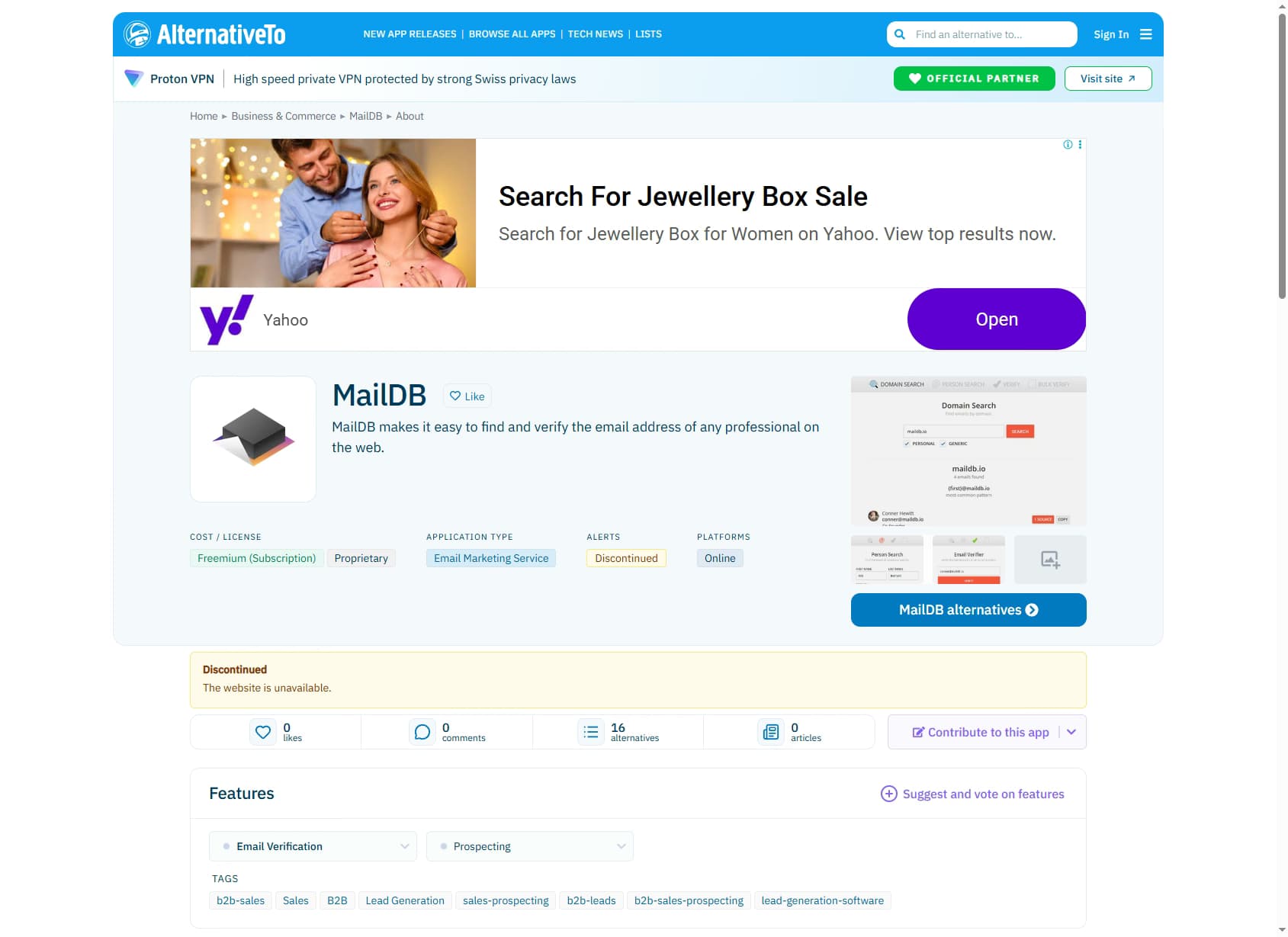
MailDB — email discovery and verification platform with domain search, person search, and Chrome extension.
MailDB is an email discovery and verification platform founded in 2016 in Chicago, Illinois by Conner Hewitt and Robert Bednarz. Its core value proposition: find and verify the email address of any professional using just a name and/or domain name. The platform targets sales teams, recruiters, email marketers, and business development professionals who need contact data for outbound prospecting.
Three core tools define the product. Domain Search surfaces all email addresses associated with a company domain — useful for mapping out the full contact list at a target account. Person Search finds a specific individual's business email given their name and company. Email Verification validates whether an address is deliverable — checking syntax errors, domain validity, and mailbox existence in real time. According to AlternativeTo, MailDB also includes lead tracking and a Chrome extension for in-browser prospecting.
A key concern in 2026: the original maildb.io domain appears to have lapsed and is now redirecting to an unrelated site. This is a significant signal that the product may no longer be actively maintained. Teams should verify product status directly before committing to a paid plan or API integration.
| Capability | What MailDB Provides | Notable Gaps |
|---|---|---|
| Domain Search | Finds emails associated with any company domain. Results include name, job title, and phone (where available). | No published hit rate. No fallback when domain not indexed. |
| Person Search | Finds business email from name + company. Instant results from hundreds of millions of sources. | No accuracy metric published. No CRM auto-push. |
| Email Verification | Single and bulk verification. Checks syntax, domain, and mailbox existence. Real-time verification available. | No catch-all confidence scoring. No risk scoring detail. |
| Chrome Extension | In-browser email finding and verification across LinkedIn and company websites. | Limited multi-site enrichment vs Apollo or Lusha extensions. |
| API Access | Full REST API available on all plans including free tier. Supports domain search, person search, and email verification. | No native CRM connectors. Custom integration required. |
| Buying Signals | Not available. | No hiring, funding, tech stack, or job change signals. |
MailDB Pricing: Plans, Credits, What You Actually Pay
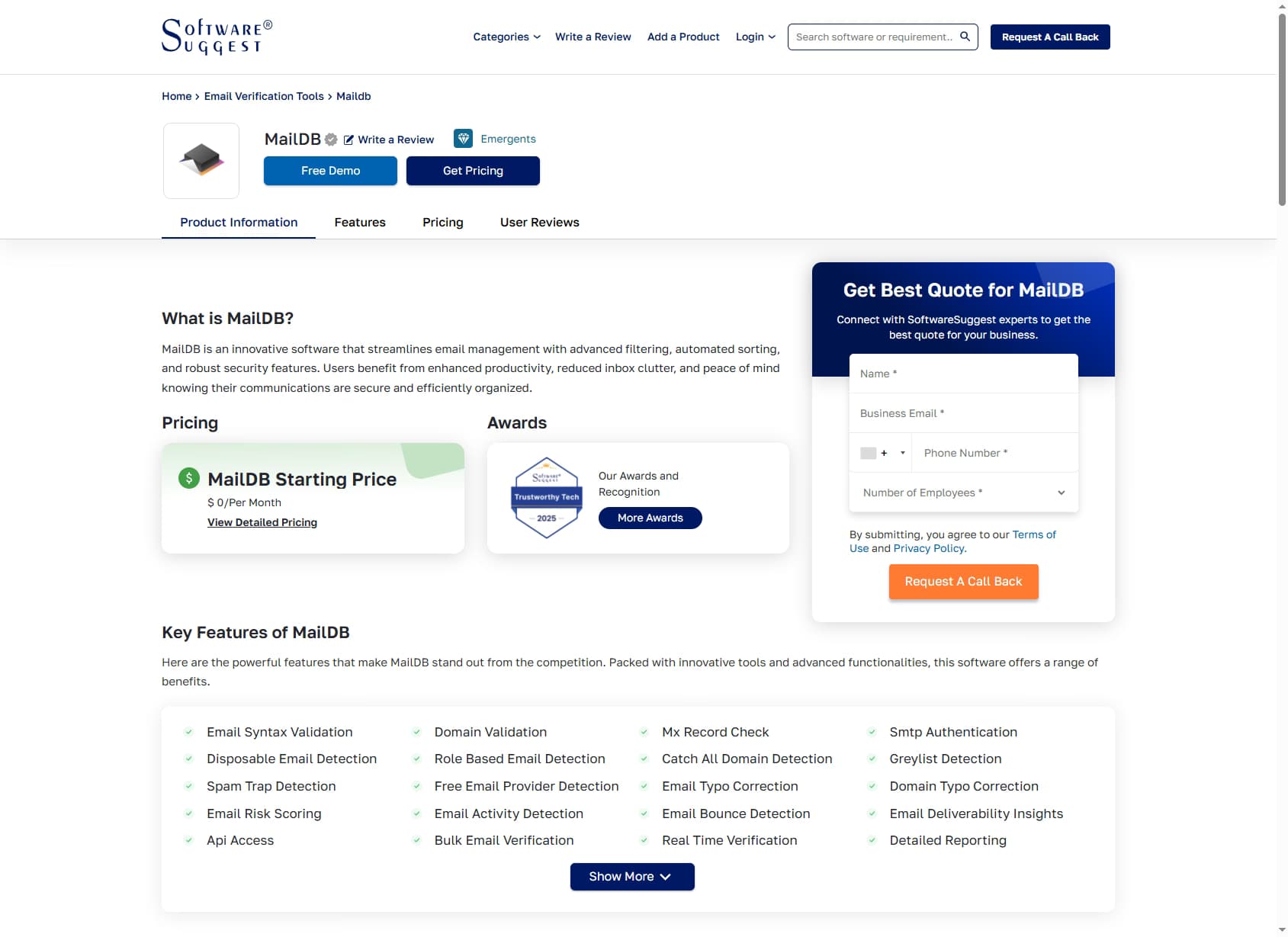
MailDB pricing — freemium tiers from $0 to $19/mo with request-based billing for domain search and email verification.
MailDB uses a request-based pricing model with three tiers. Every plan includes domain search, person search, email verification, and API access — there are no feature-gating differences between tiers, only request volume limits.
| Plan | Price | Requests/Mo | Features |
|---|---|---|---|
| Free | $0/mo | 10 requests — no CC required | Domain search, person search, email verification, API access |
| Entry | $9/mo | 1,000 requests | All free features |
| Startup | $19/mo | 5,000 requests | All free features |
The real cost math
At $9/mo for 1,000 requests, MailDB costs $0.009 per request — cheaper than Hunter.io ($34/mo for 500 searches = $0.068/search) and significantly cheaper than Apollo.io ($49/mo/user). The free tier at 10 requests/mo is enough for initial testing but not for any sustained prospecting workflow.
The pricing looks attractive until you factor in what is missing. There are no buying signals, no outreach sequencing, and no CRM integrations at any price point. Teams using MailDB for prospecting still need a separate sales engagement platform, a separate CRM integration layer, and separate signal data — costs that accumulate quickly. For context, SyncGTM starts at $99/mo and covers global ICP enrichment across 50+ providers plus signals and built-in outreach. The best waterfall contact providers guide covers how the total cost of ownership compares across platforms.
MailDB Key Features
Domain Search
MailDB's Domain Search tool surfaces all email addresses indexed for a given company domain. Enter a company URL and MailDB returns a list of professional contacts at that domain — including name, job title, and phone number where available. This is the same pattern used by Hunter.io (117M+ indexed contacts), and it works well for mapping known target accounts where the domain is already in the database.
The limitation is single-source coverage. If a domain is not indexed, Domain Search returns nothing. There is no cascade to secondary providers. According to independent benchmarks on email finder tools, single-source domain search tools typically find emails for 40–65% of contacts in a cold ICP list. Waterfall tools like SyncGTM cascade across 50+ providers to push that rate toward 75–90%.
Person Search
Person Search finds a specific individual's professional email given their name and company. The tool claims to search “hundreds of millions of sources instantly” — though no source count or accuracy figure is published to validate this claim. Person Search is the right tool when you have a specific prospect in mind and need their work email without navigating a full database. It mirrors the core function of tools like Anymail Finder and Snov.io.
Email Verification
MailDB's Email Verifier handles single and bulk email validation. Checks include syntax errors, domain validity, and mailbox existence — the standard three-layer verification stack used across the email verification category. Real-time verification is available for validating new sign-ups or form submissions at the point of entry. The verifier also flags potential risk signals — disposable email detection and spam trap identification are listed as capabilities.
The missing layer is catch-all confidence scoring. Some verifiers (ZeroBounce, NeverBounce) return a confidence score on catch-all domains — where the mail server accepts all emails regardless of whether the specific mailbox exists. MailDB does not appear to publish catch-all scoring methodology. See the NeverBounce review for how catch-all handling affects deliverability.
Chrome Extension
The MailDB Chrome extension enables in-browser email finding and verification as you browse LinkedIn and company websites. Sales reps can identify a prospect on LinkedIn, surface their verified email in-browser, and save the record without switching tabs. This is a standard feature across email finder tools — Apollo.io, Lusha, and Hunter.io all offer Chrome extensions with similar functionality.
API Access
MailDB provides a full REST API on every plan — including the free tier. This is a genuine differentiator: most email finder tools restrict API access to paid plans. The API covers domain search, person search, and email verification, enabling teams to integrate MailDB into custom workflows or enrichment pipelines without upgrading to a paid tier first. According to the MailDB API documentation, authentication and endpoint structure are standard REST patterns — low integration overhead for developer teams.
Lead Tracking and Email Client Integrations
MailDB includes basic lead tracking — monitoring email engagement metrics from discovered contacts. It integrates with Outlook, Gmail, and Apple Mail for email tracking and analytics. These integrations are thin compared to dedicated sales engagement platforms: no sequence automation, no reply detection, no A/B testing. For teams that need engagement analytics beyond basic tracking, a separate tool like a full outreach platform is required.
MailDB Pros: What It Does Well
- ✓Extremely affordable entry price. $9/mo for 1,000 requests is one of the lowest entry prices in the email finder category. Hunter.io charges $34/mo for 500 searches. Snov.io starts at $39/mo. For individual freelancers or micro-teams with low-volume prospecting needs, MailDB's pricing is hard to beat.
- ✓Free API access on all plans. API access is unlocked on the free tier — no paid plan required to integrate MailDB into custom workflows. This is unusual in the category: Hunter.io restricts API to paid plans, and Snov.io requires at least a Starter subscription. Developers can test MailDB's API with 10 free requests before committing to a paid plan.
- ✓Free tier with no credit card required. 10 free requests per month with no CC required enables genuine data quality testing before purchase. The free plan includes domain search, person search, and email verification — not just verification-only like some competitors.
- ✓Single + bulk email verification included. Email verification handles both one-off lookups and large batch uploads at every pricing tier. Real-time verification capability enables sign-up form validation without a separate tool. This bundles what many teams buy separately — email finder + email verifier — into a single platform.
- ✓Chrome extension for LinkedIn and web prospecting. In-browser email finding without switching tabs accelerates LinkedIn prospecting workflows. The extension surfaces email and contact data directly on profile pages and company websites.
MailDB Cons: Where It Falls Short
- No published accuracy metrics. MailDB does not disclose a verified email accuracy rate, hit rate, or deliverability percentage — unlike Hunter.io (92%+ claimed), Apollo.io (~80%), or Emailable (99% guarantee). Buyers cannot independently assess data quality before purchasing. The absence of accuracy data is especially limiting for teams that benchmark tools before adoption.
- Zero user reviews on major platforms. MailDB has no user reviews on G2 and near-zero reviews on Capterra as of 2026. Established email discovery tools accumulate hundreds of verified user reviews. The lack of review data makes it impossible to assess real-world accuracy, support responsiveness, or false-positive rates from independent sources.
- No waterfall enrichment fallback. MailDB queries a single data source. When a contact is not in its database, the query returns nothing — there is no cascade to secondary providers. Waterfall enrichment tools like SyncGTM hit 75–90% email find rates by cascading across 50+ providers. Single-source tools typically deliver 40–65% find rates on cold ICP lists.
- No buying signals or intent data. MailDB provides email discovery only — no data layer for hiring surges, funding events, tech stack changes, or job changes. Teams running signal-based outbound need a separate platform. SyncGTM, Apollo.io, and ZoomInfo all include some form of intent or signal data at their paid tiers.
- No native CRM integrations. MailDB provides an API but no native CRM connectors for Salesforce, HubSpot, or Pipedrive. Teams using CRM-native workflows must build custom integrations or export to CSV. Hunter.io, Apollo.io, and SyncGTM all offer native CRM sync without requiring API work.
- No built-in outreach sequencing. MailDB finds emails but does not include email outreach, sequences, or follow-up automation. Teams need a separate sales engagement platform. Apollo.io and SyncGTM both include built-in sequence automation at their paid tiers — removing the need for a second tool.
- Product activity concerns. The original maildb.io domain appears to have lapsed as of 2026, which raises questions about ongoing product maintenance and support. Teams should verify current availability before committing to a subscription or API integration.
MailDB vs Alternatives: Comparison Table
The email finder category ranges from lightweight single-source tools (MailDB) to full-stack prospecting platforms with waterfall enrichment (SyncGTM) and intent data (Apollo.io). Here is how MailDB compares across the dimensions that matter for B2B teams in 2026.
| Feature | MailDB | SyncGTM | Hunter.io | Apollo.io |
|---|---|---|---|---|
| Starting Price | $9/mo (Entry) | $99/mo | $34/mo | $49/mo/user |
| Free Tier | 10 requests/mo (no CC) | 200 free credits/mo | 25 searches/mo | 10K email credits/mo |
| Database / Coverage | Domain + person search | 50+ provider waterfall | 117M+ indexed contacts | 275M+ contacts globally |
| Email Verification | Yes — single + bulk | Yes — built-in | Yes — built-in | Yes — built-in |
| Phone Numbers | Limited — some records | Yes — mobile + direct dial | No | Yes — mobile numbers |
| Waterfall Enrichment | None — single source | Yes — 50+ providers cascade | None | None |
| Buying Signals | None | Hiring, funding, tech, job changes | None | Intent data (paid tiers) |
| Chrome Extension | Yes | Yes | Yes | Yes |
| API Access | Yes — all plans | Yes | Yes — paid plans | Yes — paid plans |
| Built-in Outreach | None | Yes — built-in sequencing | Campaigns (paid tiers) | Yes — sequences + dialer |
| Lead Tracking | Yes — basic | Yes — full signal tracking | No | Yes — sequences |
| GDPR Compliance | Limited documentation | Yes | Yes | Yes |
The honest take on each option
MailDB wins only on price. At $9/mo for 1,000 requests with a free API tier, it is the cheapest point of entry in the email finder category. For individual freelancers or developers who need light-touch email lookup with API access and no monthly minimums, MailDB is a viable option — with the caveat that product activity in 2026 is uncertain and user review data is essentially absent.
SyncGTMis the right choice when coverage and hit rate matter. SyncGTM's waterfall enrichment cascades across 50+ providers — finding emails, mobile numbers, and firmographics even when any single database misses the contact. Hit rates of 75–90% on cold ICP lists versus the 40–65% typical of single-source tools translate directly to more pipeline per dollar spent. SyncGTM also adds buying signals and outreach sequencing from $99/mo. See the B2B real-time data platforms comparison for a full category breakdown.
Hunter.iois the most direct alternative to MailDB. It is more expensive ($34/mo for 500 searches) but offers 117M+ indexed contacts, a 92%+ deliverability claim, domain search confidence scores, and CRM integrations with HubSpot, Pipedrive, and Zoho. Hunter has a substantial user review record on G2 (4.4/5, 500+ reviews) versus MailDB's near-zero review count — making it the safer choice for teams that need verifiable quality data.
Apollo.iois the strongest full-platform option. 275M+ contacts globally, built-in sequences and dialer, intent data, 20+ CRM integrations, and a free tier with 10,000 email credits per month. At $49/mo/user, Apollo costs more than MailDB but eliminates the need for 2–3 separate tools. For teams considering MailDB plus a sales engagement platform plus a CRM integration layer, Apollo's all-in-one pricing often wins on total cost.
Who Should Use MailDB?
MailDB fits a narrow profile: individual users or very small teams with low-volume prospecting needs, a budget under $10/mo, and a preference for API access without paying for it. The 2026 product activity concern narrows this further — teams building production workflows should verify the product is still maintained before committing.
Use MailDB if:
- You need fewer than 1,000 email lookups per month and price is the primary constraint — $9/mo is the lowest paid tier in the category for this volume.
- You need free API access for light integration — MailDB includes API access on its free plan, which is uncommon in this category.
- You want a combined email finder + verifier without paying for two separate tools — MailDB bundles both at every tier.
- You are a developer evaluating email finder APIs before committing to a paid plan — the free tier lets you test the API with real requests at zero cost.
Do not use MailDB if:
- You need verified accuracy data before buying. MailDB publishes no accuracy rate. Hunter.io, Apollo.io, and Emailable all publish specific accuracy or deliverability metrics that let you benchmark before purchasing.
- You need high hit rates on cold ICP lists. Single-source tools typically find emails for 40–65% of contacts in a cold list. Waterfall enrichment platforms like SyncGTM cascade across 50+ providers to push hit rates toward 75–90%.
- You need native CRM sync. MailDB provides an API but no native Salesforce, HubSpot, or Pipedrive connectors. Teams using CRM- native workflows need a different tool.
- Buying signals are part of your outbound strategy. MailDB provides contact data only — no hiring surges, funding events, or tech stack changes. A dedicated signal platform is required.
- You are building a production workflow and need reliable long-term support. The lapsed domain and zero review history in 2026 raise concerns about MailDB's ongoing maintenance. The Anymail Finder review covers a more established alternative in the same price range.
MailDB Review: Frequently Asked Questions
What is MailDB and how does it work?
MailDB is an email discovery and verification platform founded in 2016 and based in Chicago, Illinois. It provides three core tools: Domain Search (finds email addresses associated with any company domain), Person Search (finds a specific professional's email using their name and company), and Email Verification (validates whether email addresses are deliverable). MailDB also includes a Chrome extension for in-browser prospecting, lead tracking, and a full API. It targets sales teams, recruiters, and marketers who need verified contact data for outbound prospecting. Pricing starts free (10 requests/mo) through Entry ($9/mo, 1,000 requests) and Startup ($19/mo, 5,000 requests). MailDB positions itself as a lightweight, affordable alternative to Hunter.io in the email finder category.
How accurate is MailDB in 2026?
MailDB does not publish a specific accuracy percentage for its email database. The platform focuses on email verification checks — syntax errors, domain validity, and mailbox existence — rather than claiming a blanket accuracy rate for its discovery database. Independent testing data is not publicly available for MailDB as of 2026, partly because the tool has limited public review volume on G2 and Capterra. For context, Hunter.io claims 92%+ deliverability on verified emails, while waterfall enrichment platforms like SyncGTM cascade across 50+ providers to hit 75–90% find rates on cold ICP lists. MailDB's single-source discovery model means contacts not in its index return zero results — with no fallback cascade. For teams where email find rate matters, waterfall enrichment platforms deliver materially better coverage.
How much does MailDB cost in 2026?
MailDB offers three tiers: Free ($0/mo, 10 requests, domain search, person search, email verification, API access — no credit card required), Entry ($9/mo, 1,000 requests, all free features), and Startup ($19/mo, 5,000 requests, all features). A free trial is available. For teams needing higher volume, enterprise pricing is available on request. At $9/mo for 1,000 requests, MailDB is among the most affordable email finder tools in the category — Hunter.io starts at $34/mo for 500 searches, and Apollo.io starts at $49/mo/user. The tradeoff is coverage depth and feature breadth: MailDB does not include buying signals, outreach sequencing, or CRM-native integrations at any price point.
Does MailDB have a free plan?
MailDB has a permanent free plan with 10 requests per month — no credit card required. This covers domain search, person search, email verification, and API access. The free tier is suitable for light individual use or initial testing, but 10 requests per month is insufficient for any meaningful prospecting workflow. By comparison, Hunter.io's free plan includes 25 searches/mo and 50 verifications/mo, Apollo.io's free tier includes 10,000 email credits per month, and SyncGTM provides 200 free credits per month on a permanent free plan. MailDB's free tier is functional for evaluation but not for ongoing prospecting.
What integrations does MailDB support?
MailDB provides a full REST API available on all plans, including the free tier. The Chrome extension enables in-browser prospecting on LinkedIn and company websites. MailDB also integrates with email clients including Outlook, Gmail, and Apple Mail for tracking and analytics. However, MailDB does not offer native CRM integrations with Salesforce, HubSpot, or Pipedrive — CRM sync requires API-level custom work or CSV export. This is a notable gap compared to Hunter.io (HubSpot, Pipedrive, Zoho native), Apollo.io (20+ CRM/SEP native connectors), or SyncGTM (API + Zapier + CRM native). Teams relying on CRM-native workflows will need to build their own integration.
How does MailDB compare to SyncGTM for B2B prospecting?
MailDB and SyncGTM both provide email discovery, but they operate at fundamentally different scales. MailDB queries a single database — when a contact is not in its index, there is no fallback. SyncGTM runs waterfall enrichment across 50+ data providers in cascade: if Provider 1 misses the contact, Provider 2 tries, then Provider 3, and so on, until an email or phone number is found. This architecture delivers 75–90% hit rates on cold ICP lists versus lower single-source find rates. SyncGTM also adds buying signals (hiring surges, funding rounds, tech stack changes, job changes) and includes built-in outreach sequencing from $99/mo. MailDB starts at $9/mo for 1,000 requests — far cheaper for low-volume individual use. For teams running outbound at scale, the cost-per-verified-contact math favors SyncGTM's waterfall coverage.
Is MailDB still active in 2026?
MailDB was founded in 2016 in Chicago, Illinois by Conner Hewitt and Robert Bednarz. As of 2026, the original maildb.io domain appears to have lapsed or been redirected — a sign the product may no longer be actively maintained. Review platforms including G2 and Capterra show zero or near-zero user reviews, which is unusual for a product with meaningful active usage. Teams evaluating MailDB should verify current product status directly before committing to a subscription. If MailDB is no longer actively maintained, alternatives like Hunter.io, Snov.io, or SyncGTM's waterfall enrichment offer more reliable long-term support.