


Mailshake Review 2026: Simple Cold Email Tested -- Pricing and Honest Verdict

By Kushal Magar · March 20, 2026 · 14 min read · Last updated: September 30, 2026
Key Takeaway
Mailshake is a cold email and sales engagement platform with three self-serve tiers: Starter ($29/user/mo), Email Outreach ($49/user/mo), and Sales Engagement ($99/user/mo), or $25, $45, and $85 billed annually. Every plan includes sequences, A/B testing, AI writing, warm-up, and verification; Email Outreach adds unlimited sends and CRM integrations, and Sales Engagement adds a power dialer. Simple and intuitive, but there are no buying signals, Data Finder credits are thin on the lower plans, there is no free trial, and analytics depth is limited.
Mailshake is a cold email and sales engagement platform built for small sales teams and agencies. It combines email sequences, a built-in phone dialer, LinkedIn automation, and SHAKEspeare AI writing into a single tool. Pricing starts at $29 per user per month for the Starter plan, with full multichannel at $99 per user per month. Our rating: 3.8/5.
You are probably here because you want to know if Mailshake is still worth paying for in 2026 or if better options have come along. We tested all three plans, built real sequences, used the phone dialer, and ran SHAKEspeare AI against actual prospect lists. We also reviewed hundreds of G2 reviews and Capterra reviews to identify where real users get frustrated.
The short version: Mailshake is simple, reliable, and fast to set up. If you need basic cold email sequences for a small team, it delivers. The SHAKEspeare AI writing assistant generates usable first drafts and the A/B testing on the Email Outreach plan works well for subject line optimization.
The longer version: Mailshake has no buying intent signals. It does not know if a prospect just raised funding, hired a new VP of Sales, or started evaluating competitors. It does not enrich contacts from multiple data sources. You get a solid email execution engine with no intelligence layer, so deciding who to email and when stays your job.
This Mailshake review covers features, all three pricing tiers, real limitations, and which plan fits which team. We also compare it to competing tools like SalesHandy, Outplay, and Instantly so you can decide which platform fits your workflow.
Mailshake Review: What You Get (and What You Don't)
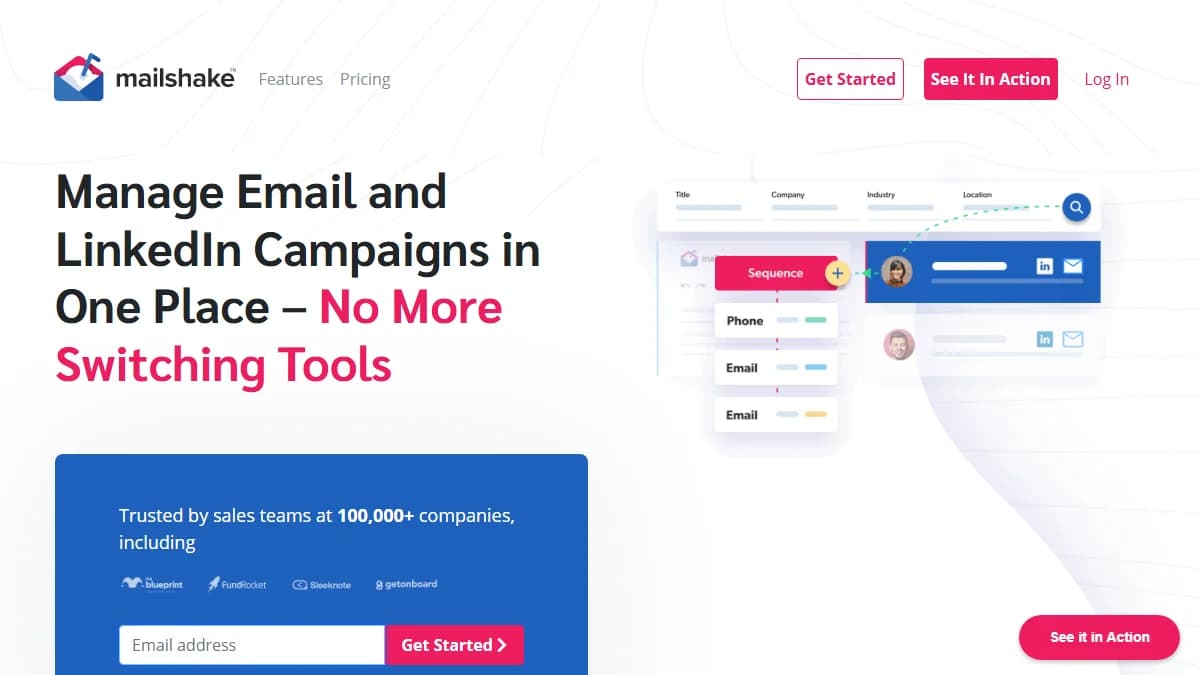
Mailshake dashboard showing email sequences, phone dialer, and LinkedIn automation for cold outreach.
Mailshake is a sales engagement platform that focuses on simplicity over depth. It launched as a cold email tool and has expanded to include phone dialing and LinkedIn outreach on higher plans. The target audience is clear: SDR teams of 1 to 10 people who need to get campaigns running without a week of onboarding.
| Feature | What's Included | Limitations |
|---|---|---|
| Email Sequences | Multi-step automated sequences with scheduling, follow-ups, and tracking. Available on all plans. | No multi-channel triggers. Sequences are time-based, not signal-based. |
| SHAKEspeare AI | AI writing assistant for email drafts. Generates subject lines and body copy from prompts. | Included from the Starter plan up (as of September 2026). Quality is decent for first drafts, not production-ready. |
| Phone Dialer | Built-in power dialer with call recording, voicemail drop, and call disposition tracking. Includes 5 phone numbers and unlimited North American minutes. | Sales Engagement plan only ($99/user/mo, or $85 billed annually). |
| LinkedIn Automation | Automated connection requests, profile views, and messages via LinkedIn. | Sales Engagement plan only. Relies on browser extension for LinkedIn actions. Not listed on Mailshake's pricing page as of September 2026, so confirm availability before buying for LinkedIn. |
| A/B Testing | Test up to two subject line and body variants per sequence step. | Included from the Starter plan up. Limited to two variants (no multivariate). |
| Deliverability | Unlimited warm-up and email verification on every plan, plus email rotation from Email Outreach up. | Starter is capped at one email address and 1,500 sends per month. |
| Data Finder | Find business contacts by role, location, or company inside Mailshake. | 50 credits on Starter and Email Outreach, 2,500 on Sales Engagement; more access is a paid add-on. |
| Buying Signals | Not available. | No intent data, no hiring signals, no funding alerts. You need a separate intent data tool for signal intelligence. |
The pattern is consistent: Mailshake covers sending, deliverability basics, and (on the top plan) calling, but leaves prospect data and outreach timing largely to you. Plan details above are as of September 2026.
Email Sequences and SHAKEspeare AI: How They Work
Mailshake's core value is email sequences. You upload a prospect list via CSV or pull contacts from your CRM integration, write your email templates (or let SHAKEspeare AI generate them), set your sending schedule, and launch. Follow-ups trigger automatically based on recipient behavior: opens, clicks, or no response.
SHAKEspeare AI is Mailshake's built-in writing assistant, included from the Starter plan up as of September 2026. You provide a prompt describing your product, target audience, and desired tone, and SHAKEspeare generates email drafts including subject lines. In our testing, the outputs were usable as starting points but required editing. Subject lines tended toward generic phrasing, and the body copy lacked the specificity that drives replies in cold outreach.
What works well
- Setup takes under 30 minutes for a first campaign. The interface is intuitive with minimal onboarding required.
- A/B testing, included on every plan, lets you test two subject line variants per sequence step. Statistical winners auto-selected.
- Mail merge personalization with custom fields. Basic but effective for small prospect lists.
- Lead Catcher feature automatically marks hot leads based on positive reply detection.
What falls short
- No signal-based triggers. Sequences fire on fixed schedules, not when a prospect shows buying intent.
- Limited native data sourcing. Data Finder includes only 50 credits a month on Starter and Email Outreach, so most teams still bring their own prospect list or use a separate enrichment tool.
- Analytics are surface-level. Open rates, click rates, and reply rates are tracked but no revenue attribution or pipeline impact.
If you want sequences triggered by real buying signals like funding rounds, leadership changes, and hiring surges, Mailshake cannot do that on its own. You would need a separate intent data source to decide who enters a sequence, then add those contacts to Mailshake via CSV, your CRM, or Zapier.
Mailshake Pricing Breakdown
Mailshake pricing is straightforward: three self-serve tiers billed per user, plus a custom-priced Agency plan with unlimited email addresses. Prices below are as of September 2026. For current pricing details, visit Mailshake's website. You can also check user reviews on G2 and Capterra.
- Starter ($29/user/mo, or $25 billed annually): One email address and 1,500 sends per month. Automated sequences, A/B testing, AI email writing, unlimited warm-up and verification, and 50 Data Finder credits. Best for solopreneurs and freelancers testing cold email.
- Email Outreach ($49/user/mo, or $45 billed annually): Everything in Starter plus two email addresses, unlimited sends, email rotation, advanced scheduling, a unified inbox, HubSpot, Salesforce, and Pipedrive integrations, and 1,000+ Zapier integrations. The sweet spot for small SDR teams running dedicated cold email campaigns.
- Sales Engagement ($99/user/mo, or $85 billed annually): Everything in Email Outreach plus 10 email addresses, 2,500 Data Finder credits, a power dialer with 5 phone numbers and unlimited North American minutes, phone scripts, lead temperature, and a 1-on-1 onboarding call. LinkedIn steps are not listed on the current pricing page, so confirm them with Mailshake if they matter to you. Competes with Outreach and Salesloft at a lower price point.
What a 3-SDR team actually pays
A team of three SDRs on the Email Outreach plan pays $147 per month ($49 times 3). This covers email sequences with A/B testing and AI writing for all three reps. To add phone dialing, you need Sales Engagement at $297 per month ($99 times 3). Annual billing brings those totals down to $135 and $255 per month. Factor in a CRM subscription and a data provider for prospect lists, and the real monthly cost is $400 to $600 before you have any buying signal intelligence.
Hidden costs
- No buying signals or intent data included. You need a separate tool like Bombora or 6sense for signal intelligence.
- Data Finder credits are thin: 50 per month on Starter and Email Outreach. Extra Data Finder access is a $19/mo add-on ($17 billed annually), and larger lists still mean an external data provider at $50 to $300+ per month.
- Ready-to-use mailboxes cost an extra $12/mo each ($11 billed annually) if you do not already have warmed sending domains.
- No free trial. Mailshake collects payment up front, so your first month is the test.
- Per-user pricing scales linearly. A 10-person team on Sales Engagement pays $990 per month before adding any data tools.
For a broader comparison of cold email tools and pricing, see our best cold email tools guide and our best sales prospecting tools for B2B teams.
What Are the Downsides of Using Mailshake?
Mailshake is a good tool with clear limits. Here are the trade-offs based on user reviews and our testing.
No buying signals
Mailshake does not include buying signal intelligence. It cannot detect when a prospect raises funding, hires a new VP, or starts evaluating competitors. Without signals, outreach timing is random rather than strategic. You are sending emails based on a static list, not on dynamic market activity. According to G2 reviewers, the lack of intent data is one of the top reasons teams upgrade to more comprehensive platforms.
Limited enrichment depth
Mailshake's Data Finder can look up business contacts by role, location, or company, but credits are thin on the lower plans: 50 per month on Starter and Email Outreach. Most teams still bring their own prospect lists or connect a separate enrichment tool. There is no waterfall enrichment across multiple data providers and no firmographic or technographic enrichment of the contacts you upload.
Analytics and reporting gaps
Mailshake tracks opens, clicks, and replies, but the analytics do not go deeper. There is no revenue attribution, no pipeline impact tracking, and no A/B testing beyond basic subject line variants. Teams that need to tie outbound activity to closed revenue will find the reporting insufficient compared to platforms like Outreach or Salesloft.
Per-user pricing at scale
Unlike SalesHandy which offers unlimited email accounts on all plans, Mailshake charges per user. A 10-person sales team on the Sales Engagement plan pays $990 per month, making it one of the more expensive options for growing teams. Alternatives like Instantly offer unlimited email accounts starting at $30 per month.
Mailshake Plans Compared: Which Tier Fits
Mailshake bills per user, and three allowances decide which tier you need: how many email addresses you can send from, how many emails you can send, and how many Data Finder credits you get. Here is the side-by-side as of September 2026.
| Plan | Monthly / Annual | Email Addresses | Sends | Data Finder Credits | Key Additions |
|---|---|---|---|---|---|
| Starter | $29 / $25 | 1 | 1,500/month | 50 | Sequences, A/B testing, AI writing, unlimited warm-up and verification |
| Email Outreach | $49 / $45 | 2 | Unlimited | 50 | Email rotation, unified inbox, HubSpot, Salesforce, and Pipedrive integrations, Zapier |
| Sales Engagement | $99 / $85 | 10 | Unlimited | 2,500 | Power dialer, 5 phone numbers, unlimited North American minutes, phone scripts |
Starter fits a founder or freelancer testing cold email for the first time. The 1,500-send monthly cap and single email address are the limits you will hit first, so it works for one sender running a few small campaigns rather than a team.
Email Outreach is the plan most teams should start on. Unlimited sends, a second address for rotation, a unified inbox for replies, and native CRM integrations remove Starter's friction points without adding features a pure email team would not use.
Sales Engagement only makes sense if your reps actually call. The power dialer, five phone numbers, and unlimited North American minutes can replace a separate dialer subscription, and the jump to 2,500 Data Finder credits helps if you use Mailshake to find contacts. If your team does not call, you are paying for features you will not use.
Budget for two add-ons as well: extra Data Finder access at $19/mo ($17 billed annually) and ready-to-use mailboxes at $12/mo each ($11 billed annually) if you do not want to set up and warm your own sending domains. Agencies that need unlimited email addresses can ask for the custom-priced Agency plan. There is no free trial, so the cheapest way to test Mailshake is a single month of Starter or Email Outreach, cancelled before renewal if it does not fit.
Is Mailshake Worth It in 2026?
Mailshake is worth it for solopreneurs, freelancers, and small sales teams (1 to 5 reps) that need a simple, fast cold email tool without enterprise complexity. The Starter plan at $29 per month already covers sequences, A/B testing, AI writing, warm-up, and verification. The Email Outreach plan at $49 per month adds unlimited sends, a unified inbox, and CRM integrations. The Sales Engagement plan at $99 per user per month adds a power dialer with unlimited North American minutes.
Mailshake is not worth it if you need buying intent signals, waterfall enrichment, or deep analytics. At scale, the per-user pricing becomes expensive, and the limited Data Finder credits mean most teams pay for a separate data tool as well. Teams that need to know who to email and when will need an intent data source alongside it.
Our verdict: Mailshake does cold email well at an accessible price, and bundling warm-up and verification into every plan makes it easy to start safely. Its weak spots are data and timing: plan to supply your own prospect lists and to decide outside Mailshake who gets emailed and when.
Still exploring options? Read our reviews of Outplay, SalesHandy, Instantly alternatives, Reply.io, Lemlist, and Smartlead to find the right fit for your outbound stack.
If Mailshake's thin Data Finder credits and lack of buying signals are a dealbreaker, SyncGTM is one alternative worth a look: it pairs waterfall enrichment across 50+ data providers with real-time buying signals such as job changes, funding, and hiring.