Outreach AI Review 2026: AI Agents, Pricing, and Rep Impact
By Kushal Magar · September 23, 2026 · 14 min read
Key Takeaway
Outreach's AI agents are the most mature in enterprise sales engagement — but they run on CRM data you still have to keep clean. Prospecting Agent and Deal Intelligence are live; Meeting Prep is Beta; Reply Agent is coming. At $100–$160/user/month (annual only), it's priced for RevOps-staffed teams with 25+ reps.
TL;DR — Outreach AI Review 2026
- Prospecting Agent: Live and capable — auto-enrolls ICP-matched prospects, but only knows prospects already in your CRM.
- Research Agent: Generates useful pre-call summaries from CRM notes and LinkedIn — quality degrades with stale records.
- Kaia: Best-in-class conversation intelligence — records, transcribes, flags competitor mentions and next steps in real time.
- Deal Intelligence: Risk-scores opportunities based on pipeline activity — needs disciplined CRM hygiene to be reliable.
- Pricing: ~$100–$160/user/month (annual). AI features on Plus and Pro tiers.
- Bottom line: Best AI layer in enterprise sales engagement. The data quality gap is real — pair it with fresh enrichment and you get what the agents actually promise.
Outreach has been shipping AI features since 2022. By 2026, the platform sits at the center of most enterprise SDR stacks — 390,000 weekly active users across 6,000+ organizations, a 4.3/5 rating on G2 from 3,500+ reviews, and an AI agent architecture competitors are still catching up to.
But "AI-powered" in sales engagement covers a lot of ground. This review tests what each AI feature actually does for a rep on a Tuesday afternoon — not the positioning page version.
We also cover the part other reviews skip: why CRM data quality is the real constraint on what Outreach's AI can deliver, and what you need to feed it for the agents to work at their ceiling.
What Is Outreach's AI Layer?
Outreach is an enterprise sales execution platform that adds an AI layer on top of its sequence engine, CRM, and conversation intelligence tools. The AI layer has five components as of September 2026.
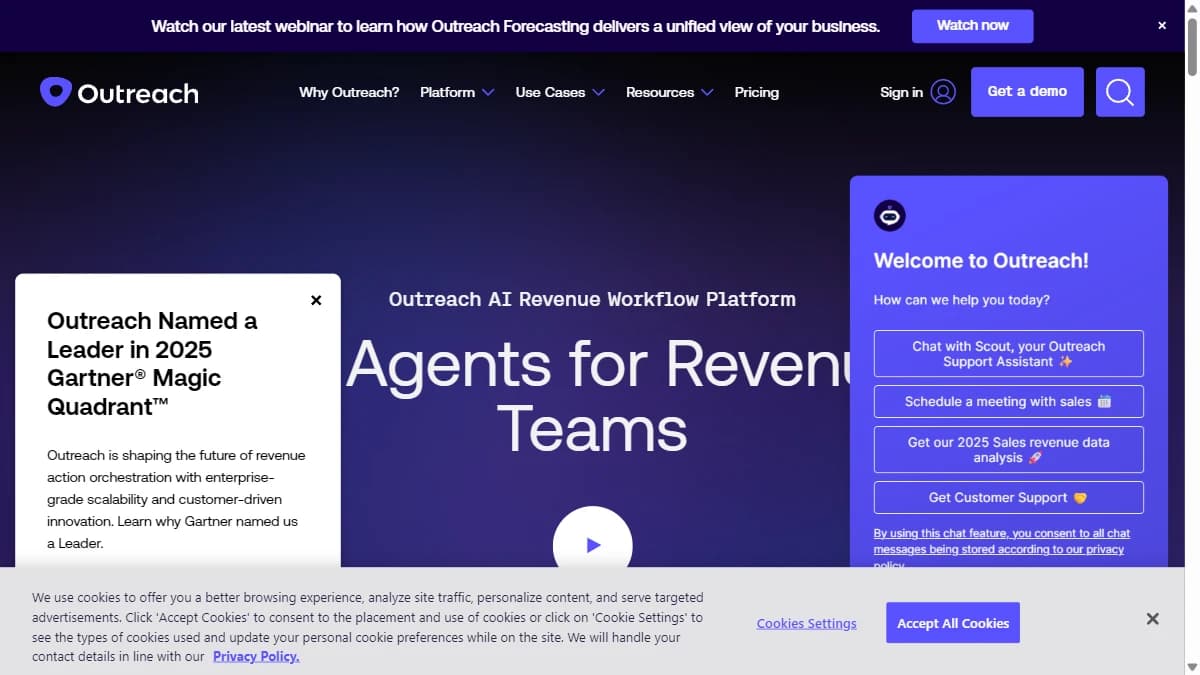
The platform serves enterprise sales orgs that want one tool for prospecting sequences, deal management, forecasting, and call coaching — rather than a stack of point solutions. Its AI agents automate the research and decision work that previously required a rep to do manually, including which prospects to contact next, what to say on a call, and which deals are at risk.
Outreach is not a data provider. It does not enrich contacts from external sources by default. What it does is take the data already in your CRM — contacts, account firmographics, deal history, activity logs — and run AI models on top of it. That distinction matters a lot for what the agents can actually do.
Outreach AI Pricing: What the AI Tier Costs
Outreach does not publish pricing publicly. Based on Gartner Peer Insights data and buyer reports, here is what teams actually pay.
| Plan | Approx. Price | AI Features Included | Best For |
|---|---|---|---|
| Core (Engage) | ~$100/user/mo | Basic Prospecting Agent, limited AI writing | Teams that primarily need multichannel sequences |
| Plus | ~$130/user/mo | Full AI agents suite, Kaia conversation intelligence, Deal Intelligence | Most enterprise teams; AI agents at full capability |
| Pro | ~$160/user/mo | All Plus features plus advanced forecasting AI, custom models | RevOps-heavy orgs with complex forecasting needs |
| Implementation | $5K–$25K one-time | Required for AI agent configuration | All tiers |
Annual contracts are mandatory. Outreach does not offer monthly billing. A 25-rep Plus team runs approximately $39,000 per year on the seat cost alone — before implementation, data tools, or add-ons.
One important note: Outreach's AI agents do not include contact enrichment. If you want agents to pull verified email addresses, phone numbers, or company firmographics, you need a separate data provider (ZoomInfo, Apollo, or SyncGTM) connected via integration.
Outreach AI Agents: What Each One Does
Outreach uses the term "AI agents" for five distinct capabilities in the platform. They vary significantly in maturity — two are fully GA, two are in Beta, and one is still coming.
| Agent | Status | What It Does | Data Dependency | Known Gap |
|---|---|---|---|---|
| Prospecting Agent | GA | Identifies ICP-matching prospects and auto-enrolls them in sequences | Clean ICP definition in CRM; enriched company/contact attributes | Misses prospects not yet in your CRM; can't infer intent from buyer behavior |
| Research Agent | GA | Generates account summaries before calls, pulling from LinkedIn and CRM notes | Recent CRM activity notes; accurate company firmographics | Summaries are only as fresh as the data it reads — stale CRM = stale briefing |
| Deal Intelligence Agent | GA | Risk-scores open opportunities based on engagement signals and pipeline activity | Consistent stage updates and logged activity in CRM | Needs disciplined CRM hygiene; misses external intent signals (funding, hiring) |
| Meeting Prep Agent | Beta | Pre-call brief with buyer context and recommended talking points | Accurate contact titles, past call transcripts, opportunity details | Beta label; context limited to what's already in your Outreach/CRM history |
| Reply Agent | Coming Soon | Auto-drafts email replies in the rep's voice | Historical email examples; rep writing style | Not yet generally available as of September 2026 |
Prospecting Agent
The Prospecting Agent is Outreach's most-used AI feature. It identifies prospects that match your ICP definition and automatically enrolls them in the appropriate sequence.
You configure the agent with your ICP criteria — company size, industry, title — and it monitors your connected data sources for new matches. When a match appears, it queues the enrollment for rep review or fires automatically depending on your approval settings.
The practical ceiling: the agent only surfaces people already in your CRM or connected data source. It cannot find net-new prospects from the open web. If your CRM has gaps in coverage — industries you haven't prospected, companies that changed tech stacks, contacts who changed roles — the agent misses them entirely.
Research Agent
The Research Agent generates a one-page account brief before a scheduled call. It aggregates recent LinkedIn activity, company news, CRM notes, and past email threads into a structured summary.
Reps using Research Agent consistently report saving 10–15 minutes per meeting. The briefs are genuinely useful when the underlying data is current. The problem is that they are only as fresh as the inputs — if the last CRM note is six months old or the company firmographics haven't been updated, the summary reflects that staleness.
Deal Intelligence Agent
Deal Intelligence scores each open opportunity on a risk-to-close scale. It factors in engagement recency (last email open, last call), stage velocity, and whether key stakeholders have been contacted recently.
This is genuinely useful for sales managers running weekly pipeline reviews. Red-flagged deals bubble up automatically rather than getting buried in a spreadsheet. The limitation is the same as with the Prospecting Agent: it scores based on internal CRM signals, not external buying signals like funding announcements, hiring surges, or tech stack changes.
Meeting Prep Agent (Beta)
Meeting Prep is a more detailed version of the Research Agent, focused specifically on call preparation. It generates recommended talking points, surfaces recent prospect content (LinkedIn posts, press releases), and highlights open questions from previous calls.
It is labeled Beta as of September 2026 and is available on Plus and Pro plans. Early feedback from G2 reviewers is positive on accuracy but mixed on consistency — some accounts get rich briefs, others get thin ones depending on how much data is linked to the contact record.
Reply Agent (Coming Soon)
The Reply Agent will auto-draft email responses in the rep's voice, trained on their previous email history. As of September 2026, it is listed as coming soon on the Outreach product roadmap. No GA date has been announced.
Kaia: Conversation Intelligence
Kaia is the most mature and consistently praised AI feature in Outreach. It records and transcribes every sales call, generates a structured summary with action items, and provides real-time coaching cards during the conversation.
During a live call, Kaia listens for trigger phrases and surfaces relevant battlecards. If a prospect mentions a competitor, Kaia pops up the relevant win card. If they ask about pricing, it surfaces the pricing objection playbook. Reps do not have to break eye contact with the screen to find these themselves.
Post-call, Kaia generates a summary with flagged moments: competitor mentions, budget objections, next-step commitments, and sentiment signals. This is useful both for rep self-coaching and for managers who want to review calls without listening to the recording.
Where Kaia genuinely outperforms competitors: transcript accuracy on technical sales vocabulary. Gong and Salesloft Drift are the primary alternatives. Kaia is consistently rated on par or slightly below Gong on accuracy, but included at the Plus tier rather than priced separately.
AI-Driven Forecasting and Pipeline Visibility
Outreach's AI forecasting models use historical deal data, engagement signals, and rep behavior to predict commit, best-case, and pipeline scenarios for a given quarter.
The model compares the current quarter's deals against similar deals in historical data — same stage, similar size, same rep — and flags where the current pipeline deviates from the historical win pattern. For RevOps teams running weekly forecast calls with executives, this is meaningfully faster than building the same models manually in Salesforce reports.
The forecasting AI requires at least six months of clean historical data to produce reliable models. Teams that are new to Outreach or that have inconsistent stage-entry criteria will find the forecasts less reliable in year one.
Outreach claims customers see up to 10x productivity increase from their AI layer. The more defensible number from G2 reviewers: most mid-market teams report a 15–25% reduction in rep time spent on administrative CRM work.
Outreach AI Pros: Where It Delivers
- Most mature AI agent architecture in sales engagement. The Prospecting Agent, Research Agent, and Deal Intelligence are all GA — not beta labels on a roadmap.
- Kaia is genuinely best-in-class. Real-time coaching cards, accurate transcription, and post-call summaries are consistently rated among the best on G2. It is included at Plus tier, not priced separately like Gong.
- AI forecasting that works at scale.Deal scoring and scenario modeling are useful from 20+ reps. Smaller teams won't have enough historical data to see the models perform well.
- Enterprise-grade Salesforce integration.Bidirectional sync, activity logging, and opportunity updates flow reliably. Outreach's Salesforce integration is rated among the strongest in the category.
- Single platform for execution and intelligence. Most Outreach customers replace Gong, their sequence tool, and their pipeline tracker simultaneously — reducing the number of vendor logins a rep manages daily.
Outreach AI Cons: The CRM Data Problem
Every AI feature in Outreach runs on the data inside your CRM. That is the system's most important architectural constraint.
The Prospecting Agent targets based on ICP criteria you define — but it only evaluates contacts and accounts already in your database. The Research Agent summarizes what's in your CRM notes. The Deal Intelligence Agent scores based on logged activity. None of these agents have access to what's happening outside your instance.
In practice, this means:
- Incomplete contact recordsproduce shallow Research Agent briefs. If 40% of your contacts are missing job titles or company revenue, the agent's summaries will miss context.
- Contacts who changed roles(an average of 28% of B2B contacts per year) remain in the Prospecting Agent's pool until manually updated or cleaned. The agent doesn't know someone left.
- No external intent signals.The Deal Intelligence Agent doesn't know that an account just raised a Series B, tripled their engineering headcount, or switched from Salesforce to HubSpot. Those are buying signals that don't live in your CRM unless you put them there.
- No native enrichment. Outreach does not verify or enrich contact data on its own. You need a separate data layer — ZoomInfo, Apollo, or a waterfall enrichment tool — to keep records current.
This is where SyncGTM fits into an Outreach deployment. SyncGTM enriches every contact from 50+ providers with 76+ data points — verified emails, phone numbers, job titles, company firmographics — and layers 15 intent signals on top: funding rounds, hiring surges, job changes, tech stack additions. That enriched data feeds into Outreach, giving the AI agents better inputs and producing better outputs across every feature.
It is the difference between an AI agent that works at 60% capacity because it's guessing from incomplete records, and one that works at its ceiling because every contact it evaluates is current, complete, and signal-enriched.
Why data quality is the hidden Outreach AI variable
Teams using Outreach with a dedicated enrichment layer report meaningfully better AI agent performance. The Research Agent generates richer briefs. The Prospecting Agent surfaces fewer false-positive contacts. Deal Intelligence catches at-risk deals earlier. The agents are the same — the data underneath them is different.
Additional cons worth noting:
- HubSpot integration has documented failure modes.Outreach's Salesforce integration is exceptional. Its HubSpot integration is rated significantly lower — data sync delays, duplicate activity logging, and field mapping issues are reported regularly on G2.
- Steep learning curve. Most enterprise teams report 6–12 weeks to full deployment. AI agent configuration requires RevOps admin time that many teams underestimate.
- Support quality has declined.Multiple recent G2 reviews (2025–2026) cite slower response times following Outreach's 2024 restructuring.
- Auto-renewal terms. Annual contracts include 8–12% auto-renewal uplift unless cancelled within the renewal window, which is typically 60–90 days before expiry.
Outreach AI vs Salesloft vs Apollo vs SyncGTM
Outreach, Salesloft, and Apollo all market AI-powered sales engagement. They overlap on sequences and CRM sync, but diverge on AI depth, data ownership, and pricing model.
| Feature | Outreach AI | Salesloft | Apollo AI | SyncGTM |
|---|---|---|---|---|
| AI Prospecting Agent | Yes (GA) | Basic | Beta | N/A — enrichment layer |
| Intent Signals | Not included | Not included | Basic (job change only) | 15 signals (funding, hiring, job change, tech) |
| Contact Enrichment | Requires ZoomInfo add-on | Requires 3rd party | 70+ data points | 76+ data points via 50+ providers |
| Conversation Intelligence | Yes (Kaia) | Yes (Drift) | No | No |
| AI Deal Forecasting | Yes | Yes | No | No |
| Sequence Execution | Full multichannel | Full multichannel | Full multichannel | No — feeds your sender |
| Starting Price | ~$100/user/mo | ~$100/user/mo | $59/user/mo | $99/mo flat |
| CRM Dependency | High — AI needs Salesforce | High | Medium | Low — optional |
SyncGTM is not a direct Outreach competitor. It is the data enrichment and intent signal layer that sits upstream of outreach execution. Teams using Outreach AI get the most from it when contacts arrive enriched with current job titles, verified emails, and intent signals — which is what SyncGTM provides.
For a detailed comparison of Outreach against alternatives, see our full Outreach.io review. For the broader category of AI outreach tools, we cover 7 platforms head-to-head.
Who Should Use Outreach AI?
Outreach AI is the right choice if:
- You have 25+ sales reps and a dedicated RevOps admin to configure and maintain the platform.
- Your primary CRM is Salesforce and you want deep bidirectional sync.
- You need conversation intelligence (Kaia) included in your seat cost rather than paying for Gong separately.
- You run complex multi-stakeholder enterprise sales cycles where Deal Intelligence's risk scoring adds genuine value.
- You want the most mature AI agent architecture in the enterprise sales engagement category.
Consider alternatives if:
- You have fewer than 20 reps — the pricing and complexity are hard to justify below that threshold.
- Your CRM is HubSpot — the integration issues are documented and ongoing.
- You need website visitor identification or account-level intent signals — Outreach has no native intent layer.
- You want monthly billing or a flexible contract — Outreach requires annual commitments with auto-renewal.
Teams landing between these two buckets — strong sequences, good CRM discipline, but limited budget for a full Outreach deployment — often find a better ROI with lighter AI outbound agents paired with dedicated enrichment than with Outreach at $100+/seat. See also: best AI agent tools for GTM teams.
Conclusion: Is Outreach AI Worth It in 2026?
Outreach has the most mature AI layer in enterprise sales engagement. The Prospecting Agent is live and useful. Kaia is genuinely best-in-class for conversation intelligence. Deal Intelligence catches at-risk deals earlier than a rep would manually. Meeting Prep Agent will get there once it exits Beta.
The constraint is not the AI — it is the data. Every Outreach AI feature produces outputs proportional to the quality of inputs in your CRM. Stale contacts, missing firmographics, and no external intent signals put a ceiling on what the agents can accomplish.
For teams serious about getting Outreach AI to perform at its ceiling: SyncGTM enriches contacts from 50+ providers with 76+ data points and 15 buying signals per account. Your Outreach agents get better inputs. Your reps get better results.