

5 Best ParseHub Alternatives for B2B Enrichment in 2026

By Kushal Magar · June 9, 2026 · 11 min read · Last updated: September 30, 2026
Key Takeaway
ParseHub is a visual web scraper, not a B2B prospecting platform — it pulls raw page data with no verification and no outreach layer, so every scrape needs cleanup and a separate verification tool before it is usable. The 5 best ParseHub alternatives for B2B enrichment in 2026 are: SyncGTM (waterfall enrichment across 50+ providers with buying signals and native CRM sync, free to start), Apollo.io (275M+ contact database with built-in outreach from $49/mo), Explorium.ai (structured data on 146M+ companies and 767M+ professional profiles via prompt, API, and MCP, with credit packages from $29.99), Hunter.io (focused email finder from $34/mo), and UpLead (real-time verified contacts with a 95% accuracy guarantee from $99/mo).
ParseHub is a visual web scraper that pulls structured data from dynamic, JavaScript-heavy pages without code. You build a project by clicking the elements you want, and it handles dropdowns, infinite scroll, and pagination. For one-off data extraction, it is genuinely good — which is why teams searching for ParseHub alternatives are usually not unhappy with the scraping itself.
They are unhappy with what comes after. ParseHub pulls raw page text — it does not verify a single email or phone number it scrapes. Every record needs cleaning, deduping, and a separate verification pass before you can send a campaign.
There is also no contact database to search, no outreach layer, and run-and-page limits that throttle volume on the lower tiers. So you scrape, clean, verify, enrich, then move it all to yet another tool to actually reach anyone. This guide covers five ParseHub alternatives that replace that chain with verified contact data you can actually send to.
Quick Summary
The best ParseHub alternatives in 2026 are SyncGTM, Apollo.io, Explorium.ai, Hunter.io, and UpLead. SyncGTM is the top pick for most B2B teams — waterfall enrichment across 50+ providers, buying signals, and native CRM integrations, free to start. Apollo.io pairs a 275M+ contact database with built-in sequences from $49/mo. Explorium.ai replaces scraping with a structured dataset of 146M+ companies and 767M+ profiles, from $29.99 per credit package. Hunter.io is the cleanest email finder from $34/mo. UpLead guarantees 95% accuracy on real-time verified contacts from $99/mo.
TL;DR: Best ParseHub Alternatives in 2026
- SyncGTM — Best overall. Waterfall enrichment across 50+ providers, buying signals, and native CRM sync. Free to start.
- Apollo.io — Best all-in-one. 275M+ contact database with built-in email sequences from $49/mo.
- Explorium.ai — Best for structured company data without scrapers. 146M+ companies and 767M+ profiles via prompt, API, or MCP. Free trial (100 credits), then from $29.99 per credit package.
- Hunter.io — Best focused email finder. Domain search, Chrome extension, and email campaigns from $34/mo.
- UpLead — Best accuracy guarantee. Real-time verified contacts with a 95% accuracy promise from $99/mo.
Why B2B Teams Switch from ParseHub
ParseHub is a general-purpose visual web scraper. It was built to pull structured data off any page — not to source, verify, and reach B2B buyers. That mismatch creates four recurring problems for sales teams.
No data verification. ParseHub extracts whatever text sits on a page. A scraped email is unverified until you run it through a separate tool, and scraped-and-guessed addresses routinely bounce at 30–50%. Sending to that list damages your domain reputation before a single reply lands.
No contact database. ParseHub has nothing to search — you have to find the pages, build the project, and maintain it yourself. The moment a target site changes its layout, the selectors break and the project needs a rebuild. That is a constant maintenance tax that a verified database simply does not have.
No outreach or CRM layer. ParseHub produces a JSON or CSV export. It has no sequences, no CRM sync, and no path from a scraped row to a sent email. Every record requires a separate stack to enrich and reach.
Run and page limits. Free and Standard tiers cap how many pages each run can process and how fast it goes — 200 pages can take 40 minutes on Standard. For high-volume prospecting, that throughput is a hard ceiling, and longer data retention sits behind the pricier plans.
According to a Gartner analysis of B2B data quality, B2B contact data decays at roughly 30% per year. A point-in-time scrape captures a page as it looked that day — it cannot keep pace with that decay. Waterfall enrichment across multiple live providers is one way to maintain hit rate at scale.
The five alternatives below address those problems with verified data, a searchable database, and no run-and-page ceiling, and several add a direct outreach path. If you want the full breakdown of ParseHub itself, see our ParseHub review.
1. SyncGTM — Best ParseHub Alternative Overall
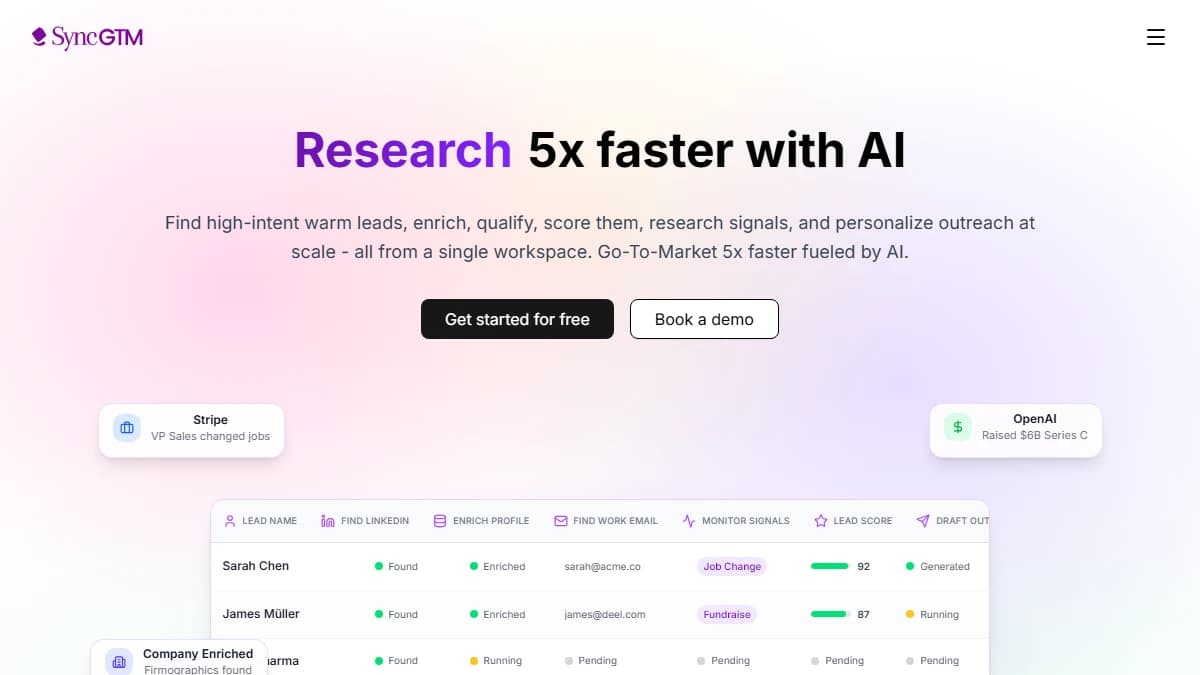
SyncGTM — waterfall enrichment across 50+ providers with buying signals and native CRM sync
SyncGTM is a B2B prospecting platform built around waterfall enrichment — querying 50+ data providers in sequence until verified contact data is found. Where ParseHub scrapes raw, unverified page text, SyncGTM returns verified emails, phone numbers, and firmographics in one pass.
The workflow difference is the whole point. ParseHub forces a scrape-clean-verify-enrich-export chain across multiple tools. SyncGTM combines waterfall enrichment, buying signals, and native CRM sync in one platform — no projects to maintain, no cleanup step, no manual export.
Buying signals — job changes, funding, headcount growth, hiring, and web traffic — flag in-market accounts, and AI lead scoring ranks leads against your ICP. MCP access from Claude, ChatGPT, and Cursor lets you run lookups from the AI tools your team already uses.
Pros
- • Waterfall enrichment across 50+ providers — verified data, not raw scrapes
- • Verified emails, phone numbers, and firmographics per lead
- • Buying signals — job changes, funding, headcount growth, hiring, and web traffic
- • AI lead scoring against your ICP
- • Native CRM integrations with Salesforce, HubSpot, Pipedrive, Attio, and Close
- • MCP access from Claude, ChatGPT, and Cursor
- • Free to start
Cons
- • Free plan is credit-limited, so regular use means moving to a paid plan
- • Not a general-purpose page scraper — if you only need to pull arbitrary structured data off any website, ParseHub still covers that niche
Best for: B2B sales teams that need verified, CRM-ready leads at scale without scraping, cleaning, and stitching together a multi-tool stack.
Pricing: Free to start. See SyncGTM pricing for paid plans.
2. Apollo.io
Apollo.io — 275M+ contact database with built-in outreach sequences
Apollo.io is a prospecting platform built around a 275M+ contact database with built-in email sequencing. It removes the entire reason most people reach for ParseHub: instead of scraping pages to find contacts, you search a verified index directly.
Where ParseHub makes you build a project, scrape, clean, verify, then hand the result to a separate sequence tool, Apollo covers the full flow. Filter contacts by job title, industry, company size, and tech stack. Push them into a sequence. Track opens, replies, and meetings — all in one platform.
Apollo's free plan includes 10,000 email exports per month, one of the most generous free tiers in B2B data. The Basic plan at $49/mo adds unlimited email finding and 250 mobile number credits per month.
Pros
- • 275M+ contacts and 73M+ companies with 65+ searchable filters
- • Verified, searchable data — no scraping or cleanup required
- • Built-in email sequencing and call recording — no third-party tool needed
- • Generous free plan: 10,000 email exports/month
- • Native HubSpot, Salesforce, and Pipedrive integrations on paid plans
Cons
- • Single data source — no waterfall enrichment to recover missed contacts
- • Mobile phone coverage weaker than purpose-built phone tools like Cognism
- • European contact coverage thinner than North American data
- • CRM integrations locked to Professional plan ($79/mo) and above
Best for: SDR teams that want prospecting and outreach in one platform without building a scraping and cleanup stack.
Pricing: Free (10,000 email exports/mo). Basic $49/mo. Professional $79/mo. Organization $119/mo.
3. Explorium.ai
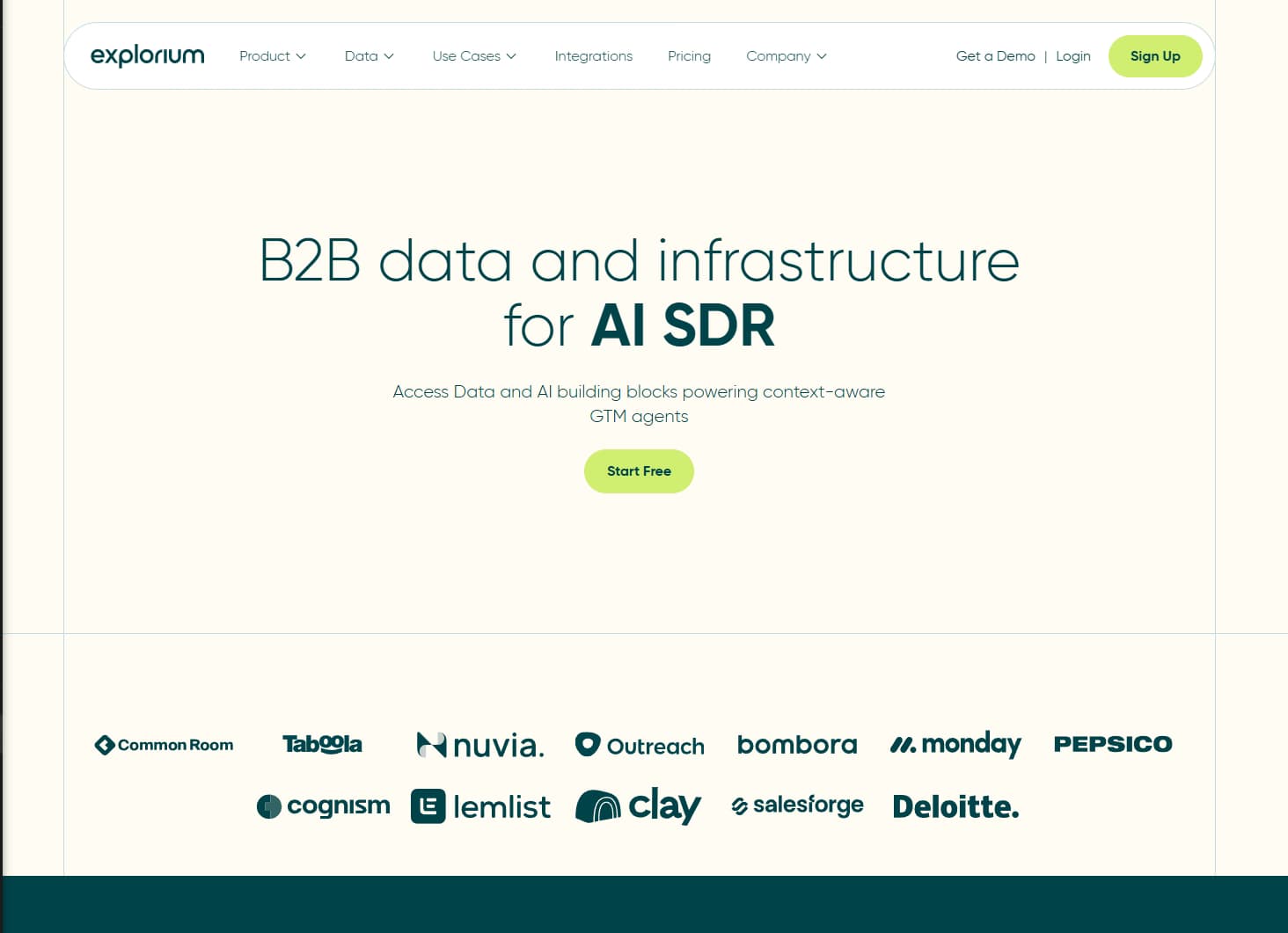
Explorium.ai — structured B2B company and contact data through a prompt app, REST API, and MCP server
Explorium.ai suits ParseHub users who were scraping company websites to build prospect data. Instead of writing a project for each site, you query a B2B dataset of 146M+ companies and 767M+ professional profiles from 100+ sources, with firmographics, technographics, funding data, website changes, and contact details already structured.
The difference from ParseHub is that the data arrives ready to use. Builders who liked ParseHub's API get AgentSource, a REST API and hosted MCP server that resolves, enriches, and monitors company and prospect records, with bulk enrichment of up to 50 records per request. Non-technical users can build lists from plain-English prompts in Vibe Prospecting.
Explorium sells credit packages rather than monthly seats. A search costs 1 credit and an enrichment costs 1–5 credits. After a 100-credit free trial, packages start at $29.99 for 500 credits, and paid credits stay valid for 12 months.
Pros
- • 146M+ companies and 767M+ professional profiles, with no scraping projects to maintain
- • Company data covers firmographics, technographics, funding, and website changes
- • REST API and hosted MCP server — a natural fit for builders who used ParseHub's API
- • 4,000+ signals such as funding rounds, hiring, job changes, and tech changes
- • Credit packages from $29.99 with no per-seat fees
Cons
- • Covers B2B company and contact data, not custom fields from arbitrary web pages
- • No native outreach sequencing — needs a separate email tool
- • No spreadsheet-style workflow builder
- • API and MCP paths assume some technical comfort
- • Credit cost varies by enrichment type
Best for: Growth teams and GTM engineers who used ParseHub to collect company data and would rather query a structured B2B dataset by prompt, API, or MCP.
Pricing: Free trial (100 credits). Lite $29.99 (500 credits). Starter $149.99 (5,000 credits). Growth $749.99 (30,000 credits). Enterprise custom.
4. Hunter.io
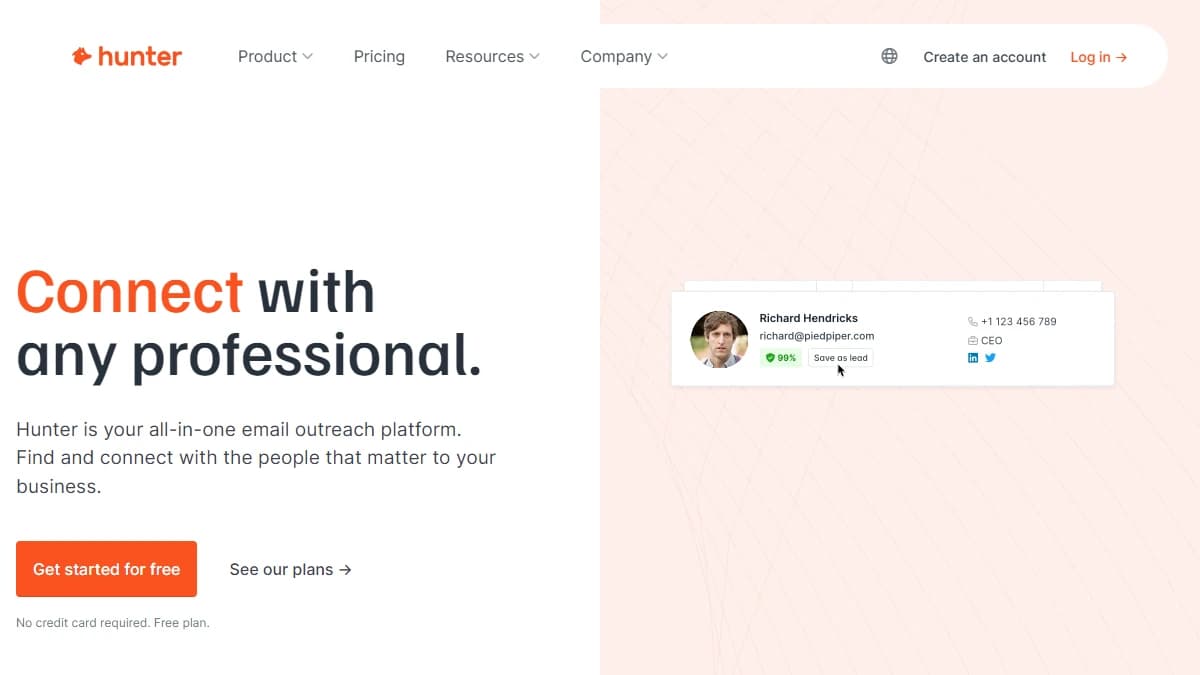
Hunter.io — domain search, email finder, and verified cold email campaigns
Hunter.io is a focused email finder — it locates and verifies professional email addresses from company domains, finds specific contacts by name and company, and validates deliverability before you send. It does one thing very well.
Hunter's Domain Search is the flagship: enter any company domain and get publicly discoverable professional email addresses with confidence scores. The Chrome extension works on LinkedIn and company sites for one-click lookups, and bulk search handles CSV uploads for list enrichment.
Unlike ParseHub's unverified scrapes, Hunter sources from publicly available web pages and verifies every address. According to Hunter's pricing page, the Starter plan at $34/mo (annual) includes 500 searches and 1,000 verifications per month, with unlimited team members on all plans.
Pros
- • Industry-leading Chrome extension for LinkedIn and website email lookup
- • Domain Search surfaces verified company emails in seconds
- • Built-in email verification — no separate validation tool needed
- • Transparent sourcing from public web pages — strong GDPR position
- • Free plan: 25 searches and 50 verifications/month, no card required
Cons
- • Email only — no phone numbers, firmographics, or technographics
- • No waterfall enrichment — single source means lower hit rate on hard contacts
- • Not a prospecting database — you need the domain to start
- • Campaign sequencing is basic versus dedicated outreach tools
Best for: Freelancers, link builders, and solo SDRs who need clean, verified emails from known company domains without complex setup.
Pricing: Free (25 searches/mo). Starter $34/mo (annual). Growth $69/mo (annual). Business $149/mo (annual).
5. UpLead
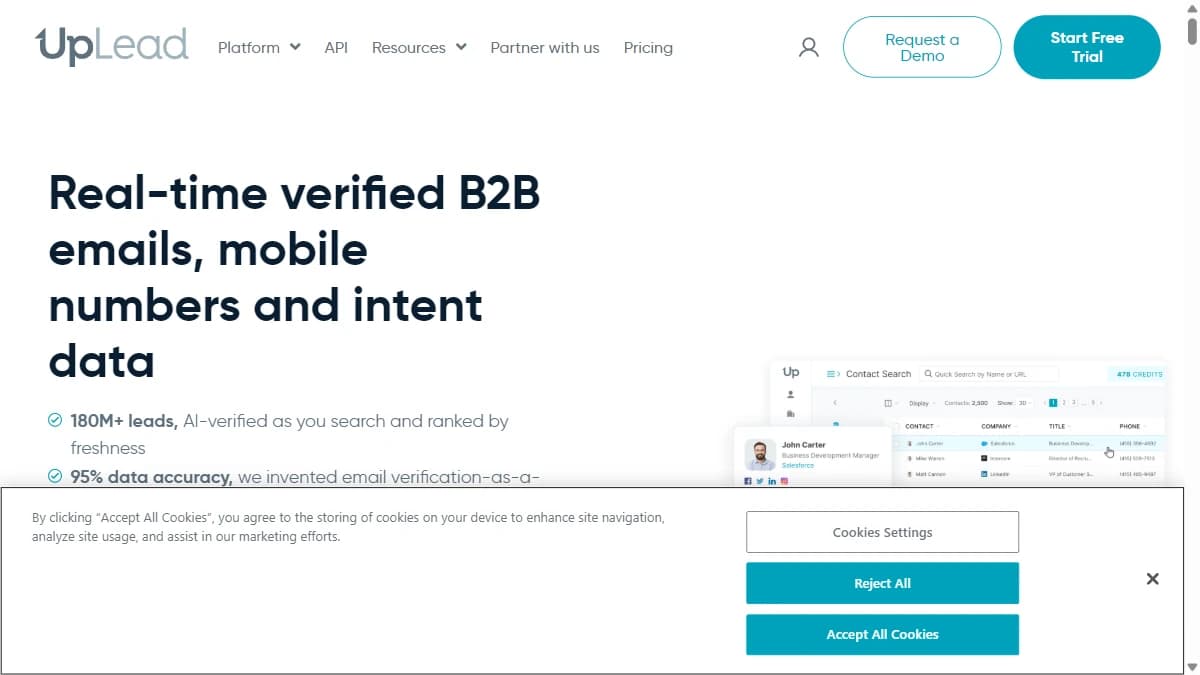
UpLead — real-time verified B2B contacts with a 95% accuracy guarantee
UpLead is a B2B contact database built around a single promise: verified data. Every email is checked in real time at the moment of export, backed by a 95% accuracy guarantee that credits you back for any bounce.
That guarantee is exactly what ParseHub cannot offer. Scraped data is unverified by definition, while UpLead validates on export so you only pay for contacts that actually land. Search 155M+ contacts across 50+ filters, including technographics and intent signals.
UpLead's Essentials plan starts at $99/mo for 170 credits, with each credit unlocking a full contact record. It is a clean, mid-market replacement for the scrape-and-verify grind, especially for North American data.
Pros
- • 95% accuracy guarantee with real-time email verification on export
- • 155M+ contacts with 50+ search filters
- • Technographic and intent data on higher tiers
- • Credit refund for any contact that bounces — no wasted spend
- • Simple, transparent monthly pricing
Cons
- • Single data source — no waterfall to recover missed contacts
- • Credit-based model gets expensive at high volume
- • International coverage weaker than North American data
- • No native outreach sequencing — export to a separate tool
Best for: Mid-market teams that want a verified, guaranteed-accurate contact database to replace scraping, especially for US prospecting.
Pricing: Free trial (5 credits). Essentials $99/mo. Plus $199/mo. Professional custom.
ParseHub Alternatives: Side-by-Side Comparison
Here is how the five best ParseHub alternatives compare on the things that actually matter for B2B prospecting — verified data, enrichment depth, and price.
| Tool | Data Approach | Verified Contacts | Starting Price |
|---|---|---|---|
| SyncGTM | Waterfall (50+ providers) | Yes — email + phone | Free to start |
| Apollo.io | Single database (275M+) | Yes — email + phone | $49/mo (free tier) |
| Explorium.ai | Own dataset (100+ sources) | Work email + phone | $29.99/pkg (free trial) |
| Hunter.io | Domain search (single source) | Yes — email only | $34/mo (free tier) |
| UpLead | Single database (155M+) | Yes — 95% guarantee | $99/mo (free trial) |
| ParseHub | Visual web scraper | No — unverified | $189/mo (free tier) |
How to Choose a ParseHub Alternative
The right ParseHub alternative depends on what you were actually using ParseHub for. Match the tool to the job.
- You want verified contacts and buying signals in one platform. Pick SyncGTM. Waterfall enrichment across 50+ providers, buying signals, and native CRM sync — the cleanest end-to-end replacement for the scrape-and-clean grind.
- You want prospecting and sequencing together on a budget. Pick Apollo.io. The 275M+ database plus built-in outreach at $49/mo is the best all-in-one value for SDR teams.
- You scraped sites mainly to collect company data. Pick Explorium.ai. Query 146M+ companies and 767M+ profiles by API, MCP server, or plain-English prompt instead of maintaining a project for every site.
- You only need verified emails from known domains. Pick Hunter.io. The focused email finder at $34/mo is the simplest, cheapest way to stop scraping for addresses.
- You need a guaranteed-accurate US contact database. Pick UpLead. The 95% accuracy guarantee with credit refunds removes the bounce risk scraping never could.
Still mapping out your stack? Our guide to B2B sales prospecting tools covers the wider category, and the best waterfall contact providers ranking breaks down enrichment depth versus cost in detail.
Final Verdict: The Best ParseHub Alternative for B2B
ParseHub is a strong visual scraper, but scraping is only the first step of B2B prospecting — and the easiest one to replace. The hard parts are verification, enrichment, and outreach, and ParseHub does none of them.
For most B2B teams, SyncGTM is the best ParseHub alternative. It collapses the scrape-clean-verify-enrich chain into one platform: waterfall enrichment across 50+ providers, buying signals, and native CRM sync — and it is free to start.
If outreach matters most and budget is tight, Apollo.io is the value pick. If you were scraping mostly for company data, Explorium.ai gives you a structured B2B dataset instead. For pure email finding, Hunter.io is the cleanest entry point, and UpLead is the safest bet when accuracy is non-negotiable.
The common thread: every option here returns verified data you can actually send to — something a raw scrape never delivers on its own. Start with SyncGTM's free tier and replace the scrape-and-clean grind with a single enrichment run.
This post was last reviewed in June 2026. Pricing and features are subject to change — verify current plans on each provider's website before purchasing.