

Salesmotion Review 2026: Signal-Based Selling — Pricing and Features

By Kushal Magar · April 8, 2026 · 12 min read · Last updated: September 30, 2026
Key Takeaway
Salesmotion is an AI-powered account intelligence platform that monitors buying signals like earnings calls, leadership changes, funding rounds, and hiring trends. The Individual plan costs $85/mo for one user, 100 monitored accounts, and 200 contact credits a month; team plans with unlimited users are custom-priced (as of September 2026). The Signal Agent and Deep Research Agent automate account monitoring and competitive intelligence. G2 rating 4.8/5. Best for: mid-market and enterprise AEs who need deep account research and signal prioritization and already have an outreach tool. Main limitations: no outreach automation, limited contact data volume, and no CRM integrations below the custom plan.
Salesmotion is an account intelligence platform that uses AI agents to monitor buying signals and prioritize your target accounts. The pitch: stop manually researching accounts and let AI surface the signals that matter most to each rep's book of business.
You are probably here because you need to know whether signal-based selling actually works or whether it is just another dashboard your team will ignore after the first month.
This Salesmotion review covers how the AI signal agents work, what the team and individual plans actually cost, where the platform stops short, and whether the signal layer justifies paying for a tool with limited contact data and no outreach automation.
Salesmotion Review: What You Get (and What You Don't)
Salesmotion positions itself as the account intelligence layer for B2B revenue teams. It monitors thousands of signal sources and distills them into recommended actions for each rep. Check their ratings on G2 (4.8/5).
| Feature | What's Included | Limitations |
|---|---|---|
| Signal Agent | Tracks earnings calls, funding, leadership changes, hiring trends | Monitors the accounts you specify (100 on the Individual plan) |
| Research Agent | Account summaries, competitive intelligence, stakeholder maps | Research only — it does not act on what it finds |
| Contact Credits | Verified emails and direct dials, plus relationship maps | 200 credits/month on the Individual plan |
| Account Prioritization | Ranks accounts by signal strength and relevance | Requires well-defined target account lists |
| Outreach Drafts | AI-generated messaging based on account signals | No native sending or sequencing |
| CRM Integration | Salesforce and HubSpot on custom plans | No CRM integrations, API, or MCP access on the Individual plan |
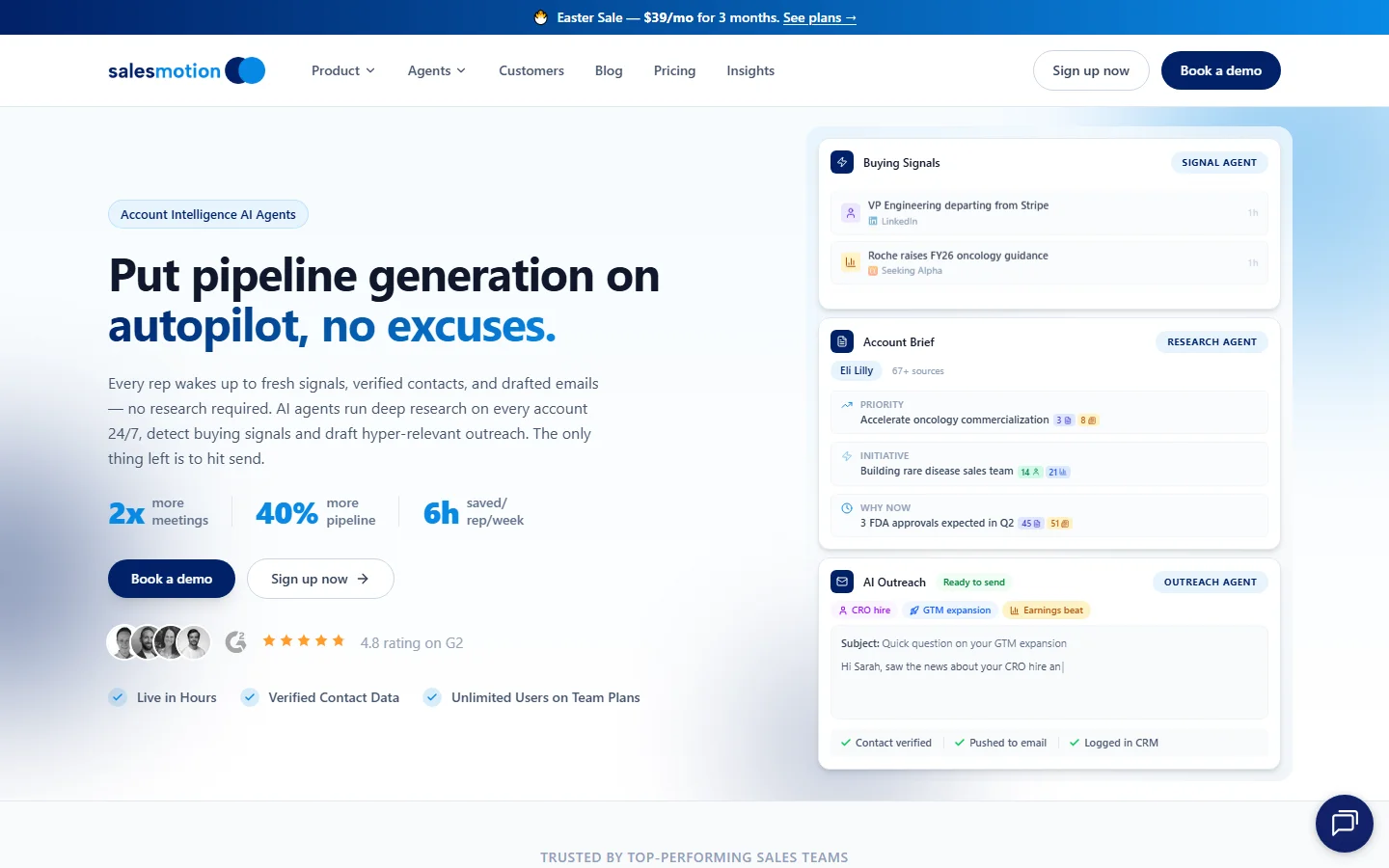
Salesmotion homepage
The takeaway: Salesmotion excels at telling you which accounts to prioritize and why. What it does not do is send anything, and its contact data is capped at 200 credits a month on the Individual plan (as of September 2026).
Salesmotion Signal Agents: How Account Intelligence Works
Salesmotion's Signal Agent continuously monitors your target accounts across thousands of sources: SEC filings, press releases, job postings, product launches, leadership changes, and earnings calls. When something actionable happens, it alerts reps via Slack or CRM with a recommended next step.
The Research Agent compiles deep account summaries on demand. Ask it about an account before a meeting and it pulls competitive intelligence, stakeholder maps, technology stack data, and recent news into a single brief. Frontify's sales team reported a 42% increase in sales velocity and 4x self-sourced revenue after adopting the platform.
What works well
The signal quality is high. Unlike broad intent data providers that flood you with noisy topic-level signals, Salesmotion ties each signal to a specific account context. Analytic Partners cut account research time by 85%, dropping from 3 hours to 15 minutes per account. The pricing model (accounts monitored, not seats) means you can give every rep access without per-seat costs on team plans.
Where it falls short
Salesmotion tells you what is happening at an account, and relationship maps plus 200 monthly contact credits on the Individual plan help you reach a few of the right people. But once you map several stakeholders across a 100-account book, 200 credits runs out quickly, so heavier prospecting still needs a separate contact data source. Read our best buying intent data tools guide for a broader comparison.
Salesmotion Pricing Breakdown
Salesmotion prices by accounts monitored, not by user seat. Their pricing page shows three options (as of September 2026):
- •Individual ($85/mo, billed monthly): One user, 100 monitored accounts, 24/7 Signal Agent, Deep Research Agent, unlimited AI outreach drafts, 200 contact credits a month (verified email and direct dial), lookalike account discovery, and relationship maps. No CRM integrations, API, or MCP access. Cancel anytime.
- •Custom (contact sales): Unlimited users, custom account and contact credit volumes, Salesforce and HubSpot integrations, API and MCP access, custom signals and data sources, founder-led onboarding, dedicated support, and SSO and security review. Annual discounts available.
- •API Only (developers): Free to start with 100 credits and no credit card, then pay-per-result.
What you actually pay
The Individual plan at $85/mo is fair for a solo AE or founder doing their own prospecting research, especially now that it includes 200 contact credits a month. The step up to a team is significant: Salesmotion no longer publishes a team price, so anything beyond one seat, and any CRM integration, means a custom contract. That buys you unlimited seats, but the real variable is how many accounts you monitor. Budget for an outreach tool on top, and for a contact data provider if 200 credits per seat will not cover your prospecting.
Hidden costs to watch
- Contact data is capped at 200 credits a month on Individual — heavier prospecting needs a separate enrichment provider
- No outreach automation — signals require manual follow-up or another tool
- No CRM integrations, API, or MCP access on the Individual plan
- No published team price — more than one seat means a custom, sales-led contract
- Account-based pricing means costs grow with your target account list
What Are the Downsides of Using Salesmotion?
Signals without execution
Salesmotion tells you that a target account just got funding or hired a new VP of Sales. It even drafts a suggested message. But it does not send that message. There is no built-in email sequencing, no LinkedIn automation, no dialer. You need to copy the insight into your outreach tool manually or build a Zapier workflow to bridge the gap.
Limited contact data
Knowing an account is in-market is only half the equation. You still need to find the right people at that account and get their contact details. Salesmotion's relationship maps and 200 monthly contact credits (verified emails and direct dials) on the Individual plan cover light prospecting, but if you work several stakeholders across a full account list, you will likely still need Apollo, ZoomInfo, or waterfall enrichment to fill that gap.
Requires predefined account lists
Salesmotion monitors the accounts you give it — 100 on the Individual plan. Lookalike account discovery can suggest companies similar to your best accounts, but it does not replace a defined ICP. If your ICP is evolving or you are expanding into new verticals, you still need to update your monitored list for the signals to remain relevant.
Team pricing is a cliff
Going from $85/mo for one user to a custom team contract is a big step. There is no published mid-tier plan, so a 3-person sales team that outgrows the Individual plan has to negotiate with sales, and CRM integrations only arrive with that custom plan. Small teams risk paying for capacity they do not fully use.
How Salesmotion Works: From Account List to First Outreach
Salesmotion makes more sense once you see the order of operations. Here is how a typical rep workflow runs, and where the plan limits show up along the way (plan details as of September 2026).
- Load your target accounts. The Individual plan monitors up to 100 accounts; custom plans set their own volume. Start with the accounts you most want to close this quarter rather than your whole TAM, because every slot counts.
- Let the Signal Agent watch them. It monitors those accounts around the clock across sources such as SEC filings, press releases, job postings, product launches, leadership changes, and earnings calls, and surfaces the events worth acting on.
- Brief yourself with the Deep Research Agent. Before a first touch or a meeting, pull an account summary with competitive context, stakeholder information, and recent news. Research is unlimited on the Individual plan.
- Map the buying group. Relationship maps show who matters at the account, and contact credits (200 a month on Individual) return verified emails and direct dials for the people you choose.
- Draft the message. AI outreach drafts turn the signal and research into a first message, and drafts are unlimited on Individual. Sending still happens in your email or sales engagement tool.
- Refill the list. Lookalike account discovery suggests companies similar to your best accounts, which helps replace accounts that close or go cold.
- Connect your systems on a custom plan. Salesforce and HubSpot integrations, API access, and MCP access come with custom plans. On Individual, insights move into your CRM by hand.
The weak point is the hand-off at step five: every signal ends in a draft that someone has to copy into another tool. When you evaluate Salesmotion, measure the time from signal to first touch, not just the number of signals surfaced. If that gap stays small, the $85/mo Individual plan pays for itself quickly; if drafts pile up unsent, the intelligence is not turning into pipeline.
Developers who only want the data can skip the app entirely: Salesmotion's API-only option is free to start with 100 credits, then charges per result.
Is Salesmotion Worth It?
Salesmotion is worth it for enterprise AEs and sales leaders who need deep account intelligence and have separate tools for enrichment and outreach. The signal quality is genuinely high. The AI research agent saves hours of pre-call prep. At $85/mo for individuals, it is a reasonable investment for reps who need contextual account insights delivered to them, though CRM sync requires a custom plan.
Salesmotion is not enough for teams that need a complete signal-to-outreach workflow. If your team needs to detect a signal, find the right contact, enrich their data, and send a personalized message in one flow, you need more than Salesmotion alone.
The verdict: excellent account intelligence with a real gap in execution. Start on the Individual plan to test signal quality on your own 100 accounts, and budget for a custom plan once you need CRM sync or more than one seat.
Exploring signal-based selling tools? Read our reviews of Common Room, 6sense, and our roundup of best buying intent data tools for 2026.
If Salesmotion reserving CRM integrations for custom plans is a dealbreaker, SyncGTM is one alternative worth a look: it is free to start and pairs real-time buying signals with native Salesforce and HubSpot integrations.