What Are the Top AI Sales Rep Tools for B2B: Compared and Ranked (2026)

By Kushal Magar · June 14, 2026 · 13 min read
Key Takeaway
The top AI sales rep tools for B2B cover five jobs: data and enrichment, outreach execution, conversation intelligence, revenue forecasting, and email optimization. SyncGTM leads for data-first teams that need high contact coverage without a three-tool stack. Apollo.io wins on all-in-one simplicity. Gong and Outreach lead for call intelligence and engagement respectively. The right stack depends on your primary sales motion.
TL;DR
| Tool | Best For | Starting Price | Key AI Feature |
|---|---|---|---|
| SyncGTM | Data-first outbound teams | Free tier available | Waterfall enrichment + intent signals |
| Apollo.io | All-in-one SMB outbound | $49/user/mo | AI prospecting filters + sequence AI |
| Gong | Call intelligence and deal risk | ~$100/user/mo | AI call analysis and deal scoring |
| Outreach | Enterprise sales engagement | ~$100/user/mo | AI sequence optimization |
| Cognism | GDPR-compliant EU/UK prospecting | Custom (enterprise) | Phone-verified data + Bombora intent |
| Clari | Revenue forecasting accuracy | Custom (enterprise) | AI pipeline and close-rate prediction |
| Lavender | Email quality coaching | $29/mo | Real-time email scoring AI |
| Clay | Custom enrichment workflows | $149/mo | Claygent AI research + 50+ integrations |
Why AI Sales Rep Tools Matter in B2B
B2B sales reps spend an average of 21% of their time on manual data work — research, list-building, CRM updates — that produces zero revenue. Salesforce's 2026 State of Sales report found that 81% of high-performing teams now use AI to automate at least three administrative tasks per rep per day.
The result: reps on AI-augmented stacks book 3x more meetingsfrom the same ICP list and close 20–35% more pipeline per quarter. That's not from one magic tool — it's from targeting the right AI at each stage: enrichment at the top, engagement in the middle, intelligence on every call.
This guide ranks the 8 top AI sales rep tools for B2B across five categories — data and enrichment, outreach automation, conversation intelligence, revenue forecasting, and email optimization. Each tool is assessed on features, pricing, data accuracy, and integrations. For a broader look at the stack behind modern outbound teams, see our guide to B2B sales automation.
According to G2's 2026 sales intelligence category data, the average B2B sales team evaluates 4.2 tools before committing to a stack — making head-to-head comparisons essential before purchase.
1. SyncGTM

SyncGTM — waterfall enrichment, multi-channel outreach, and intent signals in one platform.
SyncGTM is a data-first AI sales platform built for B2B outbound teams that have been burned by single-source data quality. It runs waterfall enrichment across multiple providers — querying Apollo, Hunter, Lusha, and others in sequence — to achieve 70–85% verified contact coverage on any ICP list.
Unlike point solutions that cover only one stage of the sales workflow, SyncGTM handles enrichment, multi-channel sequencing (email, LinkedIn, phone), and real-time buying intent signals from a single dashboard. It replaces the three-tool stack most B2B reps operate today: one tool for data, one for outreach, one for intent.
Pros
- Waterfall enrichment reaches 70–85% coverage versus 40–60% from any single provider
- Multi-channel sequences built in — email, LinkedIn, and phone without a separate engagement platform
- Real-time buying intent signals surface accounts already researching your category
- Native CRM sync with HubSpot and Salesforce including bi-directional field mapping
- Free tier available — reps can test before committing budget
Cons
- Smaller brand recognition than ZoomInfo or Apollo — fewer third-party marketplace integrations
- EU phone-verified coverage narrower than Cognism for GDPR-heavy markets
Best for: B2B outbound teams that need high contact coverage and multi-channel execution without managing three separate tools.
Pricing: Free tier available. Paid plans from $49/month — see SyncGTM pricing.
2. Apollo.io
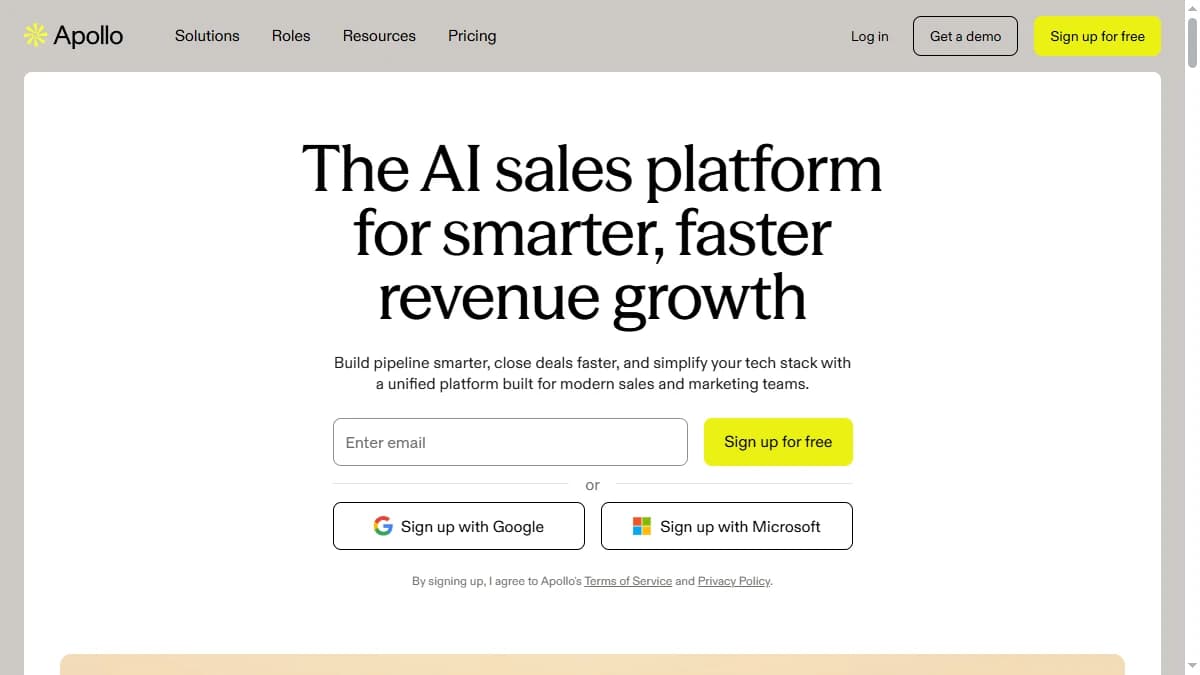
Apollo.io — 275M+ contact database with built-in AI sequencing for B2B outbound teams.
Apollo.io is the most widely adopted all-in-one AI sales platform in the B2B market. Its 275M+ contact database covers most ICP profiles, and AI-assisted sequencing lets reps build and launch email cadences without a separate engagement tool.
Apollo's AI layer handles prospect scoring, email personalization suggestions, and sequence optimization based on reply patterns. The tradeoff: email accuracy averages 55–65% — usable, but meaningfully below what waterfall enrichment achieves on the same list.
Pros
- 275M+ contacts with firmographic, technographic, and buyer intent filters
- AI sequence builder with reply-rate optimization
- $49/user/month makes it accessible to early-stage B2B teams
- Chrome extension captures contacts directly from LinkedIn profiles
- Large integration ecosystem: HubSpot, Salesforce, Outreach, Slack, and 50+ others
Cons
- Email accuracy 55–65% — higher bounce rates than waterfall providers
- Database skews US/English-speaking; EMEA and APAC coverage thinner
- Sequencing features lack the depth of dedicated platforms like Outreach or Salesloft
Best for: SMB and mid-market B2B teams running US-focused outbound who want one tool for data and email outreach.
Pricing: Free tier. Basic from $49/user/month. Professional from $99/user/month.
3. Gong

Gong — AI revenue intelligence that turns every sales call into pipeline data.
Gong is the market leader in conversation intelligence for B2B sales. It records, transcribes, and analyzes every sales call — then surfaces deal risk signals, competitor mentions, next steps missed, and coaching opportunities for managers.
Gong's AI doesn't just summarize calls — it tracks deal health across all interactions and predicts which opportunities are at risk of slipping before reps notice. For enterprise B2B teams with complex, multi-stakeholder deals, it's the most powerful signal layer available.
Pros
- AI call analysis identifies talk-to-listen ratios, filler words, competitor mentions, and objection patterns
- Deal intelligence tracks all stakeholder interactions and flags stalled deals in real time
- Coaching workflows let managers leave timestamped feedback on specific call moments
- Integrates with Salesforce, HubSpot, Outreach, Salesloft, and every major CRM
- Forecast AI improves revenue prediction accuracy — teams using Gong report 20–30% tighter forecast variance
Cons
- Enterprise pricing — typically $100–$130/user/month with annual contracts
- Does not provide contact data or enrichment — requires a separate data platform
- Implementation and onboarding takes 4–8 weeks for mid-market teams
- Call recording raises privacy questions in some GDPR jurisdictions — requires legal review
Best for: Enterprise B2B sales teams that run consultative, multi-stakeholder deals and need coaching, deal intelligence, and forecast accuracy.
Pricing: Custom enterprise pricing. Typically $100–$130/user/month with annual contracts. Contact sales for a quote.
4. Outreach

Outreach — the enterprise standard for AI-powered sales engagement and sequence automation.
Outreach is the dominant sales engagement platform for mid-market and enterprise B2B teams. Its AI layer, Kaia, joins calls in real time to surface battle cards, objection responses, and next-step recommendations — without the rep having to search.
Outreach handles the full sequence lifecycle: email, phone, LinkedIn, and SMS — with AI-suggested next best actions and sequence branching based on prospect behavior. It doesn't provide contact data, so most teams pair it with Apollo, SyncGTM, or ZoomInfo as their enrichment layer.
Pros
- Kaia AI joins calls and surfaces real-time battle cards and objection responses
- AI sequence optimization adjusts send times and step order based on reply data
- Multi-channel sequences: email, phone, LinkedIn, SMS in one cadence
- Deep CRM integration with Salesforce — bi-directional sync with custom field mapping
- Analytics show exactly which sequence steps and templates drive replies and meetings
Cons
- No contact data — must be paired with a data provider
- Enterprise pricing ($100–$160/user/month) prices out small teams
- Steep learning curve — full adoption takes 6–8 weeks for a team of 10+
- UI complexity frustrates reps coming from simpler tools like Apollo or Lemlist
Best for: Mid-market and enterprise B2B teams with a dedicated RevOps function that need advanced engagement analytics and AI-assisted real-time coaching.
Pricing: Custom enterprise pricing. Typically $100–$160/user/month with annual contracts.
5. Cognism

Cognism — GDPR-compliant, phone-verified AI prospecting data for EU/UK B2B teams.
Cognism is the leading AI-assisted B2B data provider for teams that prospect into European markets. Its Diamond Data tier is phone-verified by a human caller — not just algorithmically validated — giving it one of the highest mobile accuracy rates of any provider at 70–80%.
Cognism's AI layer enriches contacts with buying intent signals via its Bombora partnership, surfacing accounts in active research mode before a competitor reaches them. It operates as a data layer that feeds into your existing CRM and engagement tools.
Pros
- Human phone-verified mobile numbers — 70–80% connect rate on mobile dials
- GDPR, CCPA, and TCPA compliant by design — DNC registry scrubbing built in
- Bombora intent data surfaces accounts in active buying mode
- AI-enhanced search filters surface the right contacts within large target accounts
- Deep integrations with Outreach, Salesloft, HubSpot, and Salesforce
Cons
- Enterprise-only pricing — no self-serve plan, requires a sales call
- Annual contracts typically $15,000–$30,000+, inaccessible for small teams
- US contact coverage weaker than ZoomInfo or Apollo for North American ICPs
Best for: Mid-market and enterprise B2B teams running phone-first outbound into European markets where compliance is non-negotiable.
Pricing: Custom enterprise pricing. Annual contracts required. Contact Cognism sales for a quote.
6. Clari

Clari — AI revenue forecasting that closes the gap between sales rep optimism and actual close rates.
Clari is the leading AI platform for revenue operations and sales forecasting. It aggregates CRM data, email activity, call signals, and product usage data to produce an AI forecast that is typically 20–30% more accurate than rep-submitted pipeline numbers.
Clari doesn't replace your CRM — it sits above it. Sales managers use it to see deal health across their entire pipeline in real time, identify forecast risk before the end of quarter, and coach reps on the specific deals most likely to push.
Pros
- AI forecast accuracy typically 20–30% tighter than rep-submitted numbers
- Deal scoring surfaces which opportunities are most and least likely to close
- Activity capture ingests email, calendar, and call data without rep data entry
- Copilot feature generates meeting summaries and next-step recommendations automatically
- Deep Salesforce integration — replaces most forecast spreadsheet workflows
Cons
- Enterprise-only pricing — not viable for teams under 20 reps
- Value is highest when deal cycles are 30+ days with multiple stakeholders
- Implementation requires 4–8 weeks and RevOps support to configure accurately
- Does not provide contact data or outreach capabilities — forecasting only
Best for: Enterprise B2B sales teams where forecast accuracy directly impacts board-level reporting and resource allocation.
Pricing: Custom enterprise pricing. Contact Clari sales for a quote.
7. Lavender

Lavender — AI email coach that scores and rewrites cold emails in real time before you hit send.
Lavenderis an AI email coaching tool that works inside Gmail and Outlook to score outbound emails before they're sent. It analyzes subject lines, body length, personalization level, call-to-action clarity, and mobile readability — then gives a 0–100 score with specific improvement suggestions.
Teams using Lavender report an average 20–30% improvement in reply rates within the first 60 days. It's not a sequencing platform — it's a coaching layer that sits on top of your existing email workflow.
Pros
- Real-time email scoring — identifies exactly what will hurt or help your reply rate before sending
- Surfaces prospect data (LinkedIn, news, company info) in the compose window for inline personalization
- Integrates natively with Gmail, Outlook, Outreach, Salesloft, and Apollo
- Team analytics show which reps score highest and which emails generate the most replies
- Starting at $29/month — lowest price-to-impact ratio of any tool in this list
Cons
- Email-only — does not help with calls, LinkedIn, or any other channel
- Suggestions are algorithmic — reps must apply judgment on voice and context
- No contact data or sequence execution built in
- Value diminishes for reps already writing high-quality cold email
Best for: B2B reps who own their own booking and want to improve email reply rates without changing their existing outreach tools.
Pricing: Individual from $29/month. Teams from $49/user/month.
8. Clay

Clay — AI-powered enrichment table that builds custom waterfall workflows across 50+ data sources.
Clayis a flexible AI enrichment platform that lets RevOps and GTM engineers build custom data workflows using 50+ integrated providers and its Claygent AI research agent. It's not a database — it's a workflow layer that enriches contacts you already have, using any combination of sources and AI to fill in missing context.
Clay's per-credit pricing can be cost-effective for teams with large lists if configured well — but it can also balloon quickly without careful workflow design. It requires more technical setup than plug-and-play tools like Apollo or SyncGTM.
Pros
- 50+ data source integrations — run waterfall enrichment across Apollo, Hunter, Clearbit, and others in one table
- Claygent AI researches prospects, scrapes websites, and personalizes outreach fields at scale
- Waterfall coverage reaches 70–85% — matching SyncGTM but requiring more configuration
- No-code table interface — power users can build sophisticated workflows without engineering
- Direct integrations with Outreach, Salesloft, HubSpot, and Salesforce
Cons
- Per-credit pricing ($149/month Starter with 2,000 credits) scales unpredictably on large lists
- Steep learning curve — requires time to configure effective waterfall logic
- No built-in sequencing — still need a separate engagement platform
- Not suitable for individual reps who need a plug-and-play solution
Best for: RevOps-supported B2B teams building custom AI enrichment workflows who need maximum flexibility over a pre-configured tool.
Pricing: Starter from $149/month. Explorer from $349/month. Growth from $800/month.
Side-by-Side Comparison: Top AI Sales Rep Tools for B2B 2026
| Tool | Category | AI Feature | Contact Data | Sequencing | Starting Price | Best For |
|---|---|---|---|---|---|---|
| SyncGTM | Data + Outreach | Waterfall enrichment + intent | Yes (waterfall) | Yes | Free / $49/mo | Data-first outbound |
| Apollo.io | Data + Outreach | AI scoring + sequence AI | Yes (single source) | Yes | $49/user/mo | All-in-one SMB teams |
| Gong | Call Intelligence | AI call analysis + deal scoring | No | No | ~$100/user/mo | Multi-stakeholder deals |
| Outreach | Sales Engagement | Kaia real-time AI + sequence optimization | No | Yes | ~$100/user/mo | Enterprise engagement |
| Cognism | Data | Bombora intent + phone-verified AI | Yes (phone-verified) | No | Custom | EU/UK compliance teams |
| Clari | Forecasting | AI pipeline + close-rate prediction | No | No | Custom | Enterprise forecast accuracy |
| Lavender | Email Coaching | Real-time email scoring AI | No | No | $29/mo | Individual rep email quality |
| Clay | Enrichment | Claygent AI + 50+ source waterfall | Via integrations | No | $149/mo | Custom RevOps workflows |
How to Choose the Right AI Sales Tool for B2B
No single AI sales tool wins every category. The right choice depends on which stage of your sales process is the biggest constraint.
1. Fix the data problem first
If your reps are spending hours building lists or bouncing 40% of emails, the constraint is data quality — not engagement or forecasting. Start with a waterfall enrichment platform (SyncGTM or Clay) before adding call intelligence or sequence tooling. Read our breakdown of what waterfall enrichment means and why hit rate matters more than database size.
2. Match tool category to your sales motion
High-volume email outbound: Apollo.io or SyncGTM. Phone-first EU/UK teams: Cognism. Multi-stakeholder enterprise deals: Gong + Outreach + Clari. Individual reps improving email quality: Lavender. RevOps building custom enrichment pipelines: Clay.
3. Audit your existing integrations
Every tool in this list integrates with HubSpot and Salesforce — but depth varies. Outreach and Gong have the most mature Salesforce integrations. Apollo.io and SyncGTM are the easiest to connect to HubSpot. Before buying, verify that the tool writes back to the exact CRM objects your team uses.
4. Think in layers, not replacements
The best B2B AI sales stacks are layered — a data tool feeds an engagement tool, which generates call data for an intelligence tool, which improves forecast accuracy. You don't replace Gong with SyncGTM or vice versa — you combine them at different stages. For a complete look at how these layers fit together, see our guide to AI for B2B sales.
5. Start with the highest-leverage fix
Most teams underinvest in data quality and overinvest in engagement tooling. A $149/month waterfall enrichment tool that lifts your contact coverage from 55% to 80% creates more pipeline than a $150/user/month engagement platform sending sequences to contacts that don't exist. Sequence quality also matters — see our list of the best waterfall contact providers ranked by real-world hit rate.
Final Verdict
The top AI sales rep tools for B2B in 2026 aren't interchangeable — each targets a different constraint in the revenue workflow. Buying the wrong one at the wrong stage is the most common mistake B2B teams make when building their AI stack.
SyncGTMis the strongest starting point for most B2B outbound teams. It solves the data quality problem — the root cause of low meeting rates — and includes multi-channel sequencing so you don't need a separate engagement tool at the start.
Apollo.io wins on simplicity for US-focused SMB teams.Gong and Outreach belong in enterprise stacks with complex deal cycles.Cognism is non-negotiable for phone-first EU/UK prospecting.Lavender is the cheapest way to measurably improve cold email performance without changing anything else.Clari belongs at the forecasting layer once your pipeline volume justifies it.Clayis the power user's enrichment tool — flexible, but requiring RevOps support to run well.
For more on building a modern B2B outbound stack, read our guide to best SDR tools for prospecting or explore our ranked list of the top B2B sales prospecting tools.
If your biggest constraint right now is contact data quality, start with SyncGTM — free tier, no credit card required.