

Verifalia Review 2026: Email Verification Pricing, Accuracy & Alternatives

By Kushal Magar · June 12, 2026 · 12 min read · Last updated: September 30, 2026
Key Takeaway
Verifalia is a veteran email verification platform (founded 2005) with three quality levels, 40+ status codes, and full international character set support. The free tier and non-expiring credit packs make it accessible. Daily credit expiration on subscription plans and quality-tier math (2x credits at High, 4x at Extreme) are real pain points. Independent benchmarks put real-world accuracy at 92–95% — below the advertised 99%. It verifies lists you already have; it cannot find new contacts.
Verifalia is a credit-based email verification platform founded in 2005, serving over 100,000 customers with three verification quality levels and 40+ address status codes. Pay-as-you-go credit packs start from $0.0005/email at high volume. Independent benchmarks place real-world accuracy at 92–95%. Our rating: 3.5/5.
Verifalia has one of the longest track records in email verification. Unlike most competitors, it gives you genuine control over how deeply each address is checked — Standard for speed and cost, Extreme for maximum accuracy on difficult catch-all domains. That flexibility is rare in the category.
The limitation is the credit model. Subscription credits expire daily. Higher quality levels burn credits at 2x or 4x the Standard rate. A team that buys a Professional plan and runs Extreme verification will exhaust their daily allowance 4x faster than expected. For teams with steady, predictable volumes, this is manageable. For everyone else, it requires careful planning.
This review covers Verifalia's pricing math across subscription tiers and pay-as-you-go packs, its accuracy at each quality level, catch-all handling, and a direct comparison with NeverBounce, Kickbox, and Bouncer for teams evaluating email verification options in 2026.
According to G2, Verifalia has a limited review footprint (roughly 2 reviews), and Capterra shows around 5. For a platform founded in 2005 with 100,000+ customers, this sparse review footprint is a notable gap for teams relying on peer validation.
What Is Verifalia?
Verifalia is an email verification service built for businesses that need to reduce bounce rates, protect sender reputation, and ensure their outbound emails reach real inboxes. Founded in 2005, it predates most of the modern email verification category by a decade.
Verifalia — email verification platform founded in 2005, serving 100,000+ customers across 190+ countries
Verifalia validates each address through a multi-stage pipeline: syntax check → DNS and MX record lookup → disposable email detection → SMTP handshake. Each address returns one of over 40 distinct status codes — far more granular than the 5-category systems used by NeverBounce or Kickbox. This granularity helps developers build custom logic around specific failure modes rather than treating all "risky" addresses the same way.
What sets Verifalia apart is its three-tier quality system. Most verifiers give you one pass at an address — Verifalia lets you choose how hard to probe:
- Standard (1 credit) — fast check; syntax, DNS, MX, basic SMTP handshake. Best for high-volume consumer lists where speed matters more than catch-all precision.
- High (2 credits) — deeper SMTP probing; better catch-all resolution. A middle ground between speed and accuracy.
- Extreme (4 credits) — maximum depth; most accurate on catch-all and ambiguous addresses. 4x the credit cost of Standard. Best reserved for high-value B2B lists where precision is worth the expense.
Verifalia is not a prospecting tool. It has no contact database, no email finder, and no enrichment capabilities, so teams that need to discover new contacts — not just clean existing ones — will need a separate email finder. For another verification-only option, read our MailerCheck review.
Verifalia Pricing: Plans, Credits, What You Actually Pay
Verifalia pricing has two distinct layers that are easy to confuse: subscription plans with daily expiring credits, and non-expiring credit packs you buy once and use over time.
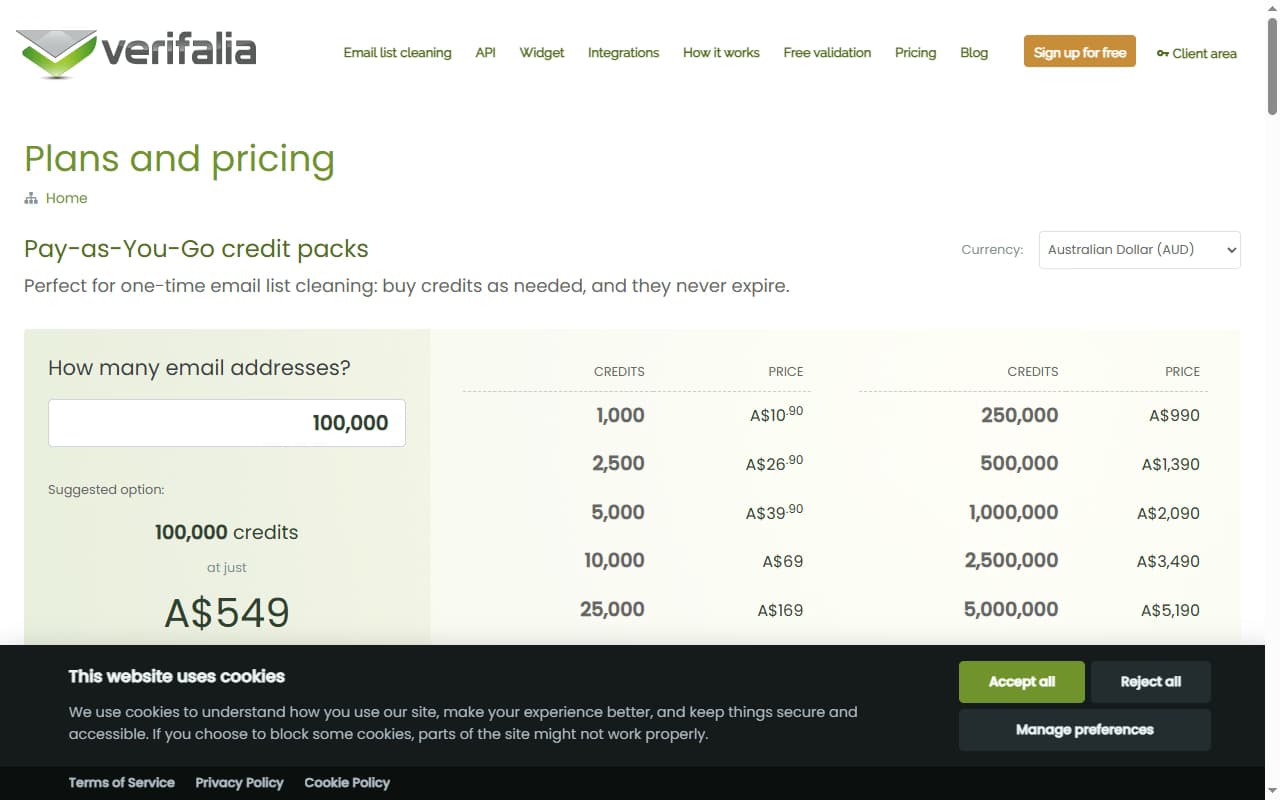
Verifalia pricing — subscription plans with daily credit limits plus separate non-expiring credit packs
Subscription Plans (Daily Credits)
Daily credit allowances below are from Verifalia's pricing page as of September 2026. Prices vary by currency and billing cycle, so check the live page for your region. A Standard verification costs 1 credit, High costs 2, and Extreme costs 4.
| Plan | Daily Credits | At Standard Quality | At Extreme Quality |
|---|---|---|---|
| Free | 25/day | 25 emails | 6 emails |
| Starter | 250/day | 250 emails | 62 emails |
| Professional | 1,250/day | 1,250 emails | 312 emails |
| Enterprise | 6,250/day | 6,250 emails | 1,562 emails |
| Ultimate | 25,000/day | 25,000 emails | 6,250 emails |
Subscription credits expire at the end of each day. Unused credits are lost — there is no rollover. Teams with variable verification volumes should factor this into their plan selection: a Professional tier running Extreme quality on B2B catch-all lists exhausts 1,250 daily credits in about 312 emails.
Quarterly and annual billing options provide 5% and 10% discounts respectively. All paid plans include priority support, reselling capabilities (Enterprise and above), and increased classification override rules.
Non-Expiring Credit Packs
For teams with irregular verification needs, Verifalia sells credit packs that never expire. You buy once, use whenever you need. At high volumes, Verifalia prices these packs competitively — approximately $0.0005–$0.003 per Standard verification depending on pack size. This compares favorably to NeverBounce's $0.003–$0.008 range, especially for teams that want to buy a large block and use it across multiple campaigns over months.
Free Tier
The free plan provides 25 verifications per day, indefinitely. Unlike NeverBounce's one-time 1,000-email trial, Verifalia's free tier is genuinely ongoing — useful for small-scale API testing, developer prototyping, or low-volume ongoing use cases.
The Quality-Tier Cost Trap to Avoid
The most common pricing mistake: purchasing a subscription plan and then running Extreme quality on everything. A Professional plan gives 1,250 daily credits. At Extreme quality, those credits cover only 312 emails per day — not 1,250. If your list is predominantly catch-all domains and you need Extreme precision, a Professional plan delivers roughly a quarter of the output its credit count suggests. Buy non-expiring credit packs for high-quality-level work; use subscriptions for steady Standard-quality daily volumes.
Verifalia Key Features
Three Verification Quality Levels
Standard, High, and Extreme — each consuming 1x, 2x, or 4x credits respectively. No other major email verifier offers this granular control. Teams can apply Standard quality to bulk lists for speed and reserve Extreme for a catch-all subset that warrants deeper probing.
40+ Address Status Codes
Most platforms return 5 categories. Verifalia returns 40+ distinct codes. Instead of "risky," you get specific classifications: catch-all server, role account, mailbox-not-found, SMTP-timeout, temporary-failure, and more. Developers can build precise filtering logic against these codes rather than applying blanket rules to vague buckets.
International Character Set Support (EAI)
Verifalia supports Email Address Internationalization (EAI) — email addresses with non-ASCII characters (e.g., Japanese, Arabic, or accented European characters). No competitor in this review (NeverBounce, Kickbox, Bouncer) offers this natively. For companies with global customer bases or international B2B lists, this is a genuine differentiator.
Developer-First API
Verifalia provides a well-documented REST API with SDKs for .NET, Go, Java, JavaScript, PHP, and Ruby. The API supports single-address real-time verification and bulk batch jobs. Response time for Standard single verifications is typically under 1 second. Rate limits scale with plan tier.
Embeddable Widget
A 9KB compressed JavaScript widget handles real-time email verification on web forms. It integrates with HTML5 forms and popular JavaScript validation libraries without requiring server-side API calls from your own backend. Useful for e-commerce and SaaS registration flows that need to block invalid emails at the point of entry.
6,000+ Integrations via Zapier and Pipedream
Verifalia connects to 6,000+ tools through Zapier and Pipedream partnerships, plus a direct Google Sheets add-on. Unlike NeverBounce's 80+ native integrations, Verifalia's integrations are primarily workflow-automation-mediated rather than direct. For standard ESPs like Mailchimp or HubSpot, a Zapier zap adds one step to the workflow.
Bulk List Upload (Up to 100 MB)
Verifalia accepts bulk list uploads up to 100 MB — covering most enterprise-scale list cleaning needs in a single job. Multiple upload formats are supported. Processing speed depends on the quality level selected and server load, with Standard quality typically offering faster batch turnaround than High or Extreme.
Verifalia Pros: What It Does Well
- Three quality levels — unique in the market. No competitor lets you choose Standard, High, or Extreme verification depth per job. This lets you balance speed and cost for bulk consumer lists while applying maximum precision to high-value B2B segments.
- 40+ status codes for precise filtering. Category labels like "risky" are useless for developers. Verifalia's 40+ codes let you build exact suppression rules: send to catch-all servers at your own risk, suppress all role accounts, retry temporary failures separately.
- International character set support. EAI support (non-ASCII email addresses) is not available from NeverBounce, Kickbox, or most other verifiers. For global B2B or B2C lists with non-Latin email formats, Verifalia is the only mainstream option.
- Non-expiring credit packs. Unlike subscription credits (which expire daily), credit packs retain value indefinitely. This is the right pricing model for teams with irregular volumes or seasonal campaigns.
- Free tier that actually works long-term. 25 verifications per day, forever. Useful for developer testing, low-volume ongoing verification, and evaluating the platform with real production data before committing to a paid plan.
- 20+ years of operational history. Founded in 2005, Verifalia has outlasted dozens of competitors. Infrastructure maturity and long-term API stability matter for teams building production workflows on top of a verification service.
- German data centers and GDPR compliance. Hosting in Germany (EU) with HTTPS/TLS encryption and explicit GDPR compliance positioning is relevant for European B2B teams with data residency requirements.
Verifalia Cons: Where It Falls Short
- Daily credit expiration wastes budget. Subscription plan credits expire at the end of each day. If you verify 100 emails on a Monday and buy a plan sized for 250/day, 150 credits are gone permanently. Teams with irregular usage should use credit packs instead — but the pricing UI makes this distinction easy to miss.
- Confusing credit math across quality levels. Standard = 1 credit/email. High = 2 credits/email. Extreme = 4 credits/email. Running Extreme verification on a 10,000-email list costs 40,000 credits, not 10,000. This catches teams off guard and can exhaust a subscription tier in a fraction of the expected time.
- Real-world accuracy trails the 99% claim. Independent benchmarks from Bouncer and Sparkle place Verifalia at 92–95% real-world accuracy — meaningfully below the advertised 99%. The gap is largest on catch-all domains, which are common on enterprise B2B lists. You can close the gap with Extreme quality, but at 4x the credit cost.
- Thin community validation. Verifalia has roughly 2 reviews on G2 and 5 on Capterra. For a platform founded in 2005 with 100,000+ customers, this is strikingly sparse. Teams relying on peer reviews for procurement decisions will find little third-party signal beyond the official marketing site.
- No B2B contact discovery. Verifalia verifies addresses you supply — it does not find new prospects, enrich records with phone numbers, or return firmographic data. For B2B outbound teams that need to build a list and then clean it, Verifalia covers only the second half of the workflow.
- No spam trap detection. Unlike ZeroBounce, Verifalia does not score addresses against known spam trap databases. For teams sending to older or cold-acquired lists, this gap increases inbox placement risk without an additional tool in the stack.
Verifalia vs Alternatives: Comparison Table
Verifalia is a pure verification tool. The table below compares it against two of the most common alternatives: NeverBounce (verification with ZoomInfo backing) and Kickbox (verification with Sendex scoring).
| Feature | Verifalia | NeverBounce | Kickbox |
|---|---|---|---|
| Starting Price | $0 (25 credits/day free tier) | $0.008/email (pay-as-you-go) | $5 (500 verifications) |
| Pricing Model | Daily subscription credits + credit packs | Pay-as-you-go or monthly | Pay-as-you-go credits |
| Verified Email Accuracy | 92–95% real-world (99% claimed) | 97–99% | 96–97% |
| Verification Quality Levels | 3 levels (Standard, High, Extreme) | Single level | Sendex score (0–1) |
| Catch-All Handling | Flagged with 40+ status codes | Flagged as catch-all, no scoring | Returns 'unknown' — no scoring |
| Credit Expiry | Daily subscription credits expire; packs do not | No expiry | 12 months |
| Integrations | 6,000+ via Zapier/Pipedream + REST API | 80+ native | 25+ |
| International Character Sets | Yes — full EAI support | Standard ASCII only | Standard ASCII only |
| Free Tier | 25 verifications/day (free forever) | 1,000 free verifications (one-time) | 100 free verifications (one-time) |
| Founded | 2005 (20+ years) | 2015 (ZoomInfo-owned since 2019) | 2012 |
Verifalia vs NeverBounce
Both are standalone email verifiers. NeverBounce claims 97–99% accuracy vs Verifalia's 92–95% real-world rate (Verifalia claims 99% but benchmarks tell a different story). NeverBounce's key structural advantages: no credit expiry (vs Verifalia's daily expiration), a 1,000-email free trial, and 80+ native integrations that Verifalia can't match natively. Verifalia's advantages: three quality levels, 40+ status codes, and EAI support that NeverBounce doesn't offer. For teams that need the deepest catch-all resolution available, Verifalia Extreme beats NeverBounce. For teams that need native ESP integrations and predictable credit costs, NeverBounce wins. See our full NeverBounce review for a deeper comparison.
Verifalia vs Kickbox
Kickbox offers a proprietary Sendex score (0–1 quality rating per address) that Verifalia lacks. Verifalia's 40+ status codes are more granular than Kickbox's 5 categories, but less immediately actionable than Kickbox's normalized 0–1 score for marketers who want a single threshold to filter on. Kickbox credits expire in 12 months; Verifalia subscription credits expire daily while packs never expire. For marketing-ops teams, Kickbox's Sendex is simpler. For developer teams building custom filtering logic, Verifalia's status codes are more useful. Read our Kickbox review for the full breakdown.
Verifalia vs Bouncer
Bouncer's own accuracy benchmarks placed them above Verifalia in third-party testing. Bouncer's pricing model is simpler — credits don't expire and there's no quality-level complexity to navigate. Verifalia's EAI support and 40+ status codes are genuine technical differentiators that Bouncer doesn't match. For teams prioritizing accuracy on standard B2B lists, the Bouncer review is worth reading alongside this one.
Learn more in our EmailListVerify review if you're evaluating the broader verification category, or the MailerCheck review for another ESP-native option.
Who Should Use Verifalia?
Verifalia is a strong fit for:
- Developer teams building email verification into products— the REST API, multi-language SDKs, 40+ status codes, and embeddable widget give developers the granular control that marketing-oriented platforms don't offer.
- Teams with international lists containing non-ASCII emails— Verifalia's EAI support is the only mainstream option for verifying internationalized email addresses. If your list includes Japanese, Arabic, or Eastern European character sets, this matters.
- Teams with mixed-quality lists needing per-segment precision— applying Standard quality to consumer addresses and Extreme quality to enterprise catch-all domains is a cost-efficient hybrid approach that Verifalia enables and competitors don't.
- European teams with data residency requirements— German data centers, GDPR compliance, and HTTPS/TLS encryption satisfy EU procurement requirements without additional infrastructure.
- Teams with irregular verification volumes— non-expiring credit packs are the right tool here. Buy a block, use it across multiple campaigns without wasting daily subscription credits on days you don't verify.
Verifalia is not the right fit for:
- Marketing-ops teams that want simplicity— the quality-tier credit math, daily expiration, and 40+ status codes add complexity that most marketers don't need. NeverBounce or Kickbox are simpler for campaigns that just need valid/invalid/catch-all.
- B2B outbound teams building lists from scratch— Verifalia cannot find contacts. Use Apollo.io or another email finder or enrichment platform for discovery, then verify if needed.
- Teams needing spam trap detection— Verifalia does not score against spam trap databases. Older lists with cold-acquired data need ZeroBounce's AI spam trap scoring instead.
- Teams wanting native ESP integrations without middleware— Verifalia's Zapier/Pipedream model adds a step vs NeverBounce's 80+ direct native integrations to Mailchimp, HubSpot, Salesforce, and Marketo.
- Teams wanting enrichment and verification in one tool— Verifalia only verifies. See our Clearout review if you need a verification tool with more built-in enrichment features.
If Verifalia's inability to find new contacts is a dealbreaker, SyncGTM is one alternative worth a look: it runs waterfall enrichment across 50+ data providers to find verified emails and phone numbers.