

Airscale Review 2026: Features, Pricing, Pros and Cons

By Kushal Magar · March 15, 2026 · 10 min read · Last updated: September 30, 2026
Key Takeaway
Airscale is a B2B lead sourcing and data enrichment platform that aggregates contact and company data from thirty-plus premium providers using waterfall enrichment. As of September 2026, pricing starts at forty-nine dollars per month for the Starter plan with four thousand credits, scaling to ninety-nine dollars for Pro with twelve thousand credits and one hundred eighty-nine dollars for Growth with twenty-five thousand credits, plus a custom-priced Scale plan. All plans include unlimited team seats and credit rollover. The Airsearch AI agent can extract custom data points from websites for outbound personalization. An independent test found Airscale hitting a ninety-one percent phone number success rate compared to Apollo's forty-two percent on hard-to-reach profiles. Key limitations include no multi-step workflow automation, mobile numbers that cost far more credits than emails, API access reserved for the custom Scale plan, limited CRM integration depth beyond HubSpot, fewer public reviews on G2 for buyer validation, and no permanent free plan. For teams whose primary need is affordable lead data with unlimited users, Airscale delivers strong value. Teams that need workflow automation, buying intent signals, or deeper CRM integrations will need to pair it with other tools.
You're probably here because you're tired of paying $200+ per month for a lead enrichment tool that still gives you bounced emails and stale phone numbers. Or maybe you've heard about Airscale as a cheaper alternative to Clay or Apollo and want to know if it actually delivers.
This Airscale review covers everything: what the platform does, how the pricing and credits work in practice, the features that matter for GTM teams, the honest downsides nobody talks about, and how a typical workflow runs from list to outreach.
No fluff. No affiliate-driven hype. Just what you need to decide if Airscale fits your stack.
Airscale Review: What You Get (and What You Don't)
Airscale is a B2B lead sourcing and data enrichment platform built for go-to-market teams. It aggregates contact and company data from 30+ premium data providers using waterfall enrichment, which means it queries multiple sources in sequence until it finds a verified result.
The platform launched as a leaner, more affordable alternative to tools like Apollo.io and Clay. It targets sales teams and agencies who need accurate contact data without enterprise pricing.
| Feature | What's Included | Limitations |
|---|---|---|
| Waterfall Enrichment | 30+ data providers queried sequentially | Mobile numbers cost far more credits than emails |
| Airsearch AI Agent | Custom research tasks on any website | Limited to data retrieval, not workflow automation |
| Lead Sourcing | LinkedIn Sales Nav, Apollo, Google Maps scrapers | Requires existing Sales Navigator subscription |
| CRM Integrations | HubSpot sync, outreach tool connections | Limited depth compared to native CRM platforms |
| Data Cleaning | AI-powered title normalization, deduplication | Manual setup for complex cleaning rules |
| Unlimited Users | All plans include unlimited team seats | Credits are shared across the entire team |
Key Features That Matter
Waterfall Enrichment Across 30+ Providers
This is Airscale's core value proposition. Instead of relying on a single data provider (which typically hits a 40-50% success rate), Airscale uses waterfall enrichment to query multiple providers in sequence. If Provider A doesn't have a verified email, it tries Provider B, then C, and so on. The result is significantly higher match rates.
An independent test found Airscale hitting a 91% phone number success rate compared to Apollo's 42% on the same set of hard-to-reach profiles. That's a meaningful difference if your team is doing cold calling.
Airsearch: The AI Research Agent
Airsearch goes beyond standard data lookups. You can ask it to visit a company's website and extract specific information -- like "find the latest blog post this person wrote" or "summarize this company's last funding announcement." It gives you custom data points for personalization that no static database provides.
The limitation is that Airsearch is focused on data retrieval. It won't build multi-step workflows or trigger CRM updates the way a full automation platform would.
Built-In Lead Sourcing
Airscale includes scrapers for LinkedIn Sales Navigator, Apollo, company lookalike searches via Ocean.io, post engagement tracking, and hiring signal detection. You can build lists from scratch without leaving the platform.
This consolidates what many teams do across 3-4 separate tools into one interface. Less tab-switching, fewer CSV exports, less room for human error.
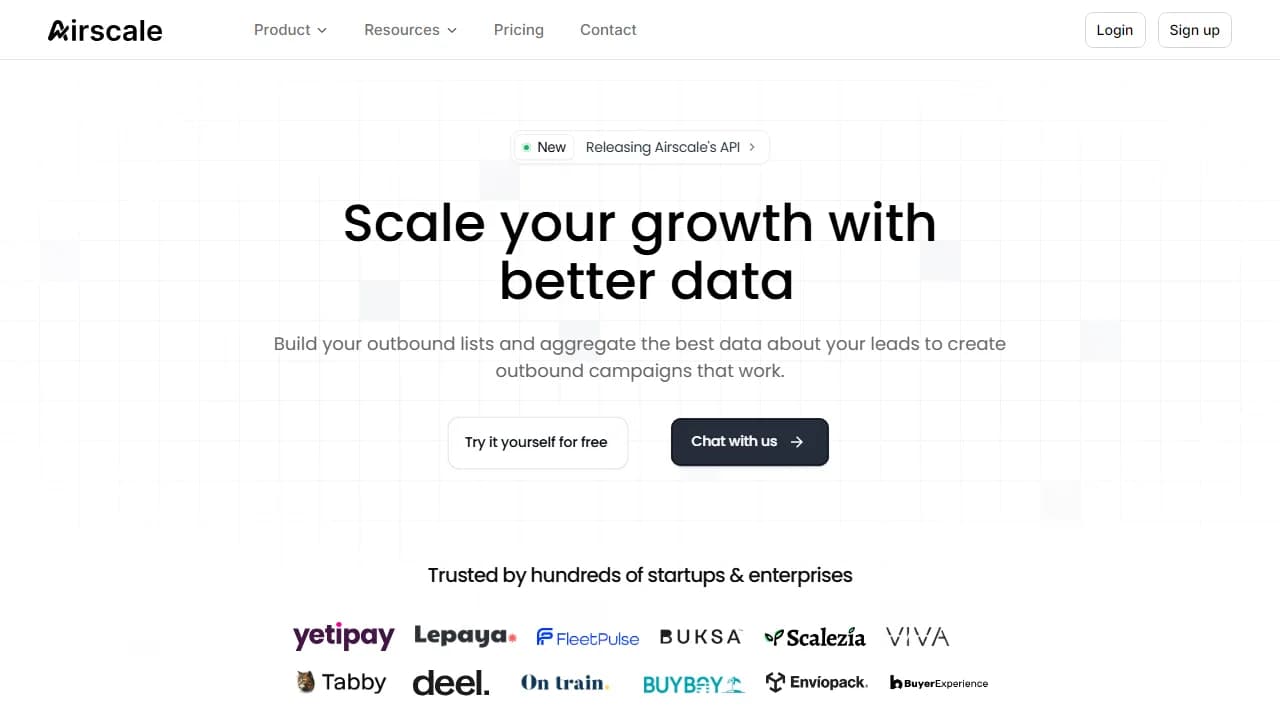
Airscale's platform consolidates lead sourcing, enrichment, and outreach sync into a single interface.
Does Airscale Integrate with HubSpot?
Yes. Airscale syncs enriched leads directly to HubSpot and connects to cold email sequencers like Smartlead, Lemlist, and Instantly. The integration is functional for pushing enriched contacts into your existing workflows.
However, if you need deep two-way CRM sync -- where changes in your CRM automatically update your enrichment data and vice versa -- Airscale's integrations are more limited. Its native CRM actions center on HubSpot (looking up and creating records), and its site does not list native Salesforce, Pipedrive, or Attio connections.
Airscale Pricing Breakdown
Airscale pricing uses a credit-based model. Every enrichment action costs credits, and all plans include unlimited team seats. Here's how the plans break down as of September 2026:
- Starter ($49/mo): 4,000 credits, waterfall enrichment, Airsearch AI agent, LinkedIn Sales Nav scraper, unlimited users
- Pro ($99/mo): 12,000 credits and the same core features, at a lower cost per credit than Starter
- Growth (from $189/mo): 25,000 credits, with larger tiers up to 150,000 credits per month and the lowest listed cost per credit
- Scale (custom): Custom per-result rates, API access, HTTP API enrichments, your own provider API keys, dedicated Slack support, and custom onboarding
- Free trial: 14-day trial available on all plans. No free-forever plan.
Credits roll over as long as you maintain an active subscription. That's a genuine advantage -- no end-of-month scramble to burn through unused credits.
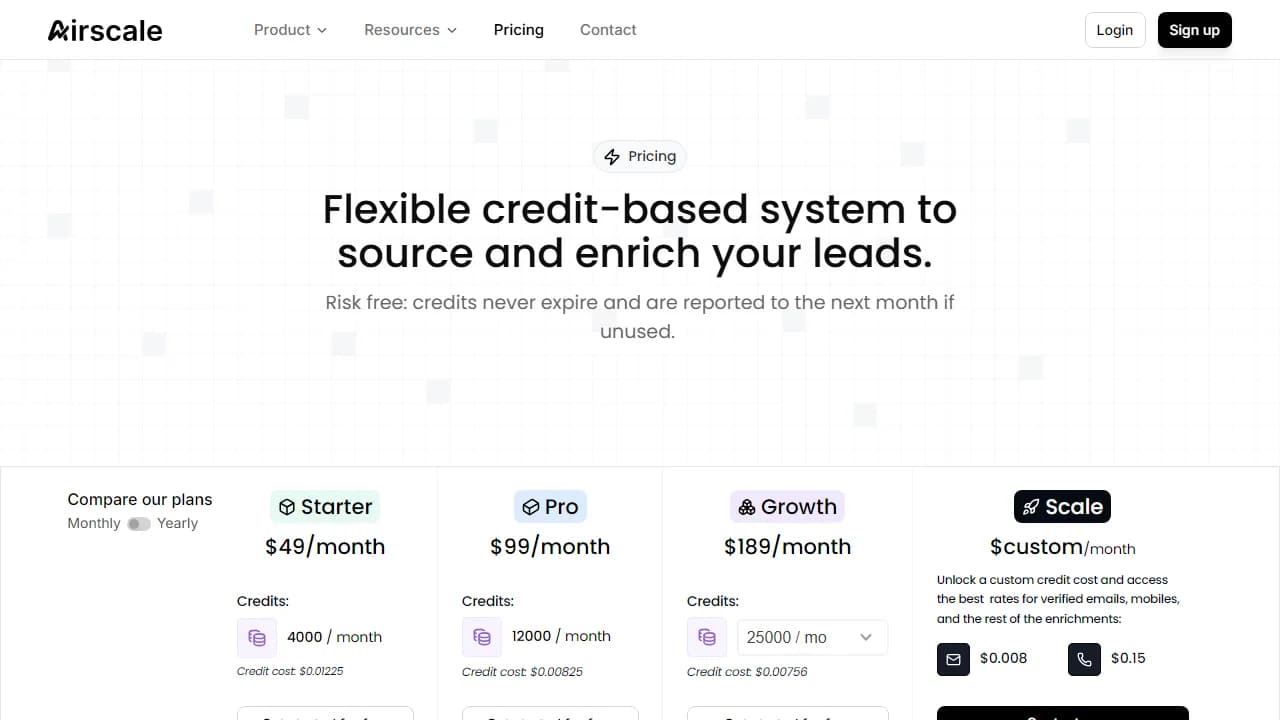
Airscale's pricing page as of March 2026. All plans include unlimited users.
What You Actually Pay: A Real Scenario
Say you have 2 SDRs each prospecting 100 leads per week, or about 800 leads per month. Finding a verified professional email costs 2 credits, so email enrichment alone uses roughly 1,600 credits per month.
The Starter plan at $49/mo covers that with 4,000 credits and leaves about 2,400 credits for company data and Airsearch queries. Phone numbers change the math: as of September 2026, Airscale's custom Scale rates list $0.008 per verified email versus $0.15 per mobile number, so a team that needs a direct dial for every lead should budget for Pro or Growth instead.
Compare that to ZoomInfo ($14,995/year minimum) or Clay ($167/mo for 3,000 data credits on its Launch plan), and Airscale's value is clear for pure data enrichment needs.
What Airscale Does Well
- Price-to-value ratio. At $49/mo for 4,000 credits with unlimited users, Airscale offers genuine enterprise-grade data at a fraction of what ZoomInfo or Cognism charges. For small teams, this is a force multiplier.
- Data accuracy. The waterfall enrichment approach means higher match rates than single-source tools. The 91% phone success rate benchmark is strong evidence that the multi-provider model works.
- Unlimited users. Every plan includes unlimited seats. Most competitors charge per seat, which adds up fast for growing teams. This alone can save hundreds per month.
- Credit rollover. Unused credits carry over to the next month as long as you keep your subscription active. No pressure to burn credits before the billing cycle resets.
- Airsearch for personalization. The AI agent can extract custom data points that static databases miss. For teams doing personalized outbound, this is a genuine differentiator.
What Are the Downsides of Using Airscale?
Limited Workflow Automation
Airscale is excellent at getting you data. It's less capable at helping you act on it. There's no workflow builder for creating multi-step automation sequences. You can't set up triggers like "when a lead's company raises funding, enrich their profile and push to HubSpot." For that, you'll need to pair Airscale with a separate automation layer or one of the buying intent data tools that watch for signals like funding rounds and job changes.
API Access Requires the Scale Plan
As of September 2026, API access, HTTP API enrichments, and the option to plug in your own provider API keys are all reserved for the custom-priced Scale plan. Teams on Starter, Pro, or Growth can export to CRMs and sequencers, but piping Airscale into internal systems or reusing existing data-provider contracts means a sales conversation first.
Fewer Public Reviews
Airscale's G2 profile has limited reviews compared to established competitors like Apollo or ZoomInfo. The platform is relatively new, which makes it harder for buyers to evaluate based on peer feedback. If your procurement process requires a threshold of public reviews, this could be a blocker.
Integration Depth
While Airscale connects to HubSpot and popular outreach tools, the integration depth is shallower than what mature platforms offer. There's no mention of native Salesforce, Pipedrive, or Attio sync. If your CRM isn't HubSpot, you may need to rely on Zapier or manual CSV exports.
No Free-Forever Plan
Airscale offers a 14-day free trial, but there's no permanent free tier. Once the trial ends, you need a paid plan to keep enriching, so run the trial on a real list rather than test data to get a fair read on match rates and credit burn.
- No multi-step workflow automation or trigger-based actions
- API access and HTTP API enrichments reserved for the custom Scale plan
- Limited CRM integration depth beyond HubSpot
- Few public reviews on G2 and Capterra for buyer validation
- No permanent free plan — only a 14-day trial
Who Should Use Airscale?
Airscale is a strong pick for: Small to mid-size sales teams and agencies that need high-quality lead data at a low price point. If your primary need is sourcing leads and enriching contact data -- and your team is larger than 3-4 people -- the unlimited users and $49/mo entry price make it hard to beat on value.
Look elsewhere if: You need more than data. If your GTM workflow requires buying intent signals, multi-step automation, CRM-triggered enrichment, or a no-code workflow builder, Airscale won't cover it. Teams running complex outbound playbooks should evaluate Clay instead.
Also skip Airscale if: Your procurement team requires extensive G2 or Capterra reviews before approving a vendor. The platform is still building its public review presence.
How Airscale Works: From List to Outreach
Airscale makes more sense once you see the order of operations. A typical run has three stages: source leads, enrich and research them, then push the finished list into the tools your team already uses. Here is how that plays out step by step, and where plan limits show up.
- Source a list. Scrape Sales Navigator search results, search Airscale's own lead and company finders, pull the people who liked or commented on a LinkedIn post, find companies hiring for specific roles, find local businesses, or import a CSV. Sales Navigator scraping requires your own Sales Navigator subscription.
- Run waterfall enrichment. Add email and phone lookups, and Airscale works through its providers in sequence until one returns a result. A verified professional email costs 2 credits. Mobile numbers cost far more per result, so decide early which rows actually need a direct dial.
- Research with Airsearch. Give Airsearch a list of domains and a question. It visits each site, finds the answer, and reports back, which is useful for personalization points like a recent product launch or funding announcement.
- Clean and personalize. Use the built-in data cleaning and formatting tools to normalize job titles and other fields, and AI-powered copywriting to draft personalized lines before anything leaves the platform.
- Push to your stack. Look up or create records in HubSpot, or add leads straight into Smartlead, Lemlist, or Instantly campaigns. Every plan includes exports to CRMs and email sequencers.
- Automate at scale. API access, HTTP API enrichments, and the option to use your own provider API keys are part of the custom-priced Scale plan (as of September 2026). Airscale also offers an MCP integration, so AI assistants such as Claude can find prospects and enrich contacts directly.
The biggest cost lever is the enrichment mix. Seats are unlimited and credits roll over, so a whole team can share one pool, but mobile lookups drain it fastest. Test each new list on 50-100 rows, check the email and phone hit rates, and only then enrich the full list.
The payoff is speed. Once a list is sourced, the same flow takes a lead from a LinkedIn search to a verified email, a personalization point, and a live campaign in your sequencer without a CSV export in between. Where it asks more of you is orchestration: as covered in the downsides above, multi-step, trigger-based workflows are not its focus.
Is Airscale Worth It?
Airscale is a legitimate option for teams whose primary need is affordable lead sourcing and data enrichment. The $49/mo price point, unlimited users, and waterfall enrichment across 30+ providers give it a clear edge over more expensive single-source tools like Apollo or ZoomInfo.
But Airscale is a data tool, not a GTM platform. If you need workflow automation, buying intent signals, CRM-triggered enrichment, or a no-code builder to orchestrate your entire outbound motion, you'll outgrow it quickly.
The practical move is to use the 14-day trial on a real list: track how many credits emails and mobile numbers actually consume, check match rates against your ICP, and confirm your CRM export path works before committing to Pro or Growth. If the trial falls short, our roundup of Airscale alternatives compares seven options on price, data coverage, and CRM sync.
If Airscale's thin native CRM coverage beyond HubSpot is a dealbreaker, SyncGTM is one alternative worth a look: it pairs waterfall enrichment across 50+ data providers with native Salesforce, HubSpot, and Pipedrive integrations.