

Apify Review 2026: B2B Data Coverage, Pricing & Alternatives

By Kushal Magar · July 3, 2026 · 12 min read · Last updated: September 30, 2026
Key Takeaway
Apify is a developer-first cloud scraping platform with 25,000+ pre-built actors, a genuine free tier ($5/mo of usage, no credit card), and paid plans from $19/mo as of September 2026. It is excellent for developers who need to scrape any website or build custom data pipelines, and its MCP server lets AI agents run Actors directly. Key limitations: compute and proxy costs compound at scale, monthly credits expire, actor quality is uneven, and there is no B2B sales workflow — no verified contacts, no buying signals, no CRM push, no outreach. Sales teams should treat it as a data source and budget for verification and CRM mapping on top.
Apify is a cloud-based web scraping and automation platform with 25,000+ pre-built actors, a free tier that includes $5 of compute credit every month, and paid plans from $19/mo. It is the largest actor marketplace in the web scraping space. Our rating: 4.5/5 for developer data pipelines; 2.0/5 for B2B sales prospecting.
This Apify review covers what the platform actually delivers in 2026. Most people arrive here from two different places. Developers and data engineers want to know if Apify is the right web crawling API for AI lead gen and whether the actor marketplace lives up to the hype. B2B sales teams evaluate it while searching for B2B sales prospecting tools and discover Apify is a data-sourcing layer, not a full outbound stack.
We tested both angles honestly. For scraping and automation: where Apify genuinely excels and where the compute billing surprises teams. For sales teams: why raw scraped data alone is not enough, and which pieces (verification, waterfall enrichment, CRM mapping, and outreach) you still have to add on top.
Key facts upfront: Apify holds 25,000+ actors in its marketplace, achieves 95–98% actor success rates on well-optimized scrapes, and ships a native MCP server for AI agent integration. Plans start at $0 with $5/mo compute credit. The catch: compute costs compound at scale, monthly credits do not roll over, and there is no verified B2B contact database, no buying signals, and no outreach tooling for B2B lead scraping.
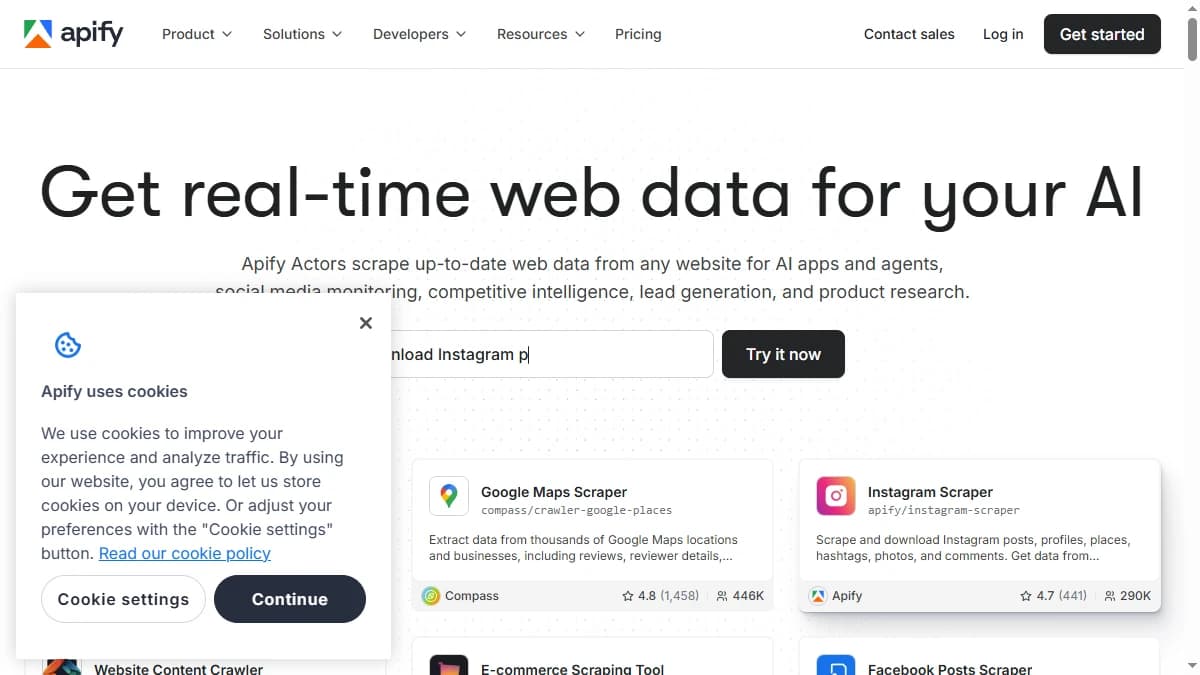
Apify homepage — a developer-first cloud scraping platform with 25,000+ pre-built actors and an MCP server for AI agent integration.
What Is Apify?
Apify is a cloud-based web scraping and automation platform built around the concept of Actors — serverless microservices that run on Apify's infrastructure to extract, transform, and deliver data from any website. You can use pre-built actors from the Actor Store or write your own using the JavaScript or Python SDK.
The platform positions itself as "the largest and most trusted marketplace of tools for AI" — a pitch that holds up. With 25,000+ actors covering LinkedIn, Amazon, Google Search, Instagram, TikTok, Reddit, and thousands of niche sources, it is genuinely one of the broadest scraping ecosystems available. If you need data from a website, there is almost certainly an actor for it.
Apify holds strong community ratings across G2 and Product Hunt. Reviewers consistently praise the breadth of the Actor Store, the quality of the documentation, and the MCP server integration for AI-native workflows. The recurring complaints center on cost unpredictability at scale and the uneven quality of third-party actors in the marketplace.
| Capability | What Apify Provides | Notable Gaps |
|---|---|---|
| Web Scraping | 25,000+ actors. Any website, any source. Headless browser and HTTP crawlers. 95–98% success rates on optimized actors. | Actor quality varies. Third-party actors can break without warning. |
| Contact Data / B2B Enrichment | Via actors (e.g., LinkedIn scraper, email finders). Data is scraped — not from a verified database. | No published accuracy benchmark. No waterfall enrichment. Verification requires a separate actor. |
| AI / MCP Integration | Native MCP server. AI agents (Claude, ChatGPT) can discover and run actors via tool use. | MCP results are raw scraped data — still need enrichment layer for sales use cases. |
| API + SDK | REST API, JavaScript SDK, Python SDK. Well-documented. Actors composable via datasets and key-value stores. | Output is raw JSON/CSV. Post-processing and field mapping always required. |
| Buying Signals + Outreach | Not available. | No intent data, no CRM push, no sequences. Not built for B2B sales workflows. |
Apify Pricing: Plans, Credits, What You Actually Pay
As of September 2026, Apify pricing follows a subscription-plus-usage model: each plan comes with a monthly compute credit equal to the plan price, and additional usage beyond the included credit is billed separately. A 10% discount applies on annual billing.
| Plan | Monthly Price | Included Credit | CU Rate | Max RAM / Concurrent Runs |
|---|---|---|---|---|
| Free | $0/mo | $5/mo (resets monthly) | $0.20/CU | 16 GB / 5 concurrent |
| Starter | $19/mo ($17 annual) | $19/mo | $0.20/CU | 64 GB / 32 concurrent |
| Scale | $199/mo ($179 annual) | $199/mo | $0.16/CU | 256 GB / 128 concurrent |
| Business | $999/mo ($899 annual) | $999/mo | $0.13/CU | 512 GB / 256 concurrent |
The most important pricing reality: one compute unit equals one gigabyte of RAM running for one hour. A typical actor run at 2 GB RAM for 30 minutes consumes 1 CU — $0.20 on the Starter plan. Run that same actor at 8 GB RAM for an hour and you consume 8 CUs — $1.60 in a single run. For heavy, long-running scrapes, costs compound fast.
Proxy usage is billed separately on top of compute. Teams scraping sites with aggressive anti-bot protection will stack proxy charges (datacenter IPs are included up to a limit per plan, from 5 on Free to 500 on Business; residential proxies are always pay-as-you-go at $7–$8 per GB) on top of CU charges. Budget against your full workflow — compute plus proxy — not the subscription alone.
Monthly credits do not roll over. Unused compute credit from a Starter plan expires at the end of the billing cycle. For teams with irregular scraping schedules — a big push one month, nothing the next — the usual fix is to stay on the smallest plan that covers your baseline and let spikes bill as overage, which paid plans allow. On the Free plan, runs are blocked once the $5 credit is used, until the next cycle starts.
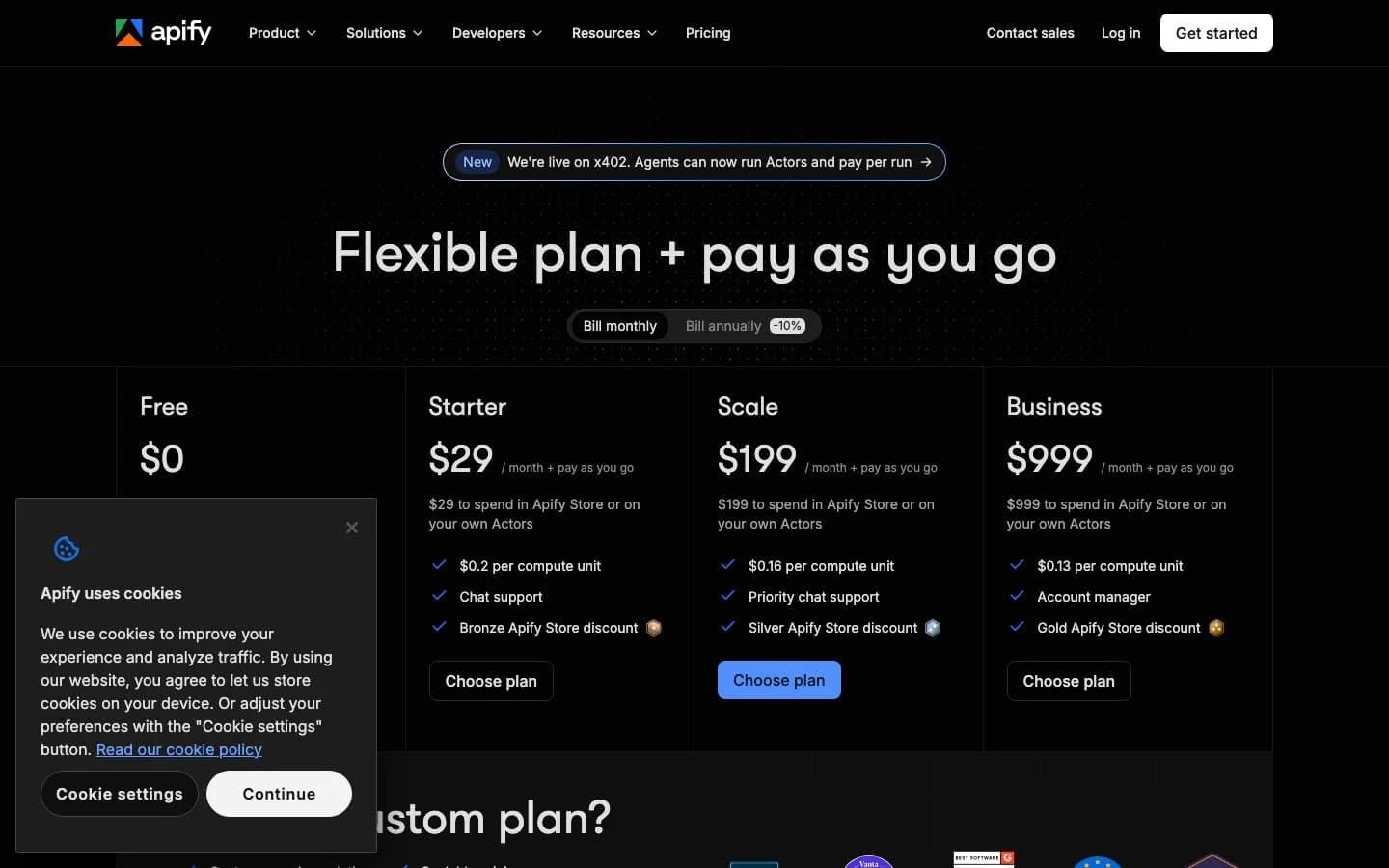
Apify pricing 2026 — subscription tiers from $0 to $999/mo, each including a matching compute credit. 1 CU = 1 GB RAM × 1 hour.
Apify Key Features
Actor Store — 25,000+ Pre-Built Scrapers
The Actor Store is Apify's standout feature. Actors are serverless cloud programs that handle a specific scraping or automation task. You browse the store, configure inputs (URL, search query, filters), run the actor, and receive structured output — no code required. Coverage spans Google Search, LinkedIn, Amazon, Instagram, TikTok, Twitter/X, Zillow, YouTube, Reddit, and thousands of niche targets.
Well-optimized first-party actors hit 95–98% success rates, making Apify one of the more reliable platforms for high-volume scraping without managing your own infrastructure.
MCP Server for AI Agent Integration
Apify ships a native Model Context Protocol (MCP) server. This lets AI agents — Claude, ChatGPT, and others — discover actors, run them, and process the results as part of an AI workflow without any manual API call setup. For teams building AI-powered data pipelines or agentic scraping workflows, this is a significant time saver.
JavaScript and Python SDKs
The Crawlee JavaScript library and the Python SDK are both actively maintained. Developers can build custom actors locally, test them, and push to Apify's infrastructure — getting cloud-native scheduling, monitoring, storage, and retry logic without setting up their own servers. The actor composition pattern (output of one actor feeding into another via shared datasets) is genuinely powerful for multi-step data pipelines.
Anti-Blocking and Proxy Infrastructure
Apify bundles IP rotation, browser fingerprinting evasion, and residential/datacenter proxy pools into the platform. Anti-blocking layers are configurable per actor. For scraping sites with aggressive bot detection, this is a major advantage over DIY Playwright or Selenium setups where you manage your own proxies and get blocked frequently.
Cloud Storage and Scheduling
Actor results are stored in Apify's key-value stores and datasets, accessible via the API or dashboard. Scheduling is built in — set actors to run on a cron schedule, trigger via webhook, or chain them into automated pipelines. For teams running recurring data pulls (weekly competitor monitoring, daily review tracking), the scheduling layer removes the need for external orchestration.
How Apify Works: From Actor Run to Usable Lead Data
Apify is easier to budget for once you see the full path from an Actor run to data a sales or ops team can actually use. Here is how a typical B2B data pull runs on the platform, and where costs and extra work show up along the way.
- Pick an Actor and check how it charges. Apify Store groups Actors into categories such as lead generation, social media, e-commerce, and jobs. Each listing shows its pricing model: pay per usage (platform compute only), pay per result, pay per event, or a monthly rental. The label matters as much as your plan, since it decides whether you are paying for compute time, for output, or for access.
- Configure inputs and test on a small batch. Set the input (search terms, start URLs, profile lists, filters) and the memory allocation, then run a small sample first. For usage-billed Actors, memory and runtime drive the bill: one compute unit is 1 GB of RAM running for one hour.
- Add proxies if the target site blocks scrapers. As of September 2026, every plan includes some datacenter IPs (5 on Free, 30 on Starter, 200 on Scale, 500 on Business). Residential proxies cost $7–$8 per GB depending on plan, and SERP proxy requests are billed per 1,000.
- Store and export the results.Each run writes to Apify's cloud storage, in datasets and key-value stores, which you can download from the dashboard or pull through the API as raw JSON or CSV.
- Verify, dedupe, and map fields. Scraped contact fields are not verified. Before outreach, run emails through a verification step (a separate Actor or a dedicated verifier), remove duplicates, and map fields to your CRM schema.
- Automate the pipeline.Schedule Actors to re-run on a cron, trigger them by webhook, or chain them so one Actor's dataset feeds the next. Results can flow onward through the API, Zapier, or Make, and the Apify MCP server lets AI clients such as Claude, ChatGPT, or Cursor discover and run Actors directly.
The simplest way to forecast spend is to run an Actor on a small sample, check the usage it consumed, and scale that up to your expected volume, adding proxy costs on top. Compare the total with your plan's included credit: paid plans keep running and bill overage once the credit is used, while Free plan runs are blocked until the next billing cycle.
For sales teams, the takeaway is that Apify supplies raw inputs such as company lists, profiles, and local business listings. Turning them into contacts you can safely email, with verified addresses and clean CRM records, is work you still have to plan and pay for separately.
Apify Pros: What It Does Well
- 25,000+ pre-built actors in the Actor Store covering virtually every scraping use case — Google Search, LinkedIn, Amazon, Instagram, TikTok, Reddit, Zillow, and thousands more. Most scenarios do not require writing a single line of code.
- Generous free tier. The $0/mo plan includes $5 of compute credit every month with no credit card required. For low-volume scraping, this is genuinely useful — not a 7-day trial that expires.
- Well-optimized actors achieve 95–98% success rates. Anti-blocking, IP rotation via Apify Proxy, and cloud-native architecture make it more reliable than running scrapers on local infrastructure.
- MCP server integration. Apify ships a native MCP server that lets AI agents like Claude and ChatGPT discover and run actors directly — a significant advantage for teams building AI-powered data pipelines.
- Strong SDK and API support. JavaScript/Node.js and Python SDKs are actively maintained. The REST API is well-documented and actors are composable — output from one can feed into another.
- Startup, student, and nonprofit discounts. As of September 2026, startups get 30% off the Scale plan, students get 30% off Starter and Scale, and nonprofits can request a personalized discount. Meaningful savings for early-stage teams bootstrapping a data pipeline.
Apify Cons: Where It Falls Short
- Compute costs compound quickly at scale. The headline $19/mo Starter plan sounds cheap, but actual usage depends heavily on actor RAM settings and runtime. A single 4 GB RAM actor running for 2 hours consumes 8 CUs — that is $1.60 of the Starter plan's $19 monthly credit gone in one run. Large, long-running scrapes on heavy pages can exhaust included credits fast and trigger overage billing.
- Monthly credits expire. Included compute credits do not roll over. Teams with irregular scraping schedules — a big run one month, nothing the next — lose value on larger subscription plans and are usually better off on a smaller plan that bills overage for spikes.
- No B2B sales workflow. Apify has no verified contact database, no buying signals, no CRM native push, and no email sequencing. Sales teams who want to scrape LinkedIn or find emails via an actor still need to bolt on enrichment, verification, CRM mapping, and an outreach tool — none of which are included.
- Actor quality is uneven. With 25,000+ actors in the store, quality control varies. Some third-party actors are outdated, poorly maintained, or break when the target site changes its structure. Vetting actors takes time, and Actor Store ratings alone do not tell the full story.
- No published accuracy benchmark for contact data. Apify does not publish official hit-rate or validation figures for email and phone actors. Contact data from scraping actors is unverified — bounce rates and deliverability vary significantly.
- Proxy costs add up. Residential and rotating datacenter proxies are billed separately on top of compute. For scraping sites with aggressive anti-bot protection, proxy usage can exceed the compute cost and push effective per-page prices well above the subscription rate.
- Cold starts add latency. Actor initialization can add 5–30 seconds of latency per run, which matters for real-time or latency-sensitive applications. Teams building time-critical pipelines should account for this.
Apify vs Outscraper vs PhantomBuster
The comparison below covers Apify against Outscraper (Google Maps scraping) and PhantomBuster (LinkedIn automation) — two tools teams often weigh when evaluating Apify.
| Feature | Apify | Outscraper | PhantomBuster |
|---|---|---|---|
| Starting Price | $0 free ($5 credit/mo); $19/mo Starter | $0 free (500 records); $3/1k PAYG | $59/mo Starter |
| Pricing Model | Subscription + compute units (CUs) — 1 CU = 1 GB RAM × 1 hr | Pay-as-you-go per task; costs stack per endpoint | Subscription + slot limits |
| Primary Use Case | Developer scraping platform (25k+ actors) | Google Maps + web scraping at scale | LinkedIn automation & social scraping |
| Data Source | Actor Store + bring-your-own scrapers | Scraped Google Maps + open web (100M+ listings) | LinkedIn, Instagram, web scraping |
| Email + Phone Accuracy | Varies by actor; no published benchmark | ~85% claimed; no official benchmark | Varies by phantom; no benchmark |
| Email Verification | Separate actor required | Separate paid task ($3/1k) | Not native |
| Native Outreach | No — export/API only | No — export only | Partial — LinkedIn messaging |
| CRM Integrations | Via Zapier/Make/API only | None native — CSV/API export | None native |
| Free Tier | $5 compute credit/mo resets monthly | 500 records/service/30 days | Limited trial |
| Best For | Developers building scrapers into products | Local lead agencies; raw Maps data | LinkedIn automation at scale |
Apify vs Outscraper
Outscraper and Apify overlap for Google Maps data, but diverge significantly in model and breadth. Outscraper is Maps-first with a pay-as-you-go pricing model ($3/1k records, no monthly fee) and a no-code dashboard optimized for non-technical users. Apify is broader but subscription-based and developer-first — you need to configure actors and understand compute billing. For raw Maps scraping without code, Outscraper wins on simplicity. For multi-source scraping across dozens of platforms, Apify wins on breadth. See the full Outscraper review for a deeper look.
Apify vs PhantomBuster for LinkedIn
Both platforms have LinkedIn scrapers, but they serve different audiences. PhantomBuster is LinkedIn-first and non-technical — it wraps LinkedIn automation into simple "phantoms" for profile scraping, connection requests, and message sequences. Apify's LinkedIn actors are more powerful and configurable, but require more setup and compute management. PhantomBuster wins for marketers who want LinkedIn automation in five minutes. Apify wins for developers who want LinkedIn data as part of a larger custom pipeline. For a broader look at top LinkedIn scrapers, see our dedicated comparison.
Who Should Use Apify?
Apify is the right fit for:
- Developers and data engineers who need to extract structured data from websites at scale and want cloud-native infrastructure (auto-scaling, storage, scheduling, retries) without managing servers.
- AI and LLM teams building agentic pipelines that need real-time web data. The native MCP server makes Apify one of the easiest platforms to wire into Claude or ChatGPT workflows today.
- Product teams and startups who need a custom scraping actor built once and run continuously — and benefit from the 30% startup discount.
- Researchers and analysts who need broad data coverage across many sources (social media, e-commerce, news, search) and want to avoid maintaining separate scrapers for each.
- Low-to-mid-volume users who can stay within the free $5/mo credit or the $19/mo Starter plan without triggering significant overage.
Apify is not the right fit for:
- B2B sales teams running outbound. No verified contact database, no buying signals (funding, hiring, tech changes), no CRM push, no email sequences. Apify is a data layer — not an outbound platform. For that use case, see Apify alternatives designed for B2B sales.
- Non-technical users who want point-and-click. While pre-built actors are usable without coding, configuring actors, understanding CU billing, and managing datasets still requires technical fluency. Outscraper or PhantomBuster are more beginner-friendly for specific use cases.
- Teams that need verified, deliverable email and phone data. Scraped contact data from Apify actors is unverified. Bounce rates will be higher than from a waterfall contact provider. High bounces hurt sender reputation and cold email deliverability.
- High-volume teams with irregular scraping cadences. Monthly credits expire. If you run a large scrape one month and nothing the next, you lose the unused credit. Size the plan to your baseline usage and let spikes bill as overage instead.
Bottom line: Apify is one of the most capable scraping platforms for developers and AI teams, and the free plan makes it cheap to test. For B2B sales prospecting, treat it as a data source and budget for verification, deduplication, and CRM mapping on top.
If Apify's unverified scraped contact data is a dealbreaker, SyncGTM is one alternative worth a look: it runs waterfall enrichment across 50+ data providers for verified emails, phone numbers, and firmographics.