
By Kushal Magar · October 2, 2026 · 11 min read
Apollo.io vs Instantly.ai: Cold Email Platforms Compared 2026
Apollo.io vs Instantly.ai comes down to where your outbound bottleneck sits. Apollo answers “who should I email?” with 240M+ contacts, buying signals, and built-in sequences; Instantly answers “how do I land 100,000 emails in primary inboxes?” with unlimited inboxes, warmup, and rotation on every paid plan.
Apollo.io vs Instantly.ai is one of the most common cold email shortlists in 2026, and the two tools are not built for the same job. Apollo is an AI GTM system with a 240M+ contact database, multichannel sequences, a dialer, and buying signals, while Instantly is sending infrastructure first, with unlimited email accounts, unlimited warmup, and inbox rotation on every paid plan.
The gap has narrowed, though. Apollo now ships a deliverability suite with email warmup and domain and mailbox purchasing, and Instantly sells its own 450M+ lead database on credits, so the old “Apollo for data, Instantly for sending” split is now a question of emphasis.
Below, we compare the four things that decide this choice (sending limits, warmup, lead data, and pricing), checked against both vendors' pricing pages in October 2026. For single-tool deep dives, see our Apollo.io review and Instantly review, or our wider roundup of cold email software for B2B outreach.
Quick Summary
Apollo.io vs Instantly.ai is a choice between built-in lead data and sending infrastructure. Apollo.io is an AI GTM system with 240M+ contacts and 30M+ companies (Apollo claims 98% email accuracy), buying signals (intent, job changes, and website visitors), multichannel sequences sent from your own connected mailboxes, and a deliverability suite with warmup and domain and mailbox purchasing. As of October 2026 it costs $49 (Basic), $79 (Professional), or $119 (Organization, 3-seat minimum) per seat per month billed annually, plus a free plan and a Custom tier through sales. Free and Basic cap sending at 1 mailbox per user and 250 emails per day, while Professional allows unlimited Google and Microsoft mailboxes and unlimited daily sends. Instantly.ai is cold email infrastructure: every paid plan includes unlimited email accounts and unlimited warmup on a network Instantly says spans 1,000,000+ real accounts, and plans are priced by volume rather than seats. Growth costs $47/month (5,000 emails, 1,000 uploaded contacts), Hypergrowth $97/month (25,000 contacts, up to 125,000 emails), and Light Speed $358/month (500,000 emails plus SISR dedicated IPs), each 20% cheaper on annual billing. Its 450M+ lead database, SuperSearch, is sold separately on credits from $47/month. Instantly wins on inbox rotation and deliverability at volume; Apollo wins when the hard part is finding and prioritizing who to email.
TL;DR
- Short answer: Instantly.ai wins on inbox rotation and deliverability at volume; Apollo.io wins on built-in lead data and signals. Pick by bottleneck: sending capacity (Instantly) or knowing who to email (Apollo).
- Sending limits: Instantly includes unlimited email accounts on every paid plan and caps monthly emails instead (5,000 on Growth, up to 125,000 on Hypergrowth, 500,000 on Light Speed). Apollo allows 1 mailbox per user and 250 email sends a day on Free and Basic; Professional ($79/seat) and up unlock unlimited Google and Microsoft mailboxes and unlimited daily sends.
- Warmup: Instantly includes unlimited warmup on a network of 1,000,000+ real accounts, inbox placement tests, and SISR dedicated IPs on Light Speed. Apollo includes a deliverability suite with email warmup and domain and mailbox purchasing from Basic up.
- Lead data: Apollo bundles 240M+ contacts (Apollo claims 98% email accuracy), 65+ filters, waterfall enrichment across 20+ partners, and intent, job-change, and website-visitor signals. Instantly's 450M+ lead database has 13 filters and waterfall enrichment across 5+ providers, sold separately from $47/month.
- Pricing (October 2026): Apollo charges per seat: $49 (Basic), $79 (Professional), or $119 (Organization, 3-seat minimum) per month billed annually, plus a free plan and Custom pricing above that. Instantly charges per workspace by volume: outreach from $47/month ($37.60 annual), lead credits from $47/month, or bundles from $94/month.
- Pick Instantly.ai if you already have lists and send 30,000+ emails a month across many inboxes. Pick Apollo.io if your reps need data, signals, calls, and sequences under one seat price.
What We Evaluated
- Apollo.io vs Instantly.ai sending limits: mailboxes allowed per plan, daily send caps, and monthly email ceilings
- Warmup and deliverability tooling: warmup network, inbox rotation, dedicated IPs, domain and mailbox purchasing, and placement monitoring
- Lead database size, filters, enrichment depth, and buying signals, using each vendor's own published figures
- Pricing model and verified October 2026 prices: per seat (Apollo) versus per workspace by volume (Instantly), plus credit costs
- Channels beyond email: calls, LinkedIn tasks, SMS, and CRM
- Integrations and automation: CRM sync, API, MCP, and AI agents
1. Apollo.io — A contact database, buying signals, and multichannel sequences under one seat price
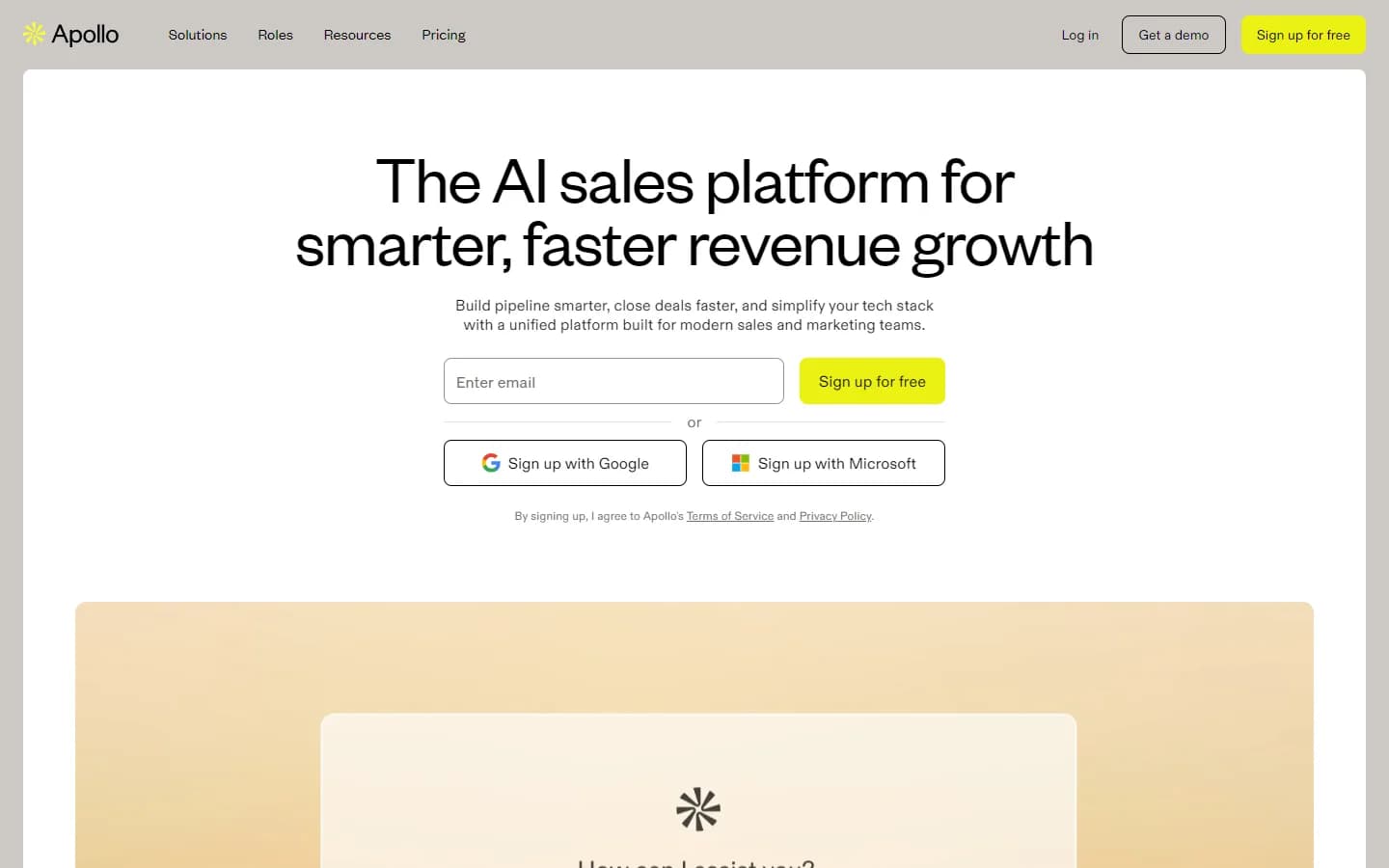
Apollo.io — A contact database, buying signals, and multichannel sequences under one seat price
Apollo.io is an AI GTM system for teams that want to find prospects and work them in one place, starting with 240M+ contacts and 30M+ companies, which Apollo says carry 98% email accuracy. Search runs on 65+ filters, and waterfall enrichment cascades through 20+ data partners when Apollo's own record is missing an email or phone number.
Buying signals cover intent, job changes, and website visitors, so targeting and sending happen in the same tool. Sequences mix automatic emails with calls and LinkedIn tasks, include A/B testing and a built-in dialer, and send from your own connected mailbox, which keeps sender reputation tied to your own domains.
Sending limits depend on the plan. As of October 2026, Free and Basic allow 1 mailbox per user and 250 email sends per day, while Professional unlocks unlimited Google and Microsoft mailboxes (plus 5 SMTP mailboxes per user) and unlimited daily sends.
Apollo also has real deliverability tooling now. From Basic up, its deliverability suite covers email warmup, domain and mailbox purchasing with SPF, DKIM, and DMARC configured for you, inbox rotation, verification, and inbox placement and blocklist monitoring; Apollo's own guidance is to start around 20 emails per mailbox per day and stay under 50.
Pricing is per seat: Basic $49, Professional $79, and Organization $119 (3-seat minimum) per seat per month billed annually ($65 and $99 monthly for Basic and Professional) on apollo.io/pricing, plus a free plan with no time limit and a Custom plan through sales for SSO, advanced security, and custom volumes. Credits are pooled across the team and don't roll over: a verified email costs 1 credit, a phone number 8, and depending on plan, credits also cover warmup and domain and mailbox purchases.
Apollo runs outside its own UI too: Apollo MCP works inside ChatGPT, Claude, Perplexity, and Cursor on every plan, alongside the Apollo CLI, an API, and 200+ integrations including HubSpot and Salesforce. G2 reviewers flag weaker data outside North America; for how it compares with a dedicated engagement platform, see Salesloft vs Apollo or the best Apollo alternatives.
Pros
- +240M+ contacts and 30M+ companies (98% email accuracy, per Apollo), plus waterfall enrichment across 20+ data partners
- +Buying signals (intent, job changes, website visitors) sit next to the data, so targeting and sending live in one tool
- +Multichannel sequences with email, calls, and LinkedIn tasks, plus a built-in dialer
- +Deliverability suite with email warmup and domain and mailbox purchasing from Basic up
- +Free plan with no time limit, plus Apollo MCP, CLI, API, and 200+ integrations
Cons
- −Per-seat pricing ($49–$119/seat/month annual, Custom above that) grows with every rep you add
- −Free and Basic cap sending at 1 mailbox per user and 250 emails per day; multi-mailbox volume needs Professional
- −Warmup and mailbox purchases can draw on the same pooled credits as contact reveals, and unused credits expire
- −Data quality outside North America is less consistent, according to G2 reviewers
- −Steeper learning curve than a single-purpose sending tool
Best for: A contact database, buying signals, and multichannel sequences under one seat price
Pricing: Free plan ($0, no time limit). Basic $49, Professional $79, and Organization $119 (3-seat minimum) per seat per month billed annually (Basic $65 and Professional $99 billed monthly); Custom plan through sales. Credits are pooled across the team, granted upfront, and don't roll over. Verified on apollo.io/pricing, October 2026.
2. Instantly.ai — High-volume cold email across many inboxes, priced by volume instead of seats
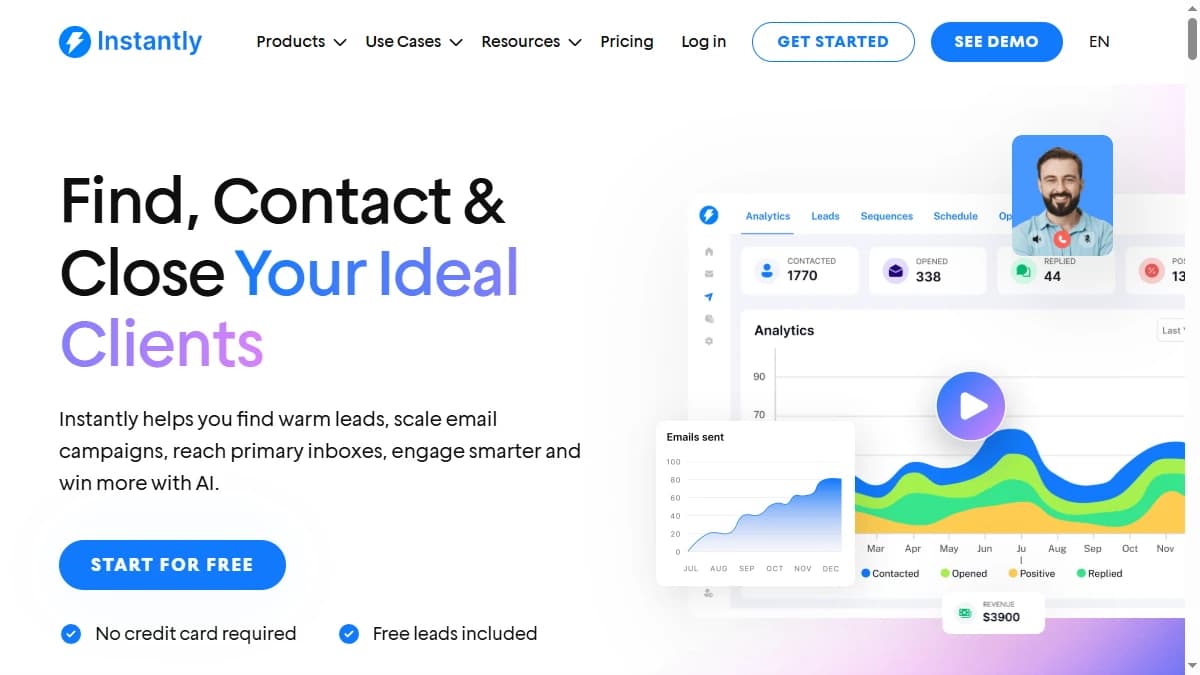
Instantly.ai — High-volume cold email across many inboxes, priced by volume instead of seats
Instantly.ai is cold email infrastructure first: every paid plan includes unlimited email accounts and unlimited warmup, so you scale by adding inboxes, not seats. Plans are priced by monthly email volume and uploaded contacts rather than by how many people log in.
Sending limits are monthly, not per mailbox. As of October 2026 on instantly.ai/pricing, Growth costs $47/month ($37.60 billed annually) for 5,000 emails and 1,000 uploaded contacts, Hypergrowth $97 ($77.60 annual) for 25,000 contacts and up to 125,000 emails (the annual plan lists 100,000), and Light Speed $358 ($286.30 annual) for 500,000 emails and 100,000 contacts.
Per-inbox volume is still your job. Instantly's cold email guide recommends 30 to 50 emails per inbox per day, 3 to 5 inboxes per domain, and at least two weeks of warmup before launch, so 30,000 emails a month works out to roughly 27 to 45 warmed inboxes in rotation.
Warmup runs on a network Instantly says includes 1,000,000+ real email accounts, with a slow ramp and read emulation. Inbox rotation spreads sends across accounts, inbox placement tests and a global block list catch problems early, and Light Speed adds SISR, which assigns dedicated server and IP blocks and swaps out flagged IPs.
Lead data is a separate product. SuperSearch, which replaced Instantly's Lead Finder, lists 450M+ B2B leads with 13 filters (including keywords and lookalikes), waterfall work-email enrichment across 5+ providers, and job-posting, news, tech, and funding enrichment, on credits from $47/month or in outreach-plus-credits bundles from $94/month.
New products push Instantly further into infrastructure: AirMail offers sending inboxes hosted on Instantly's own servers at $4 per inbox, and done-for-you Google inboxes cost $5 per account per month. Calls and SMS live in Instantly's separate CRM, which includes unlimited seats; if Instantly isn't the right fit, compare the best Instantly alternatives.
Pros
- +Unlimited email accounts and unlimited warmup on every paid plan
- +Priced per workspace by volume, so adding reps doesn't add seat fees
- +Warmup network of 1,000,000+ real accounts, inbox rotation, placement testing, and SISR dedicated IPs on Light Speed
- +Fast inbox setup through done-for-you Google inboxes ($5/account/month) or AirMail inboxes ($4 each)
- +Optional 450M+ lead database with waterfall work-email enrichment across 5+ providers
Cons
- −Lead data is a separate credit subscription from $47/month on top of the outreach plan
- −13 search filters versus Apollo's 65+, so list building is less granular
- −Email-first: calling and SMS sit in a separate CRM product rather than the outreach plan
- −Uploaded-contact caps (1,000 on Growth) often bind before the email cap does
- −Unlimited accounts doesn't mean free accounts: every inbox still costs money
Best for: High-volume cold email across many inboxes, priced by volume instead of seats
Pricing: Outreach: Growth $47/month ($37.60 annual), Hypergrowth $97/month ($77.60 annual), Light Speed $358/month ($286.30 annual), Enterprise custom. Lead credits from $47/month; outreach-plus-credits bundles from $94/month ($85 annual). Free trial, no credit card required. Verified on instantly.ai/pricing, October 2026.
Comparison Table
| Tool | Best For | Free Tier | Starting Price | Standout Feature |
|---|---|---|---|---|
| Apollo.io | A contact database, buying signals, and multichannel sequences under one seat price | Yes (free plan, no time limit) | $49/seat/month (Basic, annual) | 240M+ contacts with intent, job-change, and website-visitor signals built into the same tool that sends |
| Instantly.ai | High-volume cold email across many inboxes, priced by volume instead of seats | Free trial (no credit card required) | $37.60/month (Growth, annual) | Unlimited inboxes and warmup on every plan, with rotation and dedicated IPs for high-volume sending |
How to Choose
- Apollo.io if you need a contact database, buying signals, and multichannel sequences under one seat price
- Instantly.ai if you need high-volume cold email across many inboxes, priced by volume instead of seats
Final Verdict
Pick Instantly.ai if you already have lists, or a data source you trust, and your constraint is volume and inbox placement. Unlimited inboxes and warmup on every plan, rotation across dozens of accounts, and SISR dedicated IPs on Light Speed, all priced by volume from $47 to $358 per month, make it the stronger sending engine for agencies and email-first teams sending 30,000+ emails a month.
Pick Apollo.io if your bottleneck is knowing who to email. One seat from $49 per month (annual) gets 240M+ contacts (Apollo claims 98% email accuracy), intent, job-change, and website-visitor signals, and multichannel sequences with a dialer; with warmup now built in and unlimited mailboxes on Professional, most mid-volume teams won't need a second sending tool.
The deciding question is whether your problem is sending capacity or targeting. If it's both, the common stack is Apollo for list building and Instantly for sending, which earns its second subscription only once your volume outgrows reps' own mailboxes.
Whichever you choose, SyncGTM can strengthen the enrichment behind it with verified emails, phone numbers, and firmographics from 50+ providers.