
By Kushal Magar · September 28, 2026 · 12 min read
Salesloft vs Apollo: Sequences or Prospecting Data in 2026
Salesloft vs Apollo shows up in the same searches, but the two aren't the same kind of product. Apollo is data-first — a large B2B contact database with sequencing bundled on top. Salesloft is engagement-first — no proprietary contact database, built to run sophisticated multi-channel cadences over data you already have. The real question isn't which sequencing tool is better; it's whether you need the database or the motion, and pricing follows directly from that answer.
Salesloft and Apollo both get filed under "sales engagement platform," and both build outbound sequences, so the comparison searches make sense on the surface. But they start from opposite ends of the same problem. Apollo built a B2B contact database first — over 275 million contacts and tens of millions of companies — and layered sequencing, a dialer, and basic enrichment on top of that data asset. Salesloft built the sequencing and cadence engine first — multi-step, multi-channel outbound (email, calls, LinkedIn) with dynamic branching and deal management — and assumes you're bringing your own contact data, usually from a CRM or a dedicated data provider.
That's the honest framing: this isn't "which cadence tool wins." It's "do you need a database, a motion engine, or both." Teams that pick Apollo because it's cheaper and self-serve often end up paying for prospecting data they don't fully use. Teams that pick Salesloft because the cadence engine is more sophisticated often discover they still need a separate data source to feed it — which is where the real cost of this decision shows up.
It's also worth noting Salesloft isn't standing still. Clari and Salesloft completed their merger on December 3, 2025, with Steve Cox named CEO of the combined company and a roadmap pointed at forecasting and predictive revenue. The day-to-day cadence product is largely unchanged, but treating Salesloft as a pure standalone sequencing vendor in 2026 misses where the company is actually headed. For the two products on their own, see our Salesloft review and Apollo.io review. If you're weighing Salesloft against a peer engagement platform instead of a data platform, see our Salesloft vs Outreach comparison.
Quick Summary
"Salesloft vs Apollo" reads like a head-to-head between two sequencing tools, but the products are built from opposite starting points and most teams that scale end up needing both categories, if not both vendors. Apollo is data-first: a B2B contact database of 275+ million people and tens of millions of companies, with sequencing, a dialer, and enrichment layered on top so you can prospect and reach out from inside one tool. Salesloft is engagement-first: it has no proprietary contact database — you bring your own data, typically from a CRM or a dedicated provider — and in exchange gets a more sophisticated multi-channel cadence engine, dynamic branching, deal management, and built-in conversation intelligence, aimed at mid-market and enterprise revenue teams. The pricing structures reflect that split. Apollo publishes self-serve tiers, including a free plan, with cost scaling by seat and by credit consumption (email, mobile, and export credits) — meaning the sticker price understates cost for high-volume outbound. Salesloft is sold through a quote-based annual contract with no public list price. Post-merger with Clari (completed December 2025, Steve Cox as CEO), Salesloft's roadmap is also leaning further into forecasting and predictive revenue, which matters if you're evaluating it purely as a cadence tool. The decision that actually matters isn't which sequencer is more polished — it's whether your team needs to buy the database, the motion, or both, and SyncGTM sits underneath either choice as the enrichment and sync layer: 2-way Salesforce sync, 76+ data points per lead pulled through a waterfall across 50+ providers, and an AI Email Writer that drafts sequence-ready copy from verified data so neither Salesloft nor Apollo starts a rep from a blank cadence step.
TL;DR
- Short answer: Apollo and Salesloft solve different halves of outbound. Apollo is a prospecting database (275M+ contacts) with sequencing bundled on top; Salesloft is a sequencing and cadence engine with no proprietary database, built for data you bring in.
- Pick Apollo if you don't already have a reliable contact data source and want database plus sequencing in one self-serve, published-pricing tool — common for early-stage and SMB teams running high-volume outbound.
- Pick Salesloft if you already have a data source (CRM, dedicated provider) and need a more sophisticated multi-channel cadence engine, deal management, and conversation intelligence for a mid-market or enterprise motion.
- Pricing shape differs, not just amount: Apollo publishes self-serve tiers including a free plan; Salesloft is quote-only with no public list price. Apollo's real cost is driven by credit consumption per seat, not just the sticker price.
- The trap: teams that need both eventually pay for a database (Apollo or a dedicated provider) and a cadence engine (Salesloft) — that's not vendor bloat, it's two different layers of the same motion.
- SyncGTM isn't a third sequencing tool — it's the data layer that can sit under either one: 2-way Salesforce sync, a 76+ data point waterfall across 50+ providers, and an AI Email Writer that drafts the cadence copy Salesloft or Apollo sends.
What We Evaluated
- What each product actually owns — Apollo's proprietary contact database vs. Salesloft's cadence and engagement engine
- Pricing structure and transparency: Apollo's published, credit-based self-serve tiers vs. Salesloft's quote-only annual contracts
- Sequencing depth and channel coverage: multi-step, multi-channel branching (Salesloft) vs. sequencing bundled with a database (Apollo)
- Where the roadmap is heading post-merger — Salesloft's push into forecasting and predictive revenue since the Clari merger
- Total cost of ownership at volume: Apollo's credit consumption vs. Salesloft's per-seat quote, and whether you need a second tool either way
- Team profile fit: self-serve SMB/early-stage motion vs. mid-market/enterprise motion with an existing data source
- The underlying data quality question neither tool fully solves: keeping contact and account records current once they're in the CRM
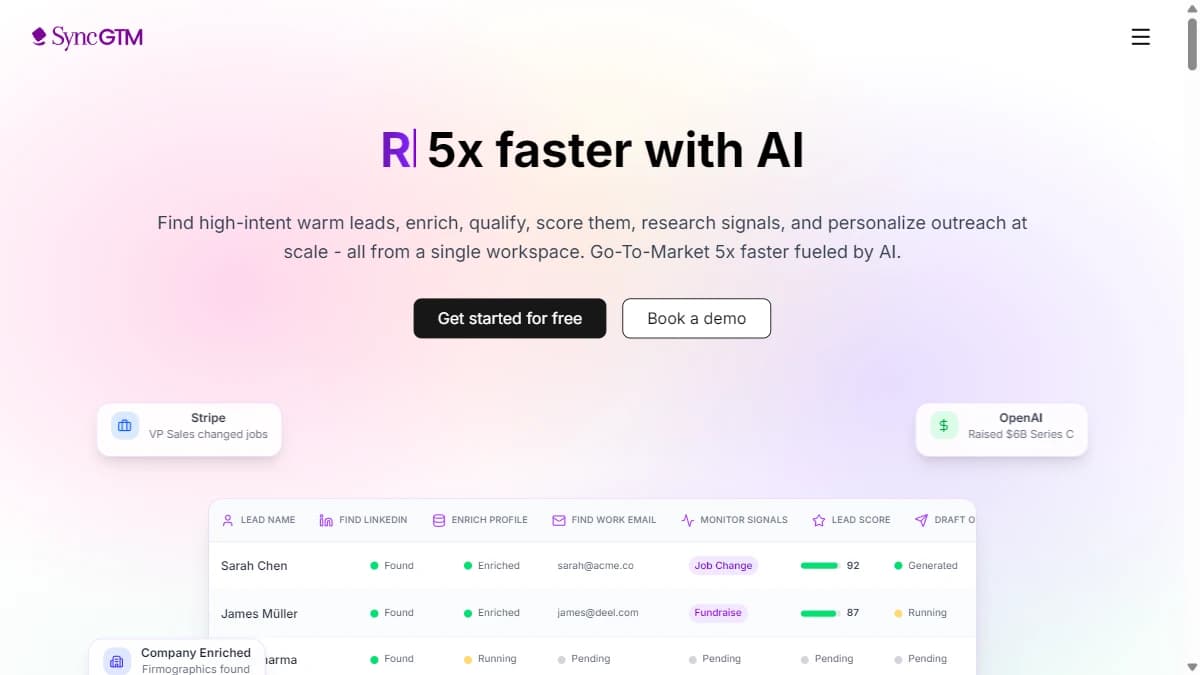
1. SyncGTM — Teams running Salesloft, Apollo, or both, who need the contact and account data behind their sequences to stay accurate and synced to Salesforce
SyncGTM — Teams running Salesloft, Apollo, or both, who need the contact and account data behind their sequences to stay accurate and synced to Salesforce
SyncGTM isn't a sequencing tool or a contact database — it's the data layer that sits underneath either one, so the decision between Salesloft and Apollo doesn't also have to be a decision about where your contact data lives.
2-way Salesforce sync keeps enriched records flowing in both directions, so whichever tool is sending the cadence — Salesloft's engine or Apollo's bundled sequencer — is working from current data instead of a stale export. Underneath that sync, a real-time waterfall across 50+ data providers adds 76+ data points per lead: verified email, direct phone, firmographics, and job-change or growth signals.
The AI Email Writer turns that verified data into sequence-ready copy for either platform, starting reps with a draft grounded in real account context instead of a blank cadence step. See the product tour, the GTM agent library, and a ready outreach workflow template for how the pieces connect, or check pricing for current plans.
Pros
- +2-way Salesforce sync — enriched data flows back into the CRM instead of living in a separate export
- +76+ data points per lead from a 50+ provider waterfall, refreshed at lookup rather than a static append
- +AI Email Writer drafts cadence copy from verified contact and account data, for use inside Salesloft or Apollo
- +Sits underneath either category — database or engagement engine — instead of forcing a third tool into the stack
Cons
- −Not a cadence engine or dialer — teams still need Salesloft, Apollo, or both to actually run outbound sequences
- −Not a standalone prospecting database — it enriches and syncs records rather than replacing a data source outright
Best for: Teams running Salesloft, Apollo, or both, who need the contact and account data behind their sequences to stay accurate and synced to Salesforce
Pricing: Starts at $99/mo. Free tier available.
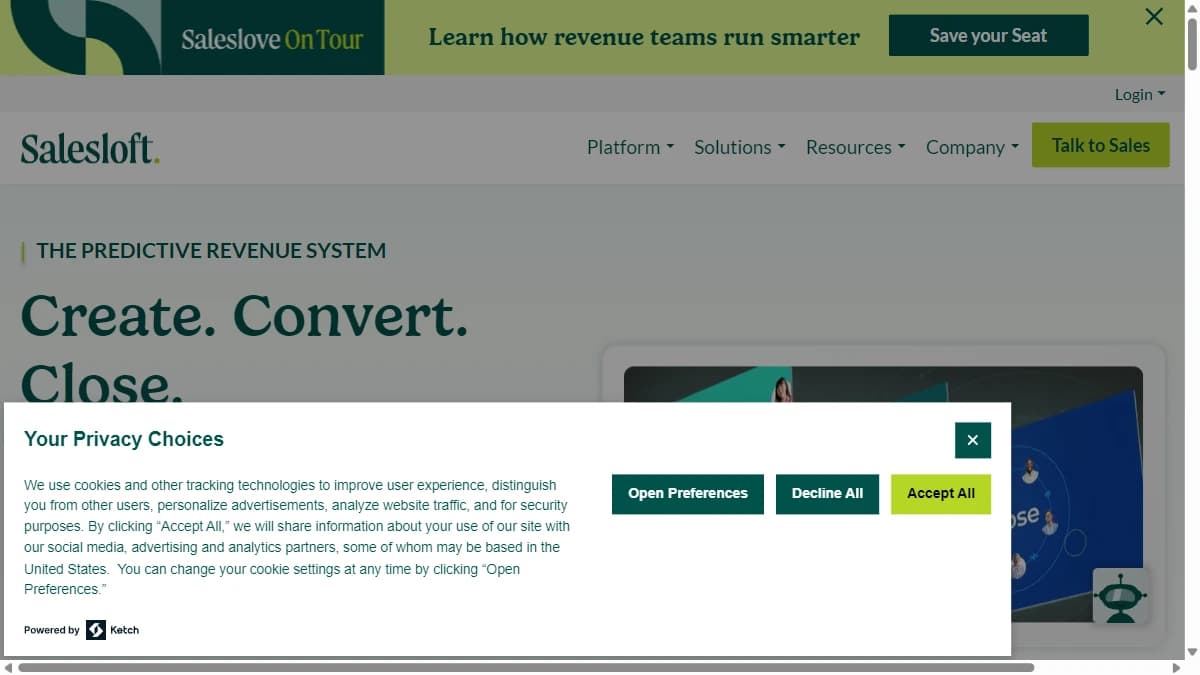
2. Salesloft — Mid-market and enterprise teams that already have a contact data source and need a more sophisticated multi-channel cadence engine
Salesloft — Mid-market and enterprise teams that already have a contact data source and need a more sophisticated multi-channel cadence engine
Salesloft is a sales engagement platform built around the Cadence — a structured, multi-step sequence of calls, emails, and LinkedIn touches that reps work through in a prioritized queue, with dynamic branching based on prospect behavior.
It has no proprietary contact database. Salesloft assumes contact and account data comes from elsewhere — most commonly a connected CRM or a dedicated enrichment provider — and puts its engineering effort into cadence sophistication, deal management, and built-in conversation intelligence instead.
Following the December 2025 merger with Clari, Salesloft's roadmap is also extending into forecasting and predictive revenue, positioning the combined company as more than a pure engagement tool going forward.
Pros
- +Purpose-built cadence engine with multi-channel sequencing (call, email, LinkedIn) and dynamic branching
- +Deal management and built-in conversation intelligence reduce the need for a separate tool at smaller scale
- +Native two-way activity sync into Salesforce and other CRMs
- +Post-merger roadmap adds forecasting depth for teams that will eventually need it
Cons
- −No proprietary contact database — teams without an existing data source still need to buy one separately
- −Public self-serve pricing isn't published; cost is quoted per seat via sales, making budgeting harder upfront
- −Not a system of record — still requires a CRM underneath it for pipeline, accounts, and reporting
- −Post-merger direction shifting toward forecasting, which may add platform complexity for teams that only want cadence execution
Best for: Mid-market and enterprise teams that already have a contact data source and need a more sophisticated multi-channel cadence engine
Pricing: Sold via annual contract with per-seat pricing quoted by sales; no public self-serve tier.
3. Apollo — Early-stage and SMB teams that don't yet have a reliable contact data source and want database plus sequencing in one self-serve tool
Apollo — Early-stage and SMB teams that don't yet have a reliable contact data source and want database plus sequencing in one self-serve tool
Apollo is a sales intelligence platform built around a large B2B contact database — over 275 million contacts and tens of millions of companies — with sequencing, a dialer, and enrichment layered on top so prospecting and outreach can happen inside one tool.
Pricing is published and self-serve: a free plan plus Basic, Professional, and Organization tiers, priced per seat with usage governed by credits for email, mobile, and export access. Real cost at volume is driven by credit consumption, not just the seat price — worth modeling before committing to a plan.
Sequencing in Apollo is less deep than Salesloft's dedicated cadence engine, but for teams that need a data source and basic outreach in one place, bundling the two removes a second purchase and a second data-sync problem.
Pros
- +Large proprietary contact database (275M+ contacts) with sequencing, dialer, and enrichment bundled in
- +Published, self-serve pricing including a free plan — transparent budgeting without a sales cycle
- +Faster to get running for teams without an existing data source
- +Basic reporting and workflow automation included at most paid tiers
Cons
- −Sequencing and cadence logic is less sophisticated than a dedicated engagement platform like Salesloft
- −Real cost scales with credit consumption (email, mobile, export), so the advertised seat price understates spend at volume
- −Free plan only supports Gmail for sending outbound email — Microsoft and other providers require a paid plan
- −Less depth in deal management and conversation intelligence than Salesloft, especially at enterprise scale
Best for: Early-stage and SMB teams that don't yet have a reliable contact data source and want database plus sequencing in one self-serve tool
Pricing: Free plan available. Paid tiers from roughly $49/seat/mo (annual) up to $119/seat/mo (annual, Organization, 3-seat minimum); monthly billing runs higher per seat.
Comparison Table
| Tool | Best For | Free Tier | Starting Price | Standout Feature |
|---|---|---|---|---|
| SyncGTM | Teams running Salesloft, Apollo, or both, who need the contact and account data behind their sequences to stay accurate and synced to Salesforce | Yes | $99/mo | The 2-way Salesforce data layer and AI-drafted sequence copy that neither Salesloft nor Apollo provides on its own |
| Salesloft | Mid-market and enterprise teams that already have a contact data source and need a more sophisticated multi-channel cadence engine | No (demo-based sales process) | Custom quote | The most sophisticated cadence and engagement engine for teams that already have the data to feed it |
| Apollo | Early-stage and SMB teams that don't yet have a reliable contact data source and want database plus sequencing in one self-serve tool | Yes | $0 (Free); paid plans from ~$49/seat/mo annual | The largest bundled contact database with sequencing on top, at transparent self-serve pricing |
How to Choose
- SyncGTM if you need teams running salesloft, apollo, or both, who need the contact and account data behind their sequences to stay accurate and synced to salesforce
- Salesloft if you need mid-market and enterprise teams that already have a contact data source and need a more sophisticated multi-channel cadence engine
- Apollo if you need early-stage and smb teams that don't yet have a reliable contact data source and want database plus sequencing in one self-serve tool