

4 Best Auto Lead Generation Software in 2026 (Ranked and Compared)

By Kushal Magar · March 17, 2026 · 14 min read
Key Takeaway
This guide ranks the four best auto lead generation software platforms in 2026 — SyncGTM, Apollo, Explorium.ai, and HubSpot — evaluated on features, pricing, data quality, integration depth, and real B2B GTM use cases. SyncGTM ranks first for bundling AI research agents, waterfall enrichment across twenty-plus data sources, signal-based triggers, and bidirectional CRM sync on every plan from ninety-nine dollars per month flat with no feature gates or credit math. Apollo ranks second for teams that want the largest native B2B contact database paired with a built-in sequencer and AI email assistant at ninety-nine dollars per user per month. Explorium.ai ranks third for teams that want company, contact, and real-time signal data delivered to AI agents through an API, a hosted MCP server, or plain-English prompts. HubSpot ranks fourth for marketing-led teams that want auto lead generation built on top of an all-in-one CRM with forms, workflows, and attribution. The correct pick depends on whether you want a consolidated AI stack on day one (SyncGTM), a big contact database with sequencing (Apollo), agent-ready data and signals for custom automations (Explorium.ai), or inbound plus CRM already unified (HubSpot). All four connect to Salesforce and major GTM stacks but differ sharply on autonomy, cost structure, and the amount of internal operations work required to operationalize the platform.
Every lead-gen vendor now claims "auto lead generation" on the homepage. Most of them ship a form builder and a static list pull and call it automation.
Real auto lead generation software does something different. It sources accounts on live signals, enriches contact data across multiple providers, scores against your ICP, drafts first-touch outreach, and syncs every record to CRM — without a human in the loop for the volume steps.
This post ranks the four auto lead generation software platforms that actually replace rep work in 2026. We evaluated them on features, pricing, data quality, and integration depth — then pressure-tested each one against real B2B GTM workflows.
No marketing fluff. No sponsored placements. Just the ranked comparison.
Quick Summary
The best auto lead generation software in 2026 are SyncGTM, Apollo, Explorium.ai, and HubSpot. SyncGTM wins on consolidation — AI research agents, waterfall enrichment across 20+ data sources, signal triggers, and CRM sync on every plan from $49/month flat. Apollo wins on contact-database depth plus a built-in sequencer at $99/user/month. Explorium.ai wins on agent-ready data, with 146M+ companies, 767M+ professional profiles, and real-time signals over an API and MCP server. HubSpot wins for marketing-led teams that want auto lead generation inside the CRM they already run. Pick the tool that replaces the most manual tasks — not the one with the fanciest dashboard.
TL;DR: Best Auto Lead Generation Software in 2026
- SyncGTM — Best overall. AI agents, waterfall enrichment, signal triggers, and CRM sync on every plan from $49/month flat.
- Apollo — Best for a native contact database plus built-in sequencing. From $99/user/month on the Multichannel plan.
- Explorium.ai — Best for agent-ready B2B data and signals. Free trial (100 credits), then from $29.99 per credit package.
- HubSpot — Best for marketing-led teams. Sales Hub from $15/user/month, Marketing Hub priced separately.
What Is Auto Lead Generation Software?
Auto lead generation software is a platform that runs the full lead funnel — sourcing, enrichment, scoring, first-touch outreach, and CRM sync — on autopilot. You define the ICP and the signals. The software does the work.
The shift from manual list-pulling to auto lead generation matters for one reason. Manual lists go stale the second you export them. Auto lead generation software re-queries live data every time a trigger fires.
A modern auto lead generation platform does five jobs well:
- Source accounts that match ICP using firmographic, technographic, and intent signals.
- Enrich records through waterfall data routing — falling back across providers when a primary source misses.
- Research and score each account with an AI agent that reads the website, news, and hiring signals.
- Draft and send outreach personalized to the research findings, then sequence follow-ups automatically.
- Sync CRM bidirectionally so reps and managers see the same source of truth.
If a tool calls itself auto lead generation software but only ships one or two of those five, you are still stitching tools together. For full context on how the category is evolving, our deep dive on the AI lead generation agent motion breaks down the architecture in detail.
One warning before you buy. Automation amplifies whatever you point it at. If your ICP is vague, your data is stale, or your message does not convert manually, automating it just sends bad outreach faster. Fix the foundation first — clear ICP, verified contact data, waterfall enrichment — then layer the automation on top.
How We Ranked These Auto Lead Generation Software Tools
Four criteria. Each tool scored against the same bar. No category averages, no vendor self-reports.
- Features and automation depth. How much of the five-job list does the platform actually ship natively — sourcing, enrichment, research, outreach, CRM sync? Form builders alone do not count.
- Pricing transparency.Published entry pricing, predictable credit math, no hidden seat or data fees. Tools that hide pricing behind "book a demo" get marked down.
- Data quality. Enrichment hit rate on a 50-prospect sample, email validation accuracy, and phone number freshness. Stale data breaks every downstream step.
- Integration depth. Bidirectional CRM sync to HubSpot and Salesforce, field-level mapping, write-back latency, and native connectors for the rest of the B2B stack.
We also weighted real output — meetings booked and records enriched per dollar — over feature count. The median B2B sales team already uses 10+ tools. Adding another one should replace three.
1. SyncGTM — Best Overall Auto Lead Generation Software
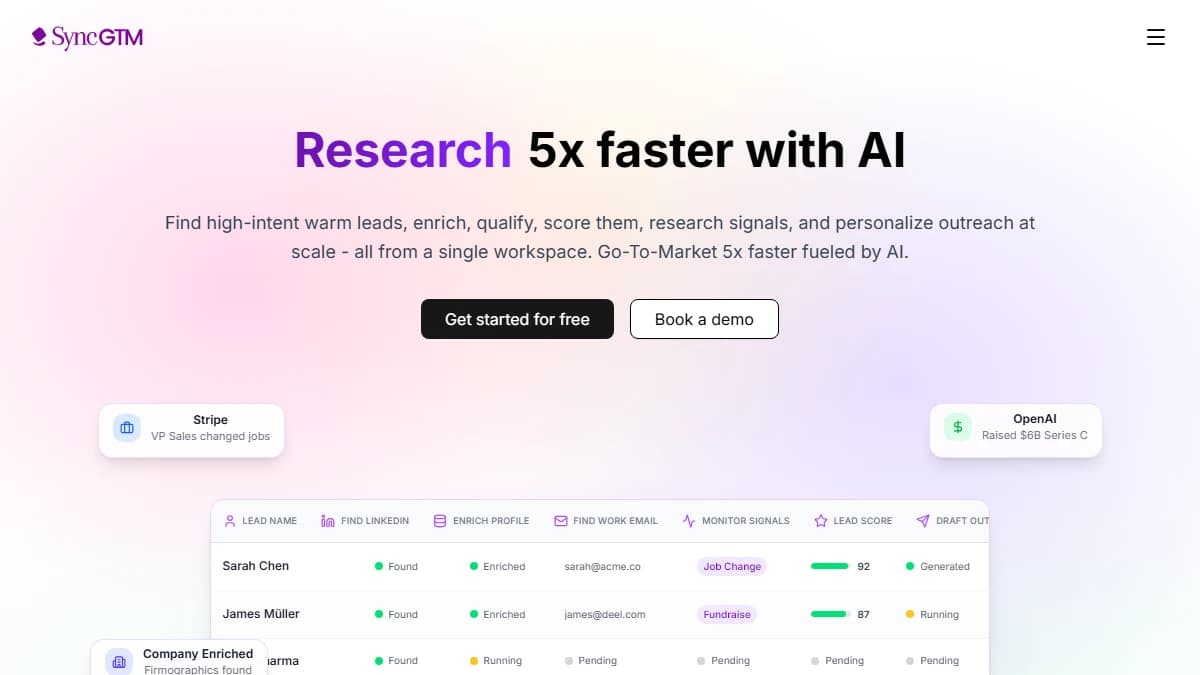
SyncGTM — AI research agents, waterfall enrichment, signal triggers, and CRM sync on every plan
SyncGTM is the best auto lead generation software overall because it ships every layer of the five-job list on a single platform — AI research agents, waterfall enrichment across 20+ data sources, live signal triggers, personalized outreach, and bidirectional CRM sync — with no feature gates.
Most platforms force you to stitch three or four products together to cover the same ground. SyncGTM collapses it into one pane.
The AI research agents read account websites, news, hiring posts, and tech-stack shifts before drafting outreach. Waterfall enrichment cascades across providers — if the primary source misses an email, the next one fires automatically — which typically lifts hit rates 30–60% compared to any single-source tool. Signal triggers fire sequences on live events like funding rounds, job changes, or tech installs. Waterfall phone finding ships on the same platform.
Pricing starts at $49/month flat — not per user, not per credit, not per feature. Every plan includes AI agents, enrichment across all 20+ data sources, signal monitoring, and native HubSpot and Salesforce sync. Teams that previously ran Apollo, a separate enrichment tool, and Outreach together typically collapse those three line items into one SyncGTM subscription and see total cost of ownership drop 40–60%.
Pros
- ✓ Full auto lead gen stack bundled — sourcing + enrichment + signals + outreach + CRM sync
- ✓ No feature gates — every plan ships every capability
- ✓ Waterfall enrichment across 20+ data sources lifts hit rates 30–60%
- ✓ Flat $49/month entry — no per-seat or per-credit math
- ✓ Native bidirectional HubSpot and Salesforce sync
- ✓ Free tier to test every feature before committing
Cons
- ✗ Smaller brand footprint than Apollo or HubSpot
- ✗ Deepest value unlocks when you replace 2–3 existing tools
- ✗ Best suited to teams already running outbound motions
Best for: B2B GTM teams that want one auto lead generation software platform covering sourcing, enrichment, signals, outreach, and CRM sync without stitching tools together. Works equally well for founder-led outbound, seed to Series B sales teams, and mid-market RevOps.
Pricing: From $99/month flat. Every plan includes AI agents, waterfall enrichment, signal monitoring, and CRM integrations. Free tier available. See the full SyncGTM pricing page for current tiers.
2. Apollo — Best for Contact Database + Built-In Sequencer
Apollo — 275M+ contact database, AI email assistant, and built-in sequencing
Apollo is the best auto lead generation software for teams that want the widest native B2B contact database paired with a built-in sequencer and AI email assistant — without assembling a separate enrichment stack.
Apollo combines three things that most teams used to buy separately: a 275M+ contact database, a sales engagement layer with sequences and dialer, and an AI email assistant that drafts first touches based on prospect context. That bundle covers roughly three of the five auto lead generation jobs natively.
The AI layer handles email drafting, subject-line variants, and simple reply classification. It does not run deep research agents, build waterfall enrichment across external providers, or fire signal triggers with the same flexibility as SyncGTM. Teams that want signal-based automation usually bolt a separate signal or enrichment tool onto Apollo — which adds cost and stitching. Our full Apollo.io review covers the platform end to end.
Pricing starts at $99/user/month on the Multichannel plan with unlimited email, AI email assistant, and 50 live data credits per month. Credits scale separately for mobile numbers and export volume. Most 5-to-25 rep teams land at $150–$250/user/month once credits and premium data are factored in.
Pros
- ✓ 275M+ contact database built in — no external provider required for discovery
- ✓ Built-in sequencer, dialer, and AI email assistant on one platform
- ✓ Strong Chrome extension for LinkedIn and web prospecting
- ✓ Native HubSpot and Salesforce bidirectional sync
- ✓ Large user community and public playbook library
Cons
- ✗ No native waterfall enrichment across external providers
- ✗ Signal triggers limited compared to purpose-built signal tools
- ✗ Data freshness varies — some records go stale fast
- ✗ Per-seat pricing plus credit math gets expensive at 10+ reps
- ✗ AI layer is mostly copy-assist, not full research agents
Best for: B2B sales teams of 5–25 reps that want a single tool for contact discovery plus sequencing — and are comfortable running a simpler AI layer focused on email assist rather than full research agents.
Pricing: Free plan available. Basic at $59/user/month. Professional at $79/user/month. Multichannel at $99/user/month with unlimited email and AI features. Data credits priced separately for mobile numbers and exports.
3. Explorium.ai — Best for Agent-Ready B2B Data and Signals
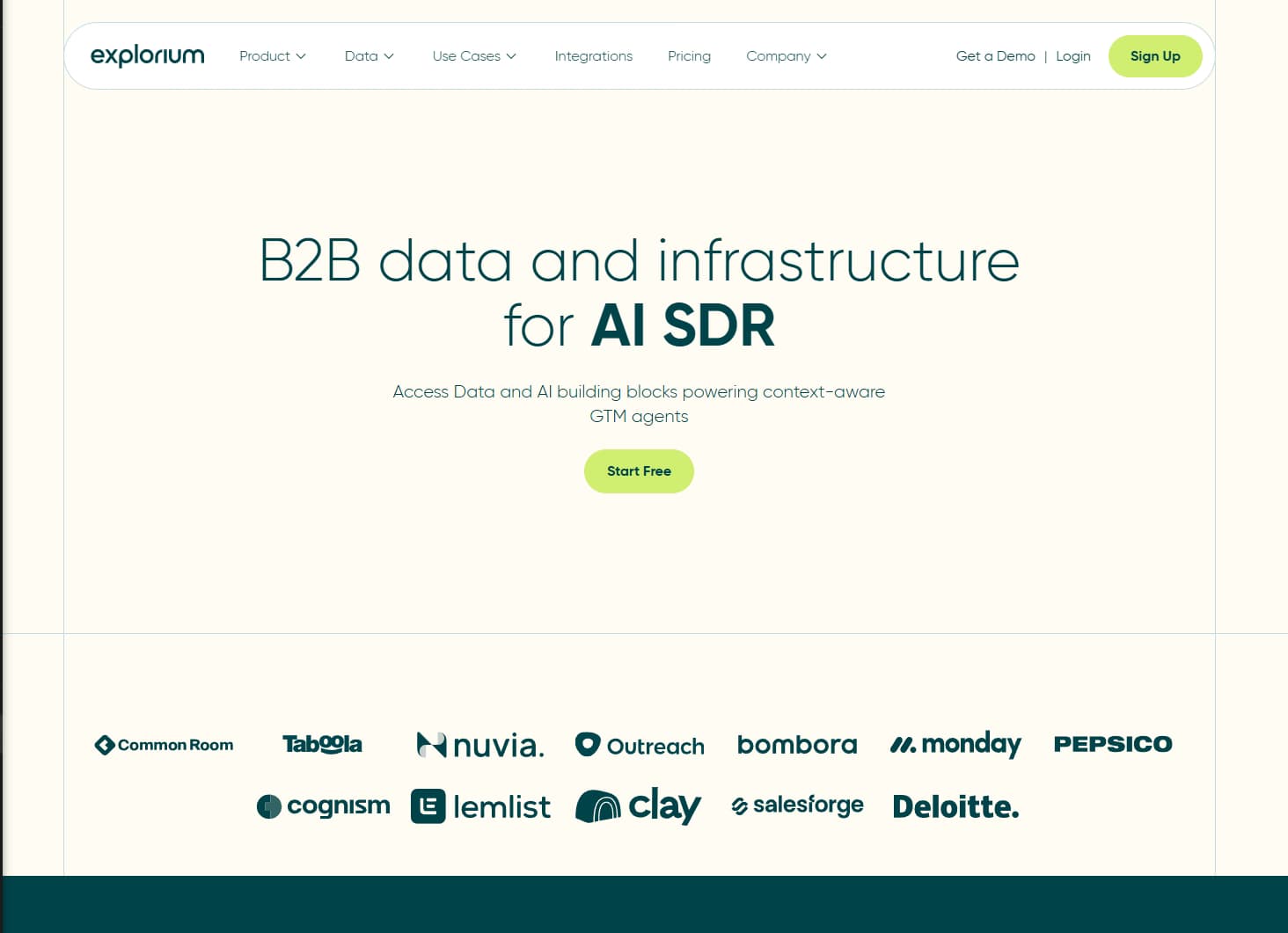
Explorium.ai — company, prospect, and event data served through an API, an MCP server, and plain-English prospecting
Explorium.ai is the best auto lead generation software for teams that want their AI agents and automations to pull sourcing, enrichment, and signal data from one B2B data layer, through a REST API, a hosted MCP server, or plain-English prompts.
Explorium calls itself the B2B data foundation for AI agents. Its AgentSource API resolves, enriches, and monitors records across 146M+ companies and 767M+ professional profiles, with 4,000+ data signals drawn from 100+ sources. Bulk enrichment handles up to 50 records per request. Event feeds flag funding rounds, job changes, hiring, and tech changes as they happen, so a trigger can start the next step automatically. Vibe Prospecting lets non-technical users build and enrich lists from plain-English prompts inside Claude or ChatGPT.
The trade-off is scope. Explorium covers sourcing, enrichment, and signals, but it does not ship email sequencing, an inbox, or a dialer, so outreach still runs through a separate engagement tool. The API and MCP paths also assume some technical comfort. Teams that want all five auto lead generation jobs running without internal build work usually find SyncGTM or Apollo faster to activate. Our breakdown of the AI lead generation agent stack walks through where data layers fit versus native agents.
Pricing is prepaid credit packages, not seats. The free trial includes 100 credits. Lite costs $29.99 for 500 credits, Starter $149.99 for 5,000, and Growth $749.99 for 30,000. A search or an event costs 1 credit, while enrichments run 1 to 5 credits depending on the data type, so spend tracks how many data points you pull per lead.
Pros
- ✓ 146M+ companies and 767M+ professional profiles in one dataset
- ✓ Hosted MCP server and REST API plug straight into AI agents
- ✓ Real-time events for funding, job changes, hiring, and tech changes
- ✓ Vibe Prospecting builds lists from plain-English prompts
- ✓ Salesforce and HubSpot integrations
Cons
- ✗ No built-in email sequencing, inbox, or dialer
- ✗ No spreadsheet-style workflow builder
- ✗ API and MCP paths assume some technical comfort
- ✗ Credit cost varies by enrichment type
- ✗ Paid credits expire after 12 months
Best for: B2B teams running auto lead generation on AI agents or custom automations that need fresh company, contact, and signal data on demand, with a separate tool already handling outreach.
Pricing:Free trial with 100 credits. Lite at $29.99 for 500 credits. Starter at $149.99 for 5,000. Growth at $749.99 for 30,000. Scale at $7,499.99 for 500,000. Enterprise custom. Packages don't auto-renew.
4. HubSpot — Best for Marketing-Led Teams
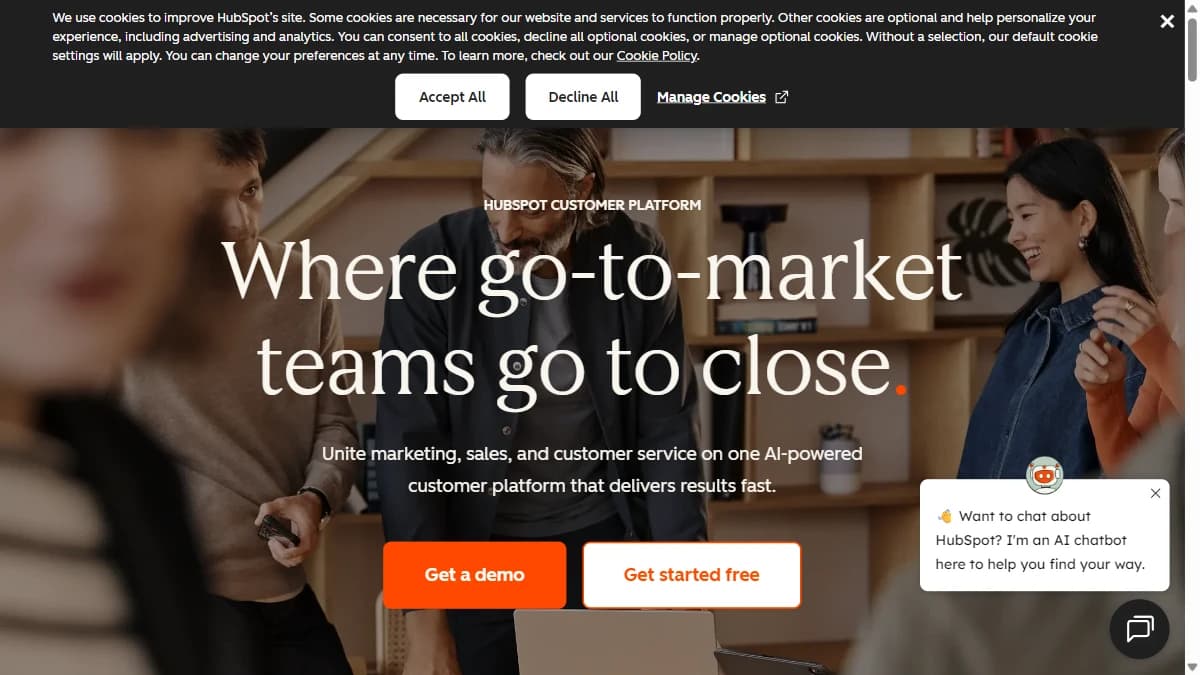
HubSpot — forms, workflows, lead scoring, and attribution built on top of a unified CRM
HubSpot is the best auto lead generation software for marketing-led teams that want forms, workflows, lead scoring, and attribution built natively on top of an all-in-one CRM — without wiring inbound tools into a separate sales database.
HubSpot is the CRM first and the lead generation engine second. That positioning is a strength for inbound-heavy motions. Forms feed directly into the same CRM that Sales Hub uses. Workflows route leads automatically. Marketing Hub lifecycle stages tie into attribution without integration work.
The gap is outbound. HubSpot does not ship a native B2B contact database, waterfall enrichment across external providers, or research agents that score live intent. Teams that need outbound sourcing layer Apollo, Explorium.ai, or SyncGTM on top of the HubSpot CRM. For inbound capture and nurture though, the unified CRM plus Marketing Hub combination is hard to beat.
Pricing is a stack. Sales Hub Starter runs $15/user/month and Professional $90/user/month. Marketing Hub — which covers forms, workflows, and lead scoring — starts at $15/month on Starter and $800/month on Professional with contact-based pricing. Most teams that use HubSpot for auto lead generation land on the Professional or Enterprise tiers of both hubs, which typically puts all-in spend between $1,500 and $5,000/month at mid-market scale.
Pros
- ✓ Unified CRM — forms, workflows, and sales data in one place
- ✓ Strong inbound lead capture with native forms and chatbots
- ✓ Marketing automation, lead scoring, and attribution built in
- ✓ Huge partner and integration ecosystem
- ✓ Free CRM tier for teams that want to start small
Cons
- ✗ No native B2B contact database for outbound sourcing
- ✗ No waterfall enrichment across external providers
- ✗ Limited AI research agents compared to purpose-built tools
- ✗ Contact-based pricing on Marketing Hub scales expensive
- ✗ Best value requires committing to both Sales Hub and Marketing Hub
Best for: Marketing-led B2B teams that want auto lead generation inside a unified CRM — strong on inbound capture, nurture, and attribution, lighter on outbound sourcing.
Pricing: Sales Hub Starter $15/user/month. Marketing Hub Starter $15/month, Professional $800/month. Contact-based pricing applies on Marketing Hub. Free CRM tier available.
Side-by-Side Comparison
| Tool | Best For | Waterfall Enrichment | AI Agents | CRM Sync | Starting Price |
|---|---|---|---|---|---|
| SyncGTM | All-in-one auto lead generation | Native, 20+ sources | Yes — research + outreach | Bidirectional | $49/mo flat |
| Apollo | Contact DB + sequencing | No (single source) | Email assistant only | Bidirectional | $99/user/mo |
| Explorium.ai | Agent-ready data + signals | No (one dataset, 100+ sources) | MCP server + Vibe Prospecting | Salesforce + HubSpot | $29.99/pkg |
| HubSpot | Marketing-led inbound | No | Content + workflow AI | Native (is the CRM) | $15/user/mo+ |
How to Choose the Right Auto Lead Generation Software
Most teams overbuy. They pick the tool with the most logos on the homepage — not the one that actually replaces manual work in their specific motion.
Start with the task, not the product.
- If you want the full auto lead gen stack bundled →SyncGTM. One platform covers sourcing, enrichment, signals, outreach, and CRM sync from $49/month flat.
- If you need a big contact database plus a sequencer →Apollo ships 275M+ contacts and a built-in sender from $99/user/month.
- If you're building lead gen on AI agents →Explorium.ai serves company, contact, and signal data through an API and MCP server from $29.99 per credit package.
- If you're marketing-led and want a unified CRM →HubSpot ships forms, workflows, and lead scoring inside the CRM you already run.
- If you're evaluating adjacent categories →Compare with AI SDR tools and AI sales prospecting tools for full pipeline coverage.
According to Gartner sales research, teams that consolidate three or more lead generation tools into one platform see 22% higher rep productivity and 31% lower total cost of ownership within 12 months. The number one lever is reducing the number of integration points between data and workflow. HubSpot's own research pegs B2B contact data decay at 22.5% per year — which is why any auto lead generation software without active re-enrichment quietly degrades over time.
Final Verdict
The best auto lead generation software in 2026 is the one that replaces the most manual lead-gen tasks with the least operational overhead. For most B2B GTM teams, that is SyncGTM.
SyncGTM covers the full five-job list — sourcing, enrichment, research, outreach, CRM sync — on a single platform with transparent $49/month flat pricing and no feature gates. That combination is rare in the category and especially rare at that price point.
Apollo wins when your biggest bottleneck is contact discovery and you are fine with an AI layer focused on email assistance rather than deep research agents. The database is real value.
Explorium.ai wins when your team builds lead generation on AI agents or its own automations and needs a data layer with real-time signals. Plan for a separate engagement tool, since Explorium does not send outreach.
HubSpot wins for marketing-led teams already running the CRM — inbound capture, nurture, and attribution ship natively. Outbound sourcing is not HubSpot's strength, so most teams layer Apollo or SyncGTM on top for that motion.
Whatever you pick, audit the result in 90 days. Measure time-to-first-meeting, cost per enriched record, and the number of tools you removed from your stack. If your auto lead generation software did not collapse the stack, it did not do its job. For broader context on where the category is heading, our rundown on agentic AI in sales covers the next 12 months of platform evolution.
This post was last reviewed in April 2026. Pricing and features may change — verify with each vendor before purchasing.