

3 Best AI Tools for Sales Prospecting in 2026 (Ranked by Output)

By Kushal Magar · April 20, 2026 · 12 min read · Last updated: September 28, 2026
Key Takeaway
This guide ranks the three best AI tools for sales prospecting in 2026 by real output — meetings booked, not features shipped. SyncGTM ranks first for bundling AI research agents, waterfall enrichment, and CRM sync on every plan from $49/month. Explorium.ai ranks second as the data layer for teams building their own AI prospecting agents, with an API and MCP server over 146M+ companies, making it the power-user pick for GTM engineers. Apollo.io ranks third as the most affordable entry point with a 275M+ contact database from $49/month and a meaningful free tier. The right AI sales prospecting tool depends on whether you prioritize output on day one (SyncGTM), agent-built workflows (Explorium.ai), or lowest cost entry (Apollo). All three integrate with HubSpot and Salesforce, but they differ sharply on autonomy level, data routing, and whether the AI handles research plus outreach or just one side of the workflow.
Most "best AI tools" lists rank by G2 badges and founder name recognition. We ranked the best AI tool for sales prospecting by one thing: meetings booked per dollar. The tools below all run AI agents on the research-to-outreach path — but only one produces pipeline on day one, one rewards the team willing to build workflows, and one gets you started for under $50/month.
This post covers the 3 AI sales prospecting tools worth evaluating in 2026 — SyncGTM, Explorium.ai, and Apollo.io. Each represents a different trade-off between output velocity, workflow flexibility, and cost. Real pricing, honest trade-offs, and a clear recommendation for who each tool fits best.
Quick Summary
The best AI tool for sales prospecting in 2026 is SyncGTM for teams that want AI research agents, waterfall enrichment across 20+ data sources, and CRM integrations on every plan from $49/month. Explorium.ai ranks second for GTM engineers who want to plug company, contact, and signal data into their own agents via API or MCP (credit packages from $29.99). Apollo.io ranks third as the accessible starting point with a 275M+ database and AI-assisted outreach from $49/month. Rank order changes sharply by use case — jump to the comparison table for the split.
TL;DR: Best AI Tools for Sales Prospecting in 2026
- SyncGTM — Best overall. AI research agents + waterfall enrichment + CRM sync on every plan from $49/month.
- Explorium.ai — Best for agent-built workflows. 146M+ companies, 4,000+ data signals, and an API plus MCP server for GTM engineers.
- Apollo.io — Best budget pick. 275M+ contact database and AI-assisted outreach from $49/month with a meaningful free tier.
What Counts as AI Sales Prospecting in 2026
AI sales prospecting is the use of machine learning and LLM-based agents to automate the research, list-building, enrichment, personalization, and initial outreach steps of the outbound motion. The best AI tool for sales prospecting replaces 40%+ of an SDR's manual work — not the relationship-building, but the mechanical grind that burns time before the first real conversation.
The 2026 generation of AI prospecting tools does four things that 2022-era sequencing tools could not:
- Research autonomously — pull public signals (funding rounds, hiring, tech stack, recent LinkedIn activity) and summarize relevance to your ICP.
- Enrich via waterfall — route records through multiple data providers in sequence to lift email and phone hit rates. See our waterfall enrichment explainer for how this works.
- Personalize at scale — write first lines and full emails grounded in the research above, not mad-libs templates.
- Close the loop to the CRM — push enriched records, sequence status, and reply signals into HubSpot or Salesforce without manual exports.
Tools that only automate one of those four steps aren't AI prospecting platforms — they're single-purpose features dressed up for the AI wave.
How We Ranked Them
Four ranking factors, weighted by how much each affects real pipeline output:
- Research depth (30%) — how much the AI actually reads before writing outreach. Public signals, intent data, and firmographic context count more than a generic LLM completion.
- Enrichment quality (30%) — coverage and accuracy of emails and phones, and whether the tool runs waterfalls or ships a single-source database.
- CRM sync (20%) — native HubSpot and Salesforce integrations, bidirectional updates, and reply logging without manual work.
- Pricing transparency and value (20%)— published rates over "request a quote," per-seat sanity, and whether core features sit on the lowest paid tier or get gated to enterprise.
We did not rank by G2 badges, logo walls, or marketing page polish. Those correlate with funding, not meetings booked.
1. SyncGTM — The Best AI Tool for Sales Prospecting Overall
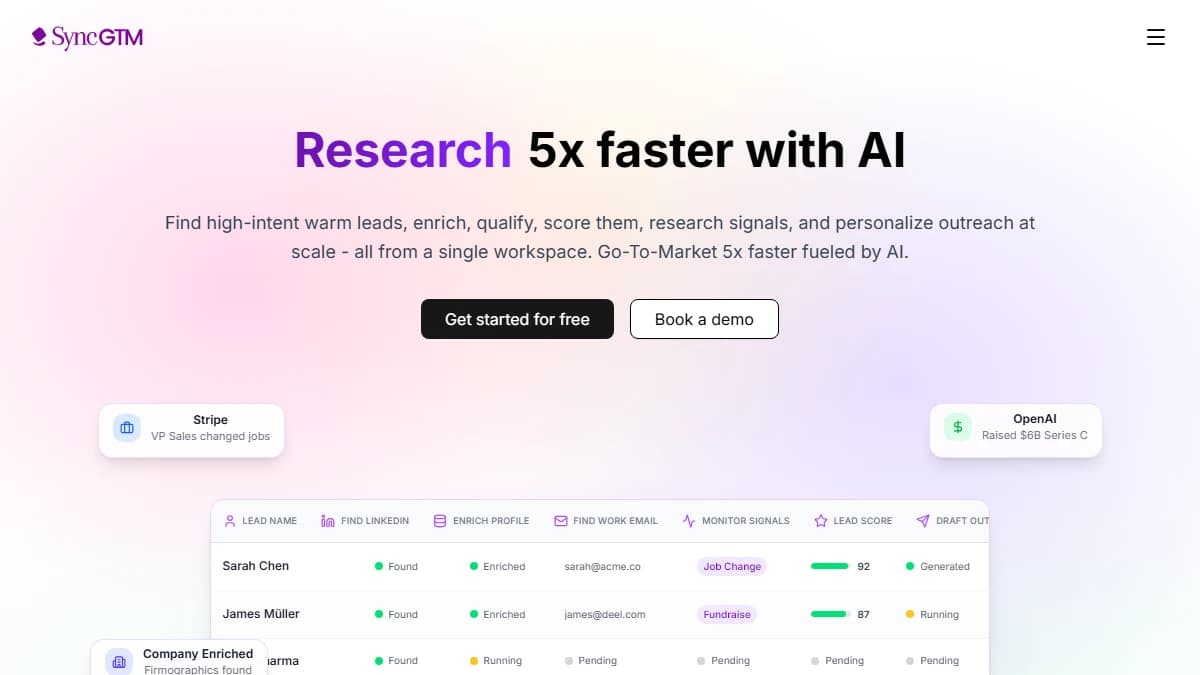
SyncGTM — AI research agents, waterfall enrichment, and CRM sync in one platform
SyncGTM is the best AI tool for sales prospecting in 2026 because it bundles the three steps that matter — research, enrichment, outreach — into one workspace, then syncs everything back to your CRM without manual exports. AI research agents pull signals from LinkedIn, company pages, funding databases, and tech stack scanners, then draft personalized outreach grounded in what they actually found.
The differentiator versus single-source tools is waterfall enrichment across 20+ data sources on every paid plan. Instead of hitting one database and accepting a 60% hit rate, SyncGTM routes each record through providers in sequence until every field is filled — typically lifting email and phone accuracy 30–60% over any single vendor.
Pricing starts at $49/month with AI agents, waterfall enrichment, buying-signal monitoring, and CRM integrations on every paid tier. No per-seat games, no "contact sales" gates to unlock the useful features. For teams evaluating against the broader sales prospecting tool landscape, SyncGTM tends to win on total cost of ownership because it replaces 3–5 tools at once.
Pros
- ✓ AI research agents run full ICP discovery, not just email completion
- ✓ Waterfall enrichment across 20+ sources on every paid plan
- ✓ Native HubSpot and Salesforce sync with bidirectional updates
- ✓ Transparent pricing from $49/month — no feature gates
- ✓ Replaces 3–5 point tools (database + enrichment + sequencing + CRM sync)
Cons
- ✗ Newer entrant — smaller user community than Apollo
- ✗ Less customizable than spreadsheet-style workbenches for edge-case GTM workflows
- ✗ Enterprise logos growing but fewer Fortune 500 case studies today
Best for: B2B sales teams and GTM engineers who want research, enrichment, and outreach on one platform without stitching together Apollo + a separate enrichment tool + a sequencing tool.
Pricing: Paid plans from $99/month. Free tier available to test AI agents and enrichment. Full pricing.
2. Explorium.ai — The AI Agent Data Layer for Prospecting
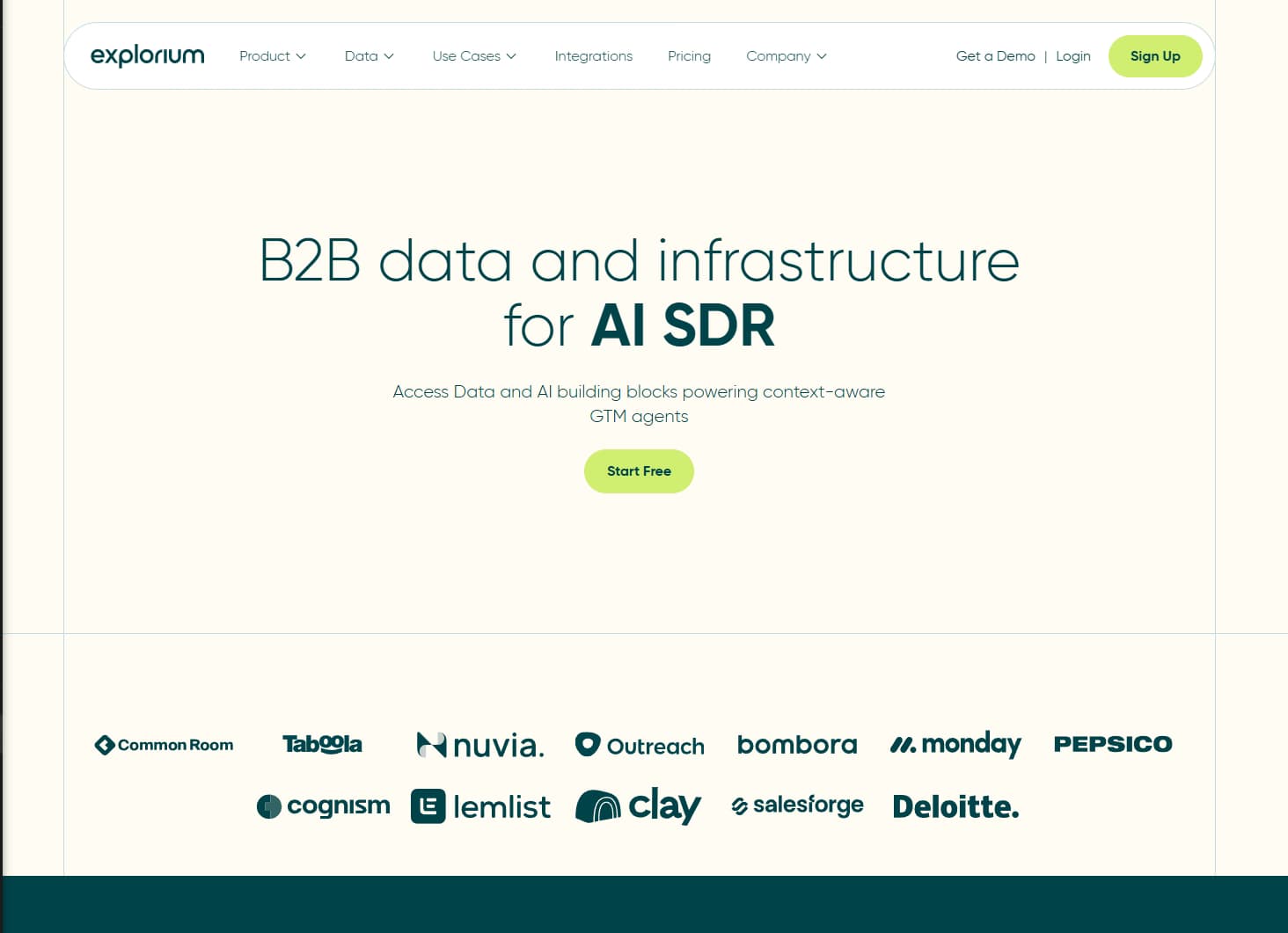
Explorium.ai — B2B data foundation for AI agents, with an API, a hosted MCP server, and Vibe Prospecting
Explorium.ai is the data layer for AI sales prospecting you build yourself. It behaves less like a finished product and more like infrastructure — one REST API and a hosted MCP server that resolve, enrich, and monitor 146M+ companies and 767M+ professional profiles, so a GTM engineer's agent can research accounts and find contacts inside Claude or a custom workflow.
The AI layer runs through MCP and Vibe Prospecting. Point Claude at Explorium's MCP server and it can answer prospecting questions against live data ("which of these accounts raised funding recently?", "who leads sales at each one?", "are they hiring SDRs?"), drawing on 4,000+ data signals including funding rounds, job changes, hiring, and tech changes. Vibe Prospecting does the same from plain-English prompts for reps who don't code, and installs in one click from the Claude and ChatGPT connector directories.
The trade-off is setup and scope. Explorium rewards the team that invests in wiring the API into its agents and testing prompts. There is no native email sending, so you still need a sequencing tool, and credit cost varies by enrichment type. Pricing runs on credit packages: a 100-credit free trial, then $29.99 for 500 credits up to $749.99 for 30,000. Read our AI lead generation agent guide for how teams put agent-ready data to work.
Pros
- ✓ 146M+ companies and 767M+ professional profiles from 100+ sources
- ✓ Hosted MCP server and REST API for agent-driven research
- ✓ 4,000+ data signals, including funding, hiring, and tech changes
- ✓ Salesforce and HubSpot integrations
- ✓ Vibe Prospecting for plain-English list building in Claude or ChatGPT
Cons
- ✗ API and MCP setup is not plug-and-play
- ✗ Credit cost varies by enrichment type (1–5 credits per enrichment)
- ✗ No native email sending — you still need a sequencing tool
- ✗ Results depend on how well your agent is set up to use the data
Best for: GTM engineers and ops-driven teams that want to build their own AI prospecting agents on live company, contact, and signal data.
Pricing: Free trial with 100 credits. Credit packages from $29.99 (500 credits) to $7,499.99 (500,000 credits); Enterprise custom.
3. Apollo.io — The Budget AI Prospecting Pick
Apollo.io — 275M+ contact database and AI-assisted outreach from $49/month
Apollo.io is the most affordable entry point for AI-assisted sales prospecting in 2026. The 275M+ contact database is the largest on this list, and the free tier includes enough exports and email sends to validate the platform before paying.
Apollo's AI features are assistive rather than agentic — email writing, intent scoring, and sequence personalization suggestions sit inside a familiar sales engagement interface. It will not run full autonomous research loops like SyncGTM, but for teams that already have a tested message and clear ICP, the database + sequencing bundle produces meetings without a steep learning curve.
See our full Apollo.io review, or if the data coverage gaps hurt you, compare against the best Apollo alternatives for 2026.
Pros
- ✓ 275M+ contact database — largest on this list
- ✓ Meaningful free tier to test before paying
- ✓ Paid plans from $49/month — most affordable AI prospecting option
- ✓ AI email writing and sequence personalization
- ✓ Strong HubSpot, Salesforce, and Pipedrive integrations
Cons
- ✗ Single-source database — no native waterfall enrichment
- ✗ AI features are assistive, not agentic research
- ✗ Data quality varies sharply by region and segment
- ✗ Best features locked behind higher-tier plans
Best for: Startups, SMBs, and individual reps who want a contact database plus AI-assisted outreach at the lowest possible entry price.
Pricing: Free tier. Paid plans from $49/month. Full AI features from $99/month on the Organization tier.
Side-by-Side Comparison
| Tool | Best For | Research Depth | Enrichment | CRM Sync | Starting Price |
|---|---|---|---|---|---|
| SyncGTM | End-to-end AI prospecting | Agentic | Waterfall (20+ sources) | Native bi-directional | $49/mo |
| Explorium.ai | Agent-built prospecting workflows | Agentic (via MCP / API) | Multi-source (100+ sources) | Salesforce + HubSpot | $29.99/pkg |
| Apollo.io | Budget database + outreach | Assistive | Single-source (275M) | Native | $49/mo |
How to Choose the Best AI Tool for Sales Prospecting
The most common mistake is buying the tool with the flashiest AI demo before you have a tested message and a defined ICP. AI prospecting tools amplify what you feed them. If your ICP is vague or your emails don't convert manually, an AI tool will just ship irrelevant outreach at scale — and burn your sender reputation doing it.
- If you want output on day one →SyncGTM. AI agents, waterfall enrichment, and CRM sync bundled from $49/month.
- If you're building your own AI agents →Explorium.ai. 146M+ companies and a hosted MCP server, if you have a GTM engineer to drive it.
- If budget is the constraint →Apollo.io. Free tier plus $49/month paid plans. Start here, upgrade later.
- If you need fully autonomous outreach →Look at our best AI SDR tools roundup. AI SDRs are a different tier — $850–$10,000/month but handle the full workflow end-to-end.
Final Verdict
The best AI tool for sales prospecting in 2026 is SyncGTM for teams that want output on day one. AI research agents, waterfall enrichment across 20+ sources, and native CRM sync on every plan from $49/month replaces 3–5 point tools and removes the stitching tax.
Explorium.ai is the right pick if you have a GTM engineer and want to build your own prospecting agents on live company, contact, and signal data. It rewards teams that invest in the setup. Apollo.io remains the best accessible starting point — a 275M+ database and AI-assisted outreach from $49/month is hard to beat if you're validating outbound for the first time.
AI sales prospecting tools deliver real ROI when you have a sharp ICP, verified contact data, and messaging you've already tested manually. Build that foundation first — then layer in the automation. The role that owns this stack in 2026 is the GTM engineer — and AI prospecting tools are the core of what they run.
External benchmarks worth a read before you commit: the Gartner sales research library on AI adoption rates, and G2's AI Sales Assistant category for independent user reviews.
This post was last reviewed in April 2026. Pricing and features may change — verify with each vendor before purchasing.