


5 Best BuiltWith Alternatives for B2B Enrichment in 2026

By Kushal Magar · June 10, 2026 · 12 min read · Last updated: September 30, 2026
Key Takeaway
This guide compares the five best BuiltWith alternatives in 2026: SyncGTM, Bloomberry, Wappalyzer, Clearbit, and Apollo.io. BuiltWith tells you which technologies a company uses, but it does not give you verified contacts, emails, or a way to reach those companies. SyncGTM is our top pick for B2B teams who want to act on technographic data: it enriches company records with verified emails, phone numbers, firmographics, and buying signals by running waterfall enrichment across 50-plus providers, and it is free to start. Bloomberry is the best source of real-time tech adoption data: it detects when companies start and stop paying for any of 1,700-plus B2B products, including backend software that never appears on a website, from 199 dollars per month. Wappalyzer is the best direct BuiltWith replacement for pure technology detection, covering 4,000-plus technologies via browser extension and API. Clearbit suits HubSpot users who need real-time form enrichment and technographic scoring built into their CRM. Apollo.io offers basic technology filters with a built-in contact database and email sequencing from 49 dollars per month.
BuiltWith has been a go-to tool for B2B sales teams who want to target companies by their technology stack — finding businesses running Shopify, HubSpot, or Salesforce and building prospect lists around those signals. But BuiltWith has a core limitation that becomes obvious once you start actually trying to reach those companies: it gives you technology data, not contact data.
You can find a list of 10,000 companies using Marketo, but BuiltWith won't tell you who to call, what their verified email is, or how to trigger an outreach sequence. For modern B2B sales teams, technology detection is the starting point — not the complete workflow.
This post compares five BuiltWith alternatives that go further: from pure technology detection tools to full B2B enrichment platforms that combine technographic signals with verified contact data and buying intent.
Quick Summary
The best BuiltWith alternatives in 2026 are SyncGTM, Bloomberry, Wappalyzer, Clearbit, and Apollo.io. SyncGTM is the top pick for B2B teams that need contact enrichment on top of technology data: it runswaterfall enrichment across 50+ providers, tracksbuying signals, and integrates directly with your CRM — free to start. Bloomberry is best for real-time adoption and churn signals across 1,700+ B2B products, including software with no website footprint. Wappalyzer is best for pure technology detection at lower cost. Clearbit suits HubSpot-native teams. Apollo.io covers prospecting plus basic tech filters.
TL;DR: Best BuiltWith Alternatives in 2026
- SyncGTM -- Best all-in-one B2B enrichment platform. Waterfall enrichment across 50+ providers, buying signals, and native CRM sync. Free to start.
- Bloomberry -- Best for real-time tech adoption data. Detects when companies start and stop paying for 1,700+ B2B products, including backend software with no website footprint. Purchase and churn events with dates, plus email and Slack alerts. $199/mo starter.
- Wappalyzer -- Best for pure technology detection. Browser extension + API detecting 4,000+ technologies. Cheaper than BuiltWith for small teams. $250/mo for Starter API access.
- Clearbit (HubSpot) -- Best for HubSpot-native teams. Real-time form enrichment, technographic data, and lead scoring built into HubSpot CRM. Included in Marketing Hub.
- Apollo.io -- Best for teams that want technology filters plus built-in outreach. 275M+ contact database with tech stack filters and email sequencing. $49/mo starter.
Why Teams Are Switching from BuiltWith in 2026
BuiltWith occupies a narrow but valuable niche: telling you exactly which web technologies a company has installed. For competitive intelligence, sales targeting by tech stack, and market research, it remains a useful signal source. But the same focused scope that makes BuiltWith good at one thing makes it inadequate for modern B2B GTM workflows. Four limitations keep coming up.
No contact data. BuiltWith tells you which companies use Marketo, but it won't give you the VP of Marketing's email address or direct dial. Sales teams end up with a filtered company list and no way to act on it without paying for a separate contact enrichment tool.
Data freshness issues. Technology detection depends on crawling public website source code, which can lag weeks or months behind real adoption. A company that switched from Marketo to HubSpot last month may still show as a Marketo user in BuiltWith's database. For time-sensitive signals like competitive displacement, stale tech data generates false positives.
Pricing model. BuiltWith's pricing is opaque and scales steeply based on technology lookups and list exports. Teams that need bulk exports for prospecting campaigns often find the cost-per-lead higher than alternatives that bundle contact data with technographics.
No outreach layer. Even with perfect technographic data, BuiltWith stops at the list. There is no enrichment pipeline, no CRM sync, no workflow builder to automate what happens next. Modern GTM stacks need the full loop from signal to enriched contact to outreach — not just the first step.
What we evaluated
- Technographic depth: How many technologies detected? How fresh is the data?
- Contact enrichment: Does the tool provide verified emails, phone numbers, and job titles alongside tech data?
- Outreach integration: Can you act on enriched data with sequences, CRM sync, or workflow automation?
- Pricing transparency: Published pricing with clear per-lead or per-export costs?
- Data freshness: How frequently is technographic data updated?
1. SyncGTM -- Best All-in-One B2B Enrichment Platform
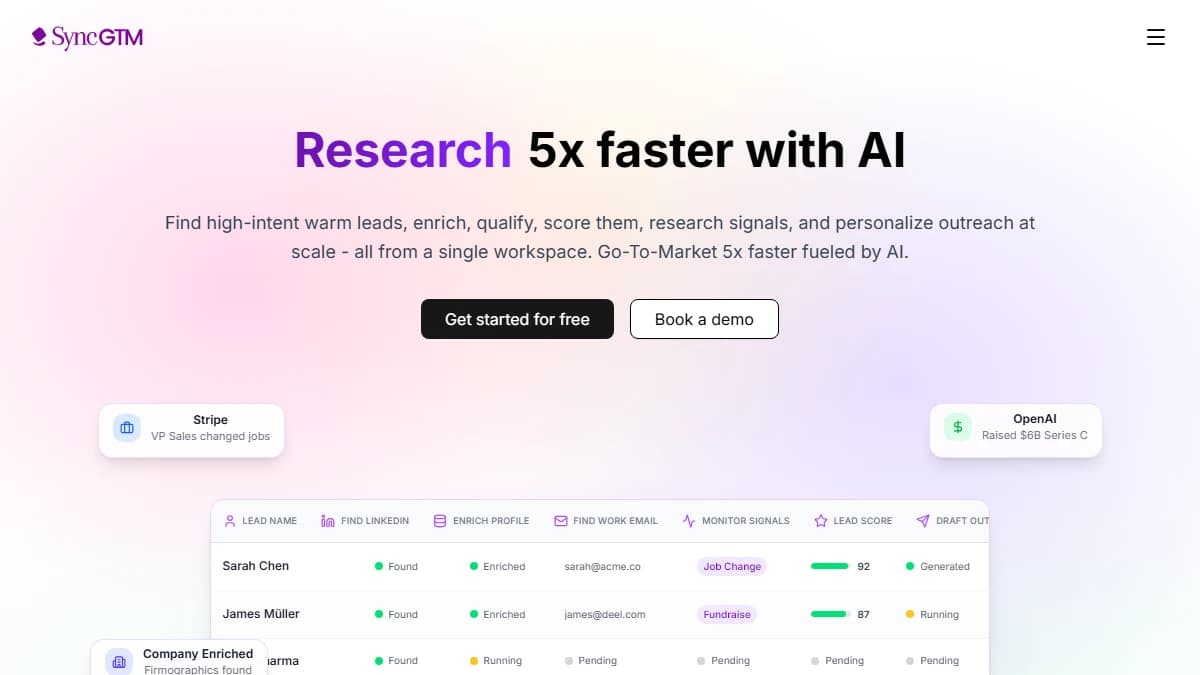
SyncGTM -- waterfall enrichment, buying signals, and native CRM sync in a single platform
SyncGTM is a B2B data and signals platform for teams that need more than a technology list. Where BuiltWith stops at identifying which technologies a company uses, SyncGTM's waterfall enrichment cascades across 50+ data providers to return verified business emails, phone numbers, and firmographics for the people at those companies — the contact layer that BuiltWith's technology-only view leaves out.
The platform's buying signals monitoring tracks real-time events across your target accounts — job changes, funding, headcount growth, hiring, and web traffic. These are the signals that indicate a company is in-market, which BuiltWith's static technology snapshots cannot provide. AI lead scoring then ranks those accounts against your ICP, so reps start with the best fits.
SyncGTM's native CRM integrations push enriched records into Salesforce, HubSpot, Pipedrive, Attio, and Close, and MCP access from Claude, ChatGPT, and Cursor lets you run lookups from the AI tools your team already uses.
Technology lookups are still covered: SyncGTM's TheirStack-powered tech-stack action and its free website technology checker detect which tools a company runs, so the technology filter and the contact data live in one workflow.
Pros
- + Waterfall enrichment across 50+ providers — not locked to one database
- + Verified emails, phone numbers, and firmographics per lead
- + Real-time buying signals: job changes, funding, headcount growth, hiring, web traffic
- + AI lead scoring and native CRM integrations (Salesforce, HubSpot, Pipedrive, Attio, Close)
- + MCP access from Claude, ChatGPT, and Cursor
- + Free to start
Cons
- - Not an email sequencer — pair it with your outreach tool
- - Newer platform with smaller community than BuiltWith or Apollo
- - Free plan is credit-limited, so regular use means moving to a paid plan
Best for: B2B sales and GTM teams that want verified contacts and buying signals synced to their CRM — in one platform instead of stitching BuiltWith with separate contact and signal tools.
Pricing: Free to start. See the pricing page for paid plans.
2. Bloomberry -- Best BuiltWith Alternative for Real-Time Tech Adoption Data
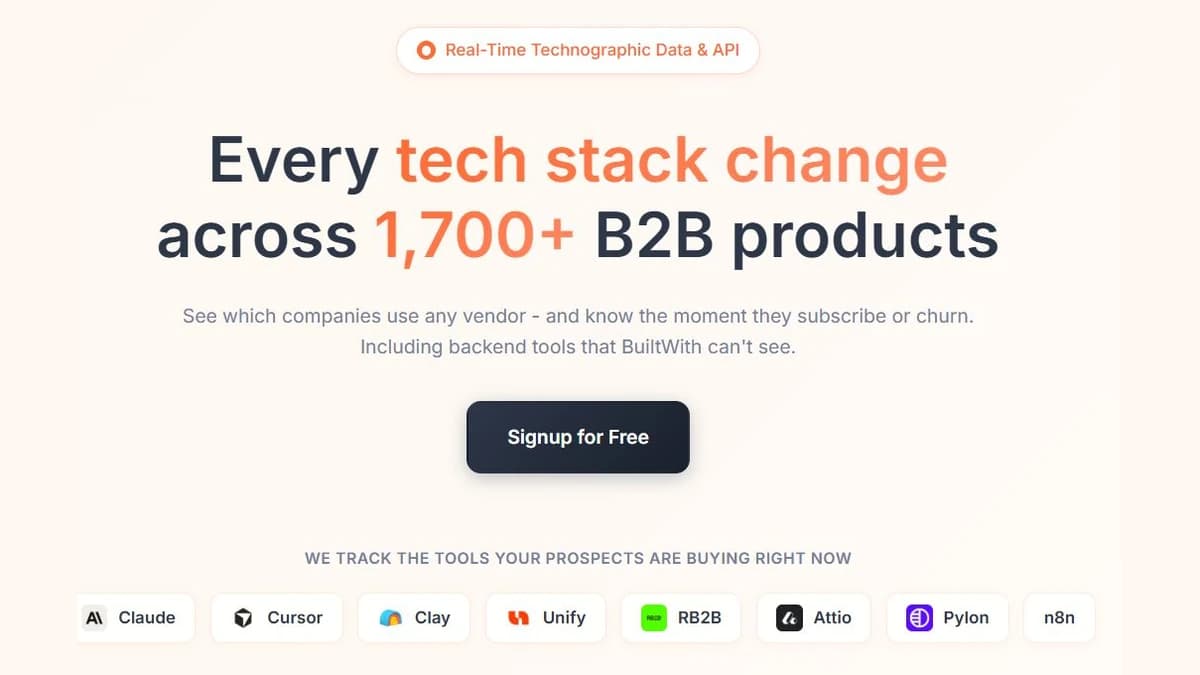
Bloomberry -- purchase and churn events across 1,700+ B2B products, including software that never appears on a website
Bloomberry tells you which companies just started or stopped paying for any of 1,700+ B2B products across 190 categories. Where BuiltWith scans websites for scripts and tags, Bloomberry reads infrastructure signals — new subdomains, DNS records, certificate transparency logs, and signals specific to how each product gets deployed. That matters most for software that never touches a public website: CRMs, ERPs, security tools, devops platforms, and AI products.
The second difference is timing. BuiltWith tells you a company uses a technology, while Bloomberry tells you when they started and when they stopped — purchase signals surface within 3 days, across roughly 400,000 subscribe and churn events per month. Churn is where script-based tools break down: a company cancels but leaves the tag on their site, so the account still reads as active. Bloomberry verifies the endpoint is genuinely dead first.
Bloomberry is a data source rather than an enrichment platform, and it is upfront about that — no contact data, no sequencing, no CRM sync. Their public product pages show what the output looks like, including this list of companies using HubSpot with adoption dates, recent churn, and upcoming renewals. It runs as a web app with email and Slack alerts, plus a REST API that platforms integrate to ship these signals to their own users.
Pros
- + Covers backend and enterprise software with no website footprint — CRMs, ERPs, security, devops, AI tools
- + Purchase and churn events with dates attached, not static snapshots
- + Churn verified by checking whether the integration still works, not just whether the tag is present
- + Email and Slack alerts on adoption, churn, and approaching renewals
- + Adds newer products continuously — tracks recent GTM and AI tools that legacy databases miss
Cons
- - No contact data — company-level signals only, so pair it with an enrichment platform
- - Smaller catalog than BuiltWith for frontend frameworks, CMS platforms, and JavaScript libraries
- - Thinner coverage in some niches, notably edtech
- - Churn signals lag adoption signals by 1-2 weeks because they are validated before reporting
Best for: Sales and GTM teams selling against an incumbent, where the trigger is a competitor's customer churning or a renewal window opening — and teams targeting backend software that script-based detection cannot see.
Pricing: Free trial, no credit card required. App and API plans start at $199/mo. Custom plans for platforms integrating the data. API documentation is public.
3. Wappalyzer -- Best Direct BuiltWith Alternative for Technology Detection

Wappalyzer -- browser extension and API for detecting 4,000+ web technologies
Wappalyzer is the most direct BuiltWith competitor, doing the same core job — identifying technologies on websites — with a different interface and pricing model. Where BuiltWith focuses on bulk exports and market research, Wappalyzer is built around a browser extension that surfaces technology data while you browse, plus an API for programmatic lookups. It detects over 4,000 technologies across 350+ categories including CMS platforms, e-commerce tools, analytics, frameworks, payment processors, and CDNs.
Wappalyzer's browser extension is free and gives immediate technology detection as you visit any website — a useful tool for competitive research and prospect qualification during live browsing sessions. The paid API tiers add bulk lookups, technology-based lead lists, and data exports at pricing that is generally lower than BuiltWith's equivalent features for small to mid-size teams.
The limitation is the same as BuiltWith: technology data only. Wappalyzer does not provide contact information, verified emails, or firmographic enrichment. Teams that want to go from “this company uses Salesforce” to “here is the VP of Sales with a verified email” still need a separate enrichment layer. For those workflows, pairing Wappalyzer with a separate contact enrichment platform covers both sides of the equation.
Pros
- + Detects 4,000+ technologies across 350+ categories
- + Free browser extension for real-time detection while browsing
- + Lower API pricing than BuiltWith for small teams
- + Technology-based lead lists with filters for industry, company size, location
- + Chrome, Firefox, and Edge extensions supported
Cons
- - Technology data only — no contact emails, phones, or firmographics
- - API Starter at $250/mo is still significant for smaller teams
- - Data freshness depends on crawl frequency, similar to BuiltWith
- - No outreach, CRM integration, or workflow automation
Best for: Individual researchers, content marketers, and small sales teams who need fast, accurate technology detection at lower cost than BuiltWith — without needing contact data.
Pricing: Browser extension free. Starter API $250/mo (1,000 lookups/mo). Business $500/mo (5,000 lookups/mo). Enterprise custom. Lead list exports available as add-ons.
4. Clearbit (HubSpot) -- Best for HubSpot-Native Enrichment
Clearbit -- real-time B2B enrichment with technographics and firmographics built into HubSpot
Clearbit was acquired by HubSpot in 2023 and is now Clearbit Enrichment, available natively inside HubSpot's platform. It is a B2B data enrichment tool that goes well beyond BuiltWith's technology-only focus — enriching company and contact records with technographics, firmographics, employee count, revenue estimates, industry classifications, and contact-level data including job titles and LinkedIn URLs. For HubSpot users, the integration is seamless: Clearbit enriches records automatically as they enter the CRM, requiring no manual exports or imports.
Clearbit's real-time form shortening feature is a meaningful differentiator. It reduces signup form friction by pre-filling known fields and capturing enrichment data silently in the background, increasing conversion rates while building richer lead profiles. For marketing teams running inbound campaigns, this alone justifies the tool. The technographic data layer includes technology installs and categories, which makes it viable as a BuiltWith replacement for teams already on HubSpot who want technology signals baked into their CRM records rather than managed as a separate export.
The catch is that Clearbit is now a HubSpot-native product. It is included in HubSpot Marketing Hub plans but is not available as a standalone subscription for non-HubSpot users. Teams on Salesforce, Pipedrive, or other CRMs who want Clearbit-style enrichment will need to look at platform-agnostic enrichment tools. For a broader view of enrichment tools, see our guide to the best CRM data enrichment tools.
Pros
- + Fully native HubSpot integration — no manual imports
- + Real-time form enrichment increases conversion and data quality
- + Technographic data included alongside firmographics and contact data
- + Enriches both company records and contact records automatically
- + Lead scoring and routing based on enrichment data
Cons
- - HubSpot-only — not available for Salesforce or other CRM users as standalone
- - Pricing tied to HubSpot plan tier, not transparent as a standalone
- - Technology detection less granular than dedicated technographic tools
- - No waterfall enrichment — single-source data model
Best for: Marketing and sales teams already on HubSpot who want technographic and firmographic data enriched automatically into their CRM without managing a separate tool.
Pricing: Included in HubSpot Marketing Hub Starter and above. Standalone Clearbit pricing is no longer available for new customers. HubSpot Marketing Hub starts at $45/mo; Marketing Hub Professional at $800/mo includes full Clearbit enrichment features.
5. Apollo.io -- Technology Filters with Built-In Outreach
Apollo.io -- B2B database with technology filters plus email sequencing for outbound teams
Apollo.io is a prospecting and outreach platform that includes technology filters as part of its broader search criteria — making it a viable BuiltWith replacement for teams that want to filter by tech stack AND immediately reach those companies in one tool. Apollo's database of 275 million contacts and 65 million companies includes technology adoption data that lets you filter prospects by CRM platform, marketing tools, analytics stack, e-commerce solution, and other technology categories.
The key advantage over BuiltWith is what comes after the filter. Apollo connects the technographic search directly to verified emails, direct dials, and email sequencing — so you can go from “show me companies using Marketo” to launching a competitive displacement email sequence in the same session. For SDR teams running technology-triggered outbound, this is significantly more efficient than exporting a BuiltWith list and then importing it to a separate outreach tool.
The tradeoff is data depth. Apollo's technology detection is less granular than BuiltWith or Wappalyzer — it covers broad technology categories rather than the exhaustive 4,000+ technology signatures Wappalyzer tracks. For competitive intelligence researchers who need precise technology fingerprinting, BuiltWith or Wappalyzer provide more detail. For outbound prospecting teams that need “good enough” tech filters plus immediate outreach capability, Apollo hits the right balance. See how Apollo compares in our Apollo alternatives guide.
Pros
- + Technology filters combined with contact database in one platform
- + Built-in email sequencing — no need for a separate outreach tool
- + Free tier available with limited monthly credits
- + 275M+ contacts and 65M+ companies in the database
- + Affordable starting price at $49/mo
Cons
- - Technology detection less granular than BuiltWith or Wappalyzer
- - Single-source data — no waterfall enrichment across multiple providers
- - Email accuracy issues reported by users (bounce rates above 10%)
- - Key features gated behind higher-tier plans
Best for: SDR teams and outbound sales reps who want to filter prospects by technology stack and launch sequences immediately — without needing deep competitive intelligence or precise tech fingerprinting.
Pricing: Free (limited credits/mo). Basic $49/mo (1,200 email credits). Professional $79/mo (2,400 credits). Organization $119/mo/user (unlimited emails). Annual billing available with discount.
Side-by-Side Comparison: BuiltWith Alternatives in 2026
| Tool | Best For | Free Tier | Starting Price | Standout Feature |
|---|---|---|---|---|
| SyncGTM | Verified contact enrichment and buying signals on top of your technology data | Yes | Free to start | Waterfall enrichment across 50+ providers, buying signals, AI lead scoring, native CRM sync |
| Bloomberry | Real-time tech adoption and churn signals, including non-web software | Yes (free trial) | $199/mo | Purchase and churn events with dates across 1,700+ B2B products, plus email and Slack alerts |
| Wappalyzer | Technology detection for small teams and individual researchers | Yes (limited) | $250/mo | Browser extension + API detecting 4,000+ technologies across 350+ categories |
| Clearbit (HubSpot) | HubSpot-native enrichment with technographic and firmographic data | No (HubSpot plan required) | Included in HubSpot Marketing Hub | Native HubSpot integration with real-time form enrichment and lead scoring |
| Apollo.io | Prospecting with basic technology filters and outreach in one platform | Yes (limited) | $49/mo | Contact database with technology filters plus email sequencing |
How to Choose the Right BuiltWith Alternative
- If you need full enrichment beyond technographics -- go with SyncGTM. Waterfall enrichment across 50+ providers delivers verified emails, phones, firmographics, and buying signals to pair with your technographic source — free to start.
- If you need to know when a company adopted or dropped a technology -- go with Bloomberry. It detects purchase and churn events with dates across 1,700+ B2B products, including CRMs, ERPs and security tools that never appear on a website — from $199/mo.
- If you only need technology detection at lower cost -- go with Wappalyzer. It covers 4,000+ technologies via browser extension and API — a direct BuiltWith replacement for competitive research and market sizing.
- If you're a HubSpot team that wants enrichment inside your CRM -- go with Clearbit. Real-time form enrichment and automatic record enrichment are baked into HubSpot Marketing Hub at no additional cost.
- If you want technology filters plus outreach in one tool -- go with Apollo.io. Basic tech stack filters combined with 275M+ contacts and email sequencing from $49/mo.
Most B2B teams end up needing more than BuiltWith provides. Technology detection identifies which companies to target; enrichment fills in who to contact and how to reach them; outreach closes the loop. For a broader view of enrichment options, see our guides to 6sense alternatives, ZoomInfo alternatives, and Clearbit alternatives.
Final Verdict
BuiltWith remains useful as a pure technology profiling tool for competitive intelligence and market research. But for B2B sales and GTM teams who need to act on technographic signals — finding who to contact, verifying their email, and triggering outreach — BuiltWith is just the first step in a workflow that needs several more tools to complete.
For most teams, the best BuiltWith alternative is SyncGTM. It adds the contact layer that BuiltWith's technology data lacks: waterfall enrichment across 50+ providers for verified emails and phone numbers, buying signals monitoring, and native CRM sync — and it is free to start. If the signal you actually care about is timing — who just bought a competing tool, who just churned off one — Bloomberry is the strongest complement, and the only one here that sees backend software with no website footprint. If you only need technology detection without contact data, Wappalyzer is the most cost-effective direct replacement. And if you're already on HubSpot, Clearbit enrichment is built in.
Ready to go beyond BuiltWith? SyncGTM gives you waterfall contact enrichment and buying signals, and it is free to start. Start free or book a demo to see the enrichment pipeline live.
This post was last reviewed in June 2026. Pricing and feature data verified against vendor websites.