

Champify Review 2026: Champion Tracking After Job Changes — Pricing and ROI

By Kushal Magar · April 8, 2026 · 11 min read · Last updated: September 30, 2026
Key Takeaway
Champify is a champion tracking platform that monitors when your customers, buyers, and evaluators change jobs and alerts your sales team for warm outreach. As of September 2026, Core starts at $2,000/mo (15,000 contacts), Pro at $3,000/mo (40,000 contacts), and Enterprise at $6,000/mo (150,000 contacts). G2 rating 4.8/5. Fast Salesforce setup and simple interface. Best for: enterprise sales teams with large customer bases where former-buyer job changes are a proven pipeline source. Main limitations: relationship signals only (no funding, hiring, or tech adoption signals), no native sequencer or dialer, no native HubSpot CRM integration, and teams commonly outgrow it within a year.
Champify tracks when your former customers and champions change jobs, so you can reach out to people who already know your product. The idea is simple: someone who bought from you at Company A moves to Company B. Champify surfaces that move and helps your sales team reconnect while the relationship is still warm.
You are probably here because your pipeline needs more warm leads, and you want to know whether champion tracking actually drives ROI or whether it is a nice-to-have that does not justify the price.
This Champify review covers how the job change tracking works, what Growth and Pro plans actually cost, where the platform stops short, and whether a single signal type is enough to build reliable pipeline in 2026.
Champify Review: What You Get (and What You Don't)
Champify connects to your CRM and watches your contact database for job changes. When a past customer, champion, or evaluator moves to a new company, Champify scores the relationship and creates an alert. See their ratings on G2 (4.8/5).
| Feature | What's Included | Limitations |
|---|---|---|
| Job Change Tracking | Monitors CRM contacts for role and company changes | Only as good as CRM and LinkedIn data quality |
| Relationship Scoring | Scores past relationships for outreach priority | Scoring based on CRM history depth |
| CRM Sync | Native Salesforce package with unlimited users | No native HubSpot CRM integration (as of September 2026); setup requires clean CRM data |
| Churn Prevention | Alerts when key contacts leave customer accounts | Detection lag depends on LinkedIn updates |
| CRM Data Hygiene | Calendar Sync fills missing contacts and opportunity roles; CRM Clean enriches and cleans the contact database | Calendar Sync starts on Pro; CRM Clean is listed with Enterprise |
| Outreach Automation | Slack and email alerts; integrates with Outreach and Salesloft | No native sequencer or dialer; Insider AI nurture campaigns start on Pro |
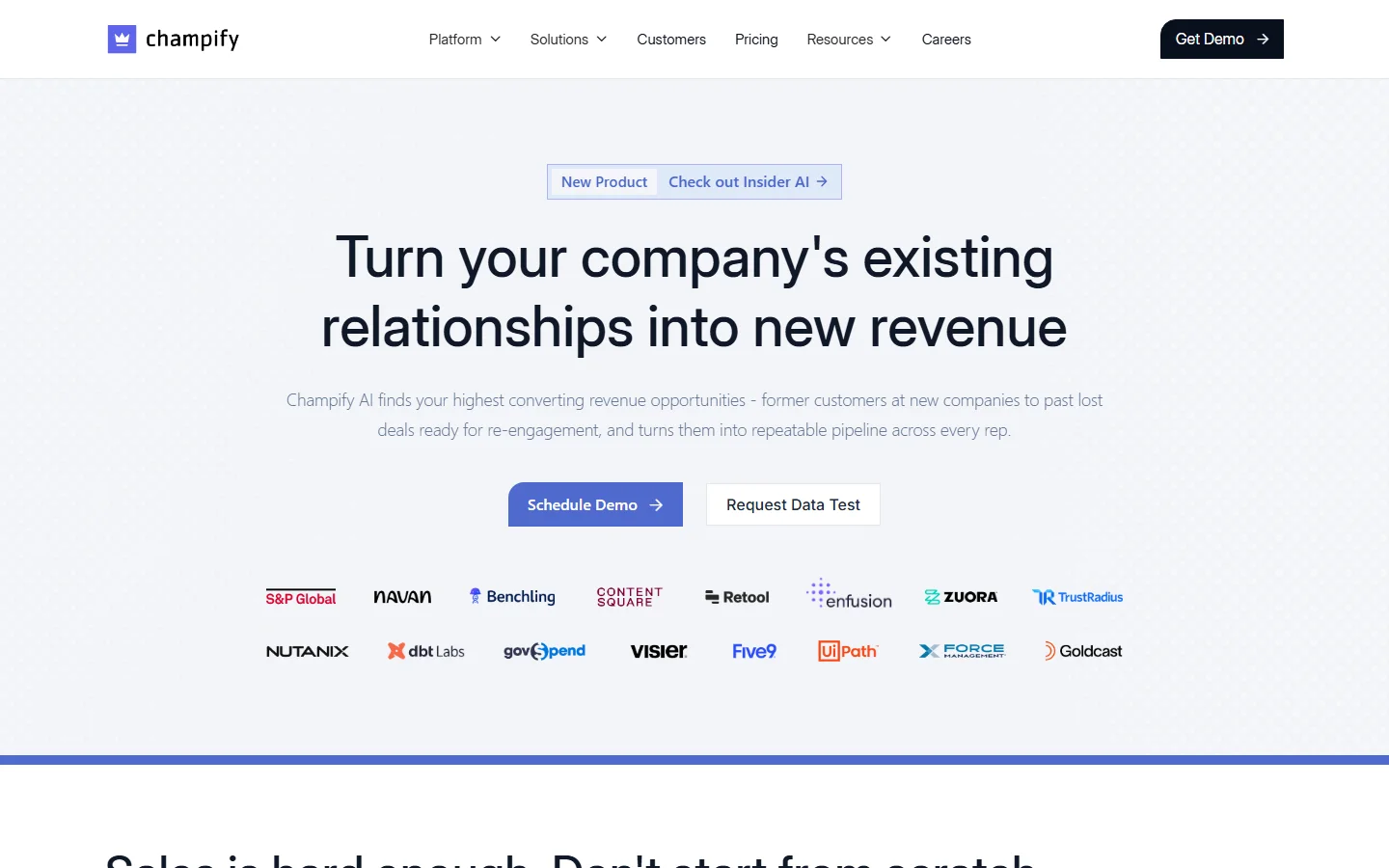
Champify homepage
The takeaway: Champify is excellent at surfacing warm leads from job changes. Acting on them mostly happens in other tools.
Champify Champion Tracking: How Job Change Signals Work
Champify connects to Salesforce through its native package and continuously scans your contact database. When someone on a closed-won deal, an active account, or a past evaluation moves to a new company, Champify detects the change, scores the relationship strength, and creates a lead record in your CRM with updated company and role information.
The scoring system weights factors like deal size, engagement level, role in the buying committee, and recency of the relationship. A VP who signed a $200K deal last year scores higher than a junior user who signed up for a free trial two years ago. The scoring helps prioritize which job changes are worth immediate outreach.
What works well
Setup is fast. Multiple G2 reviewers note that Champify takes hours to configure, not weeks. The Salesforce integration is native and reliable. Data Cleaning/Enrichment scores 9.2 on G2, and Reporting capabilities score 9.6. The interface makes it easy to see which past champions moved, where they went, and how strong the relationship was.
Where it falls short
Champify shows you the job change, but the follow-up happens somewhere else. There is no native email sequence builder or dialer: alerts land in Salesforce, Slack, or email, and reps work them in Outreach, Salesloft, or another sequencer. Insider AI nurture campaigns only start on the Pro plan. Knowing someone moved is 10% of the value. Executing on that signal quickly is the other 90%. See our UserGems review for a more feature-rich champion tracking comparison.
Champify Pricing Breakdown
Champify publishes pricing on their pricing page. Plans scale by number of contacts tracked (as of September 2026):
- •Core (from $2,000/mo): 15,000 contacts tracked (add-ons up to 150,000), Salesforce package with unlimited users, Slack and email alerts
- •Pro (from $3,000/mo): 40,000 contacts (add-ons up to 200,000), adds Calendar Sync (50+ users) and Insider AI (2,000+ accounts)
- •Enterprise (from $6,000/mo): 150,000 contacts (add-ons up to 2 million), adds CRM Clean (150,000+ contacts) and Insider AI for 5,000+ accounts
What you actually pay
At $2,000/mo to start, Champify's Core plan works out to $24,000/year, which puts it in the same range as UserGems ($15,000-$30,000+/year). That buys job change alerts and relationship scores on up to 15,000 contacts. Add the cost of a separate outreach platform and any extra signal tools, and the total climbs well past the Champify line item.
Champify's pricing page also advertises a $500K ROI guarantee for all customers. Ask for the written terms before you sign, since the conditions decide how much protection it really offers.
Hidden costs to watch
- Narrow signal scope: $2,000+/mo buys relationship signals, not funding or hiring data
- No native sequencer or dialer: sending still runs through Outreach, Salesloft, or another tool
- Contact-based pricing: costs grow as your CRM database grows
- Annual contracts required on all plans
What Are the Downsides of Using Champify?
One signal type limits your pipeline sources
Champify tracks job changes. That is it. No funding signals, no hiring intent, no technology adoption changes, no competitive displacement alerts. If your pipeline depends on multiple signal types, Champify covers one slice. Teams using Champify almost always need additional signal tools alongside it.
No execution layer
The most common complaint across G2 and competitive reviews: Champify tells you someone moved but leaves the outreach to other tools. There is no native email sequencing or dialer, so reps still work each alert in Outreach, Salesloft, or whatever sequencer they already use. Review our best B2B prospecting tools for platforms that include the execution layer.
Data quality depends on your CRM
Champify is only as good as the data in your CRM and LinkedIn profiles. If your CRM has incomplete contact records or your past buyers have sparse LinkedIn profiles, the volume of surfaced leads drops. Teams with messy CRM data get fewer actionable signals.
Teams outgrow it quickly
Multiple reviews note that teams outgrow Champify within 6-12 months. The initial excitement of finding past champions at new companies fades when you realize the tool does not scale into a broader signal and outreach strategy. You end up adding tools around it, and the total stack cost climbs well past the Champify line item.
How Champify Works: From Salesforce Install to First Warm Meeting
Champify is simple to describe and easy to underuse. Here is how a typical rollout runs, and where plan limits show up along the way.
- Install the Salesforce package. Champify is Salesforce-native, and every plan includes its package with unlimited users. As of September 2026 there is no native HubSpot CRM integration, so HubSpot-first teams should settle that question before anything else.
- Define who counts as a champion. Point Champify at the relationships that matter: closed-won contacts, power users on active accounts, and evaluators from past deals. Champify pitches both angles, former customers at new companies and lost deals that are ready for re-engagement.
- Let it track and score. Champify watches those contacts for job changes and scores each relationship on deal size, engagement, buying committee role, and recency, so a departed economic buyer outranks a two-year-old trial user.
- Route the alerts. New lead records land in Salesforce with the updated company and role, and alerts go out through Slack and email. Departures from current customer accounts double as churn-risk warnings for account managers.
- Work the signal in your sequencer. Champify integrates with Outreach and Salesloft, but it does not send emails itself. On Pro and Enterprise, Insider AI adds nurture campaigns that Champify describes as powered by your own data plus AI.
- Keep the CRM clean. Calendar Sync (Pro and up) uses calendar data to complete missing contacts and opportunity roles, and CRM Clean (listed with Enterprise) enriches and cleans the contact database. Better input data means more champions surface.
Champify's own site claims past customers convert 6-22x higher than other outbound signals. Treat that as a hypothesis to test, not a given. With Core starting at $24,000/year, run the first quarter as a measured pilot: track meetings booked from alerts, pipeline sourced from them, and the time from alert to first touch. If reps take days to act on each move, the signal loses most of its value, whichever tool surfaced it.
The setup work is light compared with most signal tools, which is why G2 reviewers highlight how quickly Champify goes live. The ongoing work is operational: making sure every alert has an owner and a play.
Is Champify Worth It?
Champify is worth it for enterprise sales teams with large customer bases where former-buyer job changes represent a proven pipeline source. If your existing customer relationships are strong and your ACV is high enough to justify $2,000/mo or more for warm lead alerts, it delivers genuine value. The fast setup and clean Salesforce integration make it easy to test.
Champify is not enough for teams that need multi-signal coverage and automated outreach. If you are building pipeline from multiple buying signals and want to act on them instantly, you need more than a job change tracker.
The verdict: excellent at one thing, but one thing is not a pipeline strategy. Pilot it on your own closed-won contacts, measure meetings booked from its alerts, and budget for the sequencer and extra signal sources you will still need alongside it.
Evaluating champion tracking tools? Read our reviews of UserGems, Common Room, and our guide to best buying intent data tools for 2026.
If Champify's focus on relationship signals alone is a dealbreaker, SyncGTM is one alternative worth a look: it tracks job changes alongside funding, headcount growth, hiring, and web traffic signals, with native HubSpot and Salesforce integrations.