

Crustdata Review 2026: Job Listings API, Signals and Pricing

By Kushal Magar · November 23, 2026 · 14 min read
Key Takeaway
Crustdata is an API-first B2B data provider for company, people and job-listing data, with watchers that turn searches into alerts. Job search costs 0.03 credits per result on every plan. Live endpoints, batch jobs and contact enrichment are plan-gated, realtime watchers cost 150 credits per record, and no dollar price per credit is published. Rating: 4.0/5. Best for GTM engineers; a poor fit for sales teams without engineering support.
This Crustdata review covers the job listings API, headcount and company signals, people data, live endpoints, credit pricing, docs, latency and plan gating, all checked against Crustdata's own site and docs in November 2026. Rating: 4.0/5.
Crustdata sells B2B data as infrastructure. There is no prospecting UI to click through, just REST endpoints, an MCP server and watchers you wire into your own stack.
That makes it a different purchase from a seat-based sales tool. The real questions are what each call costs, how fresh the data is, and which endpoints your plan can actually reach.
The top-ranking reviews skip most of that: none of them lists the per-endpoint credit costs, watcher pricing or rate-limit tiers. This one does, with a link to the Crustdata page each number comes from.
What Is Crustdata?
Crustdata is an API-first B2B data provider for AI agents and GTM teams. It offers company, people, job-listing, social-post and web data over REST, an MCP server, and flat-file datasets.
The company claims 1B+ people and 60M+ companies, exposed through 40 MCP tools. It raised a $6M seed round led by Y Combinator and A Capital, announced in October 2025.
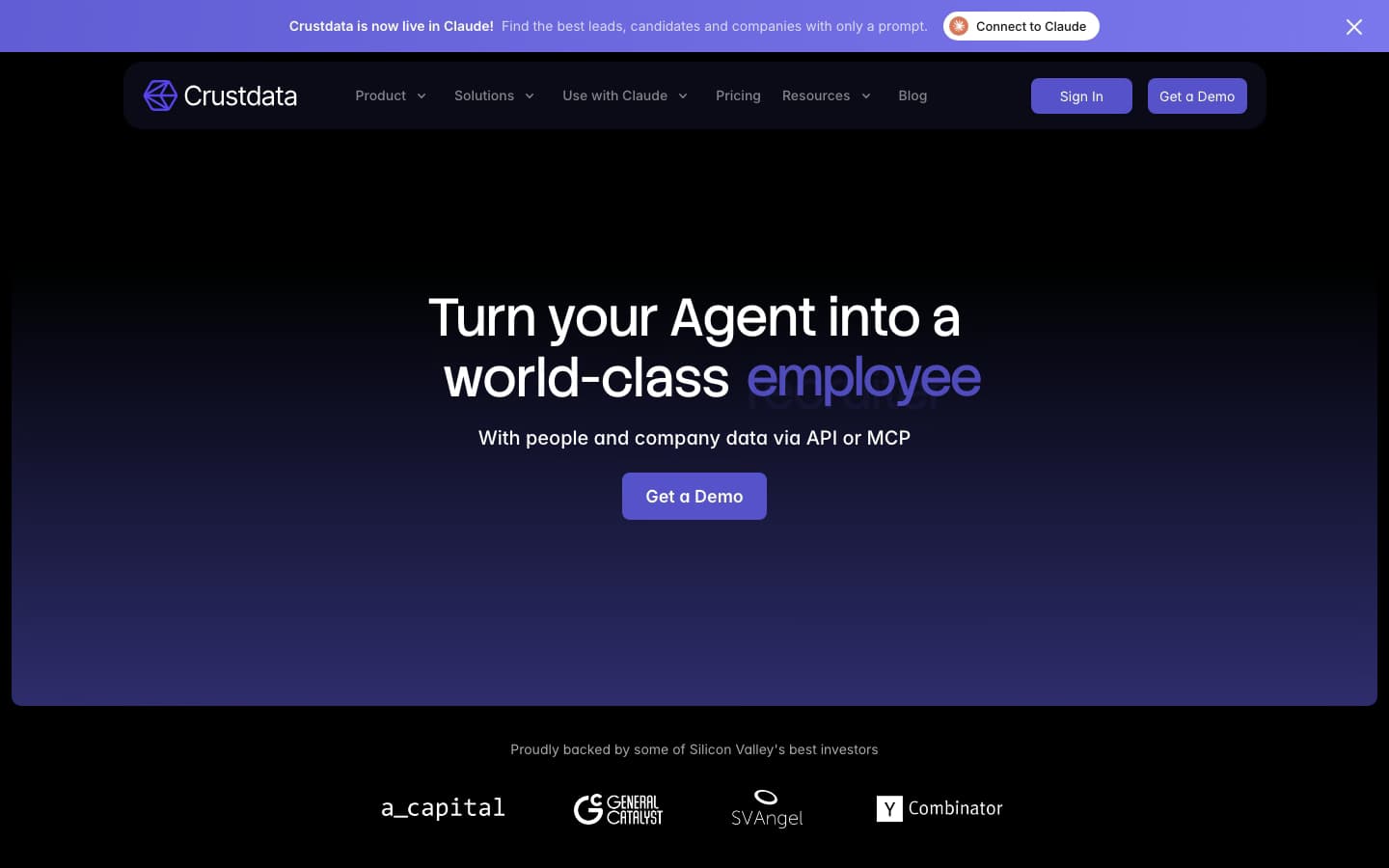
Crustdata — people and company data via API or MCP
Its customers lean technical: AI SDR products, recruiting platforms, investors and GTM engineers building internal tools. The product assumes someone on your team writes code or runs an AI agent.
| Capability | What Crustdata provides | Watch out for |
|---|---|---|
| Job listings | Indexed job search with filters and aggregations; live job search per company; Job Watcher alerts. | Live job search is plan-gated. |
| Company signals | Headcount, funding, hiring, followers, reviews and technographics as search filters and enrich fields. | Premium filter groups bill per result on top of the base price. |
| People data | Search, enrich, identify, job-change flags and contact data. | Contact enrichment endpoint is enterprise-only. |
| Watchers | Saved searches or watch lists that push changes to webhook, Slack, Google Chat or email. | Realtime (1-day SLA) pricing is far higher than default. |
| Access | REST API, MCP server, CLI, Zapier, flat files. | No native HubSpot or Salesforce connector. |
How Crustdata Works: Indexed vs Live Data
Every Crustdata dataset comes in two modes. You either query its indexed database, or you pay more to retrieve a record from the web at request time.
Per the data updates docs, indexed person, company, job and technographic records refresh every 1 to 30 days. Social posts refresh every 1 to 45 days.
| Indexed database | Live retrieval | |
|---|---|---|
| Freshness | Refreshed every 1 to 30 days | Pulled from the web at request time |
| Batch size | Up to 10,000 people or companies per job, or the postings of up to 10 companies | Up to 300 profiles per enrich job, 1,000 records per search job |
| Default rate limit | Depends on plan and endpoint | 10 requests per minute |
| Availability | All plans; batch jobs need enterprise | Enterprise plans or the live add-on |
Source: docs.crustdata.com/general/data-updates (November 2026)
Every record carries an updated_at timestamp, so you can check a record's age before acting on it. That matters more than any freshness claim on a marketing page.
Requests also carry an x-api-version header (currently 2025-11-01). Pinning it keeps your integration on the schema you tested.
Crustdata Jobs API: Job Listings Search
The Job Postings Search API is the cheapest way into Crustdata. It costs 0.03 credits per result and is open on all plans, including the free credits on a new self-serve account.
Each request returns up to 1,000 listings (default 20) with cursor pagination, sorting, field selection and aggregations. The aggregations let you count postings by company or title without pulling every row.
What a job record contains
Every listing comes back with five groups: job details, the hiring company, the job's location, the full description text and timing metadata. The company block carries headcount, funding, revenue and locations, so you don't need a separate company enrich call.
Crustdata's Jobs API page claims 37 documented filter fields and 43 datapoints per job record, including the hiring company's firmographics. Treat those as vendor claims; the useful part is that the field catalog is public in the docs, so you can check it before you buy.
Dates you can trust
The docs are explicit that metadata.date_added is the day the job was posted on the source portal, not the day Crustdata indexed it. A separate date_updated field shows the last refresh.
That distinction is what makes “companies that posted an SDR role in the last 14 days” a reliable query. It is the core of any hiring-signal outreach play.
Live job search and batch pulls
Live job search fetches one company's postings from the web at request time. It costs 2 credits per result and is plan-gated.
Batch job search pulls every listing for up to 10 companies into one file at the same 0.03 credits per result. If you are comparing job data vendors more broadly, our job posting data providers guide covers the rest of the field.
Headcount, Company Signals and Watchers
Crustdata treats signals as filterable fields, not a separate product. Headcount (including headcount by function), funding, hiring, followers, software reviews and technographics are all premium groups on company search.
Per the pricing docs, company search costs 0.03 credits per result, plus 0.2 per result to filter on headcount, funding or hiring. Receiving those fields costs another 0.2 each, and technographics is a 1-credit, filter-only group.
Company enrichment
Company enrich costs 2 credits per record, rising to 4 when you request technographics. Crustdata's product page claims 250+ datapoints from 15+ sources, including headcount time series, web traffic, reviews and hiring signals.
One inconsistency to note: the pricing page describes the flat-file dataset as unified from 11 sources. Ask which sources cover your segment before you buy.
Watchers: alerts instead of polling
Watchers are the feature that makes Crustdata useful for hiring and growth signals. A discovery watcher re-runs a saved search on a schedule and sends only the new matches to a webhook, Slack, Google Chat or email.
An entity watcher tracks a list you supply and fires when a record changes. That covers headcount moves, funding rounds, job changes and rebrands.
Pricing depends on the SLA, meaning how fresh the data behind each alert is kept. This is the number most reviews miss.
| Watcher | 30-day SLA (default) | 1-day SLA (realtime) |
|---|---|---|
| Job discovery | 0.5 credits per new job | 150 credits per new job |
| Person discovery | 0.5 credits per new person | 150 credits per new person |
| Company discovery | 2 credits per new company | 150 credits per new company |
| Person entity (job changes) | 5 credits per changed person | 150 credits per changed person |
| Company entity | 5 credits per changed company | Not available |
Source: docs.crustdata.com/general/pricing (November 2026). Person entity watchers also have 14-, 7- and 3-day tiers at 10, 20 and 50 credits.
The gap is large: a realtime job watcher costs 300x the default (150 vs 0.5 credits per new job). Runs that find nothing new cost nothing, and the first run is a free baseline.
The practical setup is to watch most accounts on the 30-day SLA and save realtime for a short list of priority accounts. Company entity watchers only run at the 30-day SLA, so daily headcount alerts on a company list aren't on the menu.
People Data and Contact Enrichment
People search costs 0.03 credits per result, plus premium groups such as experience, education and skills at 0.1 each. Person enrich is additive: 1 credit for the base profile, then extra credits for each data type, up to 9 credits per record.
| Use case | Data requested | Credits per person |
|---|---|---|
| Basic profile | Base profile only | 1 |
| Sales outreach | Base profile + business email | 2 |
| Full outbound | Base + business email + phone | 4 |
| Maximum payload | Base + all add-ons | 9 |
Source: docs.crustdata.com/general/pricing (November 2026)
The dedicated contact endpoint bills only for the contact types you request (1 credit for business email, 2 each for personal email and phone). Adding verified: true re-checks business emails at request time for 0.5 more, but that endpoint is enterprise-only.
People search also has a recently_changed_jobs flag for people whose previous role ended within 90 days of the last index rebuild, per the data updates docs. That is a usable starting point for job-change outreach, with the caveat that the window depends on when the index last rebuilt.
Crustdata does not publish email match rates or bounce rates. If contact coverage is your main need, test it on your own ICP or pair Crustdata with a waterfall enrichment step.
Crustdata Pricing: Credits and What You Actually Pay
Crustdata does not publish a dollar price per credit or per plan. Its pricing page lists credit-based API usage tiers, monthly and annual plans, a flat-file dataset with a monthly refresh, and custom enterprise pricing through sales.
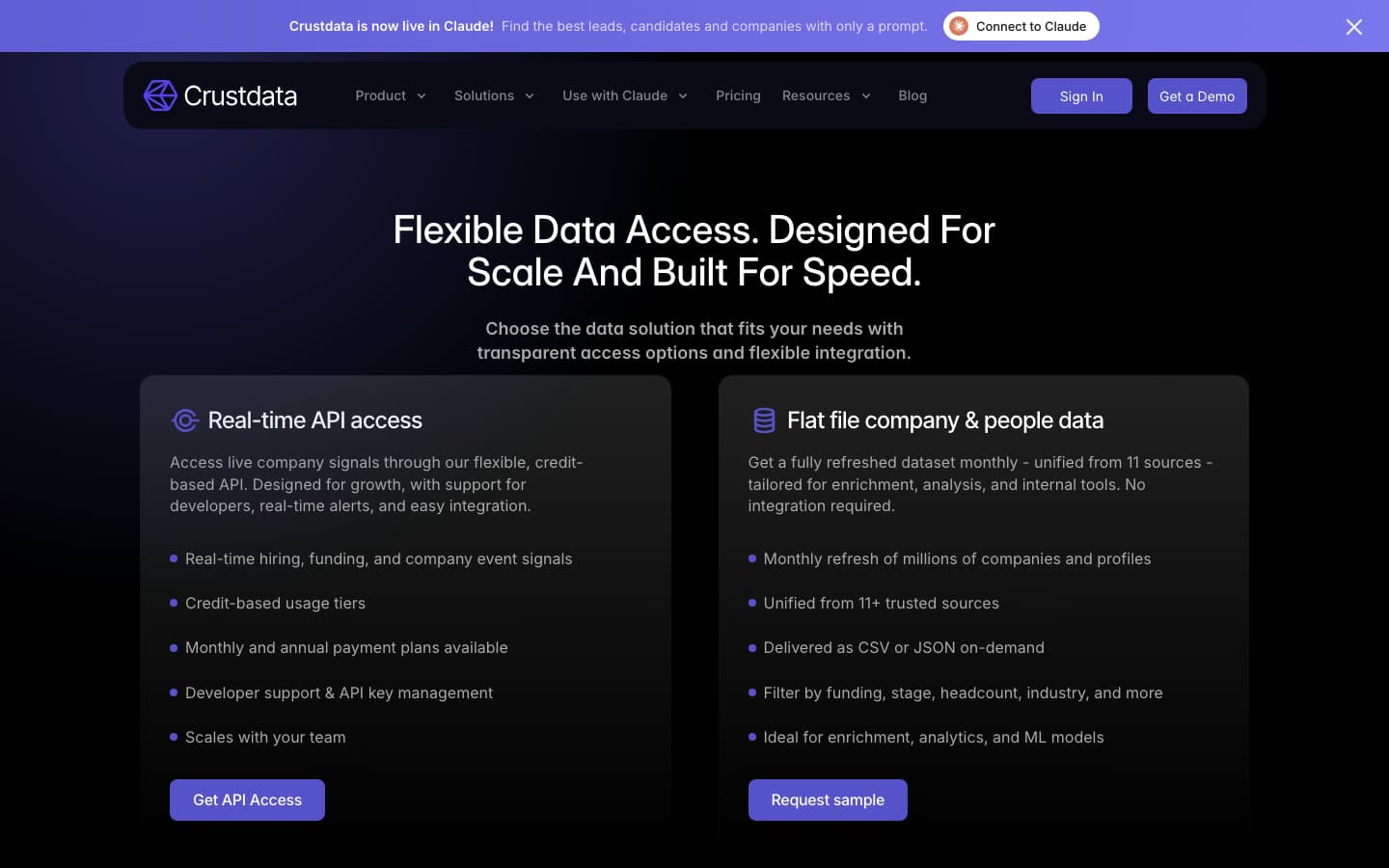
Crustdata pricing page — no dollar figures, credit-based tiers
Some third-party reviews quote dollar figures for Crustdata plans. None of those numbers appear on crustdata.com, so we left them out.
What Crustdata does publish, in its pricing docs, is the credit cost of every documented endpoint. That is enough to estimate usage in credits, just not in dollars.
| Endpoint | Credit cost | Access |
|---|---|---|
| Job search | 0.03 per result | All plans |
| Company / person search | 0.03 per result + premium groups | All plans |
| Company enrich | 2-4 per record | All plans |
| Person enrich | 1-9 per record | All plans |
| Company identify | 0.2 per match | All plans |
| Contact enrich | 1-5.5 per matched person | Enterprise |
| Live person / company / job search | 2 per result | Plan-gated |
| Live person enrich | 7 per profile | Plan-gated |
| Web search (live) | 1 per 10 results | Self-serve and enterprise |
| Autocomplete endpoints | Free | All plans |
Source: docs.crustdata.com/general/pricing (November 2026). Contract accounts can read their own rates from a free GET /account/endpoints call.
Worked example: a weekly hiring-signal pull
Say you pull 1,000 new SDR job postings a week from job search. At 0.03 credits per result, that is 30 credits.
Enriching one decision-maker per company with a business email (2 credits each) across 200 companies adds 400 credits. The job data is cheap; enrichment and realtime watchers are where the credits go.
Billing rules worth knowing
- Searches that return nothing cost nothing, and premium fields that come back null aren't billed.
- Purchased credits expire 12 months after purchase, per the pricing FAQ.
- Every response returns an
X-Credits-Usedheader, and usage and balance endpoints are free to call. - Credits are bought as one-time packages or auto top-up through the dashboard; when the balance hits zero, billable requests return errors.
Docs, Latency, Rate Limits and Plan Gating
Documentation
The docs are Crustdata's strongest asset. Each endpoint page lists its credit cost, rate limit, plan access and error codes, and there is an llms.txt index for AI agents.
There are also free endpoints to check permissions, balance and usage. That means you can find out what your plan can reach before you spend credits.
Latency
Crustdata doesn't publish p50 or p95 latency for its search endpoints. Its company enrichment page states up to 10 minutes for realtime enrichment, and “instant if cached, up to 24h if not” from the database.
In practice, cached records are fast and uncached ones are not. If your workflow calls enrich while a user waits, build for the uncached case.
Rate limits
Self-serve accounts move through tiers based on lifetime spend, per the rate limits docs.
| Tier | Unlocks at lifetime spend | Search / enrich / identify (RPM per endpoint) | Overall (RPM) |
|---|---|---|---|
| Starter | $0 | 5 | 100 |
| Standard | $5 | 15 | 100 |
| Plus | $95 | 30 | 200 |
Source: docs.crustdata.com/general/rate-limits (November 2026)
Live endpoints default to 10 requests per minute, and the docs say raising a live limit is constrained. That rules out live enrichment as a high-volume path.
Plan gating
Here's what a self-serve account can and can't reach, per the data updates and pricing docs:
- Open on all plans: indexed company, people and job search; company and person enrich; identify; autocomplete; live web search and fetch.
- Enterprise or live add-on: live company, person and job endpoints.
- Enterprise only: batch jobs, contact enrichment, employee reviews, dev-platform enrich and live social posts.
The free trial shows you the indexed side well. It won't show you live data or batch throughput, which are often what you'd buy Crustdata for.
Crustdata Integrations
Crustdata's integrations page is built around AI clients. It lists Claude, Claude Code, ChatGPT, Codex, Cursor, Grok, Replit and Dify, plus Zapier (which Crustdata says connects to 8,000+ apps).
There is no native HubSpot or Salesforce connector on that page. Sales teams who want Crustdata data in their CRM either build on the API or route it through Zapier.
The MCP server is the practical shortcut for GTM engineers. If you are comparing data MCPs, see our enrichment MCPs roundup.
What Users Say
Crustdata's public review record is thin. On Product Hunt it holds a 4.4 rating based on 14 reviews.
Reviewers there praise fresh data, easy API and webhook setup, and less manual lead research. The recurring concern is noise: some say realtime feeds need careful filtering, and a few raise latency and developer-experience questions.
Most of the other ranking “reviews” come from competing data vendors or listing sites that take placement fees. Read them for structure, not verdicts.
Who Should Use Crustdata — and Who Shouldn't
Crustdata suits GTM engineers far better than sales teams. The split comes down to who will write the integration.
Use Crustdata if:
- You are building an internal tool, AI SDR or agent that needs company, people and job data through one API or MCP server.
- Hiring is your main signal and you want cheap job search with company firmographics included on every posting.
- You want alerts, not polling, and are happy to run most watchers on the default 30-day SLA.
- You value documented per-endpoint costs and can estimate usage in credits before committing. GTM engineers who live in Claude Code will feel at home.
Skip Crustdata if:
- Your sales team needs a UI to build lists and push them to a CRM without engineering help.
- You need a dollar budget before you start; you'll have to sign up or talk to sales to get one.
- Verified contact data at volume is your main job. Contact enrichment is enterprise-only and match rates aren't published.
- You need daily alerts across thousands of accounts. At 150 credits per record, realtime watchers get expensive quickly.
Crustdata Alternatives
The right alternative depends on which part of Crustdata you need. Our full Crustdata alternatives list goes deeper.
TheirStack — job postings and tech stack
TheirStack is the closest match for the jobs side. It is built around job postings and the technologies they mention, with a self-serve UI and API.
PredictLeads — company events from public sources
PredictLeads focuses on company signals: job openings, news events, technology detections and financing. It suits teams that want event feeds more than people data.
Sumble — account intelligence from job posts
Sumble reads job posts to map tech stacks, teams and projects inside an account. It has a UI built for AEs, not just an API.
People Data Labs and Coresignal — bulk people data
If you want a large people and company dataset for bulk enrichment, compare People Data Labs and the options in our Coresignal alternatives guide. Both lean toward datasets and batch enrichment rather than watcher-style alerts.
Crustdata Pros
- ✓Cheap, open job search. 0.03 credits per result on every plan, with the hiring company's firmographics included on each posting.
- ✓Documented per-endpoint costs. Every documented endpoint has a published credit cost, plus free calls to check your balance, usage and plan access.
- ✓Watchers built in. Saved searches and watch lists push only new or changed records to webhook, Slack, Google Chat or email, and empty runs are free.
- ✓Strong docs and agent tooling. llms.txt, an MCP server, a CLI and plugins for Claude Code, Codex and Cursor make it fast to wire into agent workflows.
- ✓Honest dates. Job records separate posted date from refresh date, and every record carries a last-updated timestamp.
Crustdata Cons
- No published dollar pricing. Credit costs per endpoint are documented, but there is no public price per credit or per plan, so you can't turn a credit estimate into a budget without signing up or talking to sales.
- Realtime is expensive. A 1-day SLA watcher costs 150 credits per new record versus 0.5 to 5 credits at the default 30-day SLA, so watching a large list in realtime adds up fast.
- The best endpoints are plan-gated. Live company and person endpoints, batch jobs and contact enrichment need an enterprise plan or a live add-on, which the self-serve trial doesn't fully show.
- Low default throughput on self-serve. New accounts start at 5 requests per minute per search or enrich endpoint, and live endpoints default to 10 requests per minute.
- No native CRM connector. HubSpot and Salesforce are not on the integrations page, so sales teams depend on Zapier or engineering time to get data into their CRM.
- Thin independent review record. Public reviews are few, and most ranking write-ups come from competitors or paid listing sites.
Crustdata Review Verdict
Crustdata earns 4.0/5. It is one of the better-documented B2B data APIs available, and its job search is cheap enough to run as a standing hiring-signal feed.
Pick it if you are a GTM engineer or product team building on an API or MCP server. The watcher system and the job records with company data attached cover most signal-based prospecting workflows.
Skip it if your sales team needs a UI, a native CRM sync or a dollar price before signing. The plan-gated live and batch endpoints and the steep realtime watcher pricing mean the trial understates both the capability and the cost.
Bottom line: strong data infrastructure for teams that code, priced in credits you can model but not yet convert to dollars without talking to Crustdata.
If needing an engineer to wire up every endpoint is a dealbreaker, SyncGTM is one alternative worth a look: it pairs hiring signals with waterfall contact enrichment and pushes leads to your CRM or sequencer without code.