

7 Best Hiring Signal Tools for Sales Prospecting in 2026

By Kushal Magar · November 23, 2026 · 13 min read
Key Takeaway
A job posting is a budget signal. The best hiring signal tools detect who is building a team your product serves — and get you to the right decision-maker before that window closes.
The best hiring signal tools turn job postings into actionable prospecting lists — identifying companies that are actively building the teams most likely to need your product right now.
A company posting three SDR roles is in an outbound tool evaluation. A company hiring a VP of Data Engineering has infrastructure budget live today. These signals are hiding in plain sight on every public job board.
The challenge is not finding the postings. It is enriching the right contact at each hiring company and getting that person into a sequence before the window closes. Most raw job feeds stop at the signal. The tools below go further.
This guide covers seven hiring signal tools — ranked by job-board coverage, role and department filters, alert freshness, and how far each tool takes you toward an enriched, outreach-ready lead. See our broader roundup of job posting data providers for the raw API layer, and SDR tools for prospecting for the full outbound stack.
TL;DR — Quick Verdict
| Tool | One-line verdict | Best for |
|---|---|---|
| SyncGTM | Signal detection + enrichment + sequencer push in one step | Revenue teams running signal-triggered outbound |
| PredictLeads | Deepest structured job dataset — 300M+ historical records | Data-first teams building custom prospecting pipelines |
| Autobound | 35 signal sources, 700+ signal types in one common schema | Teams that want the broadest signal coverage per request |
| LoneScale | CRM-native job change and new hire tracking | RevOps teams keeping CRM contacts verified and fresh |
| Mantiks | Finds the end client behind agency job postings | Recruiters, staffing agencies, and B2B niche prospectors |
| Leads Otter | 100K+ job boards across 60+ countries, €199/mo entry price | SMBs that want broad job board coverage at a low price point |
| Sumble | Hiring signals tied to tech stack and org chart data | GTM teams selling into complex technical accounts |
What Are Hiring Signal Tools?
Hiring signal tools track job postings at target companies and alert your sales team when a company posts roles that signal an active buying need. A DevOps team expansion signals infrastructure spend. A new Head of Revenue signals CRM evaluation. A wave of SDR postings signals outbound tooling budget.
The core value is timing. Reaching a company during an active hiring cycle — when their budget is allocated and their team is building — is fundamentally different from cold outreach to a dormant account.
Tools in this space differ on three dimensions: how widely they cover job boards, how granular their role and department filters are, and whether they deliver a raw signal feed or an enriched lead ready for outreach. See how these tools compare to the broader category of B2B data providers to understand where hiring signals fit in your stack.
1. SyncGTM
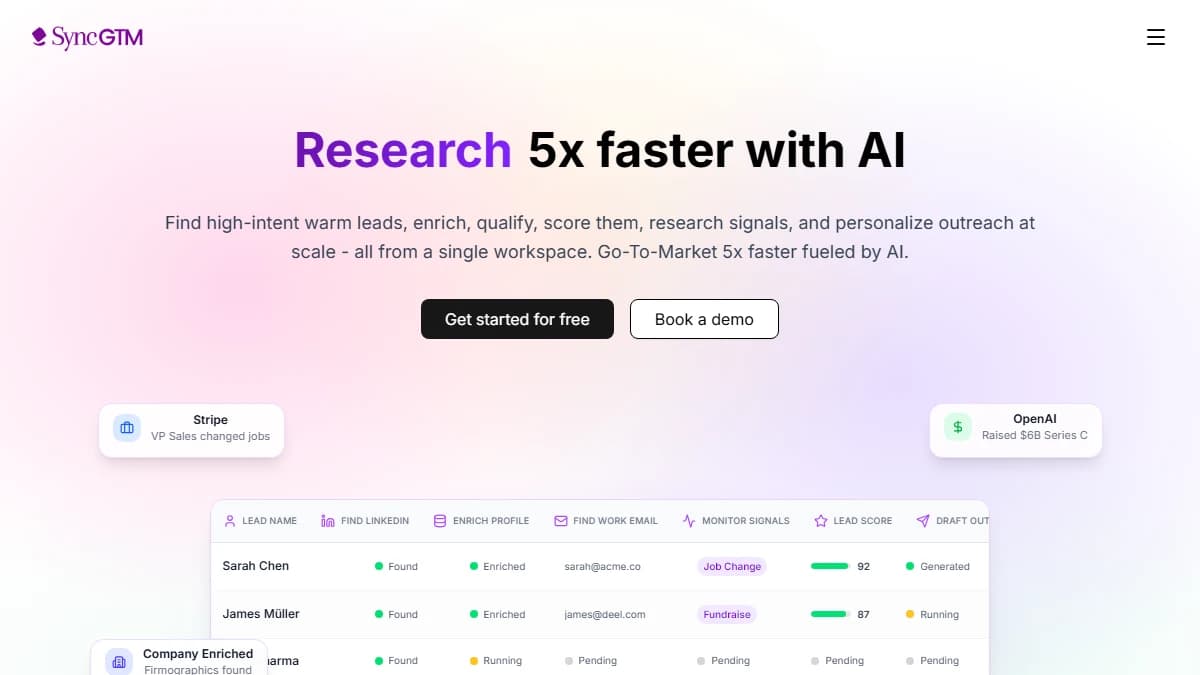
SyncGTM is the only tool in this list that completes the full journey from signal to sequencer push in one workflow. It detects companies posting for roles that match your ICP, identifies the right decision-maker at each company, enriches their email and phone number across 50+ data providers, deduplicates against your existing contacts, and pushes verified leads directly to Instantly, Smartlead, or HeyReach.
The signal-to-outreach workflow works like this: define the job titles and departments that signal buying intent for your product (for example, “Head of Sales” or “Data Engineering”), set your ICP filters (company size, industry, geography), and SyncGTM surfaces the companies posting those roles. It then finds the right contact — the VP Sales, CTO, or Head of Data who would own the buying decision — and verifies their details before pushing to your sequence.
SyncGTM also connects to HubSpot, Salesforce, Attio, Pipedrive, Close, and Zoho CRM. Duplicates are removed before sync so your CRM stays clean. The waterfall enrichment layer means you are not locked into a single data source — contacts cascade through providers until a verified result is returned.
Pros
- ✓Signal → enrichment → sequencer push in one automated step
- ✓Waterfall enrichment across 50+ providers maximizes contact coverage
- ✓Native push to Instantly, Smartlead, and HeyReach — no manual CSV exports
- ✓Deduplication before sync keeps CRM and sequencer lists clean
- ✓CRM integrations: HubSpot, Salesforce, Attio, Pipedrive, Close, Zoho
Cons
- ✗Not a raw job data API — teams wanting to build their own pipeline will need PredictLeads or Autobound instead
- ✗Best value when used for the full workflow; overkill if you only need signal alerts
Best for: Revenue teams that want to run signal-triggered outbound without stitching together separate enrichment and sequencer tools.
Pricing: See current plans →
2. PredictLeads
PredictLeads is the most data-dense option in this list. Its job openings dataset covers 3M+ companies with 300M+ historical records and approximately 9.8M active job openings at any given time. Every posting includes the full job description, O*NET occupation codes, salary ranges where available, and a direct link back to the source job page. Our PredictLeads review covers pricing and endpoints in depth.
Delivery is API-first. You can query by keyword, job title, company, location, industry, company size, or technology. Webhooks push new and closed job events to your endpoint in real time. PredictLeads also offers an MCP server for LLM-native workflows and bulk JSONL exports via S3, GCS, or SFTP for data warehouse pipelines.
The job openings feed is one of several datasets — PredictLeads also tracks 130M+ companies across news events, technology detections, financing rounds, product launches, and SEC filings. Teams commonly combine the job signal with tech stack data to find companies hiring in a department that uses your product category. For more options in this layer, see our guide to TheirStack alternatives.
Pros
- ✓300M+ historical job records — the deepest archive in this comparison
- ✓Real-time webhooks for new and closed job postings
- ✓Nine datasets in one API: jobs, news, tech stack, funding, and more
- ✓Pay-as-you-go credits — $20 free to start
Cons
- ✗API-only product — no no-code UI for sales reps without technical support
- ✗Does not include contact data — you need a separate enrichment step to reach decision-makers
- ✗Credit cost per job record rises without scale — small teams pay more per signal
Best for: Data engineering and RevOps teams building custom prospecting pipelines that need structured job data at scale.
Pricing: Pay-as-you-go from $0.04/credit, down to $0.0025 on larger packs (per vendor pricing page).
3. Autobound
Autobound bills itself as “the signal layer for data platforms.” It aggregates 35 signal sources into 700+ signal types — covering social, financial, workforce, market, and intent data — and delivers all of them in a single common schema. For hiring specifically, its Workforce category covers 21M+ companies with Hiring Trends, Hiring Velocity, Job Changes, and Work Milestones.
The practical advantage is breadth. Rather than running separate API calls for hiring data, funding rounds, and news events, Autobound returns all relevant signal types for a company in one request. Its public coverage report (updated weekly) shows audited volumes per feed — a transparency feature rare in this category. The platform is SOC 2 Type II certified and also supports an MCP server for Claude and ChatGPT integrations.
Like PredictLeads, Autobound does not include contact enrichment. It surfaces the signal; you bring the enrichment layer. Teams typically pipe Autobound's hiring triggers into a waterfall enrichment workflow to get verified contacts.
Pros
- ✓35+ signal sources in one unified schema — no multiple API integrations
- ✓Hiring Velocity and Hiring Trends give department-level growth context
- ✓Public weekly coverage audit — transparent about data freshness and volume
- ✓SOC 2 Type II certified — suitable for enterprise data teams
- ✓OEM licensing for embedding signal data in a partner product
Cons
- ✗No public pricing — all plans require a sales conversation
- ✗No contact enrichment — hiring signals need to be paired with a separate people-data layer
- ✗API-first — not designed for direct use by sales reps
Best for: Data and engineering teams that want the broadest signal coverage per API call in a consistent schema — especially when hiring is one of several signal types you track.
Pricing: Contact Autobound for a quote. Free trial available.
4. LoneScale
LoneScale focuses on two specific hiring signals: job changes (a champion leaves for a new company) and new hires (a target persona joins an account). It syncs those signals directly into Salesforce or HubSpot and pairs them with verified contact enrichment — email, direct dial, and social profiles.
The CRM-first design is LoneScale's differentiator. Rather than surfacing raw signal alerts, it updates your existing CRM records daily. When a key champion changes jobs, their new company and contact details land in Salesforce automatically. The platform claims over 90% enrichment accuracy across its 30+ live data sources.
LoneScale also ships a Slack integration for real-time alerts and a browser extension that checks whether a LinkedIn profile already exists in HubSpot or Salesforce. Its AI research agents use 50+ data points per stakeholder to draft openers or selling angles inside CRM. For teams exploring alternatives, our LoneScale alternatives guide covers comparable options.
Pros
- ✓CRM-native — signals land in Salesforce and HubSpot automatically without CSV exports
- ✓Covers both job change signals and new hire signals in one platform
- ✓Integrations: Salesforce, HubSpot, Gong, Outreach, ZoomInfo, Apollo.io
- ✓Daily CRM refresh catches job changes before your team discovers them manually
Cons
- ✗Does not track company-level job posting volume — not built for “company is hiring in X department” signals
- ✗No public pricing — requires a demo booking to get a quote
- ✗Strongest value when Salesforce or HubSpot is your CRM; less useful for teams not on those platforms
Best for: RevOps and sales teams on Salesforce or HubSpot that need champion tracking and CRM hygiene built around job change signals.
Pricing: Not publicly listed. Contact LoneScale for a quote.
5. Mantiks
Mantiks is built around a single insight: most hiring signal tools miss the postings published by recruitment agencies on behalf of their clients. Mantiks analyzes agency postings and identifies the end client behind them — a capability that surfaces opportunities invisible to any tool that only reads direct employer postings.
Its CV-based search is another standout feature. Upload a candidate profile and Mantiks finds companies currently hiring for similar roles — a prospecting workflow used by HR tech vendors, staffing firms, and training companies. For standard sales prospecting, you can set custom keyword and department filters with automated alerts and urgency scoring that prioritizes companies with active hiring pressure.
Mantiks includes contact identification alongside job data — LinkedIn profiles, business emails, and direct phone numbers for the right personas at each hiring company. All plans require an annual commitment. The Starter plan is €99/month for 500 credits and the Growth plan is €190/month for 1,000 credits, both billed annually.
Pros
- ✓Agency post analysis reveals the end client — unique in this category
- ✓CV-based search finds companies hiring for a specific candidate profile
- ✓Contact data (LinkedIn, email, phone) included — no separate enrichment tool needed
- ✓7-day free trial — no commitment to test
Cons
- ✗Annual commitment required — no month-to-month option on public plans
- ✗Credit volumes are relatively small — 500 credits/month on Starter may not scale for large outbound teams
- ✗Does not name specific job boards in its coverage documentation
Best for: Recruiters, staffing agencies, HR tech vendors, and training companies that need to find hiring companies and their real decision-makers, including through agency-posted roles.
Pricing: Starter €99/mo (500 credits), Growth €190/mo (1,000 credits) — annual commitment, prices per vendor pricing page.
6. Leads Otter
Leads Otter emphasizes breadth of job board coverage. According to ColdIQ's product review, the platform monitors 100,000+ job boards across 60+ countries, refreshing every 8–12 hours — making it one of the more geographically comprehensive options. The Runway plan starts at €199/month. Signals can be exported via CSV or transferred via webhook to your CRM.
The free tier (300 signals/month) lets you test the signal quality and filter logic before committing to a paid plan. Leads Otter is not a full enrichment platform — it delivers the company and job posting data, and you handle the contact identification step separately. API access and native integrations with tools like n8n, Zapier, and Make are listed as coming soon.
For SMBs that want early-pattern detection and lead scoring from hiring activity without committing to enterprise pricing, Leads Otter is the most accessible entry point in this list.
Pros
- ✓100,000+ job boards across 60+ countries — broad geographic coverage
- ✓8–12 hour refresh cycle — fresh signals daily
- ✓Free tier with 300 signals/month — test before committing
- ✓Accessible SMB pricing — Runway plan starts at €199/month
Cons
- ✗No contact enrichment — requires a separate tool to identify decision-makers
- ✗API and native integrations listed as coming soon — currently CSV-first
- ✗Pricing denominated in EUR — may carry currency conversion complexity for US teams
Best for: SMBs and early-stage teams that want broad job board coverage and lead scoring from hiring signals without an enterprise data budget.
Pricing: Free (300 signals/mo), Runway €199/mo (1,500 signals), Big-Time Sales €1,199/mo (10,000 signals) — verify current pricing at leadsotter.com.
7. Sumble
Sumble is a GTM account intelligence platform that links hiring activity to tech stack data, org charts, and active buying initiatives in a single account view. Its hiring trends are computed daily from a multi-year archive of job postings, surfacing not just “this company is hiring” but which specific tools appear in their job descriptions and which team is growing.
The differentiation is context. If a target account posts a role requiring Snowflake experience, Sumble surfaces that hiring signal alongside the account's full technology footprint, reporting structure, and decision-maker map. This gives AEs and SDRs a richer picture than raw job posting data alone can provide. See our Sumble review for credit costs and API limits.
Sumble ships an API, CRM and data warehouse connectors, and an MCP server for LLM-native workflows. The platform offers a 30-day free trial with no credit card required. Plans are publicly listed at sumble.com/pricing: a Free tier (500 credits/month, 8 signals/week) and a Pro plan at $99/month (9,900 credits, up to 20 signals/day). Teams that want to track hiring signals against competitor tech stacks should also review Warmly alternatives for more account intelligence options.
Pros
- ✓Hiring signals tied to tech stack data — see what tools appear in a company's job descriptions
- ✓Multi-year job posting archive enables trend analysis, not just point-in-time alerts
- ✓Org chart and decision-maker discovery alongside hiring signals
- ✓30-day free trial, no credit card — genuinely low-friction evaluation
Cons
- ✗Free plan capped at 500 credits/month and 8 signals/week — not viable for high-volume outbound teams
- ✗Heavier than tools built purely for hiring signal alerts — some teams will find more than they need
Best for: GTM and sales teams selling into complex technical accounts that want hiring signals in context — alongside tech stack, org structure, and active initiative data.
Pricing: Free (500 credits/month); Pro $99/month (9,900 credits, up to 20 signals/day). 30-day Pro trial, no card required.
Side-by-Side Comparison
| Tool | Job Data Coverage | Contact Enrichment | Sequencer Push | Starting Price |
|---|---|---|---|---|
| SyncGTM | Job signals + ICP filters | Yes — 50+ providers waterfall | Yes — Instantly, Smartlead, HeyReach | See /pricing |
| PredictLeads | 3M+ companies, 300M+ historical records | No — API signal data only | No — API or webhook delivery | from $0.04/credit |
| Autobound | 21M+ companies, 35 signal sources | No — signal layer only | No — API delivery | Contact for quote |
| LoneScale | Job change + new hire signals | Yes — email, phone, LinkedIn | CRM sync (Salesforce, HubSpot) | Contact for quote |
| Mantiks | Job boards incl. agency postings | Yes — LinkedIn, email, phone | CRM/ATS via API or webhooks | €99/mo (annual, 500 credits) |
| Leads Otter | 100K+ boards, 60+ countries | No — signal export only | CSV or webhook (API coming soon) | Free (300/mo) or €199/mo |
| Sumble | Multi-year job posting archive | Decision-maker discovery included | CRM and data warehouse sync | Free (500/mo); Pro $99/mo |
How to Choose the Right Hiring Signal Tool
- If you want signal → enriched lead → sequence without manual steps: SyncGTM. It is the only tool here that closes the loop from detecting a hiring signal to pushing a verified contact into Instantly, Smartlead, or HeyReach automatically.
- If you are building a custom data pipeline and need structured job data at scale: PredictLeads. The 300M+ historical record archive, real-time webhooks, and pay-per-credit pricing make it the most flexible raw data source in this list. See how it compares to other raw job data options in our TheirStack alternatives guide.
- If hiring is one of several signal types you track (funding, news, tech changes): Autobound. Its unified schema across 35+ sources reduces integration work significantly.
- If your use case is champion tracking — following contacts as they move between companies: LoneScale. Its CRM-native design keeps Salesforce and HubSpot fresh automatically without manual monitoring.
- If you sell to HR, training, or staffing companies and need to find the real client behind agency job postings: Mantiks. No other tool in this list offers that specific capability.
- If budget is the primary constraint and you just need a broad job feed to work from: Leads Otter. The free tier lets you validate signal quality before spending anything.
- If you sell complex deals into technical accounts and need hiring signals tied to tech stack context: Sumble. The combination of job posting trends and tech stack data in one account view is unmatched for enterprise AE workflows.
For the full outbound picture — from signal detection through to sequencing — see our guide to B2B sales prospecting tools.
Final Verdict
Hiring signals are among the highest-intent signals in B2B prospecting. A company posting six SDR roles is in an active vendor evaluation for outbound tooling — today, not in three months. The gap between knowing that and reaching the right person with the right message is where most teams lose the opportunity.
For teams that want to close that gap entirely, SyncGTM handles the full journey: signal detection, contact enrichment across 50+ providers, deduplication, and direct push to your sequencer. For teams building their own data pipeline, PredictLeads offers the deepest structured job dataset available. For teams that also track funding, news, and tech changes alongside hiring, Autobound's unified signal schema reduces integration overhead.
All three cover the core use case. The right choice depends on whether you need a finished workflow or raw data infrastructure — and how much of the enrichment and routing work you want handled for you.