

7 Best Job Posting Data Providers for Sales Teams in 2026

By Kushal Magar · November 23, 2026 · 14 min read
Key Takeaway
A job posting is one of the strongest buying signals in B2B sales. The best providers go beyond raw data — they let you act on that signal by identifying the right contact and reaching them before competitors do.
The best job posting data providers do more than serve raw listings. They help sales teams identify buying signals early, enrich the right contacts, and reach hiring managers before competitors do.
This guide compares seven job posting data providers across the dimensions that matter most for outbound sales: active job coverage, data freshness, deduplication quality, delivery method, and cost per record.
We cover SyncGTM, PredictLeads, TheirStack, Coresignal, Crustdata, Hirebase, and People Data Labs.
TL;DR
- SyncGTM — best for signal-to-contact workflows: combines job signal discovery with waterfall enrichment across 50+ providers and pushes directly to CRMs and sequencers
- PredictLeads — best for multi-signal teams: 130M+ companies, jobs, news, and tech datasets in one API, prepaid credits from $0.04 down to $0.0025/credit
- TheirStack — best for hiring + tech signals: 276M total jobs, 455k new per day, tech stack data included, $49/mo starting
- Coresignal — best for enterprise volume: 580M+ historical postings, 52M active, MCP server available, plans from $49/mo
- Crustdata — best for dev teams wanting an MCP interface: jobs + headcount in one API, continuously re-verified, custom pricing
- Hirebase — best for freshness: 1–2 hours from posting to API, direct career page and ATS crawling, free plan available, $99/mo Starter
- People Data Labs — best for teams already on PDL: 28.8M job postings in Beta, daily refresh, integrates with PDL's person and company data
Why Job Posting Data Matters for Sales
A company posting five SDR roles is signaling something specific. They are building an outbound motion — and they need tools to support it.
That signal is time-sensitive. Sales teams that reach a company while they are actively hiring beat competitors who rely on firmographic triggers alone.
Job postings reveal three things that firmographic data does not: (1) which functions the company is investing in right now, (2) how fast they are growing those functions, and (3) which tools and skills they expect hires to bring.
The requirement list in a job description — “experience with Salesforce, HubSpot, and outbound sequencing tools” — tells you which vendors are already in their stack and which gaps they are hiring around.
For more context on how B2B data providers stack up overall, see our guide to the best B2B data providers for sales teams.
How We Evaluated These Providers
We evaluated each provider on five dimensions relevant to B2B sales teams, not data engineers or researchers.
| Dimension | Why It Matters |
|---|---|
| Source coverage | More sources = fewer gaps in your ICP |
| Freshness | Stale signals lead to cold outreach on old news |
| Deduplication | Duplicate jobs inflate coverage numbers and waste credits |
| API vs bulk delivery | Determines how you can integrate it into your workflow |
| Cost per posting | Different pricing models make apples-to-apples hard — we break each one down |
Job Posting Data Providers: Side-by-Side Comparison
| Provider | Active Jobs | Freshness | Starting Price | Best For |
|---|---|---|---|---|
| SyncGTM | Multi-provider | Current signals | Credit-based | Signal → contact workflows |
| PredictLeads | 9.8M+ avg active | Not disclosed | $0.01667/credit (30K pack) | Multi-signal from one API |
| TheirStack | 276M total; ~455k/day | Continuous crawl; ~455k/day | $49/mo (1,500 credits) | Hiring + tech stack |
| Coresignal | 52M active / 580M+ total | Continuous / real-time | $49/mo (Mini) | Enterprise volume |
| Crustdata | Not published | Continuously re-verified | Custom (contact sales) | Dev teams, MCP interface |
| Hirebase | 6.6M+ active | 1–2 hours | Free; $99/mo Starter | Freshest data, ATS coverage |
| People Data Labs | 28.8M (Beta) | Daily | Varies; Pro $98/mo (person) | Teams already on PDL |
#1. SyncGTM
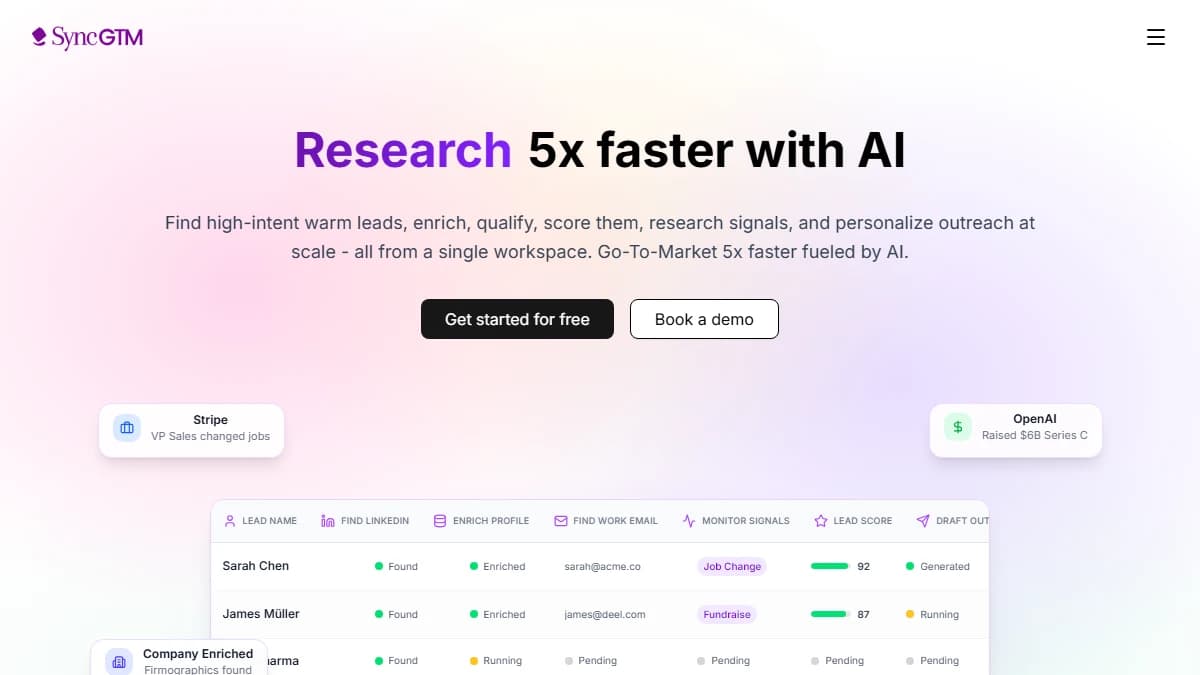
SyncGTM — job opening signals paired with waterfall contact enrichment
SyncGTM is a GTM data platform that pairs job signal discovery with waterfall contact enrichment in a single workflow.
Where most job posting providers stop at the data, SyncGTM continues to the contact. Find companies hiring for specific roles, track job openings growth velocity over three- and six-month windows, then enrich the hiring team's contacts — all in one API or MCP session.
The job search tool queries multiple providers simultaneously. The job openings growth rate tool returns growth percentages by department, so you can target companies expanding their sales or engineering headcount specifically.
Enriched contacts push directly to Instantly, Smartlead, HeyReach, HubSpot, Salesforce, Attio, Pipedrive, Close, and Zoho. Duplicates are removed before sync.
Pros
- Job signal discovery + contact enrichment in one workflow
- Job openings growth rate across 3-month and 6-month windows
- Multi-provider job search — not locked to one source
- Waterfall enrichment across 50+ contact providers
- Direct push to major CRMs and email sequencers
- MCP server for AI-native GTM workflows
Cons
- Not a raw job posting database — built for outbound workflows, not data licensing
- No historical job posting archive for retrospective analysis
- Credit costs scale with volume (0.3 credits per job returned)
Best for: Sales teams running signal-based outbound who need to go from job posting → verified contact → sequencer in one step.
Pricing: Credit-based. Job search costs 0.3 credits per job returned. Job openings growth rate costs 3 credits per company. See SyncGTM pricing for plan details.
#2. PredictLeads

PredictLeads — multi-dataset company intelligence covering job openings, news events, and technology signals
PredictLeads is a company intelligence API covering 130M+ companies across several signal datasets. Job openings are one dataset alongside funding rounds, news mentions, technology usage, and hiring patterns.
The job openings dataset averages 9.8M+ active listings and contains 300M+ historical records. Each record includes the job description, O*NET occupational codes, salary details where available, and a direct link to the source posting.
PredictLeads charges on a prepaid credit basis with no subscription required. The Enrich endpoint costs 1 credit per page of up to 1,000 results, making bulk pulls efficient. The Discover endpoint costs 1 credit per returned result. New accounts receive $20 free on signup. Our full PredictLeads review covers each endpoint and its credit cost.
Delivery is via REST API, webhooks, an MCP server, and flat files (S3, GCS, SFTP) for enterprise customers.
Pros
- 11 signal datasets in one API — job openings plus funding, news, tech
- 300M+ historical job records for trend analysis
- No subscription required — prepaid credit packs
- $20 free credits on signup
- MCP server available for AI-native integrations
Cons
- Job data freshness frequency not disclosed on the homepage
- Discover endpoint at $0.04/credit (minimum purchase) can get costly for high-volume searches
- No built-in contact enrichment — just company signals
Best for: Teams that need multiple signal types — job openings, funding, news, tech usage — from one API without managing multiple vendors.
Pricing: Prepaid credits from $0.04/credit down to $0.0025/credit on larger packs. The 30,000-credit pack ($0.01667/credit) is marked most popular. Credits last 12 months.
#3. TheirStack
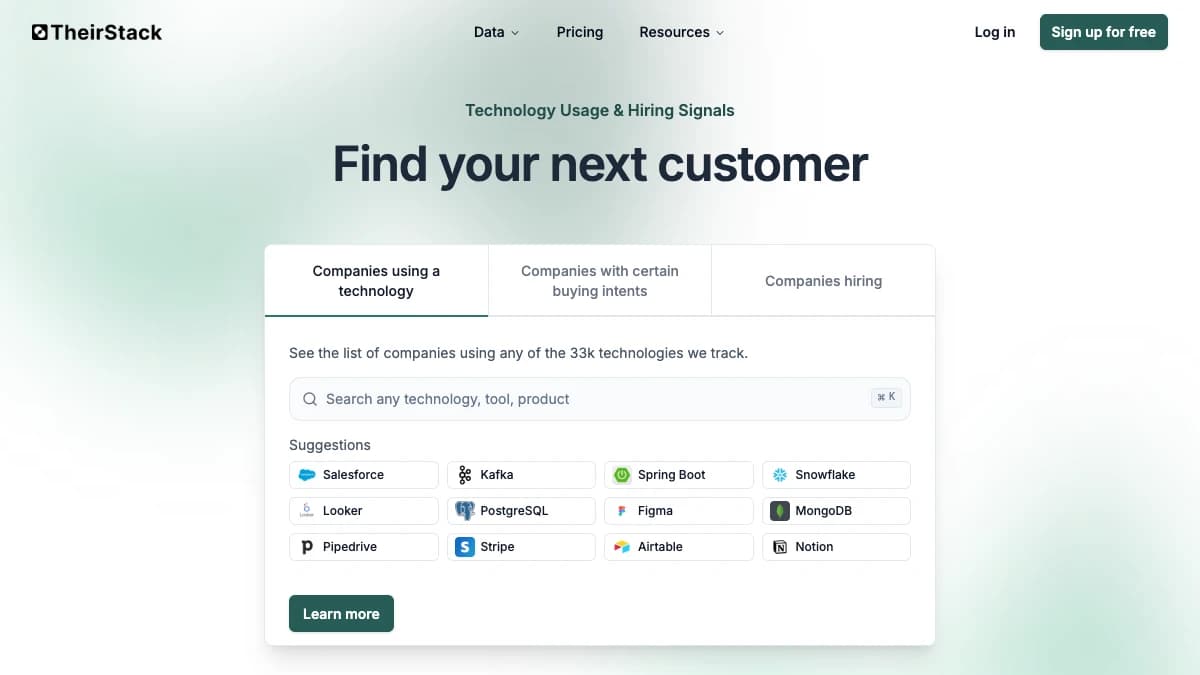
TheirStack — job postings from 375k sources combined with technographic and buying intent data
TheirStack specializes in two signals that pair well for sales: job postings and tech stack data. The job dataset covers 276M total postings from 375,000 sources including career sites, ATS platforms, and job boards, with history back to 2021. TheirStack crawls continuously and surfaces approximately 455,000 new postings per day.
The platform deduplicates postings from multiple sources and includes closed jobs in the archive. The tech dataset covers 33,000 technologies, so you can filter for companies posting SDR roles that also use Salesforce.
For the dataset tier, TheirStack delivers JSON, CSV, or Parquet to S3, GCS, Azure Blob, Snowflake, or HTTPS with hourly, daily, weekly, or monthly refresh options. The API rate limit is 4 requests per second, and the in-app export is capped at 200 jobs per company.
For a deeper look at TheirStack, see our TheirStack Review and our list of TheirStack alternatives.
Pros
- ~455,000 new postings per day (continuous crawl) — highest daily ingest in this list
- Historical archive back to 2021 for trend analysis
- Technographic signals included at no extra tier
- Closed jobs preserved in the archive
- Transparent per-credit API pricing (1 credit/job)
- Dataset delivery to Snowflake and cloud storage
Cons
- 4 req/s API rate limit — slow for large batch pulls
- In-app export capped at 200 jobs per company
- No built-in contact enrichment layer
Best for: Sales teams targeting companies by tech stack, or data teams building hiring + technology signal pipelines.
Pricing: API plans from $49/mo (1,500 credits) to $1,500/mo (1M credits). One-time company credit packs from $109 (1,000 credits) to $999 (200,000 credits). 1 credit per job, 3 per company lookup or technographic query. Unused API credits roll over for 12 months.
#4. Coresignal

Coresignal — 580M+ job posting records across 195+ countries with 80+ data fields
Coresignal is an enterprise-grade alternative data vendor. Its job postings product — Multi-Source Jobs — covers 580M+ total historical postings with 80+ fields per record, drawing from job boards (Indeed, Glassdoor), company career pages, and ATS platforms. Active job coverage is 52M postings, with 25M active in the US alone.
Data is deduplicated across sources and enriched with hiring company and recruiter context. Freshness is described as continuous and real-time, with daily growth. Coresignal also offers an MCP server, Agentic Search API, and webhooks for programmatic access.
Note the credit cost difference: a full job posting record costs 1 credit, but an employee or company record costs 20 credits. Teams combining job and employee data should model this before choosing a plan.
For alternatives to Coresignal, see our Coresignal alternatives guide.
Pros
- 580M+ total historical postings — deepest archive in this list
- 52M active jobs, 25M active in the US
- 80+ fields per job record
- MCP server available
- Continuous / real-time data freshness
- Enterprise delivery to Snowflake and data warehouses
Cons
- Employee and company records cost 20 credits vs. 1 for job records — mixing data types gets expensive fast
- Meaningful volumes require the Growth plan at $1,000/mo (150,000 credits)
- No built-in contact enrichment
Best for: Enterprise data teams that need depth — historical archives, 80+ fields, and warehouse delivery — not just current signals.
Pricing: Mini $49/mo, Starter $199/mo, Pro $499/mo, Growth $1,000/mo (150,000 credits), Elite $5,000/mo. Annual billing saves 10%. Job record = 1 credit. Employee/company record = 20 credits.
#5. Crustdata

Crustdata — B2B company signals API with job openings, headcount growth, and firmographics
Crustdata provides a unified API for B2B company intelligence covering job openings, headcount, firmographics, and buying signals. The data is described as continuously re-verified.
Crustdata has a Jobs API and Watcher API for tracking company signals over time. It also offers an MCP server, making it a natural fit for AI-native sales workflows. Flat files are refreshed monthly from 11 sources and delivered as CSV or JSON.
Crustdata's pricing page lists no dollar prices, but its docs publish per-endpoint credit costs: job search is 0.03 credits per result. Its data-updates page says job postings refresh every 1 to 30 days. Teams evaluating Crustdata should still run a proof of concept against their own ICP. Our Crustdata review breaks down credit costs and rate limits.
Pros
- Jobs + headcount + firmographics in one API call
- MCP server for AI-native pipeline building
- Continuously re-verified data
- Watcher API for ongoing company monitoring
- 11-source flat file delivery for data warehouse teams
Cons
- No job count or freshness details published publicly
- Pricing is custom — no self-serve option disclosed
- Requires a sales conversation before you can evaluate fit
Best for: Dev teams building signal pipelines who want an MCP interface and jobs + headcount + firmographics from one endpoint.
Pricing: Custom. Contact Crustdata sales for plan details.
#6. Hirebase

Hirebase — 1–2 hour job freshness from direct career page and ATS crawling
Hirebase takes a direct-source approach. Rather than collecting postings from job boards, it crawls 1.2M+ company career pages and 80+ ATS platforms. New jobs appear in the API within 1–2 hours of posting, and expired listings are removed hourly.
Active coverage is 6.6M+ jobs — smaller than aggregator-based providers, but fresher. The archive contains about 29M expired jobs since 2023. Hirebase also offers a Hiring Manager API that returns the manager associated with a posting at $0.30 per run.
Delivery is via REST API, Python SDK, Apify, RapidAPI, and native integrations with n8n and Make. Enterprise plans include S3 bulk export.
Pros
- 1–2 hour freshness — fastest in this comparison
- Direct from career pages + ATS, not aggregators like Indeed
- Expired jobs removed hourly — no stale data
- Free plan available (500 jobs, 50 companies per month)
- Hiring Manager API for direct contact identification
- Python SDK and no-code integrations (n8n, Make, Apify)
Cons
- 6.6M+ active jobs — smaller than Coresignal (52M) or TheirStack (276M total)
- No technographic signals alongside job data
- Hiring Manager API costs $0.30/run on top of base plan
Best for: Teams that compete on timing — getting to a hiring company before competitors by acting on data within hours of a posting going live.
Pricing: Free (500 jobs/month), Starter $99/mo (25,000 jobs), Growth $249/mo (250,000 jobs then $1.50/1K), Scale $999/mo (2M jobs then $1/1K). Annual billing saves 20%. Pay-as-you-go via Apify at $3.00/1,000 jobs.
#7. People Data Labs
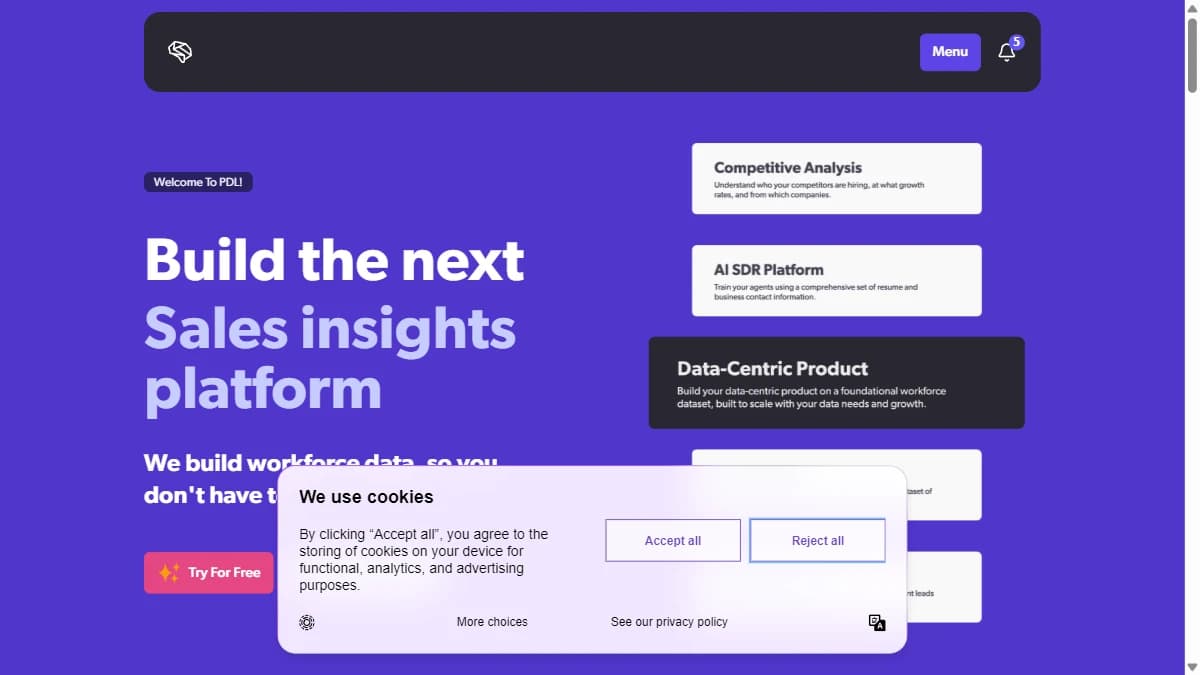
People Data Labs — developer-first enrichment with a job posting API currently in Beta
People Data Labs (PDL) is a developer-first data platform known for person and company enrichment. Its job posting product is currently in Beta, covering 28.8M postings scraped directly from company career pages and refreshed daily.
The job posting API is Elasticsearch-based, so it supports complex query filtering. Delivery is also available via Snowflake and Databricks data licensing, making PDL a natural add-on for teams already using its person or company APIs.
The Beta label means job posting coverage is still expanding. At 28.8M postings, PDL is behind Coresignal (52M active) and TheirStack (276M total). Teams need jobs as their primary signal should evaluate whether the Beta coverage meets their ICP needs.
For alternatives to PDL, see our People Data Labs alternatives guide.
Pros
- Pairs job posting data with PDL's person and company enrichment
- Elasticsearch-based API — advanced query filtering
- Snowflake and Databricks delivery for warehouse teams
- Daily refresh — new jobs within 24 hours
- Direct from career pages (not job board aggregation)
Cons
- Beta status — 28.8M postings is significantly behind competitors
- Job posting pricing not published (requires a sales inquiry)
- 24-hour refresh is slower than Hirebase's 1–2 hours or TheirStack's continuous crawl
Best for: Teams already using PDL for person or company data who want job postings in the same platform and data delivery pipeline.
Pricing: Job posting pricing requires contacting PDL. Person API Pro starts at $98/mo for 350 credits. Free tier: 100 credits/month.
How to Choose the Right Job Posting Data Provider
If you need to go from signal to booked meeting
Choose SyncGTM. Finding companies is only the first step. Enriching the right contact and pushing them to your sequencer is what actually creates pipeline. SyncGTM does all three in one workflow.
If freshness is your competitive advantage
Choose Hirebase. With postings in the API within 1–2 hours and expired listings removed hourly, Hirebase is the best option for teams that win by moving first.
If you sell to companies based on the tools they use
Choose TheirStack. It is the only provider in this list that combines job posting data with tech stack signals out of the box, so you can filter for companies posting SDR roles that use your competitor.
If you need multiple signal types from one API
Choose PredictLeads. With job openings, news events, technology, and company datasets in one API and no subscription required, it suits teams that need breadth without managing multiple vendors.
If you need enterprise-scale historical data
Choose Coresignal. Its 580M+ historical postings, 80+ fields per record, and warehouse delivery to Snowflake make it the right choice for data teams building retrospective models.
Final Verdict
The right job posting data provider depends entirely on what you do after you find the signal.
If the signal lives in a spreadsheet, TheirStack or PredictLeads give you the best raw data coverage per dollar. If you need the freshest possible data with no aggregator lag, Hirebase is unmatched. If you want alerts and hiring-manager contacts rather than raw postings, see our ranking of hiring signal tools.
For enterprise data teams building historical models, Coresignal's 580M+ archive and 80+ fields per record are hard to beat. For developer-first teams already in the PDL ecosystem, adding their job posting Beta API is the path of least resistance.
For sales teams — the ones where the whole point is to convert a job signal into a reply — the gap between finding the company and booking the meeting is contact enrichment. SyncGTM closes that gap.
You can explore plans and credit pricing at syncgtm.com/pricing.